Shadowrun: Hell on Water, page 7


“I did no such thing!”
“Look, let me tell you a story. I got my start with the area boys, like a lot of Igbo. First thing you learn when you’re an area boy is who you can mess with and who you can’t. Second thing you learn is if you don’t keep increasing the total number of people who you can mess with, you’ll just be a lousy street thug your whole life. So you work to get better and better, catch bigger fish.
“I was driving back then, too, and driving’s a good way to start. Usually you’re part of someone else’s plan, and usually no one sees anything of you besides a windshield or a helmet. I was involved in plenty of jobs that might have been over my head, but all I was doing was driving getaway or playing courier. Doing jobs that no one really cared about.
“But then I got the chance to do something else. Some Yoruba merchants had managed to secure some sapphires for themselves, and they were coming down from Kaduna in an armored van. The planners had thought it over and decided the best way to get our hands on those sapphires was to take them from the van, so they’d need some transportation. I was going to be it. It was your basic van robbery—stop them, blow the doors, shoot whoever is in the way, grab the stuff, and get out. We met the rig when it was coming in the city, and everything went just like it should—except one thing. I had tinted windows, I was nice and covered up, but when I skidded in to pick up the gems, I was turned a little sideways. And I never stopped to think that there was a camera inside the truck. So I was leaning over with the car doors open when the guys with the gems jumped in, and I looked at it. I looked right at it, saw the camera in the other van, and I knew that no matter what we had done to that damn van, that camera was still working.
“They had my picture. I knew there weren’t any police that would do anything about it, and I didn’t think it was big enough for the Yorubas to bother to track us down. But they knew who I was, and that shook me.
“I didn’t sleep for days. I didn’t go out much, and when I did I flinched whenever I saw anything that looked the least bit Yoruba. They were looking for me, I thought. They were coming for me.
“But none of them were. The first ones I saw, I crossed the street to avoid. Then others, when I saw them, I looked away, or flinched a little. But none of them did anything, or even paid attention to me. My life after the heist was pretty much like it was before the heist. Except I had a little more money.
“So the next time I did something that was going to hurt the Yorubas, I didn’t worry too much. I was still cautious, of course. Still careful on the job. But after it, I didn’t flinch each time some Yoruba came in sight.
“I’ve crossed paths with plenty of Yorubas since then. The Seven Kings War presented plenty of chances, and I took a lot of them. And I’m still doing my same basic thing. Maybe the Yorubas can afford to ignore me, since they won the thing. But whatever the reason, I’m safe for now. They might come after me some day, and I’ll be ready if they do. But I’m also ready to just keep living my life.”
He did not say anything for a while, and neither did Agbele Oku. The cycle kept up a steady whine, and they started to occasionally pass people in the streets. They were definitely out of Alimosho.
“It’s easy enough,” Agbele Oku said. “I just should not flinch.”
“Right,” Akuchi said. “It’s the only way to live.”
He took a right, and all of a sudden there were many more people. The streets were crowded, people were surging, and they did not look happy, which was not unusual for Lagos, but it put Akuchi on edge—his senses told him what to avoid, and they were telling him to avoid the whole thing.
“We’ll try to skirt north of this,” he said, “but if we can’t get around everyone, we’ll have to go through some of them.”
“Okay,” she said.
Akuchi turned north. It was good, he knew, to take the most direct route to where you were going, but it was better to make sure you survive long enough to get there. The path of less resistance was always better than the path that left you dead.
He would make his way through the city, they would get through the crowd, and soon they would be at the boat. And everything from there, Akuchi thought, would be clear.
Chapter Ten
It only took a few hours and an exploded boat, but at the moment it seems Akuchi’s prediction of everything being clear has finally been realized. The Daughters of Yemaja are behind them. The bodies of whomever it was that assaulted them are behind them. The clash between the Black Rogers and the Razor Cutlasses is behind them. They have only six kilometers or so to go, they have made it to the halfway point, and in perhaps an hour they will be where they want to be.
Cayman walks with his eyes fixed on the Lagos Island skyline. When he was a young man, a boy young enough to worry about frivolous concerns rather than focusing intently on matters of survival and related topics, Cayman had engaged in a fierce debate with a friend of his about running style (and let me say at this juncture that you can be assured that this story is a true account of Cayman’s past, but even if it was not, it would be a completely accurate representation of how Cayman thinks, and so it fulfills any definition of “truth” that matters). Both boys liked to run, partly because it was a pastime that required little in the way of equipment and socializing. Cayman had seen his friend running, and his form was terrible. His head was bowed, he stared at his shoes the entire time he ran; he looked as though he was running to try to get in front of a heavy sorrow but was not succeeding.
Cayman pulled his friend aside and informed him that his running style was not correct.
“It’s always better to look at your goal,” Cayman said. “Keep your eyes on where you are going and you’ll get there faster.”
The boy, who had glasses that always slipped down his nose, pushed them back to their proper position. “I don’t like to do that,” he said. “It just reminds me how much farther I have to go, and sometimes it seems like it’s not getting any closer.”
“That’s why you look at it!” Cayman said. “So that if you’re not getting there fast enough, you can run faster!”
“That doesn’t help. I like to look down for a while. Then, when I look up, I’m surprised at how far I’ve come. Or sometimes I look from side to side, and I see something interesting, and that makes me forget for a little to think about running. It’s a nice distraction.”
“Distraction?” young Cayman said, outraged in the disproportionate style of fourteen-year-old boys. “Running is what you’re doing! You shouldn’t be distracted from it!”
But the other boy only shrugged, looked down at his shoes, and said “Sometimes I like to look down.”
Thirty years, give or take some, had passed since that time, and Cayman still did not understand his friend. There will always be time to look down or from side to side when you are done with what you are doing. He would not be distracted—he would keep looking at the Lagos Island skyline until he was directly under it.
They are making wonderful time now, they are almost jogging, and Cayman is remembering the one-two-three-four-in, one-two-three-four-out breathing rhythm from his running days, and he knows he could keep up this pace forever if he needed to.
The huts, the booths, and the crowds are gone. They must be far away from any entry points to the bridge. Traffic is scarce—in fact, Cayman thinks it has been a few minutes since they have seen a single person coming from the south. That is, of course, fine with him. The less distractions, the better.
Then a possible cause of the lack of northbound traffic makes itself known. Ahead, Cayman can see one of the bridge’s many broken spots. It does not look to be large, Cayman can see the clean shear at the other edge of the break. The gap is perhaps twenty meters long, making it much like the other gap, but there are no people at this one. No line on either side waiting to get across, no stairs down, no platform, no boat crews in the water. This does not please Cayman, as it makes it more likely that he will have to get into the water of the lagoon, and he does not believe there are enough vaccinations in the world to protect him from everything that is swimming in that fetid mess.
He could perhaps ask Agbele Oku to build a horizontal barrier that would serve as a bridge for them, but that would be asking for a lot of effort from her to provide what he knows is a luxury. There will, of course, be the small matter of ascending back up onto the bridge once they are on the other side, but it is situations like this that justify Cayman’s belief that, no matter how technology advances, a rope and a grappling hook will always remain one of the most useful items in the world (he is, however, grateful for the technology that combined those two things into a wonderful, single gun). In fact, he could shoot the hook across the entire gap, and most of the team could go hand-over-hand to the other side. Only the last person would have to jump down in the water so he could bring the gun along with him.
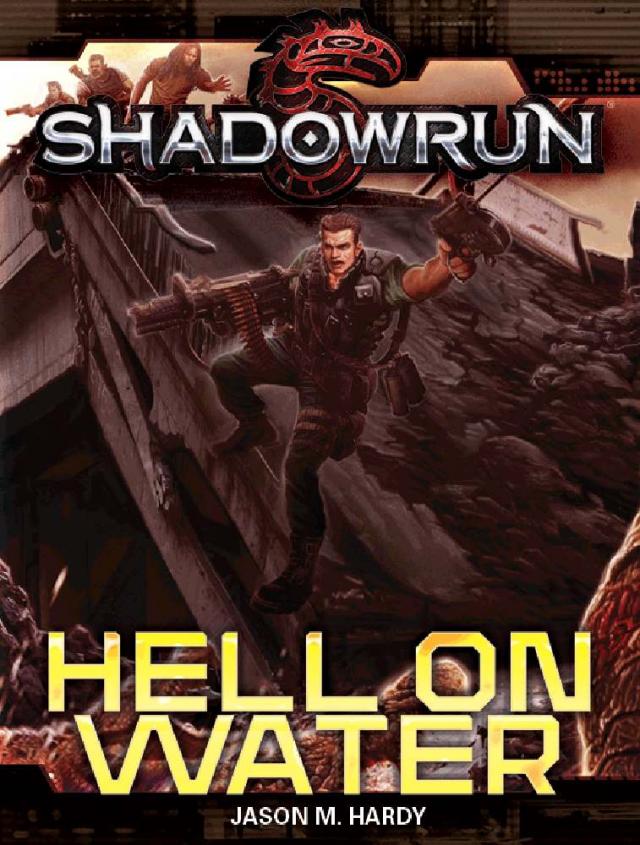
As they walk closer to the gap, Cayman realizes it will be even easier than he thought. The far side of the bridge crumbled, but the north side, it stayed attached, so the bridge swung down and now forms a ramp that leads down into the lagoon. It is a very steep ramp, and a misstep on it will result in a very unpleasant roll into the water, but the bottom of this ramp is only five meters or so from the other side of the bridge. He can picture it already—shoot the hook into the top of the bridge, get the winch moving, jump in the air, pull your legs up, and swing forward while the winch takes up the slack. His legs might get a bit damp, but that’s it. Then he will simply toss the gun back to the next team member, and they will all ascend, and they will be on their way.
His plan changes, however, when he takes a closer look at the water.
It is darker at the base of the ramp. None of the water in Lagos Lagoon is a natural color—it is dark blue, dark green, oily, and bubbles in unpleasant and inappropriate places. But here, in this spot, it is even darker, and some of the bubbles are red. And there are things floating in the water, things Cayman cannot and does not want to identify, but he is pretty sure those things used to be a part of something living not long ago. He does not believe that they just drifted there.
He stops at the top of the ad hoc ramp. “I’m pretty sure we don’t want to go down there,” he says, and just as he does the water roils and a flash of scaly leg and tail appear at the water’s surface. Then another tail.
Halim is standing next to him. “Ammits,” he says. He watches the water for a moment. “Plenty of them.”
“What are they doing here?”
Halim points to the ramp. “Food is sliding right down to them. It’s like a vending machine.”
“The ammit Stuffer Shack,” Groovetooth says.
“It’s not a problem,” Cayman says. “We can go hand over hand.” Then he turns to X-Prime.
X-Prime has been with Cayman too long, knows too well how he thinks. “Oh no,” X-Prime says. “If you’re making the plan, you get the hard part.”
Cayman scowls. “I wasn’t going to ask you anyway,” he says, and it is true. He is often hard on the boy, yes, but the number of unpleasant things he considers doing to him are far greater than what he actually does. And he has always been reluctant to come up with a plan where the truly difficult part is assigned to someone else. “I’ll fire the grappling gun across the way, then tie it off on this end. You all can go across, and when you’re done, I’ll follow.”
No one asks Cayman how he’ll get there, and he finds that very disappointing. It was a good little plan, and it would be nice if the other runners would recognize that. But they just assume that he will take care of himself, and he cannot say that he blames them for that assumption.
The grappling hook does not take hold on the first shot, pulling out amid a shower of concrete. Chunks splash into the murky water, and immediately the water froths around the ripples, and Cayman counts and he sees at least five massive bodies churning through the water, looking for something to eat. He looks at the steep ramp leading down to the water and is grateful that the giant crocodile-like creatures below are terrible climbers.
On the second shot the grappling hook finds an anchor. Both Cayman and Halim pull and pull on the rope and it does not come loose. There is no guarantee that it will stay that way, but it must do. Cayman ties the rope around part of the railing at the other end, and he leaves the gun barrel dangling helplessly off the side of the bridge. He yanks the rope a few more times to make sure it is secure, then there is nothing more he can do.
Groovetooth walks to the edge of the ramp without anyone telling her to. This is not the first time she has been the smallest member of a group, and she knows what she is expected to do. She gets to test the grappling hook’s hold on the bridge.
In combat, in driving, in almost any situation, the other runners have made sure to put Groovetooth in the back, and so she is going to take advantage of this chance to be in front and she is not going to be timid about it. She takes firm strides to the edge of the bridge, she bends her knees when she approaches the edge, and she jumps, almost dives off the end.
Perhaps it is not as dangerous as it looks, because there is the ramp beneath her that would catch her if she fell, but it is steep and she may not be able to get a hold anywhere, and so there is a good chance that she would slide all the way to the bottom and find her way into the mouths of the ammits waiting patiently below. But the thought of failing, the thought of missing the rope, it does not cross her mind, and she grabs it and pulls so her legs swing beneath her, giving her some forward momentum that she uses to carry herself a meter or two. Then she slows, and she is dangling over the ramp and the ammits, and she has to move at a slow, unspectacular pace. But that first jump, she thinks, was fun.
She makes her way across, and the hook seems completely sturdy in its place. She takes up a position near the embedded hook so that she can keep an eye on it in case it is considering wiggling loose, and then Halim is on his way, which Groovetooth resents a small bit because it is as if they feel she is helpless on her own and she needs the big man and his sword to keep her safe. She resents the decision to send Halim even more when she feels a small breath of relief that he is on his way.
Halim makes it across smoothly, taking swings along the rope that are as long as his walking strides. He is then with Groovetooth, and Akuchi, Agbele Oku, and X-Prime take their turns. Then Cayman is the only one left on the north side.
He has studied the ramp while the others have been making their way, and he has concluded there is no way he can just leap from the top, swing down, then have the gun’s winch pull him up. The slope of the ramp will not allow it—if he jumped, his ass would scrape on concrete before the winch could take up enough slack. This means he will have to move to the bottom of the ramp and go from there.
He pulls out his rifle and sprays the water at the bottom of the ramp with bullets. He cannot afford to be as thorough as he may like, as ammunition is limited, and the supply he is carrying on him must last him all day, but Halim adds some fire of his own from above, and in a few spots the water darkens to a red-violet color. He hopes these wounds are enough to slow the ammits, or even scare them off. He thinks this because he has not been in Lagos long, and his understanding of ammits is very limited.
Cayman cannot walk straight down the ramp, as it is far too steep. He is left to serpentine, crossing the ramp slowly one way, then the other, gradually making his way down. He keeps an eye on the water at the bottom of the ramp, looking for any sign of ammit activity, but it stays calm, so they have either left or they are being quite crafty.
Then the bridge bucks beneath him. It is as if he is no longer standing on concrete, but rather on a gigantic slab of grey jelly, and it shakes in every direction and resists any effort he puts forth to keep his feet safely in a single place. Both of his knees are moving in different directions, and his ankles, too, have become very independent minded in their movements, and his arm shoots out because he is going down.
It is regrettable that the arm he uses to try to catch himself is the one that holds the rifle, which means that the weapon is no longer pointed at the base of the ramp. Shaken by whatever it was that heaved the earth underneath Cayman’s feet, the ammits have re-emerged, nervous and unhappy, and like so many other creatures on this earth when they are unhappy and nervous, ammits have a great propensity toward eating. Their great mouths open, their sharp teeth are studded with flesh from their last meal, but they are hungry nonetheless, ready for the next piece of food to slide into the red darkness lurking behind the teeth.
Cayman is falling now, a kind of rolling tumble, and he knows he has nothing to lose, so he activates the grapple gun’s winch and it starts its slow wind. It is not totally taut, of course, but it gains a little tension, it is a pivot point around which Cayman can rotate his body and attempt to get straight. He rolls, moves onto his back, he is just sliding now, not rolling, he feels small rocks under his back that help lubricate his movement downward. He hears a few pop-pops and knows that Halim is trying to harm or at least scare the ammits before Cayman reaches them. He appreciates the effort, but he knows it will not be enough.
He is getting more in control now, he has his rifle pointed in the general direction of the water and he fires, and some light water spray hits his face a few moments later. He sees the horrible bloody murk coming closer, he smells it, and it smells of mold and iron and dead plants, and he dearly wishes he did not have to come into contact with it, but that now seems quite inevitable.
Cayman pulls his legs up as the water comes closer, and then his feet break the surface, and he kicks, kicks hard, not at anything in particular, just a hard kick forward. And he makes contact. Contact so hard it feels like he might have just shattered his shins. Then there is movement under his feet, a rough surface bumping under his boots, and he knows it is the skin of the ammit that he just kicked. He hopes he has not just made the creature angrier, but then he knows of no creature in the entire world that does not become angrier when you kick it.