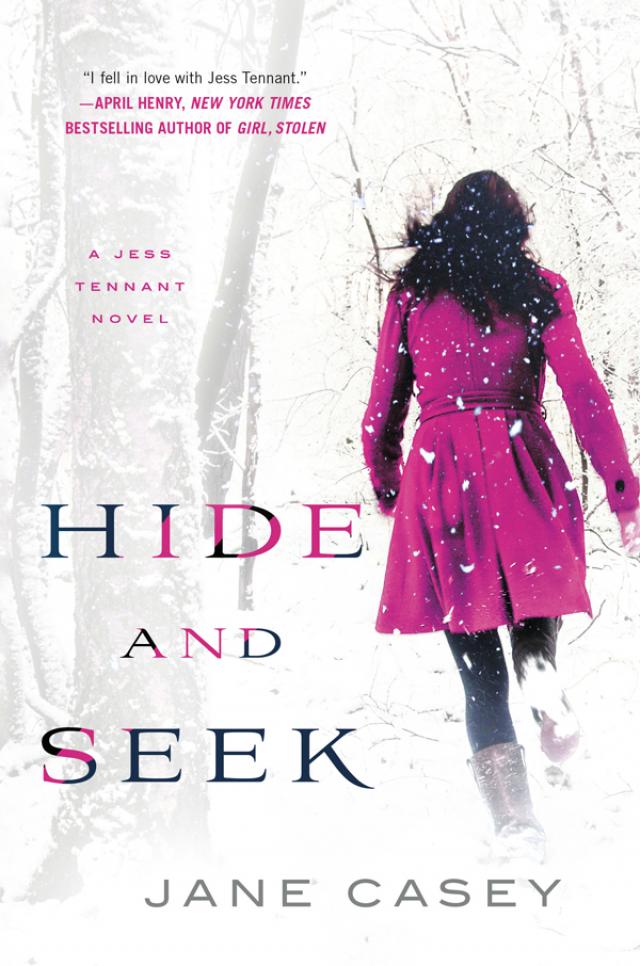
Hide and Seek, page 3


I would have preferred to believe in the magic, but it wasn’t how I was made. My mother was artistic, creative, gentle, and imaginative, while my father was hard-edged and cynical, realistic to a fault. His genes had won that particular battle, though I tried very hard to keep the curious side of my personality under control. I’d interfered before, to good effect and bad, and as a result I’d learned a few lessons about involving myself in other people’s lives.
I felt a little happier as I pushed open the glass door that led into the central atrium of the library, inhaling the distinctive leather-and-old-book smell I loved. The building was old, and no expense had been spared in furnishing it, although now it was looking somewhat frayed around the edges. There were occasional murmurs about refitting it with more computers and modern seating, but so far they had come to nothing and I was glad. It was dark and cold but atmospheric, and I’d spent many hours doing homework there.
I walked through the seating area in front of the door, where there were armchairs in little groups, and where I’d expected to find Gilly waiting for me. No one at all sat there, let alone anyone I knew. I checked the different areas of the atrium, hoping I might find her at one of the long tables in the history section. Or biography. Or (getting slightly desperate) the children’s section. They were all deserted, the cream-shaded lamps shedding pools of light on the scuffed mahogany tables. There were two people reading in the fiction section, and I saw a librarian shelving books in travel, but otherwise I was alone.
I came back to the front door and checked the time. Ten past five. I’d been a few minutes late so there was a chance that Gilly had already left. But even if she’d gone at one minute past five precisely, I would have seen her as I walked toward the library. It was more likely that she just hadn’t arrived yet. I sat down on one of the armchairs and unwound my scarf, staring at the door like a dog waiting for its owner to show up. The sun had set an hour earlier, so it was properly dark outside and the wind was picking up. A handful of rain scattered against the glass, which was just perfect as I’d left my umbrella at home.
I peeled off my coat and gave myself a good talking to. There was absolutely no reason to think it was strange that Gilly had turned up. She wasn’t outrageously late. She didn’t have a mobile phone, so there was no point in checking mine every two seconds for a message that wasn’t coming. I took my book out of my bag and started to read, glancing up every now and then.
A quarter past five.
Twenty past five.
Twenty-three minutes past five.
At twenty-five minutes past five I put the book down, not having taken in a word of it. I went over to the main desk where the librarian was now sitting, working at her computer. She was young, her hair swinging in a ponytail, her nails dark purple.
“Excuse me, can you tell me what time the library closes?”
“Six.” She smiled at me. “You still have half an hour.”
I retreated to my chair. Half an hour wasn’t going to be long enough to talk about the project, even if Gilly turned up now. And there was still no sign of her. I played back our conversation in my head. We had definitely agreed to meet there, at five, on Friday. I’d seen her in the corridor at school earlier and she’d nodded when I said I’d see her later. So she hadn’t forgotten about it.
After we’d agreed on when to meet, we’d talked about her house and where she lived. I chewed the edge of my thumbnail. Was it possible that she’d got confused? Had she thought we were going to meet at her house rather than the library? Or maybe something else had come up; something that had delayed her at home. I could go there and see if she was in.
But I knew she would hate that. She’d given me the very definite impression that she didn’t want me anywhere near her house.
I stood up, knowing that it was pointless to spend the extra—I checked—twenty-four minutes waiting for the librarian to kick me out. Gilly wasn’t coming, and whether I went to try to find her or not, I wasn’t staying where I was. I slid my arm into my coat and turned to find the sleeve with the other hand, and as I did so, I saw a movement behind one of the bookshelves at the end of the room. It was a furtive movement, as if someone had quickly stepped out of sight, surprised that I’d turned in their direction. Not Gilly; too tall.
And maybe it was nothing to do with me, and I was being paranoid. I turned my head away, bending to get my bag, and then suddenly looked back, in time to see Max Thurston leaning out from behind the bookshelves. He was staring straight at me, his long face pale against the dark background of paneling and books. He ducked out of sight again, and I felt my heart thudding with surprise and irritation and—just a little—fear. He didn’t have to lurk like that. I knew him and he knew me, so he could have walked over and spoken to me. And I didn’t like being watched.
I strode across the library, my boots thudding on the floor, so he knew very well that I was coming. I walked round the side of the bookshelves to find him leaning against them. His head was tilted back and his eyes were closed. Rain flecked his jacket and he was breathing hard, as if he’d been running.
“What the hell are you doing?” I whispered, trying to get as much outrage into my voice as possible, even though I couldn’t shout at him in the quiet library.
Max looked down at me, and again I had the impression that I was completely insignificant to him, an irritating distraction from his thoughts. “What do you mean?”
“Don’t give me that,” I snapped. “You were watching me, and now you’re hiding.”
He shook his head, but weakly. “I wasn’t watching you.”
“Why are you here?”
“It’s a public library. I don’t have to explain myself to you.”
“You do if you’re here to spy on me.” I thought back to our history class. “Or Gilly.”
Max shivered at the sound of her name, an involuntary movement that made the hair stand up on the back of my neck. His voice was sharp as he said, “Is she here?”
“No. She didn’t show up.” I frowned. “What do you know about it? How did you even know she was supposed to be here?”
“Is there some problem here?” The librarian was standing at the other end of the bookshelves, her expression saying very clearly, Not in my library, thank you very much.
“No,” Max said. “Sorry.” He stepped away from the shelves and pushed past me. He was too big for me to be able to block his way, but I hurried after him, grabbing my things as I passed my chair. I got to the door just as he let it swing back behind him, and I had to stop sharply to avoid getting a slab of solid glass in the face. I pushed it open and followed him out, but the second or two had been enough to enable him to get a head start. I saw him running through the gate of Percival Square, and watched from the top of the steps as he shoved his way through the crowds of shoppers, dashing away from me. He was too tall to hide, but there was precisely no chance of me catching up with him, even if I ran round to the other side of the square. I frowned. Something was going on here, something I didn’t understand. Max was literally running away from me, and Gilly hadn’t turned up to meet me.
Max might have known that I was meeting Gilly at the library. We hadn’t been quiet when we discussed it. Or at least, I hadn’t been quiet. I hadn’t known I needed to be.
Max had been upset when Gilly refused to work with him. He had taken it personally.
Max, who had waited outside Mr. Lowell’s classroom so that he could talk to Gilly. I didn’t know if he’d succeeded.
What I did know was that he must have come in while I was talking to the librarian about when the library was closing, because he hadn’t been there when I searched for Gilly and I’d been watching the door pretty much the entire time after that. There was no other entrance to the building in regular use—the emergency exits had alarms on them and the windows were barred. So he had slipped in behind my back.
And maybe—just maybe—Gilly hadn’t come to the library because she’d known Max was going to be there. Maybe she’d seen him outside, and hadn’t dared come in.
And maybe it was a good idea after all to go to her house in Pollock Lane, to see if she was there. To warn her that Max was looking for her. To see if she wanted to talk about it. To see if she was all right. That wasn’t interfering, I told myself. That wasn’t poking my nose in where it wasn’t wanted. That was just being friendly.
I shouldered my book bag and started walking, cutting down side streets to avoid the crowds and get to Pollock Lane more quickly. The rain was light now, more like sea mist than proper drops of water, and I folded my arms, tucking my chin down into the collar of my coat, pretending I didn’t mind. It was strange: I knew Port Sentinel very well by now and was generally quite happy to walk around it at night, but I still felt uneasy. I was unsettled by Max’s behavior, and worried about Gilly: I saw the blood sliding between her fingers at the party, and the blank look in her eyes. The desperation on her face in history class. Her friend Nessa saying she was sorry in that low, hoarse, hurried way. Abigail’s face twisting in disgust as she looked at Gilly. Whispers and rumors and people hiding in shadows added up to a mystery, and mysteries weren’t fun. They were secrets that had to remain hidden. They were thoughts that couldn’t be spoken. They were sacrifices and struggles and actions that didn’t make sense in the cold light of day. They were a narrowing set of choices that could lead to disaster. And I’d blundered into the middle of this particular mystery by chance. I didn’t know where it had started, or how. I didn’t even know what it was. But I knew that there was something to know.
The streets in this part of Port Sentinel were narrow, the buildings leaning out over the pavements at crazy, drunken angles. The lanes were too narrow for proper streetlights, so there was just the occasional lantern mounted on a wall, shedding not quite enough light. I walked quickly, checking behind me now and then to see if anyone was following me—if Max had doubled back, or if there was someone else to fear. I’d been a little too successful in getting away from the crowds. There was no one around at all. My footsteps echoed as I ran down a flight of steps that brought me to the seafront, where the wind was stronger and the waves were breaking close to the shore. I tasted salt on my lips, and I still wasn’t used to it, even after five months. This was the way Gilly would have walked to meet me, if she’d started at her house, and I couldn’t help peering into the shadows and side streets I passed, just in case she was there.
As I got closer to Pollock Lane, I started to feel more nervous, not less. I didn’t know what I was going to say to Gilly apart from, Where the hell were you? It was hard to know how to start a conversation with someone about the fact that they possibly—no, definitely—had a stalker. Pollock Lane ran parallel to the seafront, but it was a little way back up the hill and I trudged up the road that led to it, my bag thumping on my hip with every step. There was no pavement at that point, which wasn’t all that unusual in Port Sentinel; there was barely enough room for a car to drive down some of the streets. I was a few meters away from Pollock Lane when a car drove out of it and turned toward me, much too fast, the headlights pinning my shadow to the wall behind me as I jumped back out of the way. The light slid over me as the car passed by, and I didn’t have time to see who was inside or what kind of car it was or even what color it might have been. At the time, it didn’t occur to me that it was anything more than someone driving badly. That happened. Locals were arrogant and tourists were ignorant, and everyone was in a hurry all the time. My heart was thudding again, my knees trembling, and I strode on, eager to get to Gilly’s house now. Whatever was waiting for me there, it surely couldn’t be more intimidating than the shadows that were pressing on my heels.
But as it turned out, I was wrong about that.
4
Pulling myself together, I headed up Pollock Lane. It was cobbled and steep, and more or less like stepping back in time, if you ignored the cars. They were parked with two wheels up on the pavement, on one side of the road only, and just barely fitted. The cottages looked pretty even in the dark, with Christmas wreaths on the front doors and sparkling Christmas trees in the front windows. The cottages were tiny, now that I looked at them properly—two windows at the top, a door and a window on the ground floor. I tried and failed to imagine my adopted family, the sprawling collection of Leonards who filled my life, managing to fit themselves and their personalities into a Pollock Lane cottage. Gilly’s silent withdrawal seemed more appropriate. It’s just me at home, she’d said, and I might be going to see my father. So I’d assumed it was just her and her mother living in Pollock Lane. Looking back on it, she hadn’t said that. She hadn’t said much at all.
Number fourteen was about halfway along, and in contrast to the others, there was no wreath on the door. The shutters were firmly closed, with just a little light leaking through to make me think that someone was at home. The cottage was painted a drab shade of gray with a black front door, and the overall impression it made was grim. I stood there for a second, apprehensive, then reached out and knocked on the door. It was a good loud knock, as if to make up for my lack of confidence. For all that, no one came to answer it for a long time—more than a minute. I could hear movement inside the cottage—a strange shuffling sound that made me uneasy all over again. Something being dragged. No, someone walking—but slowly. Someone old? Scuffling from within, and a bumping sound that made me wince without knowing why. I looked up and down the street, seeing no one, squares of light falling on the cobbles from the ordinary, normal houses on either side of number fourteen. How I wished I was knocking on one of the other doors.
A scrabbling sound came from behind the black door, and I fought the urge to run away as the latch turned and it opened, very slowly. A woman stood there, clinging to the door for support. She was tall and very slender. She had a long, angular face with a square chin, and bony hands. I saw the resemblance to Gilly in the color and texture of her hair, and in the pale blue of her eyes. This woman’s eyes were cloudy, though, and she frowned as she tried to focus on me.
“What is it? What do you want?” The words came out slowly, so slurred that I hesitated before replying, not sure I’d understood her.
“Mrs. Poynter? I’m Jess Tennant. I’m looking for Gilly.”
“Gilly?” She said the name as if it belonged to a stranger. “Oh, Gilly.”
“I was supposed to work on a history project with her.” Something told me not to mention the fact that Gilly hadn’t turned up at the library. “Is she here? Could I see her?”
Mrs. Poynter stood in the doorway, not moving, considering what I’d said. I didn’t know if she’d been drinking or if she’d taken something, but there was no way she was sober. Her face was slack and she swayed where she stood. She put a hand to her head and I saw blood on her knuckles, a graze right across them.
“Gilly,” she said eventually.
“Yes.”
“What did you say your name was?”
“Jess.” I waited another few seconds. “May I come in, Mrs. Poynter?”
Her gaze fell on my very old, very battered boots and she frowned, slowly, with effort. “You’ll have to take them off.”
“Of course. No problem.”
She hadn’t moved from the doorway. I stood outside on the doormat and yanked off my boots, shivering as the cold seeped up through the soles of my feet. It was enough, apparently, to pass muster with Mrs. Poynter, who stood back and motioned for me to come in. She collided with the wall behind her, which seemed to come as a surprise to her. I sidled in past her, not wanting to get too close. There was something witchlike about her, something off, even allowing for the effects of whatever she’d taken. I was starting to see why Gilly hadn’t been all that keen to meet at her house.
I went straight into the living room because there was nowhere else to go—there wasn’t a proper hallway. I put my boots down side by side on the floor by the wall. The room was cold and unwelcoming, with no fire in the grate. There was a single lamp on in the corner, beside a battered armchair. Paperbacks filled shelves on either side of the empty fireplace, but that was it as far as entertainment was concerned. No television that I could see. No music system. No pictures on the walls. Definitely no Christmas decorations.
Behind me, Mrs. Poynter swore quite comprehensively as she overbalanced. She managed to cling onto the door latch so she didn’t actually fall, but she was by no means steady on her feet. I went to help her and she allowed me to take her by the arm. I guided her slowly across the living room to the armchair in the corner, where she collapsed. There was no glass near the chair, no sign that she had been drinking, and I couldn’t smell alcohol on her breath.
“Mrs. Poynter, are you all right?”
She had her eyes closed. Her face was pale, and slightly sweaty. “Fine,” she said on a gasp, looking and sounding anything but.
“Can I get you some water?”
She shook her head, then seemed to change her mind. “Yes. All right. Water.”
I went through the door at the back of the living room, past the dark stairs that cut the cottage in two, and found myself in a kitchen that was marginally more cheerful than the living room. It was warmer, anyway, thanks to the cast-iron range that filled the fireplace. An old worn table with three chairs stood against one wall. One door stood open, revealing a tiny bathroom, and there was another door that gave onto the small yard behind the cottage. I looked in the sink and found a single plate covered in crumbs, and a badly chipped mug. There was a half-inch of brownish liquid in the bottom, and when I tilted it to tip the liquid out, a gritty residue coated the inside. I abandoned the thought of washing it out and went looking for a clean glass. I filled it at the tap and went back to Mrs. Poynter, who had slumped sideways. Her eyes were closed again and her breathing was heavy. I put the glass down beside her dangling hand and felt the inside of her wrist for her pulse, not really knowing what it should be like. It was slow but regular, and when I shook Mrs. Poynter’s shoulder, she woke up easily enough.