Return to Glory, page 1
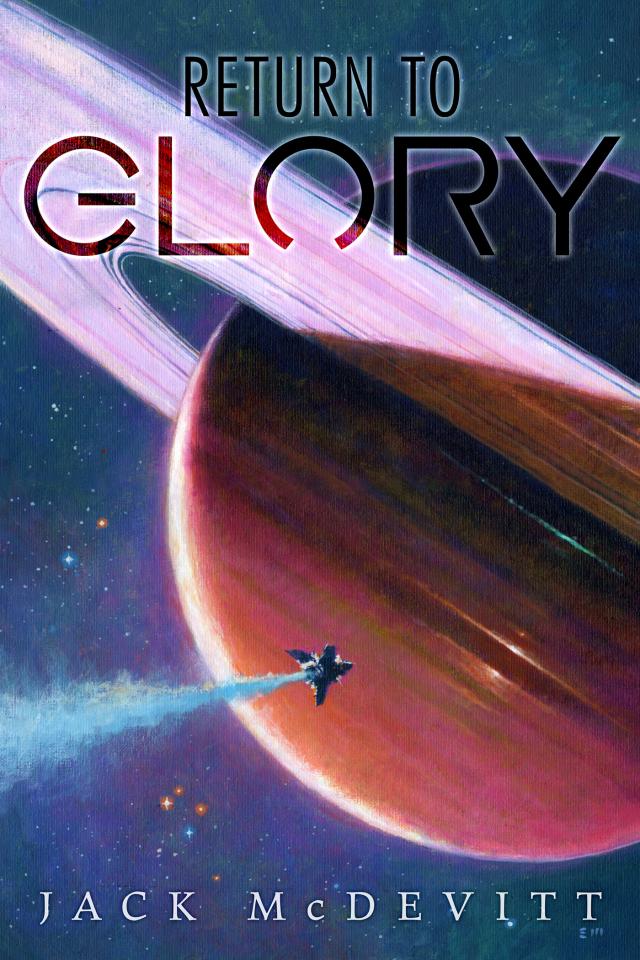


Return to Glory Copyright © 2022
by Cryptic, Inc. All rights reserved.
Dust jacket illustration Copyright © 2022
by Edward Miller. All rights reserved.
Interior design Copyright © 2022
by Desert Isle Design, LLC. All rights reserved.
See copyright information page for individual story copyrights.
Ebook Edition
ISBN
978-1-64524-074-7
Subterranean Press
PO Box 190106
Burton, MI 48519
subterraneanpress.com
Manufactured in the United States of America
Table of Contents
Dangerous Information: An Introduction by Tom Easton
Unlikely Gifts:
The Emerson Effect
The Jersey Rifle
Voice in the Dark
Tau Ceti Said What?
The Oppenheimer Club
What’s the Point of Being Alive If You’re a Tree?
Deep Space:
Tidal Effects
Standard Candles
The Cat’s Pajamas
Enjoy the Moment
Arcturean Nocturne
Tea Time with Aliens
Cosmic Harmony
The Gold Signal
High Hopes:
Crossing Over
Holding Pattern
The Big Downtown
Return to Glory
The Sunrise Club
Good News
Incoming Tech:
Variables
Eyes on the Prize
The Eagle Project
Riding with the Duke
The Wrong Way
Bring On the Night
Looking Back:
Leap of Faith
Lake Agassiz
The Cassandra Project
Dig Site
Excalibur
Timely Visitor
Dangerous
Information:
An Introduction by Tom Easton
Back in 2016, at the Kansas City Worldcon (MidAmericon II), I sat down to lunch with Jack McDevitt. I had been thinking about something called parabiosis, in which two mice, one old, one young, have their circulatory systems spliced together so the blood of each flows through both mice. Curiously, the old mouse gets partially rejuvenated by the process, and people were beginning to try transfusions of plasma from young people into old people to see if it could have a similar effect. Together, Jack and I speculated that one’s own young plasma would surely work better than someone else’s. Perhaps a business should start freeze-banking plasma for future use. Then Jack mentioned that he was booked for a time travel panel that afternoon.
The result was our one and only coauthored story, “Blood Will Tell,” which appeared in Nature in November 2016. We have been arguing ever since over whose work made the story as good as it was. I may have drafted it, but I insist that it was Jack’s consummately professional and insightful touches that made the story.
Jack starting doing short stories in the early 1980s. I started paying attention when The Hercules Text came out in 1986. It dealt with an alien signal bearing a great deal of dangerous information (see the excerpt “Voice in the Dark,” in this volume). When I reviewed it for Analog, I noted that the theme was the moral issue of the scientific conscience: Are there topics humans should not study, things that should be kept secret, at least until our species is more mature? Jack’s point was that in an ideal world scientists should be free to work as they please. But they should not give all their results to governments, which tend to be barbarous. Nor should they destroy their results, for that, in essence, robs the future of its options. Should, then, potentially dangerous information be hidden? If so, who should be the guardian?
“Dangerous information” has been a recurring theme for Jack. Two years later, in A Talent for War, he introduced Alex Benedict, an amateur historian with a talent for solving historical mysteries. Jack himself, I said in my review, confirmed “a prodigious talent for SF.” Then came The Engines of God, introducing Priscilla Hutchins, starship pilot extraordinaire, with the mystery involving the deaths of civilizations. And then there was Ancient Shores, a time-travel mystery, and so far, mirabile dictu, there had been no sequels. When I met him for the first time, I asked about that. His publishers, he said were not asking him for sequels.
Well, that was a quarter century ago. Jack’s publishers decided they had a good thing going. Both Alex and Hutch became the central characters of their own series; you will meet them briefly in this volume. Hutch resurfaced in Deepsix (2001), and then half a dozen more times. Alex came back in Polaris (2004), and then six more. Even Ancient Shores got a sequel, Thunderbird (2015).
Meanwhile, he has been nominated for awards more times than you can count. He won the 2015 Heinlein Award, the 2000 Phoenix Award, a HOMer for Time Travellers Never Die, a Nebula for Seeker, a Campbell Memorial Award for Omega, a Locus Poll Award for The Hercules Text, and a NASA award “for keeping the science in science fiction.” To top it all, the International Astronomical Union put his name on an asteroid.
Of course, there were also a great many short stories, of which some of the best are in this volume. A recurring theme here too is “dangerous information.” Put another way, he is deeply concerned with the biggest of big questions: “What is our relationship with the cosmos? Are we unique? Are we one of many? Has the universe, in some manner, been designed for us? It’s a question with the profoundest philosophical implications. It’s the great enigma” (see “Tidal Effects” in this volume).
For the most part, Jack finds his big questions in deep time (alien civilizations that died eons ago), astronomy and cosmology (pulsars, alien signals), and the impact of technology (alien and home-grown)—or even the knowledge that such technology exists—on human civilization. One of his iconic short stories is “Cryptic,” in which radio astronomers detect a pair of worlds emitting radio signals. Then one stops, perhaps because it lost a war. You can find a copy at https://www.baen.com/Chapters/1596061958/1596061958___3.htm or you can buy a copy of Cryptic: The Best Short Fiction of Jack McDevitt (https://www.amazon.com/dp/B003Y8XR5U/ref=dp-kindle-redirect?_encoding=UTF8&btkr=1), which Subterranean Press released in 2010, well before most of the stories in this book were published.
It has long been debated, both in science fiction and in the field of science, technology, and society studies, just how the detection of an alien intelligence Out There would affect people. People who insist that their favorite religious tome is the sole repository of truth might have serious problems, but they would hardly be alone, as we know in this era of fake news and science denialism, in refusing to wrap their minds around the concept. Now make that two alien intelligences, and they’re at war, and they’re about as far from each other as they are from us. Are you looking at the sky yet? Do you want to stick your head in a sandpile somewhere and just quietly gibber to yourself? Or would you rather join those who deny the truth of global warming and the value of vaccines and just say “Nope! Nope! Nope!”? Jack’s characters would prefer that we immediately start getting ready.
Some things you just can’t get ready for. But Jack is not just telling us that some knowledge is dangerous. Again and again, he says, “Okay. It’s dangerous. So what are we going to do about it?”
Think of the alien science textbook at the heart of The Hercules Text and “Voice in the Dark.” It holds the secrets behind some frightening weapons. If we ignore it, then we have a chance not to do ourselves in. If we don’t ignore it, then we have a chance if a “Cryptic” enemy shows up.
“Dangerous information” should not be ignored. It deserves respect and caution, of course. But there is as much or more danger in ignoring what we know.
Unlikely
Gifts
The Emerson
Effect
The package looked as if it had been kicked into a bathtub. The brown wrapping paper was brittle and wrinkled, the address a blue smear. A long piece of twine hung from the parcel. It was stamped Books Only—Second Class Matter. There didn’t seem to be a postmark.
Hank sipped his coffee and held the package up to the window. The only legible word in the return address was “Braintree.” No zip code had been used. Further, the abbreviation for Massachusetts was clearly not the two-letter designate sanctioned by the Post Office. Hank vaguely disapproved of the package.
Outside, a truck backed into the loading dock. He looked up at the sound and glanced across the workroom at Jenny McIntyre, the gorgeous new clerk. Jenny stood at the counter, her back to him, writing a money order for a bored-looking woman in a threadbare coat. Hank would never have been bored in Jenny’s presence.
He cut the package open and removed the contents: a heavy leather-bound book. There was no clue to either sender or recipient. Why did people neglect the simple precaution of enclosing an address?
He balanced the volume in his hand. It had a heft and texture that suggested walnut paneling and oak furniture.
He had assumed it was a Bible, and was consequently surprised to discover gold letters across the front spelling out emerson. He recalled the name from school. Something about hobgoblins.
Four colored ribbons served as bookmarks. The pages appeared to be India rice paper and were gold-trimmed. The book was old, worn, but well cared for.
He opened it and glanced at the publication data: “Boston, 1878.” On the inside cover, in ink faded almost to gray-green, he read For Henry, with Confidence a nd Best Wishes. Below the inscription was the single initial E.
Hank looked again at the wrapper. It wasn’t even insured!
***
Jenny McIntyre disposed of her last customer and started toward the Midwest case, where she had been sorting several piles of mail. It was not a route that would take her close to Hank’s desk, so he bit his lip, took a deep breath, and walked halfway across the workroom pretending to head for the rear office. He passed a few feet from her, carrying the book and trying to look unobtrusive. “Hi, Jenny,” he said. “Look at this.”
She turned at the sound of her name and smiled.
Hank’s resolve melted in that moment, and his heart began to quicken. It was, he thought desperately, the sort of smile that melts men into their socks. “Leather-bound?” she said. “Where’d that come from?”
“Don’t know,” he said. “Can’t read the address.” He held it so she could see the package.
She shook her head. “I can’t make it out either.” She was bright, friendly, and yet maintained a distance. Her uniform had clearly been designed by someone who grasped both trigonometry and nuance. Maybe later things would fall into place. For now, he understood she was trying to move on. He said something about human carelessness and started to move away.
“Hank.” She’d seen the inscription. “Do you think that’s really his writing?”
“Whose?”
“Emerson’s.”
He shrugged. “If it is, they might have found a better way to ship it. Do you know anything about him?”
She smiled and Hank’s heart melted. “‘Here once the embattled farmers stood/And fired the shot heard round the world.’ Ralph Waldo Emerson had been required reading back in high school. I’ve always remembered him because he said that you can do anything you really want to.” She touched the book with her fingertips. “You better put it somewhere safe. If that’s actually his signature, it’s worth a lot of money.” She smiled again, self-consciously this time. “I’ve always wanted to go back and read him on my own.”
And she was gone. Probably headed for the ladies’ room. Slightly breathless, Hank carried his find to the other end of the building and into Wade’s office. Wade Schreiber, the postmaster, was younger than Hank by several years. He was easy-going, liked to eat out with his subordinates now and then, but probably ate too much. His frame was sliding down into his belly. Schreiber was too competent to stay where he was.
“What have you got, Hank?” he asked, tossing some documents into his pending tray.
“This came in from Boston today, Wade. No address, forward or back. Looks as if it might have originated in Braintree.” He put the book down on Wade’s desk. The postmaster looked at the packaging, turned a few pages, and shrugged.
“Okay. Put it with the other stuff.” He squinted. “Is there some reason to give it special attention?”
“Well, it might be a rare edition, and it looks like it was signed by the author. It might be valuable, Wade.”
“Where signed?” Wade frowned and grinned simultaneously. “Is it a Bible? No? All right. Save the wrapper and anything else that pertains. Log it, and we’ll put it in the safe for the time being. Notify Boston they can have it if they want it. If they do, we want a receipt.” He examined the book a second time and read the inscription. “I’ll be damned,” he said. “Who’s Henry?”
Hank shrugged. “No idea. Me, maybe.” He managed a smile. “You know anything about him, Wade? Emerson, that is?”
“Sure. He wrote about New England a lot. I saw his grave once.”
***
The Winona Post Office, a branch of the Philadelphia region, emptied promptly at five. Old Jake Hobson and Don Tebbetts, both nearing retirement, pulled on jackets and left together as they had almost every afternoon for the ten years that Hank had been there. Then a group of the younger employees, carriers and clerks and a driver, crowded noisily out the door, waving to Hank and joking with Jenny.
A light rain had begun falling.
Jenny pulled a coffee-colored jacket gracefully about her shoulders. She shook her long chestnut hair free over the collar and was gone. Hank felt an easing of tension. Too young for me, he thought. Anyhow, not a good idea to get involved at work.
Wade locked his office, rattled the knob, stopped to look at the international log, and buttoned his jacket tight. It was early October, and there was a chill in the air. He strode through the door, alone.
He smiled too much when he talked to his boss, and he was always slightly out of breath in his presence. Irritating. But it was good to be last man out. He looked around at the empty mail sacks piled near the rear exit, at the sorting cases, and at the battered tables. All his life he had liked being in public places when they were deserted: churches in the late afternoon, schoolrooms at night.
He strolled across to Jenny’s section and picked up some mail that had come in late. One letter in pink was going to Riverside. Another, in a white hand-addressed business envelope, was bound for Needles. He’d always been fascinated by the names of towns in far-off places: Mountain Home and Tarzana and Pueblo and Cando and Truth or Consequences. Once, years ago, in the most courageous undertaking of his life, he had driven to California, stopping along the way at towns he felt he knew. It had been exhilarating to leave Winona behind, to roll past the farms and villages where he’d spent his entire life, and to burst into Ohio in his dusty Toyota. He’d spent that first night on the road in Steubenville. He’d checked into a motel, eaten dinner, and then wandered aimlessly around town, reflecting on how utterly alone he was. Lights were on in the high school, and its parking lot was full. Through open doors he could see clusters of people. It all looked warm and friendly, something of which he would have liked to be part.
He had not really enjoyed his trip much. Mostly he had driven aimlessly from town to town, strange places with familiar names, stretched dinner hours as long as he could, gone to local movies. He’d found Needles breathlessly hot and Loveland brutally cold. He hit a couple of bad restaurants in Salt Lake and endless construction outside San Diego. But that was trivial. Or would have been, had he not recognized that any relationship between these towns and the neat little pigeonholes into which he shoved their mail was strictly administrative.
In the end he had been glad to get home, back to the sorting cases, where the “real” towns appeared again on crisp white envelopes.
He folded the postal form notifying Boston of the undeliverable package, slid it into an envelope, and dropped it on his desk to go out tomorrow. Then he locked the book away in the safe, reflecting sadly that, when he finally got up the nerve to approach Jenny, he would undoubtedly make a stuttering hash of it. He sighed, turned out the lights and went home.
***
He lived just off the main bed of the Penn Central. Trains whistled and rumbled in the night. He’d grown up close to the train tracks through Grays Ferry, in Philadelphia. There was nothing anywhere that sounded as lonely as trains at night. Rain rattled against the windows, and occasional lightning glimmered in the curtains.
It was uncomfortable to watch younger men move past him. Wade had come in about a year ago when their old boss of twenty years retired. Wade was openly affable and self-confident, and Hank, hoping somehow to improve his situation, or just to make friends in high places, had gone out of his way with the man. Not fawning. Not like that. But not himself either. And he was certain Wade had sensed it.
And then there was Jenny. All the lovely women he had pursued with varying degrees of failure over the years smiled at him through Jenny’s eyes. Gentle, compelling, almost shy, she seemed nevertheless untouchable. Not that he hadn’t been occasionally successful with women. He’d had a few romances, but they had been things of mutual convenience. And occasionally, when someone especially attractive drifted into his life, his personality went into its paperweight phase.
He turned over and listened to the rain.
He had begun, but not finished, two books on self-assertiveness. Both had imposed mind-numbing exercises guaranteed to build a dynamic, confident psyche. I am a person of consequence. Speak coolly and people will listen. Eventually, money, advancement, and women would all fall into his lap. In fact he didn’t care much for all that. But he would have liked— what? He had never really known, never tried to put a name to it. But it was beginning to look as if he would divide all his days between this small apartment and the post office.