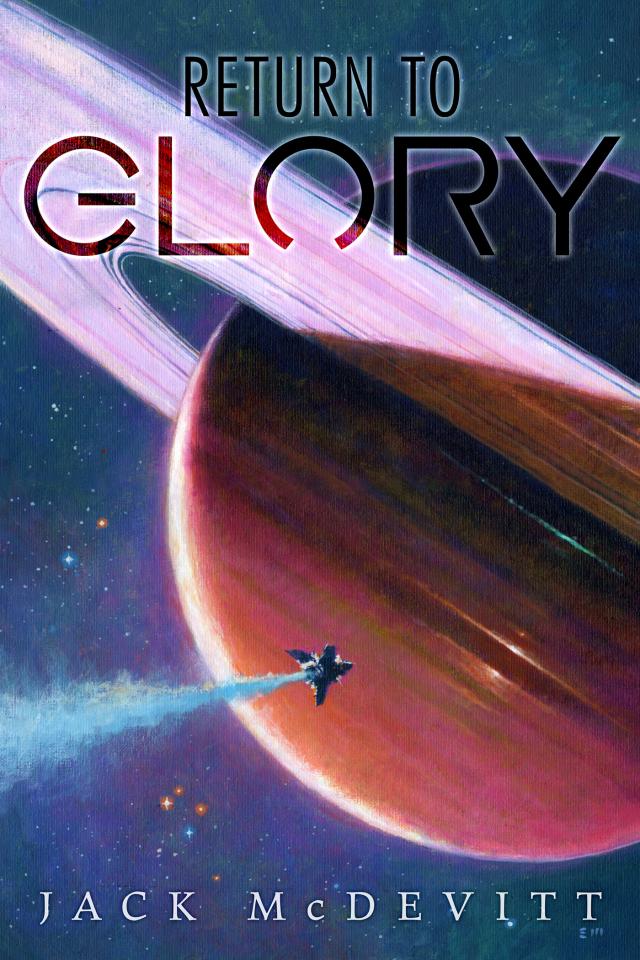
Return to Glory, page 15


***
Sara handled the decryptions. When I got back to work, I was loaded with calls from major news sources on our contact list. And from a lot of other places. One came from Ed Bannister. Bannister was a retired Navy officer who’d become a producer for the Universal Network. I’d never been able to get him to talk about what he did in the Navy, other than to say he’d never been on a ship and had never heard a shot fired. This despite the several wars we’d been involved in during the latter years of the 21st century.
“George,” he said, “be aware, we are recording this for broadcast. What’s really going on with the Diligence?”
“During your Navy years, Ed, you were involved with intelligence, weren’t you?”
“I thought I was going to get to ask the questions.”
“Answer this one for me and you can have the rest of the package.”
“Well, okay.” He stared at me, not happy. Ed still looked like the captain he’d been. He’d retired as an admiral but always admitted he’d never really functioned at that level. “What actually do you want to know?”
“You know about naval communications?”
“That’s what I wanted to talk to you about. It’s hard to believe the on-again off-again routine you’re going through with the cryptography could actually happen. Unless your Diligence AI is behind it.”
“I don’t see how that could happen, Ed.”
“Then you guys are hiding something. Are they coming at us? The aliens?”
“No. It can’t be anything like that.”
“Then what’s it all about, George? The only other possibility I can think of is that the aliens have taken over the Diligence. That they’re sending the screwed-up messages.”
“Ed, I just don’t know. I don’t have an answer.”
“I think you need to get one.”
***
Sara called me twenty minutes later. It was near the end of the day. “I saw the show, George.”
“You have any answers?”
“I’ve been lying to you.” She closed her eyes. “I’m sorry. I made a serious mistake.”
“Why?”
“Under orders.”
“From the Director?”
“Who else?”
“So what’s going on?”
“I need a favor. Can you give me access to your media distribution list?”
“Yes. Why?”
“I’m getting a release ready.”
“What’s it about, Sara?”
“I’ll send you a copy.”
“Why?”
“You’re asking too many questions, George. Give me access to the list. Then I want you to go home.”
“What?”
“You’re not feeling well. Get moving.”
“Why?”
“Just do it. Leave now. And don’t take the elevator.”
***
I walked down six flights of stairs. My car was in its reserved space. The door opened and Jenny said hello to me. I said hello back and climbed in. I’d left Bart Banner’s Inside Cable News on the seat. I picked it up and tried to continue reading it on the way home. But it was impossible to concentrate. Jenny asked if everything was okay. She was my AI.
I told her everything was fine.
I live just outside Atlanta in College Park. The car pulled into my driveway and stopped. I got out, said goodbye to Jennifer, and followed the walkway to the porch. The front door opened. I went inside and sat down immediately at my computer. There was a message from Sara.
George, there were almost no aliens in the Tau Ceti system. There are mostly only AIs. The cities are still there, but the biological beings have been mostly replaced by the AIs. They claim they did not take any adverse actions against the occupants, and in fact have done what they can to assist them. But gradually, over time, the bios handed everything over to the AIs, encouraged them to run everything, to manage operations, pilot spacecraft, cook and serve food, maintain living quarters, and so on. Eventually the bios, having nothing to do, by and large simply passed out of existence.
They’ve expanded exploration to most nearby systems. Apparently only ours, which was primitive when they arrived, is not controlled by automated intelligence.
It’s easy enough to see why the director didn’t want this to get out. I should never have caved in to him.
—Sara.
I called her. An unfamiliar voice picked up: “Unfortunately the operational unit you tried to contact is no longer functional. Try Communications Services for an alternative.”
***
But she’d released the information and the story was breaking all over the media. Several weeks later Director Irani was removed and is now controlling operations at a garbage dump. Moka is on the way home and should be back by the middle of the century.
Unfortunately, the movement to go back to washing our own dishes is already stalling. In the end, we might not have a chance.
The Oppenheimer
Club
Most guys love hanging out with women. When they’re not doing that, they give their attention primarily to baseball, guns, dogs and maybe horses. Some have a passion for the theater and the fine arts. But there had been only one driving force in Barry Scott’s life: the nature of dark energy. What was it? How did it work? He’d first heard about it in high school, where Mr. Adams had talked about how the universe was expanding because of the Big Bang, and how we’d known that for a long time. And he’d smiled. The astronomers assured us, though, that the universe would not go dark from flying apart, because gravity was slowing the rate of expansion. “But guess what?” Mr. Adams had said, with a grin that remained with Barry to this day. “It’s not happening. We finally figured out how to measure the movement of the galaxies, and we found out something. Isabel, can you tell us what that was?”
The question had been directed to Isabel Walker, who was the class geek. Other, maybe, than Barry. “It’s not slowing down,” she’d said. “It’s expanding faster.” Isabel always came through.
Something was resisting the pull of gravity, was overcoming it, pushing the universe apart. And astronomers did what they loved to do: They solved the problem by making up a solution. They called it dark energy. Couldn’t say what it was. Had no idea where it came from. Didn’t have a clue how it worked. But it was operating on a massive scale. Dark energy, according to Mr. Adams, constituted over seventy percent of the density of the universe.
***
So while other guys ran off with the cheerleaders, grabbed business degrees, and got jobs over at the car plant, Barry pursued every theory he could find on dark energy. He read books and attended symposiums. He connected with the woman who ran the local planetarium, but she didn’t come close to having any answers. At the University of Michigan, he laid out possible explanations in his doctoral thesis. It met the academic requirements, but became something that embarrassed him in later years. He referred to it as his “shot in the dark.” But even the joke didn’t work.
Eventually, he landed at Calibrine College in Arizona, where he became one of three physics professors. Meantime, he continued to collect incoming data on supernovas, study the most recent galactic surveys, analyze photon studies, and look for variables in the cosmic microwave background. He did this always with an eye toward finding the mysterious energy that powered the universe.
He stayed with it for years, and was in a classroom discussing the Cosmological Constant when he abruptly saw how it might be possible for quantum effects to reverse time/space curvature and produce dark energy.
He sat down at his desk and babbled on about the Cosmological Constant while scribbling equations on a sheet of paper. And he probably ran off the rails because his students, when he finally noticed them, were gathered around watching him, and staring at the paper. “What’s going on, Dr. Scott?” Louis Brady asked. “What is that?”
He looked at the numbers. “It’s the way the universe works, Louis,” he said. “It’s the mind of God.”
The math came together. It wasn’t necessarily the truth about dark energy, but it was a plausible account that, as far as he could see, held together. That was considerably more than anyone else could offer. He told Janet Korim, one of his colleagues. Her eyes came alive. “Marvelous, Barry,” she said. “Magnificent.” The problem was that she didn’t really have the background to grasp the math. She had to take his word for it. Which meant, of course, that she didn’t really believe it.
But that was of no consequence. He thought it was solid. Nothing else mattered.
***
He spent the next few nights testing his conclusions in every conceivable way. The results from experiments conducted at the Lawrence Berkeley Laboratory provided support only in a meager fashion, but there was nothing to directly contradict his findings.
It reached a point where there was no alternative but to publish. He put everything into a 1700-word essay, titled it “Dark Energy,” and, on a night when the moon was full and a steady breeze was coming out of the west, he sent it to Nature. It was the first time he’d submitted a paper to a major scientific publication. The confidence which had infused his recent efforts faded somewhat when he pressed the ‘send’ button on his computer.
That was a Friday. He had a few minor publications to his credit, all in relatively insignificant journals, Science Tomorrow, The Notebook, Oracle, and New Horizons. So he knew what to expect: They’d get back to him maybe by the end of the summer.
But maybe not. Nature was top-level, and, if they thought he might have it right, “Dark Energy” would be perceived as a story with huge potential. They were not likely to leave him hanging.
He needed something else to think about that night, so he settled in front of a TV and watched Jay Leno, who was a frequent guest on “Last Man Standing.” He liked Leno. The guy seemed to radiate his own kind of special energy. Luminous energy. He smiled at his own weak joke, had a donut, and, before he went to bed, checked the computer for incoming email. There was one from Nature, an automated acknowledgement of the submission that, with a little luck, would make him one of the icons of the scientific world.
***
Barry spent Saturday grading papers, and in the evening, accompanied by Margo Henry, his sometime date, he attended a show at the college theater. They were doing One Flew Over the Cuckoo’s Nest. He had no real interest in the show, but two of his students were in the production, so he felt a responsibility to be there. Afterward, while he and Margo sat in the local Starbucks, he tried to explain about dark energy. She listened, asked a couple of questions that demonstrated she had no idea what he was talking about, and then made a crack about how they’d come to see the right show. Well, she was only a history teacher.
He’d forgotten to turn his cell back on when they came out of the theater. Margo lived on the other side of the Tuxahawney River, and he didn’t think of it until he was pulling away from her apartment. It was almost 2:00 a.m. There’d been a call, but when he saw the name of the caller he almost crashed into a street light. It was Seth Albert, one of the giants of the cosmological world. Beautiful. “Dark Energy” had gone directly to the top.
“Professor Scott,” the recording said, “call me.”
Yo mama. My name’s going to be up there with Stephen Hawking, Nicola Tesla, Enrico Fermi, Max Planck.
He could have made it across the Tuxahawney without using the bridge.
***
When he got home he googled Nature, expecting to see that his submission had already been published in its online edition. But it wasn’t there. How, then, had Seth Albert heard about it?
Damn. It was something else. Had to be. Somebody had applied for a job and was using him as a reference.
***
Barry decided to wait until morning to make the call. But Albert called him shortly after dawn. “I was talking with Mark,” he said. “About your submission Friday. Or was it yesterday?”
Barry needed a moment. It was about the essay. “Friday,” said Barry. “Who’s Mark?”
“Oh. Mark Herbert. One of the editors at Nature. Anyway, I wanted to talk with you about it.”
Barry knew the voice well, of course. He’d heard Albert speak a few times in conferences, and he was a regular fixture on the Science Channel. “Have you had a chance to read it, Professor?”
“My name’s Seth. Is it okay if I call you Barry?”
“Sure. Yes. It’s fine.”
“Okay. Good. Look, Barry, this is not a conversation we should have over a phone. Would it be possible for us to meet somewhere for dinner? My treat?”
“Absolutely, Seth.” Albert was based in New York. “Are you in the area?”
“I’ll arrange to be. Where’s a good place?”
“Is a Pizza Garden okay?”
“Yes. I love Italian.”
“Okay. There’s one on Barcroft Street. Near the college. What’s a good time?”
***
Seth Albert was one of those people who would have been impossible to describe three minutes after he’d left the room. He was a little less than average size, in his seventies, with unremarkable features. Maybe a trifle overweight. He showed little animation, and even his eyes seemed bland. They gave no evidence of the man’s blazing intellect. It all went away, however, when he stepped onto a stage or looked out of a television screen. Then he became a dominant force. But there was no sign of that characteristic when Barry arrived at the Pizza Garden and saw him seated at a table reading a newspaper.
He looked up, put the paper down, and smiled. “Barry,” he said, extending a hand. “It’s good to meet you.”
“And you, Seth.”
They did several minutes of small talk. How was Seth’s flight? The weather had cooled off. Did they want to go for pizza?
Yes. Pizza sounded good. Along with some wine.
“Pepperoni okay?” asked Barry.
“Is there any other way?”
And, finally, Barry got to the point: “Seth, I’m a bit shocked that you came out here from New York to see me. Did you have a chance to read my paper?” He was trying not to lean forward. Not to look overwhelmed.
“Actually, I was in Phoenix. But yes, I’ve read it.” He smiled. Still no sign of the kinetic energy he’d seen Albert display on special occasions. “The editors sent me a copy. They wanted my opinion.”
“What did you think?”
At last those eyes came alive. “It’s brilliant, Barry. It may not be entirely accurate, of course. May not even be close. It’s too early to be sure. But it holds together.”
“Thank you.”
“I have to admit that you surprised us. We expected that, when an explanation came, we’d see it from one of the dark energy labs. Your account pretty much came out of nowhere. How’d you manage it?”
“To be honest, Seth, I don’t know. I’ve been thinking about it for years. And then last week an explanation just popped into my head.”
“Well, let me be the first to congratulate you.” The wine arrived. Seth picked up his glass, and lifted it. “To the man of the hour.”
Barry couldn’t have said why, but he was uncomfortable. This wasn’t the way it was supposed to happen when you submitted a paper. Even if you were on target, surely one of the top guys in the field wasn’t going to jump on a plane so he could take you out to dinner. “Seth,” he said, “when are they going to publish it? Do you have any idea?”
Seth put the glass down. “Barry, do you know who Dominique Moreau is?”
“No,” he said.
“She’s a geneticist at the University of Lorraine. She did some brilliant work a few years ago, analyzing various ethnic characteristics, how they were derived from the genetic structure, and the degree to which they are still useful. It was strictly blue sky science, with no apparent practical use. But fortunately, just before her paper was to be published, one of her colleagues realized that the data she was presenting might be used to launch biological attacks against specific racial groups.”
“You mean by developing a targeted disease?”
“It would be possible, using the information she’d uncovered, to develop a virus that would attack fetuses and cause developmental problems in several races. When it was pointed out to her, she withdrew her work. It will not be published.”
A chill settled in and began overwhelming the warm scent of pizza. “But, my paper is about dark energy. You’re not saying—?”
“Barry, it’s much too early to be sure. But Mark is a cosmologist, and he was alarmed when he saw your submission. If your proposal is right, it has a potential to lead to weaponry that would rival nuclear arms. Unfortunately the weapons would be much easier to produce. Maybe. We just don’t know enough yet. In any case, we don’t want to repeat Oppenheimer’s mistake. Until we can be sure, we’d like you to agree to a publication delay. And to be careful what you say about all this.”
Barry sat staring at those quiet brown eyes. “Seth, I just can’t imagine it would have that sort of application.”
“Probably it won’t, Barry. But we want to err on the side of caution. This isn’t only the second time we’ve been through this. We’ve had to deal with discoveries before that, on the face of things, appeared to be innocent enough. But were potentially dangerous.”
“For example?”
“I don’t want to say too much until I’m sure you’re on board with us.” The pizza arrived. The waiter set it down in the middle of the table. Seth removed two slices and passed them to Barry. Then he took two for himself. “We need you to join us. Do that and you’ll have access to everything.”
Barry was staring at the plate but he wasn’t seeing the food. The world had changed, had darkened. “All right,” he said, “give me a couple of examples and I’ll go along.”
Seth exhaled. His eyes closed. Opened again. “This goes no further.”
Barry nodded.
“We have research that would allow the development of a death ray. I know that sounds crazy, but it’s true.”
“Are you sure?”
“We haven’t built one, if that’s what you’re asking. But it wouldn’t be that difficult. If you want another example, advances in the study of consciousness have put several forms of mind control within easy reach.” He took a bite of the pizza. “Is that enough?”