The Bovadium Fragments, page 1
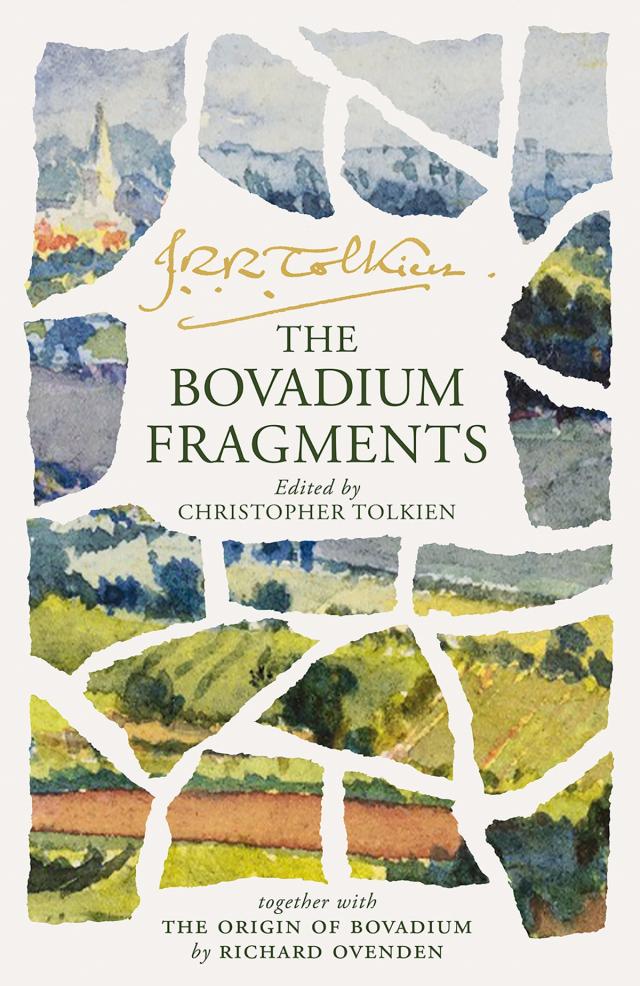


The Bovadium Fragments
By
Edited by
CHRISTOPHER TOLKIEN
Together with
The Origin of Bovadium
by
RICHARD OVENDEN
Copyright
HarperCollinsPublishers Ltd
1 London Bridge Street,
London SE1 9GF
www.harpercollins.co.uk
First published by HarperCollinsPublishers Ltd 2025
Text by J.R.R. Tolkien copyright © The Tolkien Estate Limited 2025
Introduction, commentary and notes by Christopher Tolkien copyright © the estate of C.R. Tolkien 2025
‘The Origin of Bovadium’ © Richard Ovenden OBE 2025
Illustrations by J.R.R. Tolkien copyright © The Tolkien Estate Limited 1995, 2018, 2025
Publisher’s note by Chris Smith © HarperCollinsPublishers 2025
Photographs by Cas Oorthuys reproduced from Term in Oxford (Bruno Cassirer (Publishers) Ltd, Oxford, 1963) figs. 8-11, 66, 84, 95, 96, 99, 116, 121-3, 127 & 140
Plans by Thomas Sharp reproduced from Oxford Replanned (Architectural Press, Oxford, 1948)
®, ® and ‘Tolkien’® are registered trademarks of The Tolkien Estate Limited.
The Tolkien Estate Limited and the estate of C.R. Tolkien have asserted their respective moral rights in this work.
The illustrations by J.R.R. Tolkien in this book are reproduced courtesy of the Bodleian Libraries, University of Oxford, from their holdings labelled MSS. Tolkien Drawings: 84, fol. 28r; 85, fol. 27; 86, fols. 15 & 20; 87, fols. 25 & 32; 88, fol. 22.
All manuscripts cited in ‘The Origin of Bovadium’ are held by the Bodleian Libraries.
Jacket design by Emily Langford/HarperCollinsPublishers Ltd
Jacket illustration by J.R.R. Tolkien © The Tolkien Estate Limited 1995
A catalogue copy of this book is available from the British Library.
Without limiting the exclusive rights of any author, contributor or the publisher of this publication, any unauthorised use of this publication to train generative artificial intelligence (AI) technologies is expressly prohibited. HarperCollins also exercise their rights under Article 4(3) of the Digital Single Market Directive 2019/790 and expressly reserve this publication from the text and data mining exception.
All rights reserved under International and Pan-American Copyright Conventions. By payment of the required fees, you have been granted the non-exclusive, non-transferable right to access and read the text of this e-book on screen. No part of this text may be reproduced, transmitted, downloaded, decompiled, reverse engineered, or stored in or introduced into any information storage and retrieval system, in any form or by any means, whether electronic or mechanical, now known or hereinafter invented, without the express written permission of HarperCollins.
Source ISBN: 9790008737764
eBook Edition © July ISBN: 9780008782801
Version: 2025-06-13
Note to Readers
This ebook contains the following accessibility features which, if supported by your device, can be accessed via your ereader/accessibility settings:
Change of font size and line height
Change of background and font colours
Change of font
Change justification Text to speech
Page numbers taken from the following print edition: ISBN 9790008737764
CONTENTS
Cover
Title Page
Copyright
Note to Readers
Publisher’s Note
Introduction
THE BOVADIUM FRAGMENTS
Foreword
Fragment I
Fragment II
Fragment III
Postscript by the Editor
Other Texts of Fragment II
THE ORIGIN OF BOVADIUM
Acknowledgements
Works by J.R.R. Tolkien
Endnotes
About the Publisher
PUBLISHER’S NOTE
As Christopher Tolkien notes in his Introduction, The Bovadium Fragments was a ‘satirical fantasy’ written by his father. It grew out of a planning controversy that erupted in Oxford in the late 1940s when J.R.R. Tolkien was the Merton Professor of English Language and Literature.
Inspired by a comic poem, Motor Bus by A.D. Godley, of which he had received a copy, together with what he described as ‘a recrudescence of the debate about Oxford roads’, Professor Tolkien’s tale was written initially for his own amusement, a private academic jest that poked gentle fun at such things as the ‘pomposities of archaeologists’ and ‘hideousness of college crockery’. However, it was at the same time expressing a barbed cri de coeur against the inexorable rise of motor transport and ‘machine-worship’ that was overwhelming the tranquillity of his beloved city. This was something of which Tolkien was acutely aware, as expressed in his letter to his son, Michael, written in 1944 when he and Edith were living in Holywell:
‘We are having a very bad time here, as the traffic goes from mad to madder, and the past week-end was intolerable.’ [The Letters of J.R.R.Tolkien (Revised and Expanded edition), #134a, p. 238]
The Tolkiens eventually escaped the din and disturbance and moved to 76 Sandfield Road in the spring of 1953, but the increasing volume of traffic was an ever-present cause of disruption for the city. Yet the solution proved to be less palatable than the cure. When writing to Michael Straight in 1956, Tolkien referred to the proposed ‘Sharp plan’ to provide a relief road through Christ Church Meadow:[1]
‘… the spirit of ‘Isengard’, if not of Mordor, is of course always cropping up. The present design of destroying Oxford in order to accommodate motor-cars is a case.’ [The Letters of J.R.R. Tolkien (Revised and Expanded edition), #181, p. 340]
Christopher Tolkien remarks that, in the early 1960s, it seemed that The Bovadium Fragments might find its way to publication. By 1966, Tolkien’s longtime publisher Rayner Unwin had given his endorsement of the work. Yet around this time, J.R.R. Tolkien also sought the opinion of Clyde Kilby, who was then assisting the professor with his preparation of The Silmarillion. Regrettably, Kilby demurred, concerned that the tragedy within the comedy might be disregarded, and the liberal use of Latin within the text might prove off-putting to modern readers; this lukewarm response was enough to persuade Tolkien to shelve it.
In this new edition, Christopher Tolkien has provided notes and commentary which serve to address Kilby’s concern, and which will enable the reader to enjoy at last this tale of an imagined Oxford viewed through the lens of future (and not wholly reliable) academic study. As is now customary, his notes and commentary are printed in smaller type to that used for his father’s text.
The tale is accompanied by a small selection of illustrations by the author, some of them previously unpublished, which while not created specifically for this work, convey something of the tone and setting of the story, thereby enriching the tale. They may be found on pp. 1 (‘London to Oxford through Berkshire’), 15 (‘O to be in Oxford (North) now that Summer’s here’), 20 (‘Turl St., Oxford’), 26 (Untitled [‘Alder by a Stream’]), 29 (‘Broad Street, Oxford’), 39 (‘King’s Norton from Bilberry Hill’) & 44 (‘The Wood at the World’s End’).[2]
In his essay, ‘The Origin of Bovadium’, which accompanies Tolkien’s short story, Richard Ovenden OBE, Bodley’s Librarian, paints a vivid portrait of Oxford during the first half of the twentieth century. The essay is illustrated with contemporary photos of the period by the award-winning Dutch photographer and designer, Cas Oorthuys, from his book, Term in Oxford, together with Thomas Sharp’s actual plans that sparked the controversy. He also provides rich background to the casus belli which led to the furore that Tolkien witnessed first-hand, as the embers of debate between ‘Town’ (the municipal planners seeking to solve the city’s notorious traffic congestion) and ‘Gown’ (the university colleges opposed to change) were fanned into flame.
Playful, erudite, and ultimately tragically moving, The Bovadium Fragments is like nothing else that J.R.R. Tolkien wrote, and its themes remain both provocative and timely. Within its lines may be found a concern for the fragility of our natural world, a love of which that was shared by both father and son. As Christopher Tolkien’s final presentation of his father’s work, it is therefore perhaps fitting that The Bovadium Fragments should be their coda.
CHRIS SMITH, 2025
INTRODUCTION
This work was certainly in being near the end of 1960: for on 25 October in that year my father’s secretary, Elizabeth Lumsden, wrote to Rayner Unwin ‘to ask on Tolkien’s behalf the name of the current editor of the magazine Time and Tide. Tolkien wants to offer him a short piece he has written, “a sort of satirical fantasy”’ (Christina Scull and Wayne G. Hammond, The J.R.R.Tolkien Companion and Guide, Vol. I, p. 593, citing Tolkien–George Allen & Unwin archive, HarperCollins). On the same day, Elizabeth Lumsden, in a letter in my possession, wrote to my father telling him that she had written to Rayner Unwin as requested, and also that she had ‘typed half of the Motores MS and will finish it by the end of the week and send it to you’. On 28 October she wrote again (my father not being at home at that time) to say that Rayner Unwin knew the editor of Time and Tide, and that my father was very welcome to use Rayner’s name, if he wished, when submitting ‘the Bovadium Fragments’; and she added: ‘Please try to ignore cold feet and just send it.’
Whether he did or did not do so I don’t know; but some refer
It is also recorded (op. cit. p. 707) that at some time in the summer of 1966 my father gave ‘Bovadium’ to Clyde Kilby to read, asking him if he thought it publishable. His comments, the only ones that I know of, survive, on a typescript slip preserved with the texts.[3] He told my father that he saw ‘two difficulties’ (i.e. in the way of publication). One was that ‘the use of Latin, clever as it is, becomes a stumbling block of an obvious kind for most people, even those of considerable education perhaps.’ He had observed, presumably, that the Latin passages were translated, so that the mere presence of Latin would in his view constitute a stumbling-block. The second difficulty was the danger that readers wouldn’t see ‘the tragedy behind the comedy’, for ‘the motor has made itself so much a part of our lives’ that any writing hostile to it would be simply disregarded. If these criticisms were accepted they would of course instantly sink the ship.
The initial inspiration for the work lay in verses entitled Motor Bus by A.D. Godley. From a letter found with the manuscripts and typescripts of The Bovadium Fragments it appears that my father received a copy of these verses from an acquaintance in April 1957. At the head of the printed page there is a cartoon sketch of a startled don in mortarboard and gown leaping, in the High Street at Oxford, out of the way of a ‘double-decker’ bus filled with men in bowler hats. The verses appear in two forms in The Bovadium Fragments, but in one case they are much changed, and in the other they are not precisely in the form as my father received them, which I print here.
MOTOR BUS
WHAT is this that roareth thus?
Can it be a Motor Bus?
Yes, the smell and hideous hum
Indicat Motorem Bum!
Implet in the Corn and High
Terror me Motoris Bi:
Bo Motori clamitabo
Ne Motore caeder a Bo –
Dative be or Ablative
So thou only let us live:
Whither shall thy victims flee?
Spare us, spare us, Motor Be!
Thus I sang; and still anigh
Came in hordes Motores Bi,
Et complebat omne forum
Copia Motorum Borum.
How shall wretches live like us
Cincti Bis Motoribus?
Domine, defende nos
Contra hos Motores Bos!
A.D. GODLEY, JANUARY 1914
BUS STOP OUTSIDE QUEEN’S COLLEGE ON THE HIGH STREET. The poem was once widely known, and as presented here gives the impression of a page from an anthology. Alfred Godley (1856–1925) was a classical scholar at Oxford who became the Public Orator of the University.
My father sent me a copy of The Bovadium Fragments, I imagine about 1960, but his note which accompanied it has no date. His note reads:
The enclosed nonsense may afford you some passing amusement. It was produced by coming across the old verses of Godley together with a recrudescence of the debate about Oxford roads. But it has become overelaborated (from its original Fragment II) with elements of satire upon other things than ‘machine-worship’: the pomposities of archaeologists, the hideousness of college crockery, and what not. I am afraid the Latin portions are not very successful as imitations of the better sort of Dark Age or Biblical Latinity. Return at your leisure.
The comic point of Godley’s verses lies in the absurdity, from an etymological point of view, of the word bus. It was a colloquial reduction of omnibus, which is the dative (also ablative) plural ending -ibus of the Latin word omnis ‘all’ (the ending is seen in Motoribus in line 18). This was derived from a French expression voiture omnibus, ‘vehicle for all’. Godley treated the word Bus with the absurdity it deserved as if it were a noun of the Latin second declension, ‘declining’ like Dominus and a great many other words. Thus Bum in line 4 is the accusative or object case, like Domin-um. In ‘Spare us, Motor Be!’ (line 12) Be is the vocative case, the case of address to a person, as in the Latin line 19, Domine! ‘O Lord!’ So also in lines 5–6, Implet … terror me Motoris Bi, ‘the terror of the Motor Bus fills me’, where Bi is the genitive case of Bus; and in lines 7–8, Bo Motori clamitabo ne Motore caeder a Bo, ‘I will cry out on the Motor Bus (dative case) lest I be slain by the Motor Bus’ (ablative, this being the same as the dative in that declension). Motores Bi in line 14 is the nominative plural; copia [‘abundance of’] Motorum Borum in line 16 the genitive plural; cincti [‘encircled by’] Bis Motoribus in line 18 the ablative plural; and Motores Bos in the last line the accusative plural.
The word motor was derived from Latin, the radical meaning being ‘that which imparts motion’. Godley declined this in his verses as a Latin noun, thus Motorem accusative in line 4, Motoris genitive in line 6, Motori dative in line 7, Motore ablative in line 8, Motores nominative plural in line 14, and accusative plural in line 20, Motorum genitive plural in line 16, Motoribus ablative plural in line 18.
There are as usual a number of pages of drafting in manuscript, but I will not go into this material in detail. It is sufficient to say that there is a complete manuscript which I will call ‘M’, roughly written but legible, that contains the whole work, the opening discussions of the opinionated Doctors, the three ‘Fragments’, and the postscript by Dr Gums. In this text the unhappy city is named Vadum Bovinum, and the work as a whole The End of Vadum Bovinum.
Fairly closely following the texts in M are two typescripts, which can be called together ‘T’. One of these was made by my father. The other is a carbon copy of this, but it extends only to Fragment I: from this point the text is a typescript made on a different machine by Elizabeth Lumsden, as mentioned on page xv (it may be that the remainder of the carbon copy was already lost).
It seems clear that ‘T’ was the ‘final’ text, and that this was what Rayner Unwin and Clive Kilby read in 1966.
In this edition I have only used the draft material to a very limited extent: chiefly a passage from a draft for Dr. Gums’s piece that was rejected (pp. 11–12), and a poem with a Latin prose version that are given on pp. 46 ff.
CHRISTOPHER TOLKIEN
THE BOVADIUM FRAGMENTS
FOREWORD
by Doctor Sarevelk
Excavations have been proceeding for many years at Vasti, the prehistoric site in the midst of the marshes on the borders of the Southern Region. At first the results were disappointing. Vasti had evidently been evacuated after some catastrophe, and the area was for many centuries (how many it is not yet possible to calculate) completely abandoned, most of it reverting to wide swamps and dense thickets. But in the central site, a little raised above the marshes, a large population seems at one time to have been crowded for no discernible reason. Stranger still, it is now clear that this population was composed of two distinct peoples, speaking unrelated languages: A and B.
A was evidently the language of the primitive inhabitants, who long held out in the central and higher parts of the site, in what appears to have been a number of irregular stone forts grouped on either side of a wide causeway climbing the eastward slope of a low eminence or ‘academy’. B was the language of an incoming people from the North, of a somewhat higher cultural level. Before its disastrous end, however, the two peoples of Vasti had largely merged, and language B had almost entirely superseded A, even in the fortified central area.
The artefacts so far recovered present a confused picture. Most of them are indeed depressingly ugly and graceless.They evidently belong mainly to the A-people. Many fragments of clumsy and ill-made pottery in fact bear inscriptions or devices belonging to language A. Here and there, however, small hoards have been discovered, probably made at the time when the final catastrophe was approaching, in which a number of objects of very various cultural affinities are jumbled together. Some of these have artistic merit, and may be attributed to the speakers of language B.