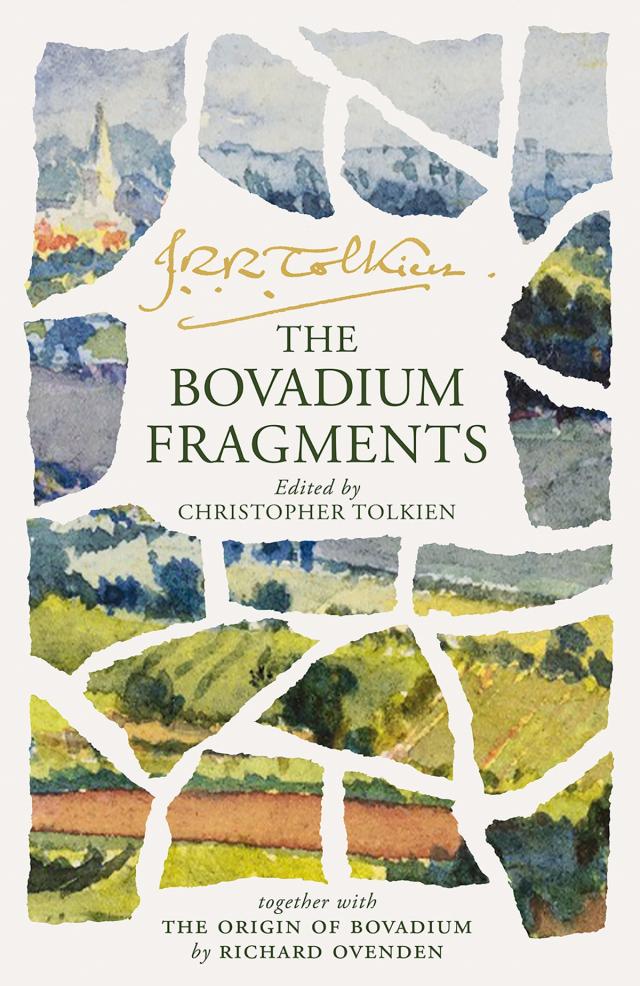
The Bovadium Fragments, page 4


There seems to be no trace in the draft material of how my father may have intended this poem and its Latin prose companion to stand in relation to the existing Bovadium Fragments.
There follows here, first, the poem, in thirty-one octosyllabic couplets.
Domine defende nos contra hos Motores bos!
A.D. Godley, 1914
Alas! that prayer was never heard:
Jove’s ears, maybe, were rendered surd;
for Motors prolific bred and teemed;
from near and far to Town they streamed,
hunting their prey with hooting shrill
from Iffley turn to Hinksey Hill.[5]
Their stink above the steeples went;
stones were shaken and ears were rent
by din of wheels and engine-blare.
And in those days no man would dare
on foot to cross the reeking High,
unless he suddenly would die;
and thus the North-folk and the South
conversed no more by word of mouth;
the town divided, tongues were changed,
and sundered men became estranged.
The North folk then became aware
that Motors by a fraud unfair
their Southern neighbours did not vex
with bang and blast of Shell and Mex;
for these had never suffered road
of tar to pass their quiet abodes.
Against the South in envious hate
the North then sent a delegate,
and begged the King to build a street
and bridges through the meadows sweet
of Southern folk, that Motors might
desert the High and bring their blight
of stench and din among the trees,
but they themselves should sleep at ease.
Then red with wrath the South arose
to battle with their Northern foes
yet neither side, though hot with hate,
could crush the other in debate.
So then the Southern folk took thought,
and in their turn the King besought
rather to break the North-men’s halls,
blow up their houses, mine their walls,
that so might in unhindered flow
yet more and swifter Motors go
slap through the Town, but peace of old
should still the southern meads enfold.
The King did nothing. Yet each day
louder and larger the array
of Motors grew, until no more
the voices of that wordy war
were heard beneath the savage roars
of huge mechanic carnivores.
Thus came the end of battle long:
so deep and dense became the throng
of Motor-cars that every street,
byway, and lane was choked, replete
till blocked in endless lines at last
immovable no Motors passed.
All stopped. And then a silence fell:
the silence of a tomb. To Hell
to seek a cleaner air long forth
had fled the souls of South and North.
Slain by the all-pervading stink,
deaf ghosts they stood on Styx’s brink,
aghast to see fell Charon gloat,
beckoning them to his Motor-boat.
There follows now the second of these texts, in Latin prose; at the end of it I have added a translation.
Domine defende nos contra hos Motores bos!
Sed Dominus [> Deus] preces eius non exaudivit; at prolem propagabant innumerabilem Motores Bi, usque donec fere cives et togati[6] vehebantur Motoribus, et ascendebat putor in fastigias ædium, et cælum concutiebat fragor.
Et in diebus illis nemo audebat pedester transire Viam Maximam propter periculum morris; et divisa est urbs, et quia non loqui poterant Australes cum Septentrionalibus, diversae factæ sunt linguæ eorum, et alienati sunt.
Tum videntes Motores non vexare Australes (quod hi nullam viam pica tam agros suos transire siverant) magnum odium Australium ceperunt Septentrionales; et orabant Cresarem viam struere et pontes per australia prata, ut Motores relicta Via Maxima transferrent putorem suum and fremitum in lucos et hortos Australium, sed ipsi viam habitarent quietam.
Tunc ira magna affecti surgebant Australes in Septentrionales, et proeliis factis neutri superabant. Australes igitur Cresarem appellabant vicissim, perfodere potius redificia Septentrionalium, ut Motores crebrius and velocius possent percurrere urbem, et antiqua maneret quies australis.
Sed Cresar neutrum fecit. At multiplicatis indies Mortoribus, adeo increscebat fragor ut voces altercantium nemo diutius audire possset. Ita finita est causa: tot et tanti facti sunt Motores ut omnes vias et calles obstruxerunt; et densis tandem constipatis agminibus ipsi immobiles conticuerunt omnes; tum demum silentium. Silentium autem sepulcri. Jamdudum et Australes et Septentrionales ex putore erant mortui. Puriorem in infernis aerem petentes umbræ surdæ steterunt denique Stygis in ripa, attonitæ et deiectæ. Atrox ibi indicavit iis Charon cymbam sua motricem.
But the Lord [> God] did not hear his prayers; the Motores Bi brought forth a countless progeny, until almost all the citizens and wearers of the toga were borne in Motors, and the stench rose up to the tops of the buildings and the noise shook heaven.
And in those days no one on foot dared to cross the Via Maxima on account of the danger of death; the city was divided, and since the Southerners could not speak with the Northerners their languages became divided, and were estranged.
Then, seeing that the Motors did not harass the Southerners (because they allowed no tarred road to cross their fields) the Northerners were seized by a great hatred of the Southerners; and they entreated the King to build a road and bridges across the southern meadows, so that the Via Maxima being deserted the Motors would transfer their stink and roaring to the groves and gardens of the Southerners, but they themselves still dwelt in quiet.
Then in great rage the Southerners arose against the Northerners, but in their battles neither overcame the other. The Southerners therefore in their turn called upon the King to dig up rather the buildings of the Northerners, so that Motors in greater numbers and more speedily could dash through the city, and the ancient southern quiet would endure.
But the King did neither. Yet with the Motors multiplying every day the noise increased so greatly that no one could any longer hear the voices of the disputants. And thus the matter came to an end: so many Motors were made that they blocked up all the streets and alleys; and at length, in densely packed lines immovable all fell still, and then silence. But the silence of the grave. Both Northerners and Southerners were long since dead of the fumes. Seeking a purer air in Hell they stood at last, deaf ghosts, on the bank of Styx, awestruck and cast down. There fierce Charon pointed out to them his Motor-boat.
THE ORIGIN OF BOVADIUM
THE ORIGIN OF BOVADIUM
J.R.R. Tolkien arrived in Oxford in the autumn of 1911 to begin his first year as an undergraduate at Exeter College. Until his death more than sixty years later the city and the University would be a central point in his existence, the main context in which his scholarly, creative, social and family lives would operate. At the same time that he climbed down off the train from Birmingham at Oxford station, however, another modern mode of transport – the motor-car – was beginning its journey to become the dominant industry in the city, one that would have massive influence on both its urban and its social landscape. The University had been at the heart of Oxford, evolving the way the city looked and operated over many centuries, but the motor industry would make its mark much faster. The collision between Tolkien’s life as a scholar and writer in the ancient University, and the impact of modernity through the increasing use of the motor-car, would eventually lead Tolkien to write The Bovadium Fragments, a satirical tale set long in the future that neatly combined Tolkien’s life as a scholar working on manuscripts, with his incredulity that mankind should become so intensely obsessed with the automobile (and all that came with it).
The Dwelling of the Genius of Repose
The Oxford that welcomed Tolkien in 1911 was still essentially a small market town, the centre of a mainly rural community, but one with a celebrated University, the oldest in the English-speaking world, and one that ranked in reputation as one of the greatest seats of higher learning.Viewed from a raised vantage point such as the roof of the Radcliffe Camera (access to which could be had for a small sum), the boundaries of the city could be easily seen – the surrounding wooded hills of Cumnor, Wytham and Shotover clearly visible in the distance. Even Headington, now very much a suburb of Oxford, was at that time still officially a village in the county and not administratively part of the city. The historic heart of Oxford was already a tourist destination, and had been for some considerable time. The colleges had occupied the same locations, in a complex pattern of small streets through a process of gradual development and expansion which had begun in the thirteenth century. Medieval buildings predominated but there were handsome stone structures of later periods which added to the richness of the urban landscape, many of them designed by the nation’s most famous architects: Christopher Wren’s Sheldonian Theatre, Vanbrugh’s Queen’s College, Hawksmoor’s Clarendon Building are just a few examples.The Victorian era added some much newer architectural elements to many of the colleges, and some University institutions, such as the University Museum, as well, but they were for the most part designed in the predominant Gothic revival style of the late nineteenth century, and as such blended almost seamlessly in with the genuine Gothic of the older colleges.
OXFORD’S DREAMING SPIRES The central parts of Oxford were, however, not purely the domain of the University. Small shops and private housing could be found dotted in the streets among the colleges, with the city’s main shopping streets of Queen Street, Cornmarket and George Street being only a few steps away from University buildings. Markets were still a major part of the city’s life for buying and selling fresh food, most of it produced locally. The central part of the city is bisected still by the imposing, wide High Street, known as ‘The High’. The High was one of the grandest streets in Britain outside the major cities. Running from Magdalen Bridge at its eastern end up to Carfax, the public water conduit at the heart of the city where four roads meet from the city’s four ancient gates, the High had a pleasing mixture of imposing stone buildings of ancient Colleges (such as Magdalen, University College, and All Souls), Georgian town houses, and older shop buildings, many of them timber-framed, with the tall spire of the University Church at its mid-point.
TRAFFIC UNDER THE BRIDGE OF SIGHS (HERTFORD COLLEGE) What made Oxford both unusual and special was that this patchwork of traditional shops and houses together with old university buildings – many of them with high walls, but with trees and ivy bringing colour into the honey-coloured stone (albeit stained with the soot of centuries) – was closely adjacent to abundant areas of green space. To the north of the historic city, the University Parks provided a mixture of spaces for sport and walking, and the dons’ housing of North Oxford was gradually expanding into pleasant streets where the gardens of these new houses were full of trees. At the eastern end of the central university area, Magdalen college could boast an expansive deer park and a water meadow. Toward the west of the city was Port Meadow – 400 acres of grazing land and water meadow bordered by the Thames on one side, which had been common land since the Domesday Book recorded it as such in 1086. To the south of the older colleges in the centre of Oxford could be found Christ Church Meadow, a large stretch of water meadow, bounded by the Thames (also referred to as the ‘Isis’ when it passes through Oxford) and the Cherwell rivers to its east and southern edges, with Corpus Christi and Merton Colleges forming its northern boundary, together with the Botanic Gardens, which had been founded in 1621, with its original walls still largely intact, but with a recent addition of garden land leased to it by Christ Church.
Christ Church Meadow’s origins go back to the twelfth century, the original land having been owned by the medieval religious institutions of St Frideswide’s Priory and Oseney Abbey.The properties of St Frideswide were transferred to the new institution of Cardinal College in the 1520s, and then a few years later at the Reformation, Cardinal College became Christ Church, with the old Priory Church becoming the Cathedral of Oxford within the Church of England.The extensive land holdings of the Priory and the Abbey, including the Meadow land were amalgamated and transferred to create Christ Church’s extensive property portfolio. All through the middle ages and the upheaval of the sixteenth century the Meadow remained grazing land leased to local farmers, and water meadow. During the Civil War in the seventeenth century the natural borders created by the river and the Meadow were utilized by the Royalist army as part of the defensive line for the city during the Siege of Oxford, but this brief military episode did not spoil the essential bucolic charm of the Meadow. Elegiac lines in John Milton’s Il Penseroso are reputed to have been inspired by the Meadow, and other writers, scholars and commentators have remarked on its special character noteworthy for its wildlife, botany (especially the famous snake’s head fritillaries) and in particular its proximity to the buildings of the University and the city itself. For students, scholars and the citizens of Oxford to be able to walk around the Meadow (on well-established paths) was regarded throughout the period of Tolkien’s residence in Oxford as a special amenity, one of the unique features of a city famous for its individual character.[7]
Oxford’s beauty, formed by its unique combination of the adjacencies of superb architecture, unspoilt nature and antiquity meant that William Henry Fox Talbot, the inventor of photography, would choose Oxford as one of the first destinations for a photographic journey, and the subject matter for the first photographs to be included in a printed book, The Pencil of Nature, published in 1844. Oxford in the summer was, according to Talbot, ‘the dwelling of the Genius of Repose.’[8]
CHRIST CHURCH MEADOW - VIEW OF MERTON COLLEGE
Motopolis
The Oxford that Tolkien arrived at in 1911 had little in the way of manufacturing industry, the economy of the city being dominated by its role as a county town. The city’s industry was almost entirely focussed on printing, with the University Press and other academic publishers driving the demand for paper (especially from the Wolvercote paper mill) and the print works in Jericho.[9] In the mid-nineteenth century the city had turned down an approach from Great Western Railways to host new workshops which would have employed over 1,500 workers. In contrast in 1911 the city was home to over 6,000 domestic servants, with fewer than 3% employed in engineering or allied trades.[10]
All of this would change dramatically thanks to the energy, drive and determination of one man, William R. Morris (later Lord Nuffield). Morris was born and raised in the city and began his commercial life through repairing bicycles; by the time Tolkien came to the city he had a workshop on Longwall Street where bicycles were repaired, and motor-cars were sold, mostly to well-heeled undergraduates, through an agency operated by Morris.
Around this time it dawned on Morris that there was a more lucrative opportunity than simply selling cars made by someone else. If he could manufacture his own vehicle, not only was there a ready market among the student body, he could make serious money not just in Oxford but across the whole nation. Thanks to significant start-up investment from a local grandee, the Earl of Macclesfield, Morris started to turn his idea into reality: the Autocar magazine in October 1912 reported that a new miniature light car had been put on the market by W.R.M. Motors of Longwall Street, Oxford, with a power rating of ten horsepower.[11] By 1913 Morris had purchased land from a former military training school in Cowley, to the east of the old city of Oxford, and had established a motor manufacturing plant. His first car would be called the ‘Morris Oxford’ and would become a firm favourite of the British public for decades to come. By the close of 1914 Morris was making 1,300 new cars a year, and by 1919 the company had grown in size and reputation, warranting a change of name: Morris Motors. Six years later the company was the largest motor manufacturer in the UK, and the Cowley car plant, as it moved towards genuine mass production, needed a constant stream of component parts. To supply this demand other industries began to establish factories in the city, one of which, the manufacture of pressed steel, was a joint financial venture between Morris and other investors. On the eve of the Second World War, the car industry in Oxford had grown from 200 employees in 1919 to over 10,000, spread across Morris Motors and the companies making component parts.[12] By 1965 this number had almost tripled to 28,000, and Morris Motors had become part of an industrial conglomerate called the Nuffield Corporation, which would swallow up many other automobile companies in the Midlands and even Australia.
Such spectacular growth would affect the city in numerous ways. To begin with it made Morris a wealthy man. By the time of the Second World War his personal wealth was turned to good use through philanthropic initiatives especially in the University’s medical sciences (endowing individual professorships and eventually whole departments), and to various Oxford colleges, including establishing Nuffield College with entirely new buildings (which were modern but very much inspired by the local vernacular style) and a substantial endowment.[13]
BATTALIONS OF MORRIS TRAVELLER CARS AT THE COWLEY CAR PLANT The rise of Morris Motors would also alter the social structures of the city’s population in profound ways. Oxford became the fastest growing city in the country between the wars, with a total population increasing from 67,290 in 1921 to 95,600 in 1939, an astonishing rise of 42%, driven in no small measure by the growth of the car industry. This profound demographic change created a rise in the demand for housing. Morris worked with the local authorities to encourage large-scale house building (such as the Bullingdon Fields estate) in Headington and Cowley, with the result that these suburbs grew so fast that they had to become administratively part of Oxford city. The pace would not slacken off after the war: between 1945 and 1973 more than 8,700 council houses were built, mostly to fill the demand of the motor industry’s expanding workforce. Some of these new estates further expanded the topography of the city, such as at Blackbird Leys, where more than 23,000 dwellings were built on farmland from 1957 onwards.