

Wreckage: An Addictive Psychological Thriller Packed with Twists, page 4
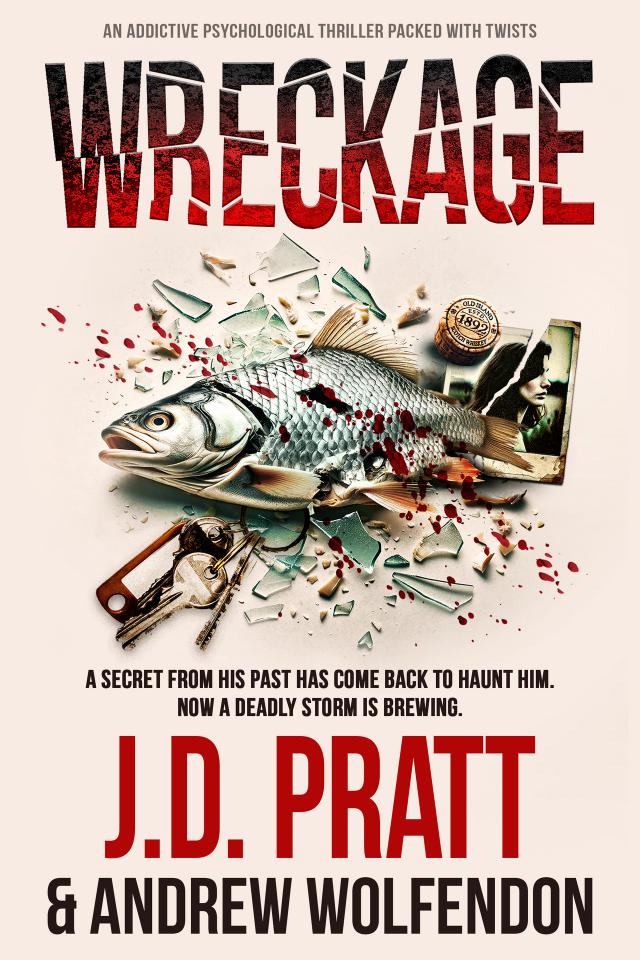


I packed Miles into the car. I was clear-headed enough for driving, but still, I did have more than trace quantities of alcohol in my system, so I stuck to the back roads on my way to Miles’s apartment. Miles clung to the Glenmalloch and continued to hit it like it was Dr. Pepper.
We hadn’t driven more than a mile or two when he let out a wounded-animal wail and buried his face in his hands.
I found a place to pull over at the edge of the state park. There, Miles proceeded to have what I can only call a breakdown. He threw himself on the ground, chest-down, and blurted out all the fears and doubts he’d been stuffing inside for years. Fears about his future. Fears about the expectations hung on him by his family and himself. Fears about his upcoming marriage to Beth. “I want what you have with Jeannie. I want to be an artist and a vagabond like you. You’re so lucky. You can live the life you choose. Love whoever you want.”
I think I offered him some thin counsel, but he was too drunk to hear it. Just as well. He finally staggered to his feet, wrung out, and stumbled back to the car.
After driving another mile or so, I spotted a police car parked in the shadows on a wooded section of Carlisle Road. Watching for speeders and drunks. My heart revved.
“Shit,” I said to Miles, “The bottle.” Massachusetts law forbade “open containers” of alcohol in moving vehicles.
As I drove out of the woods onto an open stretch of road, I kept my eyes glued to the rear-view mirror, certain the cop would be tailing us any minute. I didn’t notice we were going over a bridge, but Miles evidently did.
Before my brain could register what he was doing, he rolled his window down. He slurred the words, “My apology to the river gods,” and then his window went back up. My eyes were still riveted to the rear-view mirror, watching for the cop.
A moment later, we were passing a carved wooden sign with a crucifix on it when I heard—or thought I heard—a series of sounds that didn’t make immediate sense to me.
“Miles? Did you hear that?”
“Hear what?” he said, his head wobbling precariously.
I glanced at Miles’s lap and noticed it was empty.
“What did you do with the bottle?”
“Tossed it in the Merrimack,” he said. “Ba-bye.”
It was then I noticed headlights following us at a distance.
“Shit, Miles, that’s the cop. What if he saw you throw it?” I didn’t think the cop could have seen anything; he wasn’t behind us at the time, but still...
“Jeez, I was jus’ try’na help.”
“We’re screwed, man.”
I drove a little farther, hewing to the speed limit, and the headlights continued to follow us. And then the dreaded thing happened. Blue lights. My heart hammering, I looked for a place to pull over. That was when I noticed another bridge up ahead of us on Carlisle Road.
My body must have put two and two together before my conscious mind did, because a wave of nausea rose from my gut. “Oh no, Miles,” I said. “This is the bridge over the Merrimack. This is the bridge over the Merrimack.”
I pulled the car over as the full weight of the realization sunk in.
If this was the bridge over the Merrimack, that meant only one thing: the previous bridge had been the bridge over route 495.
Oh no. Oh shit. The sounds I’d heard—or thought I’d heard—when we were passing the crucifix now made damning sense. They were the sounds of squealing brakes, shattering glass, and smashing metal.
The blue lights loomed larger in my mirror. Life as I knew it was about to end.
But instead of pulling to a stop behind me, the police car turned on its siren, did a quick three-point turn, and sped off in the direction from which it had come.
I should have been massively relieved that the cop was rushing off to deal with an emergency but was only sickened by the implications. “Miles,” I said, gathering my strength to tell him what I now knew. “You didn’t throw the bottle into the river, you threw it onto the highway.”
But as I turned to look at Miles, he was passed out, stone cold.
6
Istare, spellbound, at the rushing black water below. There’s no question what my next move must be, though I long for an excuse to stall.
I drag myself back to Brew Moon, giving Django the Brave a little nod as I enter. He fails to acknowledge my existence with even a microscopic facial twitch.
Jumping back onto the rented computer, I pull up my “suicide” note and stare at that hypertext link on it, ripe with odious promise. I click the link before I can change my mind. The elderly iMac churns arthritically.
Moments later, a Boston Globe news article from 1999 appears on my rented screen: “Police Investigate Fatal Three-Car Collision in Bridgefield.”
No, no, no.
I want to throw up. I want to run away. I want to drink something infinitely stronger than a Cà Phê Dá.
I can’t believe what I’m reading, yet the words strike home with the fatedness of cancer after a thirty-year smoking binge.
A fatal accident occurred at 1:21 a.m. Sunday on Route 495 South near the Carlisle Road exit in Bridgefield, say police. According to an eyewitness, a 1987 Chevrolet El Camino driven by Edgar Goslin of Wentworth lost control “for no apparent reason” and veered into the passing lane where it collided with a 1998 Ford Aerostar occupied by Paul and Laurice Abelsen and—please no—their two-year-old daughter. The Abelsens’ vehicle veered off the highway, rolled over and struck a tree, where Goslin’s car struck it a second time, crushing the roof of the Abelsen’s vehicle and the front end of Goslin’s car. All three members of the Abelsen family were pronounced dead on arrival at Wentworth General Hospital. Goslin is listed in critical condition with multiple undisclosed injuries. Police have not ruled out alcohol as a factor and are continuing to investigate.
I read the words again. Then again. And again.
Nausea reaches right down into my soul.
Thinking back to that night long ago, I revisit the fateful decision I made. After the cop sped off, I drove away, letting Miles remain unconscious. I remember convincing myself I probably hadn’t heard those crashing noises. And if I had, the accident probably wasn’t as bad as it sounded. And if it was, then Miles’s tossed bottle probably had nothing to do with it. And even if the worst possibility was true—that Miles had inadvertently caused a serious accident—what good could come of bringing that to light? It was his graduation night. He was about to embark on an exciting new life. Why kneecap his destiny? Whom would it help, really, to assign blame? The cops had the situation handled.
And anyway, I probably hadn’t heard anything. Right?
The day after graduation, though, I shocked my parents by announcing I had changed my mind about going to grad school in Providence. I wanted to take a year off to think about it. I’d decided, instead, to accept an invitation from a couple of college classmates to drive to California with them and hang loose for a while. Seek my fortune—by way of minimum wage—in the Land of Milk and Honey.
My folks tried to reason with me, but my mind was made up.
I busied myself on May 13, 1999, packing duffel bags, returning library books, selling my old Chevy at a used car lot open on Sundays, and saying goodbye to Jeannie a week earlier than planned. I studiously avoided looking at newspapers and televisions—if nothing was confirmed, then as far as I knew, no accident had happened. And then, on the morning of May 14, I jumped into a thirteen-year-old Aries K-car with two stoners from Godwin I didn’t even like and headed for the Golden West.
I didn’t return to Massachusetts for five years.
My attention snaps back to my Brew Moon environs. I study the suicide note on the computer screen again, mystified by both its accuracies and its inaccuracies, and dumbfounded as to its purpose. Who wrote it and why now?
I log into my Gmail account, copy the text of the note into an email, and send it to myself, verifying it arrived intact.
I do the same with the Globe article.
.....
Twenty minutes later, I’m lying on my bed at the Oak Crest Motel, drinking a beer, staring at the cracked ceiling, and listening to the rattle and hum of the in-name-only air conditioner. My mind wants to spin out of control. I don’t have the slightest idea how to process the events of the past few days, and I have no clue what I’m going to do when I wake up in the morning. Or any morning thereafter, for that matter.
It’s ten-thirty at night, and I know what I want to do: call Miles. I have an almost physical urge to share the burden of what I’ve just learned. But the hour is late. And besides, I can’t just dump those ancient deaths on him now.
Do I even have a right to dump them on him? After all these years? To throw such a crowbar into the machinery of his carefully executed life? The man is a partner in one of New England’s finest law firms, for God’s sake, and a state senator. What possible good could come of sharing this information? It would either ruin his career or destroy his peace of mind. Or both.
No. My time to speak was eighteen years ago, when I heard—or did I?—that distant sound of smashing glass and metal. Not now.
On the other hand, do I have any right not to tell him? Who appointed me Truth Fairy? Does he not have a fundamental right to know something of such vital import to his life?
That is the question.
I turn on my phone, play a little gem-matching game for a while, trying to numb my brain. It doesn’t work. I look at the time again. Ten forty-three.
Screw it. I lose the battle. I won’t call Miles, but I’ll text him, see if he’s still up. Long time, brother, I type. Sorry for the radio silence. Hope all’s well. Didn’t want to phone this late and invoke the wrath of Beth, but if you’re awake, so am I.
Less than a minute after I hit Send, my phone rings. Miles. The instant I slide the answer icon, a flat voice says, “So you didn’t die in a freak circus accident.”
“Is there any other kind of circus accident?” I deadpan back.
“Man, it’s great to hear your voice.”
“Yours too.”
A pause ensues. We both know there are fissures to be mended, but, by silent accord, we agree to save the harder conversation for later. We are both happy to be reconnecting.
We spend the next few minutes playing catch-up. What am I up to these days? (I spin the living crap out of that one.) How’s Miles’s four-star career going? How are Beth and the kids? When the grace period for codswallop expires, Miles says, “But I’m guessing you didn’t call after all this time just to find out if Kelsey made the freshmen soccer team.”
He’s right. But of course, I can’t tell him what really prompted my call. Not by phone. No, if that conversation is ever going to take place—and that’s a very large if—it will need to happen face-to-face.
I suddenly realize there’s a deeper, truer reason I’ve called him: I miss my friend, and I long for his voice and comfort. “I’m scared to death, Miles.” I blurt out the story of the home invasion, the attempted forced suicide, and the later clean-up of the evidence. The only part I omit is the suicide note, because that would lead us into complicated terrain. The whole time I’m talking, Miles is silent, but I can feel his listening presence like a ship’s beacon.
When I’m done, he asks me to hang on. He puts me on hold for a couple of minutes, then returns and pronounces, “Here’s what you are going to do. First, get some sleep. Mainline some Nyquil if necessary. Set your alarm for five a.m. When you wake up, you will drive directly to New Harbor, where you will get on the ten o’clock ferry to Musqasset.”
Yes, Miles owns a summer home on my beloved Musqasset Island—a place he didn’t even know existed until I browbeat him into visiting me there—and I am living in my parents’ den of depression in Wentworth, Mass. How that perversion of fortune came about is a subject for later discussion.
“Beth and I and the kids are out on the island for the Labor Day weekend,” he says. “You are going to stay with us. You will be safe here, and you and I will figure out exactly what is happening and what to do next.”
“I’m sure Beth would love that.”
“I already talked to her, and she thinks it’s a great idea. She’ll be thrilled to see you. Listen to me, Finn: it’s important you get on the morning ferry.”
“Why?”
“You do watch the news, don’t you?” Actually, I’ve been a smidge preoccupied. “That tropical storm off the coast? It’s huge. The morning ferry may be the last one leaving the mainland for a couple of days. Tell me you understand, and you’re going to do what I say.”
Why is he talking to me like I’m seven?
“I don’t know, Miles. I haven’t been back to the island since Jeannie and I...” No need to finish my sentence. “I’d have to think about it.”
“Okay, then, think. I’ll give you ten minutes.”
He hangs up.
Go to Musqasset Island? Me? Tomorrow? I last set eyes on the place four years ago. Jeannie and I had just broken up for the second and final time. Changes were taking place on the island—Miles was in the thick of them—and the place just didn’t feel right to me anymore. My mom’s health problems gave me a handy excuse to return to Wentworth. So, one morning, I just quietly packed my bags, stepped aboard the ferry, and closed the door on the “Island Artist” chapter of my life. The end.
But not a day has passed that I haven’t thought about Musqasset. As I close my eyes right now, I can hear the screeching of the gulls and the rumble of the lobster boats. I can see the seals basking like drunken cruise-ship passengers on Table Rock. I can feel the welcoming warmth of Pete’s Lagoon, The Mermaid Café, Mary’s Lunch.
And the light. Oh God, the light. There’s a reason Musqasset attracts painters from all over the world. Everywhere you focus your eyes, from the tightest close-up to the grandest panorama, you see an oil painting—a tiny flower peeking out of the lichen, a lobster trap in the tall grass, the lighthouse silhouetted against a translucent sea. It’s an artist’s wet dream.
Leaving was agony. But the wounds have healed, the breaks have mended. And I know I can’t go back.
Maybe for a few days, though. Arrive unannounced, hole up at Miles’s place.
The idea makes sense, under the circumstances. For one thing, I’m not safe here in Wentworth. For another, I have no freaking clue what my next move is. It would do me enormous good to spend some time in a safe place with old friends. Step back from my predicament, think and strategize a bit.
Then, of course, there’s the fact that I may need to have a serious conversation with Miles.
Momentum starts to build. If I slipped out of here in the pre-dawn hours, I could make it to New Harbor by eight or eight-thirty. Be out on Musqasset before noon. The brewing ocean storm gives me added incentive. By the time my assailants could pick up my trail, they won’t be able to follow me, at least for a couple of days. The ferry will be down. I’ll be safely unreachable, several leagues out to sea.
The logic seems ironclad.
But ultimately, it’s not logic that moves my decision needle. It’s the fact that I feel safe on Musqasset. It is still home to me. Deep down, I’ve been longing for an excuse to return there. If only for a visit.
Miles calls back.
“I’ll see you in the morning,” I tell him.
.....
I lie back on the lumpy motel mattress and let my mind roam to the suicide note again. Of all the many disturbing, unanswered questions it raises, the one that will gnaw at my sleep the most is this: Why and how does the note sound exactly like something I would write—from its feeble attempts at gallows humor, to its linguistic style, to its specificity of details (like the Clyde Gilchrist reference), to its misspelling of the word “party” as “patry,” a habitual typo of mine?
How could any other person have captured me so perfectly?
I’m scared about the places this question wants to take me. And I wonder if there’s a deeper reason I don’t want to get the police involved in this. Or talk to Miles about it.
7
I’m up and dressed by four forty-five. I wouldn’t have been able to sleep even if the motel mattress wasn’t made of dead rodents, so I figure I’ll hit the highway early.
As I throw my few belongings into my backpack and do a final room check, I can’t tell if I’m excited or terrified. Maybe there’s no difference. But one thing is certain: I feel more alive than I have in years. Being almost murdered has done wonders for my state of mind. Can’t say I recommend it for everyone, but still.
As I slip out into the predawn darkness of the Oak Crest’s unlit parking lot, a brisk morning breeze salutes me. Must be the western edge of that ocean storm. It smells of the sea, even this far inland. It smells of adventure too, if I’m being honest.
I consider driving back to the house and grabbing my iMac, but I’m worried the house is being staked out. Better not. I jump into my car and head north.
Route 95 is deserted at this hour; most of the trip I see no one behind me for more than a quarter of a mile. Same deal when I switch onto 295. No cars come near me, except to pass. Still, I take a couple of side trips onto the surface roads just to be sure I don’t have a tail on me. And to gas and coffee up.
As I exit onto Route 1, the main coastal road, my confidence remains high that I’m alone and unfollowed.
I find a market in Damariscotta that’s open early and buy some freshly baked crusty bread, a couple of bottles of half-decent wine, and the makings of a pasta puttanesca and a Caesar salad. I don’t want to show up empty-handed at Miles’s, and I know grocery options are sparse on the island.
It’s seven fifty when I arrive in New Harbor, plenty early for the ten o’clock ferry. I park in the grassy field designated for long-term parking, open the car door, and pull the swirling ocean air into my lungs. Ah, that smell stirs my blood. I think on a cellular level I can still remember my ancestral sea-dwelling days. I probably had a nice lungfish family that loved me.


