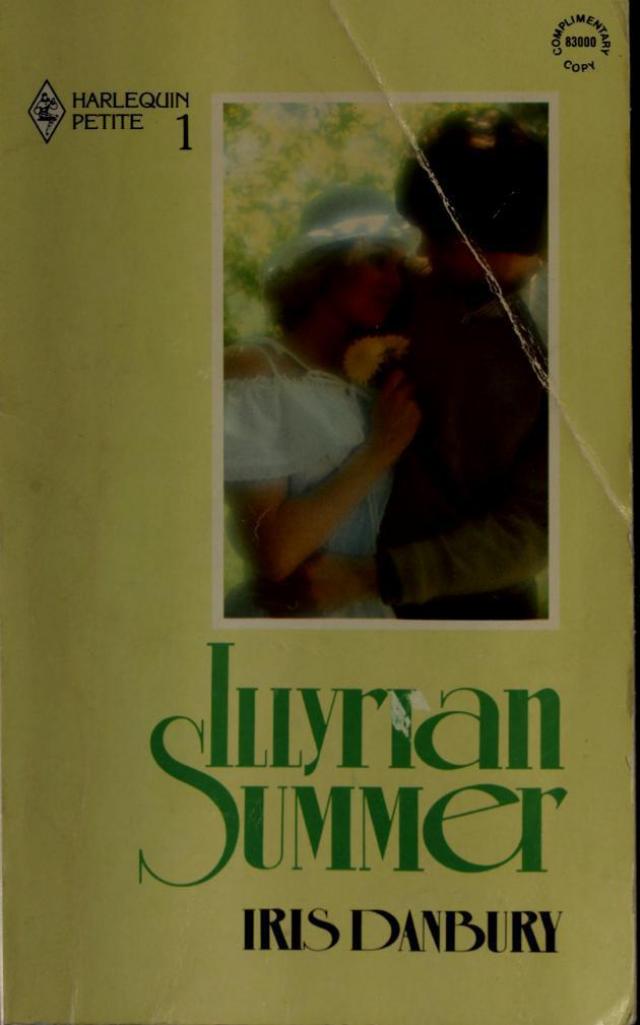
Illyrian Summer, page 12


There were voices and shouts outside as other tent occupiers found they were in trouble, and Radmilla stepped out into the drenching rain.
“Quick, Sarah!” she said when she returned almost immediately. “Put on as many clothes as possible, and your anorak, and we can run to someone else’s tent.”
“I’ll have to come back for some of my things.” Sarah gathered all she could and ran to a neighboring tent, where a young German couple made room.
She and Radmilla made several journeys, splashing through the torrent, and on the last trip when Sarah was trying to find her typewriter the tent collapsed on her, tangling her in heavy wet folds. But she extricated herself at last and, clutching the typewriter, returned to the other tent, which was by now almost as wet as Sarah’s and Radmilla’s own, but was not so much in the patch of the streams making courses for themselves down the sloping ground.
By daylight the rain had not subsided, but at least one could see what was happening.
“We must run down to the road,” Radmilla suggested. “and perhaps trucks will pick us up as they did the first time when the storm came.”
All the roads were covered in liquid mud. but Sarah and Radmilla were picked up by an army truck and taken to a group of huts where there were hot drinks available and, later, facilities for drying clothes.
In the general confusion the two girls had rescued each other’s belongings, and Radmilla picked up Sarah’s rucksack. “Everything inside is wet, Sarah. You should dry them, I think.”
Sarah was perturbed about her typewriter, for muddy water had seeped inside the case, but she had to leave it for the time being and go to her work at the cafeteria.
During the morning some of the British soldiers came in, among them Harry, the young man who had obligingly made Sarah a dozen bent-wire plate racks.
“Dried yourself out, ducks?” he asked her. “Gosh, when it rains here, it rains—and no mistake.”
“I suppose you don’t know how I can get a typewriter properly dried, do you?” Sarah queried. “I’m afraid some of the parts may rust or jam themselves.”
“It’s not up my street, but one of my pals could do it for you. He’s a wizard with radios, typewriters, tape recorders, anything like that.”
He borrowed another man’s waterproof cape to put around Sarah’s shoulders when she went to the hut to collect the typewriter. In places the ground was a sticky morass like dark brown custard.
“After you’re really wet through a few times,” she said as Harry accompanied her on the return journey, “you don’t care.”
The young man promised to take the typewriter to his friend Joe, and return it the same evening if possible, or else the next day.
“Thanks very much. I’d like it back as soon as possible.” She was thinking of tomorrow when she was due to go to Adam’s office and might need the typewriter.
As the day went by, Sarah was aware that her throat was dry and her head ached intolerably. She worked mechanically, scarcely knowing what was said to her or what she answered. Radmilla sent a message saying that Adam had telephoned and the two girls were to go to the house in which he lived, near the steelworks, where Madame Pavlica would look after them.
Adam’s house was too far away. Sarah spoke to one of the other assistants. “I’m going back to the hut. I feel as though I’m starting a cold.”
The rain was still coming down in torrents, and when she arrived at the hut Sarah stripped off some of her wet clothes, but little else was dry enough to put on. She wrapped herself in a blanket and flopped onto her bunk bed.
It might have been hours or only minutes later when she heard Radmilla’s voice. “Sarah! Why are you here? We must go to Adam’s house.”
Sarah sighed and closed her eyes again. “You go. I can’t be bothered. I’ll stay here.”
“Sarah! You are ill!”
But Sarah had slipped away into blankness.
When she again became aware of her surroundings, she blinked her eyes and stared. Why, she was not in the hut at all, but in a comfortable bed in a charming little room. “I thought Adam was here.” She was surprised to hear her words spoken aloud.
“So he is.” His warm hand clasped hers.
“Have I been ill?” she asked. “How long?”
“Only three days,” Adam answered. “A feverish cold, complete exhaustion ... you shouldn’t have tried to work when you were so wet through, Sarah.”
“Three days!” she murmured. “Sliced right out of my life.”
“You were taken to the American army field hospital, but when they found you didn’t have pneumonia they threw you out and I brought you here.”
“Thank you, Adam. That was kind of you. And Radmilla?”
“She’s also been looking after you, along with Cjospoda Pavlica.”
Radmilla came into the room to bring a glass of yogurt. “Ah, that is better,” she said. “Now you begin to look like the Sarah we know.”
Adam moved toward the window. “Radmilla and I brought all your possessions here, so I hope nothing is missing. One of your army friends in the Royal Engineers brought your typewriter. Said he’d oiled and cleaned it. He gave his name as Harry’s pal, Joe.”
Sarah smiled. “It was Harry who made me the plate racks.”
“I rescued your straw hat,” Adam continued. “It’s dried out, but rather an odd shape. I’m afraid.” He had picked it up from the knob of axhair and was twirling it in his hand.
Sarah laughed shakily, but she was near to tears.
“You must have some new ribbons for it, Sarah,” Adam said casually, and replaced the hat. While his back was turned she brushed away the idiotic tears.
After Adam left, Radmilla told Sarah the news of the past few days. “But Adam!” Radmilla shrugged expressively. “I do not know what kind of man he is. First he is running this way and that for Mirjana and then he takes her to Belgrade. When she is out of the way, he is everywhere at once, at the hospital, here in this house, asking about you many times every day.” She sighed. “Perhaps he just likes to have many girls all at one time.”
Sarah smiled. She was not sure, either, what kind of man Adam was. She merely said now, “Safety in numbers.”
Radmilla explained that she, too, was living here temporarily in the house, but Adam had moved to one of the huts near the prefab site.
“Oh, we have turned him out!” exclaimed Sarah. “Madame Pavlica must be wondering how many more of Adam’s girl friends she will have to shelter.”
By the time Sarah was fit to go out of doors, the long rainy spell had ended and the ground had dried out considerably, though the roads and paths were rutted. Adam insisted that she was not to return to work at the cafeteria.
“I’ll provide you with whatever job you need—and you’ll be just as useful as you were there doing the washing-up or burning the kebabs.”
“I never burned anything!” she protested. “They wouldn’t let me near the cooking.”
“Perhaps that was to everyone’s benefit!”
In spite of his bantering tone, Sarah was convinced that Adam’s manner had become more distant. As she became better in health, so he receded. She tried not to be depressed, realizing that despondent moods were the usual reaction to minor illnesses, but it seemed that Adam was interested only in offering a helping hand in emergencies. Once the crisis was over, he turned his attention to someone else. Sarah remembered Melanie’s caustic remarks—“Adam is marvelous in emergencies ... a dog with an injured paw is a challenge to him...”
Perhaps, thought Sarah, he should have been a doctor instead of a construction engineer. There again, in every critical situation caused by the earthquake or the subsequent storms, Adam immediately took charge, working round the clock, exhausting himself.
Sarah was forced to the conclusion that Adam’s kindly ministrations were only part of his personality, and apparently Mirjana was no more to him than Sarah herself: a girl to be extricated from difficulties.
Might it not be better in the end, Sarah asked herself, to return to London? Winter would bring even harsher conditions to Krasnograd, and frantic haste was needed to erect enough buildings to shelter those who required them, so that the more permanent building could start.
Sarah was reluctant to come to a decision. At least she could not leave yet when she had promised to help Adam with secretarial work in Mirjana’s absence.
On the day she presented herself at the steelworks, she was greeted by a smart young girl who said she would take Sarah to the Gospodin Tahorny.
“Tahorny,” Sarah repeated softly to herself as she was conducted along corridors. So this was what Adam had meant when he said he would provide her with a job! She was not to work for him after all, but she realized immediately that during her illness he had found it necessary to have another secretary.
The girl ushered her, into a large room with floor-length windows. “Gospodica Cat—Catzeral,” she announced, doing her best with Sarah’s surname.
Adam turned from the windows, murmured something to the girl and greeted Sarah.
“I—I thought I was—they said Mr. Tahorny—that’s what it sounded like,” she stammered.
Adam laughed. “Oh, I’m known everywhere here as Tahorny—it’s that difficult ‘th’ we have in our language. Thorne—Catherall—you heard how you got yours pronounced. Well, where shall we start?”
“At the beginning, I suppose,” she answered briskly.
From the opposite side of his desk he regarded her with a strange twinkle. “I don’t know if we can go back that far. I have a letter from Edmund. He was concerned when he heard you were ill and hopes you’re better.” Adam leaned back in his chair. “Sarah, there’s a piece about Daniel. Do you want to hear it?”
“Of course. Read it.”
Once again Adam gave her a long measuring glance.
“Edmund says that Daniel seems to have recovered his gaiety and is, er, quite taken with a young Italian actress in the film studios.” Adam glanced up sharply, as though to catch Sarah’s expression.
She smiled with relief. “Oh, that’s nice. I’m glad.”
“I believe you are.”
“I don’t want Daniel to be miserable,” she said.
“But you don’t mind if I am?”
“And are you?” she queried.
“I don’t know,” he answered thoughtfully, and then pulled a sheet of paper out of a drawer.
“I’ve another note here. I only recently received it.”
Sarah recognized the paper immediately as the note she had pushed into the parcel of blankets. She reddened and looked away.
“These bales of blankets were never unpacked until now,” Adam explained. “They weren’t needed in the hot weather, but now they are being distributed.”
“Oh, that was a long time ago, Adam. It was just a thought. I’d no idea if the note would ever reach you.”
“I’m glad to have it. Did you mean what you said in it?”
“I’ve forgotten what I wrote,” she mumbled, wishing he would dismiss the silly little note and start dictating his real work.
“I’ll read it to you,” he offered. He rose and came to stand behind her. Sarah composed herself, for after all, the wording was innocuous enough.
“‘Love from Sarah’—and Edmund’s name added as an afterthought.”
“Adam!” She sprang to her feet. “Give me the note!” He held it tantalizingly out of her reach and with his free arm encircled her waist. “Sarah!” he whispered softly. “Was it your love you were sending me all that time ago?”
“I didn’t mean to—” she began.
“No, I didn’t mean to fall in love with you, either. I tried hard not to. My kind of life is rough, and I can’t have a wife who dotes on suburban tea parties and fashion parades. But you’re different, Sarah, darling, and I love you for it.”
“Oh, Adam! I thought you weren’t interested in me.”
Interested! When I spied you tripping about on that amphitheater at Pula, I thought you were a menace, accident-prone. But when I met you again, I knew I had to be the one to catch you when you fell.”
Sarah leaned against him in perfect bliss, and his kisses were long and hard and satisfying.
Presently she said, “I’ve told you how little Daniel means to me. What about Melanie—and Mirjana?”
With his arm still around her, Adam moved toward the windows. “Melanie was a boy’s infatuation. She wanted to move into the world where she is. One day she’ll marry Chester Kernick or some other man who speaks the same language, the show-business language, and I hope she’ll be happy.”
“And Mirjana?” Sarah prompted.
Adam looked down at her and laughed. “Jealous of Mirjana? You don’t understand. Mirjana is an excellent secretary, but she has the roving eye. For a short time her glance fell on me, but that didn’t last long when a handsome Serbian doctor smiled at her.”
“You wouldn’t wait to listen to explanations. I could have told you then.”
“That you loved me—and not Daniel?”
“Yes.”
“Then say it now. I haven’t heard you tell me yet.”
“Adam, I do love you.”
“Splendid!” He took her hands and kissed her fingertips. “And if you marry me, will you put up with all the hardships of working in isolated places? The heat, the cold and few civilized comforts?”
“By myself, no. But with you, Adam, I’ll enjoy it all.”
“A taste for travel is going to lead you a long way. My next job is in South America.”
“Oh, marvelous! I must learn Spanish—or will it have to be Portuguese?”
Adam laughed. “Impulsive as ever! This is what makes you climb shaky amphitheaters. Before we start on the next trip, there are certain formalities. Don’t I have to meet your aunt and uncle and get their permission to marry you?”
“Formally, I suppose so, although they’re not really my legal guardians.”
“Well, as soon as I can get away from here, we’ll take a trip to London. I’m due for a holiday anyway. Come on, darling, let’s go out. We’ve quite a lot to discuss.”
“Now—in the middle of the morning?”
He laughed. “Oh, they’re used to the wild ways of the Englishman, Tahorny, here.”
In the village to which he drove, he and Sarah lunched at a riverside inn. “D’you like foreign food, Sarah?” he queried, munching away at minced veal wrapped in vine leaves.
“I’m always experimenting in eating,” she answered. His blue eyes regarded her for a few moments.
“You have nice eyes, Sarah—the color of toast.”
“Depends whether you like your toast black or brown.”
He raised his glass of wine to her. “Darling, we’ll have a wonderful time together. Where shall we go for our honeymoon?”
“To the coast of Illyria,” came her immediate answer. Her eyes—toast color, he had called them—were like stars, golden amber stars.
Iris Danbury, Illyrian Summer