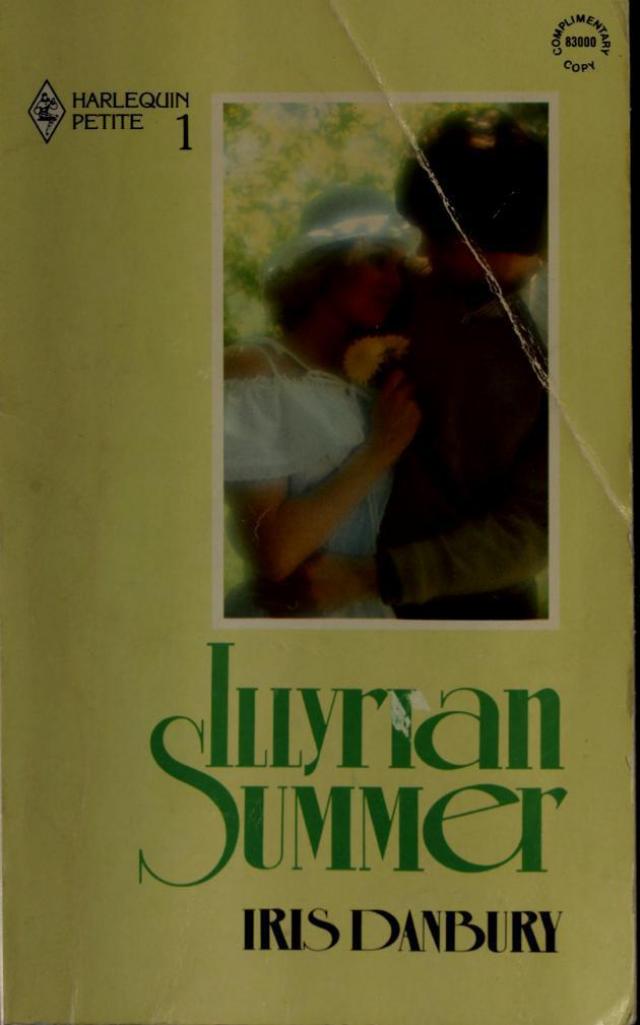
Illyrian Summer, page 10


It was no surprise to Sarah that after Edmund’s talk of “a couple of days,” the film unit was still in Dubrovnik at the end of a week. Time schedules seemed to mean very little in the film world, she thought, in spite of the lament that all possible expenses should be saved.
Sarah had already told Edmund of her decision to return to London. “But please don’t tell Daniel yet,” she said. “He’ll accuse me of running out on him and try to persuade me to go to the Italian studios.”
“As you wish,” Edmund agreed, “but when he knows that you’re booked on the plane from Dubrovnik, what then?”
“Too late then.”
Radmilla had arrived at the villa the previous day to collect her clothes and personal oddments, and Sarah was glad of her company.
“I am sorry to leave you all, but I am so happy. Edmund has paid me very generously for my work, and now I can spend a little and help my parents also until they have a new home.”
“When are you returning to Sarajevo?” asked Sarah.
“In one day or two days, perhaps. But I am then going on to Krasnograd. Oh, I must work there. So much to do.”
“I wish I could come with you,” murmured Sarah wistfully.
“Why not?” Radmilla’s dark eyes were aglow, and somehow Sarah had the impression that her Slav friend had resolved some of her recent problems. There was a lovely radiance about Radmilla’s face.
“No, it wouldn’t be—no.” Sarah took refuge in incoherence, remembering that she could not face Adam again.
“Let us go out tomorrow together,” Radmilla suggested happily, “and buy presents and enjoy ourselves.”
“With pleasure. I also have my golden handshake from Edmund.”
“His handshake? Golden?”
Sarah dissolved into helpless giggles while she tried to explain the phrase to Radmilla.
“I shall miss you, Radmilla, when I am back in England,” she said.
Next day Melanie arrived unexpectedly from her short trip to Greece, and almost immediately, it seemed to Sarah, the happy mood at the villa was destroyed.
Whatever the cause of Melanie’s ill temper, she vented it on everyone—Edmund; Daniel; Pepica, the housekeeper; Senka, the cook. Sarah and Radmilla kept out of her way as much as possible, but Sarah had the bad luck to be typing a few letters for Edmund when Melanie came storming into the room.
“I have some correspondence I want you to type,” Melanie began abruptly.
“Certainly, Miss Roche.” Sarah picked up her notebook and waited.
“I hear that Edmund is arranging a job for you in the Italian studios,” Melanie said accusingly. Before Sarah could answer, Melanie continued, “You’re not very sensible, are you?”
On her guard, Sarah asked, “In what way?”
Melanie flung out her arms dramatically. “In Daniel’s way. And that exactly expresses the situation. You’ve planted yourself right across Daniel’s path!”
“I don’t really think I’ve done quite that,” Sarah protested mildly.
“My dear child, you don’t know what you’ve done! You’ve gone a long way toward wrecking Daniel’s career. I warned you. I even offered you a job at my own villa. You weren’t satisfied until you wheedled him into going to the earthquake town, where anything might have happened to him, any accident or injury. Then when you’d got him there you tried to play him off against Adam Thorne.” Melanie laughed without amusement. “I imagine you found Adam a rather tougher proposition that you had supposed!”
Sarah had risen to her feet to meet this onslaught. Her eyes blazed with anger “I don’t know why you’re attacking me like this. If you think that Daniel—”
“Oh, please don’t play the little innocent!” Melanie interrupted. “You’ve twisted Daniel round your little finger until he’s gone to pieces, his acting is ruined. The only way to save him is for you to leave him alone.”
“Leave him alone?” Sarah exclaimed. “You don’t realize how extremely funny that is, Miss Roche.”
“Only a girl with her eye to the main chance would find it so amusing.”
Melanie swung away with violent fury, took three steps and turned to face Sarah again. Sarah had the distinct impression that Melanie was dramatizing as though she were on the stage or a film set.
“What action do you intend to take, Miss Roche?” asked Sarah quietly. In the circumstances she thought she could afford to be politely hostile. If Melanie had been misinformed, Sarah had no intention of enlightening her.
“I shall insist that Edmund sack you and send you back to England.”
“You must do what you think best,” Sarah returned evenly.
Melanie gave a little sneering smile. “Oh, Edmund will also think it best, you may be quite sure. You don’t suppose he’s going to have one of his best actors ruined by a little typist in the company.”
“I wonder!” Sarah said softly.
“What are you wondering?”
“Whether it’s Daniel’s career or Daniel’s marriage that you’re taking so much to heart.”
“Both. One is bound up with the other. You must feel that you’re in a very strong position if you can afford to be so impertinent.”
“I’m sorry,” Sarah apologized in that decisive tone that negates contrition. “I didn’t mean to sound impertinent, but I thought we were trying to discuss a situation you find particularly unpleasant, if not dangerous.”
Melanie stared at Sarah, who returned the scrutiny without flinching. “I shall go to Edmund at once,” Melanie declared, “before matters get completely out of hand.”
Sarah considered the question from several viewpoints. Perhaps the truth was that Daniel was Melanie’s protégé and she would not allow anyone else to dominate him. In Sarah she fancied she saw a new source of power. In reality, the whole situation was ludicrous, and Sarah chuckled to herself.
Edmund, however, soon wiped the smile off Sarah’s face. He came into the room half an hour later, when she had finished his typing and asked crossly, “Why didn’t you tell Melanie that you were going home?”
“And have Daniel pestering me all day long? Or am I flattering myself?”
“She was in a rare state, demanding that I sack you at once,” grumbled Edmund.
“Why didn’t you tell her then that all the arrangements were made and I was being packed off to England?” Sarah demanded.
Edmund looked sheepish. “Sometimes it’s best to let her think she’s seized her own way by force. Deflating her doesn’t have a good effect.”
“Then that’s why I didn’t deflate her, either,” Sarah asserted. “I couldn’t help it if she jumped to all the wrong conclusions. I suppose Daniel gave her the impression that I was going to Florence with the unit.”
“You should have been more honest with Daniel and told him the truth.”
Sarah nodded. “Yes, I should,” she admitted. “Now he’ll hear about it from Melanie in the worst possible way.”
“Actually, I think he won’t. I’ve persuaded her not to let him know until tomorrow anyway. There’ll be less time then for further upsets.”
“I’d better tell him myself,” Sarah decided. “In any case, I wouldn’t like him to think that Melanie was responsible for my being sent home.”
After a long pause, Sarah asked, “Have I really damaged Daniel’s acting? I’m not being conceited, I hope, but you can tell me the truth, Edmund.”
He smiled. “Daniel’s not the type to ruin all for love. Or maybe you’re not the girl. Does that prick your conceit?”
“No, I’m relieved. After all, I have so much to thank him for. It was he who insisted I should come with you. Perhaps that’s why Melanie is so worried. She doesn’t know how close we were before she arrived. Is she always like this when she’s upset? Don’t you find all this turmoil wearing?”
Edmund laughed. “You don’t understand her temperament. It’s just because she’s so neurotic that she’s such a fine actress, and of course she carries every worry, every tiny accident, over into real life.”
“I couldn’t live at that pace. I like the quiet life.”
Edmund gave her a long appraising look before he spoke. “You wouldn’t get that with Daniel.” He strolled toward the door, then turned. “Nor with Adam.”
She reflected that Edmund, too, had been a stage and film actor before he became a director. He certainly knew how to deliver an exit line.
Radmilla appeared on the terrace. “Sarah, you are ready to come shopping?”
“Yes. I’ll get my handbag.” Sarah was glad of a diversion to take away the taste of that past hour.
In the town the two girls strolled through the narrow streets off the Placa Stradun. One shop had a wide assortment of national costumes, and Sarah said, “Let’s go in and you can tell me which part of Yugoslavia they belong to.”
Eventually Radmilla chose, as her gift from Sarah, a dashing Slovenian costume in dark red with a long blue overskirt and fichu, and the most attractive pleated white headdress like the dome of a miniature mosque, set into a band of colored embroidery.
Radmilla insisted that Sarah, too, must have a costume. “But I’m not entitled to wear it,” she protested.
“If it is a gift from a Slav, then you have a right to wear the dress.”
In her turn Sarah chose a Dalmatian dress chiefly because its most striking feature was the embroidered, fringed apron. “When the dress is not being worn,” she said, “I can always use the apron as a beautiful piece of wall hanging.”
“When you are married,” Radmilla pointed out, “you must have a white veil over the hat.”
“I’ll remember,” Sarah agreed with a smile.
“When I went back to Krasnograd, I was so relieved to find my Zoran safe and uninjured that I discovered then it is Zoran I love,” Radmilla told Sarah.
Sarah had recovered her wits enough to congratulate Radmilla. “I hope you’ll both be very happy,” she murmured. “Now I know why you’ve been so gay these past few days and why you’re so anxious to return to Krasnograd.”
Even as Radmilla was disclosing her happy news, Sarah’s mind was busy with strange possibilities.
“Let’s go to the Gradska Kafana,” Sarah said hurriedly to Radmilla. “I want to talk to you, ask your advice.”
“But we have not finished the shopping.”
“We can do that afterward. Come, it won’t take long.” Radmilla smiled. “You are full of mystery, Sarah.”
In a fairly secluded corner of the vaulted terrace cafe, Sarah said, “Supposing I changed my mind—and came back to Krasnograd with you?”
“It would be wonderful. But you said you could not.”
“I know. But now it’s different. Tomorrow you’re due to go by train to Sarajevo and I’m booked on the plane for Zagreb and from there to London. But if I cancel the plane booking I could come with you. Would it be possible for me to stay at your aunt’s apartment with you? If there’s not room, then I can easily find a small inn or pension for a night or two.”
“No, no!” Radmilla was shocked. “After you have helped us so much—and we could not find you a bed for a night or two! Of course my aunt will have you. Also you could leave some of your luggage there. I am taking all my goods with me, but I shall not take everything on to Krasnograd. There is nowhere to put our good clothes—yet.”
“Good,” Sarah agreed. “That would solve the problem of carting everything with us. Besides, I should hate to lose my beautiful Dalmatian costume.”
Radmilla was silent for a few moments. Then she said, “Sarah, are you sure that you want to do this? Life will be very uncomfortable in Krasnograd for a long time.”
“Listen, Radmilla. From all over Europe and even other countries farther away, people are coming to help Krasnograd. Here am I, only two or three hundred miles away, with nothing to do.”
“You do not understand how it is in winter—and in such a wrecked town,” Radmilla pointed out.
“If I’m a coward and can’t stand the winter when it comes, then I’ll give up and go home to England. But at least I might have been able to help a little while the summer lasts.”
Radmilla put out her hand, and covered Sarah’s. “We shall all thank you. And for me, you will again be my friend and companion. It is so nice to have you with me.
Sarah was slightly ashamed that she had made herself sound noble and unselfish and ready to suffer hardships, when secretly her motives were not nearly so high-minded. It was a fantastic notion to expose herself again to Adam’s scorn and contempt, yet she had to put herself to the test.
“Don’t mention our new plans, Radmilla,” Sarah urged, “until I’ve had a chance to tell Edmund.”
When the two girls returned to the villa, Sarah sought out Edmund and told him of her idea. “Will it be difficult to cancel the plane booking?”
“No, I’ll do that for you. But what will you tell Daniel now?”
“Has he returned from his boat trip?”
“Any minute now,” Edmund grinned.
“I’ll tell him the truth,” Sarah promised. “If I don’t see him I’ll leave a note. But either way I know he’ll jump to the wrong conclusion.”
“I wonder. If he believes that Adam is the magnet, won’t he be right?”
Sarah’s face reddened. “Possibly.”
Edmund smiled. “I wish you luck, Sarah, although I don’t really know whether I ought to let you go haring off like this with Radmilla. I feel responsible for you. But Adam’s a decent chap. Perhaps you’ll be all right.”
“Thank you, Edmund, but I’m going to Krasnograd to work, not to run about after Adam.”
“By the way, would you like to take the portable typewriter with you? You might need it.”
“Oh, thank you!” Sarah was touched by his thoughtfulness. “But isn’t it the company’s property?”
“Yes, but I’ll fix it with a credit. You’ll also need some extra money, so I’ll send a few pounds to a bank in Sarajevo. After all, we’re not paying your plane fare home, so there’s an extra bit there for you. You can use it for your train fare.”
Sarah’s eyes shone. “It’s very kind of you to do so much for me.”
“Well, remember to let us know how you get on. Write to me at the studios in Florence. You know the address—and mind, if you’re in any kind of jam, let’s hear about it. No false pride.”
“No false pride. That’s a promise.”
He gave her that familiar, smugly quizzical glance. “I think Daniel’s just come in. Go to it, my pet.”
But the scene that Sarah had most dreaded did not materialize. She had imagined that Daniel would reproach her with the stormiest resentment, goading her into retaliating in the most hurtful way. She did not want to hurt him, because she liked him too much for that and he had given her a great deal of pleasant companionship.
But when she told him frankly what she intended to do, he merely said, “What difference does it make—London or Krasnograd? If you won’t be where I can see you most days, I don’t really care where you are.”
“I’m sorry, Daniel, that things haven’t worked out the way you wanted, but thank you for all the pleasant times together.” She was near to tears, and the fact surprised her, but she had not seen Daniel before in this morose, resigned mood.
“Adam,” he murmured, looking across the bay. “With a name like that, I ought to have known. What makes it so funny is that I was the one who brought you out here to the place where he was. You’d never have met him in London, would you? Oh, well, we’ll call it a day, shall we?” He turned toward her, kissed her cheek lightly and turned away, resting his elbows on the stone parapet of the terrace. “Bye, Sarah. See you at the film premiere, perhaps, if it ever gets shown.”
When Edmund accompanied the two girls next morning to the station, he produced a package for Sarah. “Present from—guess who?”
Daniel’s name flashed into her mind, but she would not utter it in case it was not his gift.
“Don’t know,” she said, “but thank him, anyway. I know it won’t be from Melanie.
Edmund laughed. “It’s a ... well, you’ll see when you open it—from Ricardo and me.”
“Many thanks. I’m sure it’s just what I wanted.”
The train had traveled some distance before Sarah opened the package.
“Look, Radmilla!” she exclaimed. “A camera! A cinecamera! And boxes of color films. I hope there’s an instruction book, too.”
There was, and Sarah’s attention was distracted from the beautiful scenery through which she was passing by the prospect of being able to take her own films. Another secret thought entered her head. When she had watched the rushes of the films taken by Edmund in Krasnograd, she had remembered dismally that those pictures of Adam were probably the last she would ever see, but now she would be able to take her own.
In Sarajevo Sarah and Radmilla stayed a couple of days at the apartment of the latter’s aunt, then resumed their journey.
Sarah left a suitcase full of clothes at the flat, but took with her the Dalmatian costume, in addition to more serviceable pants and shirts.
The railway line into Krasnograd had now been cleared, although the station there was wrecked, and when Radmilla and Sarah alighted they had to walk along a narrow path from which the debris had been shifted.
“Zoran should be here to meet us,” Radmilla said, “but perhaps he did not receive my letter.”
He appeared the next moment and greeted Radmilla with a warm embrace and exclamations of delight.
“You have met Zoran,” Radmilla reminded Sarah, and the young man bowed over her hand.
Outside in the street they waited for a convoy of brand-new trailers to pass, towed by sturdy cars. Each trailer had a strip of paper pasted across the sides: Help for Yugoslavia from Great Britain.
“Britanski!” Radmilla and Zoran exclaimed in unison, and patted Sarah on the back as though she had sent the trailers personally.