A Scandalous Connection, page 3
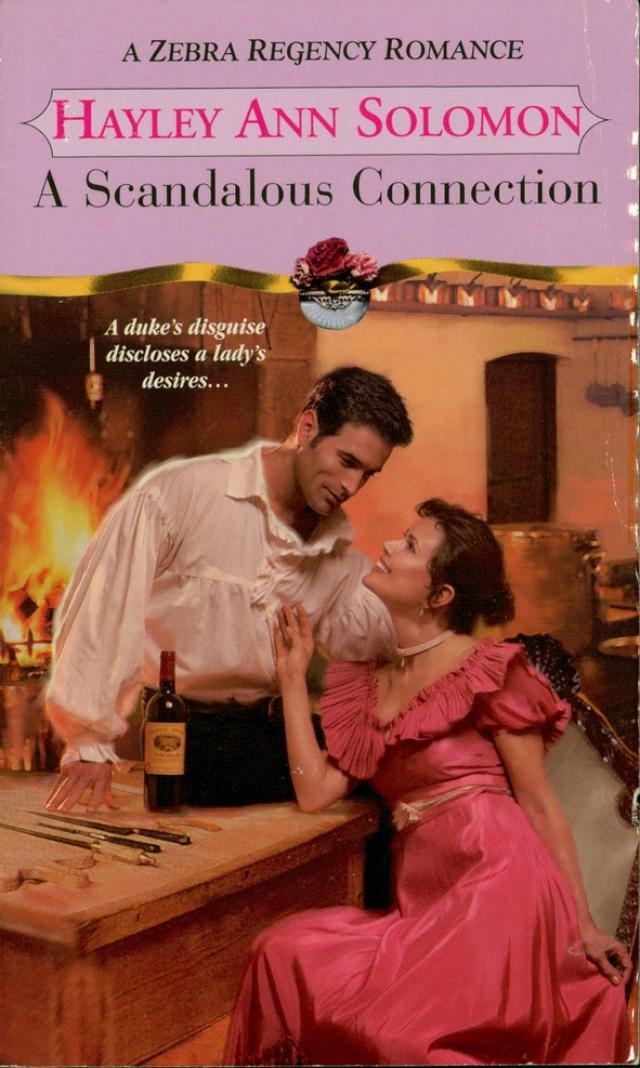


He ducked as Mr. Endicott nearly—very nearly—planted him a facer. He seemed to take no particular offense at this outrage, for he continued on mildly. “I’ve vastly reduced the stables, but I still require several serviceable traveling chaises and they all need teams. Then there are the dratted corn laws . . .”
“Not to mention Caroline’s debut. . . .”
“Yes, but the dear child refuses to allow me to outfit her! She has taken some cockeyed notion into her head that she and Martha can refurbish some of Lady Tryon’s old gowns and nothing I say seems to reverse that opinion!”
He followed up this pronouncement with a swift blow to poor Mr. Endicott’s chest.
“Have her come up to London, then! One turn in a dowdy bonnet should quickly change her mind.” Thomas sidestepped the next punch, and even went so far as to land quite a notable one of his own. The duke grimaced.
“Quite! Which is precisely why I need funds when she does finally step out.” His right hand maneuvered itself below Mr. Endicott’s skillful defenses.
The thud that ensued caused the honorable Thomas to stop his rather stylish footwork and glare up at the curls, and the familiar aquiline nose, and the wide brow that dripped with perspiration yet nevertheless remained classical and aloof.
“I give up, Demian! I will not fight you in this mood! You are liable to murder me!”
Demian grinned and removed his gloves. “Murder you? Impossible! But I tell you one thing, it will be a blessing if I don’t murder her.”
“Who?”
His Grace tried very hard to be patient with his num-skulled friend.
“Lady Raquel Fortesque-Benton, very soon to become Lady Raquel Radcliffe, duchess of Darris.”
“. . . and marchioness of Hartford and countess of Shrewsbury—”
“Cut line, Thomas!”
But Thomas hadn’t finished. “—and your wife.”
There was a small silence between them.
“I told you you were mad!”
“And I told you I was sane. If there was another way, Tom, I would gladly seize it. The lady is as cold as a fish.”
Now Thomas was shocked.
“Surely not when she is contending with the most skilled lover in all of London—saving myself, of course.” He could not help being flippant, but his eyes lost their twinkle swiftly when he saw the gloom engulfing his noble grace.
“Oh, come, Demian, it can’t be that bad! It is not as if she is an antidote, after all! Why, her hair gleams with pure gold and her lips . . .”
“. . . are like toffee. Clammed shut.”
“You are merely miffed. Come, when she is your wedded wife things will be different.”
“Indeed they will! Then her lips will be perpetually open. Driving me to distraction, no doubt, with her various edicts and points.”
“At least they will be open.” Tom refused to be drawn into the melancholy. His words were laden with just the type of innuendo to lift His Grace from the doldrums. He handed him over a towel and waited for the inevitable chuckle. Finally, grudgingly, it came.
“Oh, you are impossible, Thomas Endicott!”
“Not as impossible as you!” came the ready retort.
“And I still think you are mad! If you are as cross as crabs at the very thought of this alliance, cry off! There is nothing settled, after all!”
“Only a mere matter of a hundred thousand pounds to whistle to the wind. Besides, the deed is done. I proposed this morning.”
“Hence your punishing form in the ring. I begin to understand.”
“Do you? The lady requires cicisbei. It was number eleven—or, no, was it twelve?—on her wretched list.”
“Beg pardon?”
“You heard me right. Cicisbei, and, for your ill-informed mind, that means lovers.”
“I do retain a smattering of Italian, Demian.”
“Good! Then there is no need to translate.”
“Does she have anyone . . . eh . . . current in mind?”
“I assume not. She informs me that she will bide her time until her duty to the line is done.” The duke’s answer was crisp, but the bitterness of tone was unmistakable. Mr. Endicott conceived a sudden dislike to the wench.
“Does she, by God!” His eyes became speculative.
“I believe she deserves a lesson in manners.”
“Shall you be her teacher?” The duke’s question was mildly rhetorical. By now, he had clad himself in a shirt of the finest white lawn—though it had been skillfully darned once or twice—and had only the last intricate knot to achieve in his cravat before stepping out from Gentleman Jackson’s into the mild sunshine outside.
“Do you know, Demian, I believe I shall!” There was mischief in Thomas’s words as he eyed the duke.
The knot remained untied.
“What devilry do you mean, Thomas Tyrone Endicott?”
“Now that would be telling, but I do wager you, Demian, that when you come to wed her you will find her entirely more biddable.”
The duke’s eyes narrowed. “My wife has to be above reproach, Thomas.”
“And she shall be.”
“I find that hard to believe if she is going to spend any length of time in your rakish presence!”
Mr. Endicott scowled and contrived to look hurt. Too bad his blue eyes twinkled outrageously as he leaned forward and completed Demian’s elusive knot.
“True, true, I am sadly irresistible. Nevertheless, my lord, Your Grace”—he stressed this last, for he only ever used Demian’s titles when he was mocking—“she shall remain as pure as snow. You have my word on it.”
Demian nodded. “Then I shall be entirely in your debt, for though it is no doubt churlish of me to admit it, I am hard pressed to continue on with my suit. If Lady Raquel were softer hearted . . .”
“She would bore you to tears in a minute.”
Demian allowed a languid smile to play at his lips. “Very likely! I would also, I suppose, find it hard to be as calculating. The role of fortune hunter sits uneasily upon my shoulders.”
“Lucky they are so broad, then! But it is a fair exchange, and one as old as ages. An illustrious title for an illustrious fortune. Doubtless Lady Raquel has cast the die very carefully. You are really no different from thousands of esteemed peers before you.”
“How salutary! And here I was, imagining, for a whisper of a moment, that I might be something very different indeed.”
“And now you grow whimsical! I suppose, you beast, you want me to outline all your virtues extraordinaire! Well, I shan’t do it. You may drive to an inch and have the very devil’s own graces, but you shan’t put me to the trouble extolling them!”
“Thank God for that!” Lord Darris regained some of his usual composure and grinned. By the time they had greeted several well-heeled gentlemen and walked the length of the long, well-polished floor, he was feeling decidedly more cheerful.
“Shall I expect an announcement in the Gazette?”
“Good heavens, no! I haven’t approached the father yet.”
Thomas raised his brows a fraction. “Whyever not?” “He is with Lord Sefton’s men at Versailles. I shall approach him directly on his return.” His tone became a little wry. “I don’t anticipate opposition.”
“Lord, I should say not!”
“In the meanwhile, Lady Raquel desires to review Darris Castle.”
“How appalling!”
“Quite. The place is like a mausoleum and as drafty as hell.”
“Can it not be made a trifle cheerier?”
“Caro does her best. We live very cozily in the west wing, but I doubt that ‘coziness’ is exactly in Lady Raquel’s style.”
“Lady Raquel needs a hearty awakening, by the sound of things.”
“Quite possibly. Are you volunteering that, too?”
Of a sudden, Thomas grinned.
“I can but try, my dear Demian! I am in your debt for ten gold guineas, I believe.”
“Are you?”
“Indeed I am, for I forgot to tell you that that hamstrung bony beast out at Winsham came first in all his races. You were right, of course, though how you should be has me in a puzzle. You wagered me ten to one that the animal would show his paces.”
“Did I? Lucky thing he won, then, for I have no recollection of it and certainly not a sovereign to spare!” His Grace’s tone was dry.
“Well, now you have ten, though that is purely hypothetical, my good man, for I shall keep them.”
“Shall you?” Amusement crept into the shadows of Demian’s dark eyes.
“Yes, you wretch, it shall be my payment for escorting Lady Raquel out to Darris. Included in the charge will be that lady’s hearty awakening. Mark my words, she will be as meek as milk when she arrives.”
“Ha! You have not yet had an audience with the lady. You had rather give me my ten sovereigns immediately, for undoubtedly you shall fail.”
“Fail? Me? Is that a challenge, Demian?”
“Oh, God rot you, I suppose it is!”
Mr. Thomas Endicott grinned.
Three
It was, unfortunately, several days later that a certain cream-colored wafer was brought to Demian’s attention. It was unusual for the duke’s secretary to make so careless an error, but truly the wafer was so crumpled the seal was hardly visible. His Grace had borne such an air of distraction the last few days that poor Mr. Monteforte had decided to hold back on all but the most urgent of his correspondence.
Upon reading the letter, however, the duke’s unusual lethargy seemed to be shaken. Without berating his excellent secretary in the least, he nevertheless murmured that anything, in the future, from Lady Caroline, should receive the most immediate of attention. Then, with an engaging apology to Mr. Monteforte—who would be required to cancel all the most pressing of his engagements—he alerted what staff remained in his service to the fact that he would be returning to his principal seat at Darris. Such an action may have seemed extraordinary in light of the fact that he had only just arrived in London some few days earlier, but the duke’s servants were all quite used to his “queer starts” and cheerfully began packing an array of valises that would require at least three of His Grace’s lesser barouches to convey.
Fortunately, His Grace did not trouble himself about such matters, for he had learned that it was useless to protest to his valet, who had the very severest notions regarding what was wanting to his dignity and consequence. Instead, he permitted his household to subject themselves to a veritable frenzy of activity—for which he could see no just cause in the least—and saddled up Season’s Glory, his latest—and rather extravagant—purchase from Tattersall’s. Still, he had sold off most of the stables—much to the glaring disapproval of the head groom—and thus felt reasonably conscience easy with regard to the great black beast who stood, coat gleaming, on the cobbled flag way.
“My lord cannot be thinking of riding to Darris?” The groom, newer than the rest of the staff, and therefore not acquainted with the duke’s headstrong ways, sounded a trifle incredulous.
Demian smiled perfunctorily, for he was always punctiliously charming to his staff, and nodded. “Indeed, I am, so I beg you to fasten the girth a little more tightly, and take heed of the stallion’s head. I believe he is a little frisky this morning.”
This, of course, was an understatement, for Season’s Glory was straining at the bit for a good gallop and sensed, in his master, a similar sentiment. The air was crisp and deliciously fresh, a matter of some relief to Demian, who had no wish to be caught in incipient snows. Though he had not the slightest notion what the meaning behind his sister’s garbled message to him might be, all warning bells had been alerted at the very first phrase. As for “Do not—I repeat—do not come home till Sunday next,” the very sentence filled him with such foreboding that he considered it a matter of first importance that he return immediately. This conviction was even stronger when read together with “I have a perfectly clever plan up my sleeve,” and caused him to be thankful that he had, indeed, succumbed to temptation and bought Season’s Glory, undoubtedly the only horse in his current mangy stable capable of undertaking such a journey. Even so, what with resting the animal at various stages along the way, he doubted whether he would reach his destination in time for dinner, much less in time to avert any impending catastrophe Caro’s words might be portending. He could but try, however, and with his own state of affairs in anything but a blissful state, the ride, at least, would do him a world of good.
It did not take very long before he was trotting steadily down the countryside, frowning a little at instances of bad husbandry or cottages in evident disrepair. His frown cleared, however, when he reached the southernmost borders of Darris, for there, the lands seemed greener—due, he believed, to a radical new irrigation scheme that only this year seemed to be showing its rewards, as well as another the practice he insisted upon using—leaving one meadow in four fallow throughout the year. All the corn had been reaped for the period, but he noted with satisfaction that the lands had been sowed and that smoke was billowing steadily from the mill, where corn and wheat were being crushed to powder even in these winter months. Several dozen sheep grazed on the higher pastures like little, round cumulus clouds overlooking Darris and its southwestern border with Monmouth. These had been introduced by way of experiment, and appeared, at a glance, to be one of his more inspired ideas. Certainly, they were looking gratifyingly fat, and if only Caro hadn’t been secretly feeding them from his grain stores, he would be satisfied. There was not much else to be done with such hilly land, for pulling a plow had proven an impossible task.
The duke sighed as Season’s Glory responded to his bit and turned toward home. He would see no profit from all the year’s hard toil, though indeed he could insist upon the receipts if he so desired—but the income would insure that in the future Darris would be self supporting enough not to present any further drain on his limited resources. For if the duke had one fault, it was that of kindheartedness. He would spend his own fortune recklessly if his tenants required it. And in the last four years they had, for the fourth duke of Darris had been sadly improvident. This year, however, His Grace’s dwindling cash resources need not be drawn upon. Darris, the marquisate of Hartford and the earldom of Shrewsbury were all in satisfactory repair, save for the roofs that needed rethatching and the woodpiles that needed stocking across the breadth of his lands.
It was dusk when he detected the huge stone gates of Darris Castle. He murmured politely to the sentry, who had been posted at the entrance for upward of fifty years, by the third duke of Darris, and who was now pensioned off. Nevertheless, despite all remonstrations to the contrary, he preferred to spend his days guarding the portals of the ancient—and decidedly drafty—principal seat. His toothless grin and creaking bow were a comical mixture of the cheeky, the cheerful and the respectful. Demian could never decide in which proportion.
“Evenin’ Yer Grace! ’E be a hearty beast, I’m asure!”
“Season’s Glory? A splendid animal, Carlew! And how are the chilblains?”
“Ah, Yer Grace, sure an’ I ’aven’t cockled up me toes yet, I ‘aven’t, though like as not with all this openin’ and closin’ of them gates wot I don’t hold with, pleasin’ yer ’onor, the gout will strike me yet.”
Even as the duke tut-tutted sympathetically, his sharp wits focused on the ominous portent of the man’s words.
“Opening and closing? There should not be much carriage traffic with just Lady Caro in residence.”
There came a sharp snort in response, followed by a rubbing of hands and an eager spark to the old man’s crusty dark eyes. “ ’Ad ’alf of Lunnin in ’ere today, I did, must ‘ave been five coaches or more rollin’ up, and none of them no gentry folk neither, that’s wot I say! All merchants and milliners and wot have yew.”
The duke’s eyes twinkled. He did not consider five carriage loads half of London, no matter what his esteemed sentry regarded it. And if Caroline had finally come to her senses regarding what was required for her upcoming season, he supposed he should only be grateful. Perhaps his haste in returning to Darris had been unfounded. All seemed perfectly normal, though his eagle eyes detected that the manse had undergone a certain degree of sprucing, for the topiary gardens had been restored and the flagstones were all gleaming. Even the huge statues of Venus and Androcles at the entrance seemed whiter than he remembered. Still, he supposed, that was no cause for alarm.
His complacency would have been shattered, however, had he but seen the flurry of activity within, for apart from seizing several bottles of champagne and burgundy from his cellars, the ladies of the house had gone so far as to turn the kitchens upside down by marching belowstairs personally to oversee the cooking of wild geese, several turkeys and the delicate brewing of mussel and oyster sauce. Caroline was covered in flour from head to toe, for she had been kneading dough and tammying broth when the scullery maid had come hurtling past with a great bag of newly milled flour. As she turned, the bag had collided with her hooped skirts, causing great quantities of white powder to waft about her in clouds. Fortunately, her ladyship seemed to find the matter rather humorous, for rather than scolding, she had sent the scullery maid out for her brother, and urged the two most earnestly to fish in the duke’s ponds for the largest trout they could manage.
“And that,” said Caro triumphantly, “should get rid of dear Betty for a few hours at least!” Betty was one of the neighboring crofter’s daughters, newly in service, and a notorious butterfingers. It was considered a decided advantage to have her out of the house, rather than within, especially as the Sevres china was even now lying in great sinks of steaming water, ready to be dried. Demian would not be pleased if the valuable Darris tableware was shattered, no matter how excellent the cause.
Now he peered past Carlew and was startled to catch a glimpse of two liveried house servants settled neatly with fishing rods at the rim of his seventeenth-century ornamental pond. He raised his brows quizzically.