Coco at the Ritz, page 27


These revelations of Chanel’s seeming willingness to do business with the enemy and her apparent refusal to go on record to save a Jewish friend raised serious questions about her loyalties and character. Was she a collaborator, and, if so, what was the nature of her collaboration? Since she left behind no memoir, letters, or diaries that might offer clues to her interior life, her motivations were accessible only imaginatively.
The Occupation offered a stark contrast between good and evil, yet few people were either heroes of resistance or villains of collaboration. Most citizens, as the writer André Gide noted, were like old shoes floating in murky waters: battered and torn, riding the turbulent flow, just trying to survive. It’s impossible to discern to what extent, if any, Chanel supported Nazi ideology. She is on record making anti-Semitic remarks, but like most of the world, she almost certainly didn’t know (or didn’t want to know) about the death camps until the end of the war.
For many years in France after the end of World War II, the Occupation remained a raw, agonizing wound. Women who’d had relations with German soldiers were reviled pariahs shunned by their neighbors and even their own families. Chanel remained in exile for ten years, living on and off with her Nazi boyfriend, Spatz von Dincklage, who, having escaped arrest and prosecution, joined her in Switzerland at the war’s end. The couple parted amicably in the early 1950s. Spatz moved to an island off the coast of Spain, where, supported by a trust set up by Chanel, he passed the time painting nudes. Chanel returned to Paris in 1954 to reopen her fashion house. Her countrymen weren’t quick to forgive her recent past, and French journalists panned her first postwar collection. Americans, though, who were largely ignorant of Chanel’s personal life and still revered her as the personification of French style, hailed her return as the second coming of the fashion messiah.
Fifty-seven years later, in his 2011 book, Sleeping with the Enemy, journalist Hal Vaughan published the contents of declassified intelligence documents that revealed Chanel’s wartime activities. Executives at corporate Chanel were quick to deny Vaughan’s charge that their founder had been a German spy recruited by her lover. The documents were real, yet the exact details of the schemes they revealed, including Chanel’s efforts to safeguard her assets, and Modellhut, the harebrained plot she cooked up with Spatz to negotiate a separate peace, were hazy. To this day, Chanel’s official bio on the company’s website makes no mention of Spatz; the years 1940 to 1944 are mostly ignored on the timeline of her life. In Chanel Inc.’s many extravagant promotional films, including those starring Geraldine Chaplin as the mature Chanel and Keira Knightley and Kristen Stewart as young Coco, there is only one reference to Spatz. In Once and Forever, an eleven-minute fictional film directed by Karl Lagerfeld in 2015 about the supposed making of a Chanel biopic, Stewart’s character asks, “What about Spatz? Is he going to be in the movie?… It’s probably one of the most important aspects of her life.” The actor playing the imaginary film’s producer answers, “We will only cover the years of happiness and success.”
After all, the several-billion-dollar Chanel brand thrives on the sense of chic its handbags, perfume, sunglasses, clothes, lipstick, and other products confer on women. No one understood better than Chanel herself that fashion is a form of escapism, “the most intoxicating release from the banality of the world,” as the legendary magazine editor Diana Vreeland put it. Chanel strove vigorously to hide the ugly aspects of her life, even going so far as to bribe people who knew her darkest secrets. Nazi intelligence chief Walter Schellenberg was one. Chanel paid his medical expenses when he was suffering from cancer and then paid for his funeral. Schellenberg’s posthumously published memoir, The Labyrinth, makes no mention of Chanel or Modellhut, which he authorized.
In a way, Chanel’s story epitomizes the treachery of France during World War II. She’s a kind of anti-Marianne, the symbol of French liberty, equality, and fraternity. In writing my book, however, I was mostly interested in exploring Chanel’s particular sensibility. At its heart, Coco at the Ritz is a story about the choices one woman made when the stakes were at their highest, why she made them, and the consequences to those around her. In today’s world, at a time when anti-Semitism, right-wing extremism, anti-immigrant violence, and hatred in general have exploded anew, I hope my novel can be read as a cautionary tale about the necessity of standing against evil when it stares you—seductively—in the face.
ACKNOWLEDGMENTS
My obsession with the story told in these pages stretches back so many years that it would be impossible to thank everyone who helped me understand it, flesh out its details and unlock its mysteries.
That I found a way to tell it at all seems a miracle, and I’m grateful to Jessica Case at Pegasus for guiding the book into print. Thank you to Molly von Borstel for designing a stunning cover, to Andrea Monagle for her thoughtful, careful copyediting, to Maria Fernandez for the book’s interior design, and to April Roberts for her work on publicity.
I’m fortunate to have Flip Brophy as my agent, and I’m deeply thankful for her support, patience, friendship, and wise counsel.
Though most of the dialogue in the novel is invented, the character Coco Chanel sometimes says things her real-life counterpart reportedly said, according to articles, web sites, and books. The quoted snippets of Max Jacob’s poetry are authentic. Letters, newspaper stories, and other documents that figure in the novel are largely based on real records.
Following is a partial list of the books I found invaluable: Jean Cocteau: A Life by Claude Arnaud; Coco Chanel: An Intimate Life by Lisa Chaney; Mademoiselle: Coco Chanel and the Pulse of History by Rhonda K. Garelick; Misia: The Life of Misia Sert by Arthur Gold and Robert Fizdale; Coco Chanel by Marcel Haedrich; Selected Poems of Max Jacob by Max Jacob; The Cost of Courage by Charles Kaiser; The Secret of Chanel No, 5: The Intimate History of the World’s Most Famous Perfume by Tilar Mazzeo; The Allure of Chanel by Paul Morand; Chronicles of Wasted Time by Malcolm Muggeridge; Picasso: A Biography by Patrick O’Brian; Vichy France: Old Guard and New Order 1940–1944 by Robert O. Paxton; Coco Chanel: The Legend and the Life by Justine Picardie; A Life of Picasso: The Triumphant Years 1917-1932 by John Richardson; And the Show Went On: Cultural Life in Nazi-Occupied Paris by Alan Riding; When Paris Went Dark: The City of Light Under German Occupation by Ronald C. Rosbottom; Chanel by Edmonde Charles-Roux; Sleeping with the Enemy by Hal Vaughan; Fashion Under the Occupation by Dominique Veillon; Shorn Women: Gender and Punishment in Liberation France by Fabrice Virgili; Max Jacob: A Life in Arts and Letters by Rosanna Warren.
Thank you also to Judith Sternlight, who read early drafts of Coco at the Ritz and provided crucial insights; James Bohnen, who taught me how to write a play, parts of which found their way into this narrative; and my dear friends Jonathan Rabb, Dinitia Smith, and Christine Sneed, brilliant novelists themselves. Jonathan gave me expert advice on structure and point of view. Dinitia and Christine read the book with incisive rigor and made many important suggestions.
I couldn’t get through writing a book without my posse of forever friends: Jonathan Black, Maureen Dowd, Ted Fishman, Brenda Fowler, Victoria Lautman, Trish Lear (another talented writer who read an early draft), Ann and Phil Ponce, Kaarina Salovaara, Julie Shelton, Rachel Shteir, Sara Stern, and Monica Vachher.
Finally, and most profoundly, thank you to my husband, Richard Babcock, and our son, Joe, for everything. You are my life.
ABOUT THE AUTHOR
GIOIA DILIBERTO has written biographies of Jane Addams, Hadley Hemingway, Diane von Furstenberg, and Brenda Frazier, as well as the critically acclaimed novels I am Madame X and The Collection. Her books, which center on the lives of women, have been translated into several languages. As a journalist, Gioia has contributed to many publications, including the New York Times, the Wall Street Journal, the Los Angeles Times, the Chicago Tribune, Smithsonian, and Vanity Fair. She also teaches writing and has taught at DePaul and Northwestern Universities and the Savannah College of Art and Design. Gioia lives with her husband in Woodbury, Connecticut.
ALSO BY GIOIA DILIBERTO
FICTION
I Am Madame X
The Collection
NONFICTION
Diane von Furstenberg: A Life Unwrapped
Paris Without End
A Useful Woman: The Early Life of Jane Addams
Debutante: The Story of Brenda Frazier
COCO AT THE RITZ
Pegasus Books, Ltd.
148 West 37th Street, 13th Floor
New York, NY 10018
Copyright © 2021 by Gioia Diliberto
First Pegasus Books edition December 2021
Interior design by Maria Fernandez
Cover design: Faceout Studio, Molly von Borstel
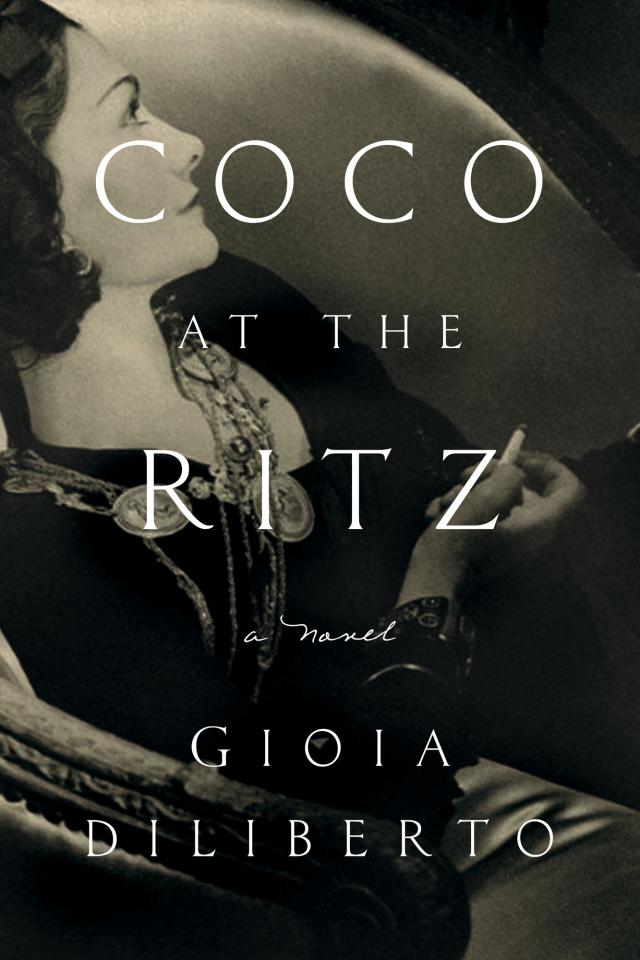
Cover imagery: Horst P. Horst, Coco Chanel, Museum für Kunst und Gewerbe Hamburg
Author photo: Stephanie Krell
Jacket imagery: Shutterstock
All rights reserved. No part of this book may be reproduced in whole or in part without written permission from the publisher, except by reviewers who may quote brief excerpts in connection with a review in a newspaper, magazine, or electronic publication; nor may any part of this book be reproduced, stored in a retrieval system, or transmitted in any form or by any means electronic, mechanical, photocopying, recording, or other, without written permission from the publisher.
Library of Congress Cataloging-in-Publication Data is available.
ISBN: 978-1-64313-841-1
Ebook ISBN: 978-1-64313-842-8
Distributed by Simon & Schuster
www.pegasusbooks.com
Gioia Diliberto, Coco at the Ritz