The Spitting Cobra, page 11


lapis lazuli A deep blue semi-precious stone that the Egyptians valued highly. It wasn’t found in Egypt, but had to be imported from modern-day Afghanistan.
limestone Along with sandstone, this was a rock commonly found in Egypt and used to build the many temples (but not houses, which were made of mud brick).
Medjay Originally a Nubian people from the south. Many Medjay joined the Egyptian army and police force, so that by the New Kingdom, the police force itself was called ‘the Medjay’. The Medjay was used to guard the village of Set Maat.
mortuary temple There were two kinds of temple in ancient Egypt. Cult temples were for the worship of a particular god or gods, while mortuary temples were for the worship of a king after his death. Mortuary temples were mostly found on the west bank – the Kingdom of the Dead.
Next World The place ancient Egyptians believed they would go after death. It would be better than this world, of course, but quite similar – which was why they needed to take their bodies and many possessions with them.
Nile flood Also called the ‘inundation’. Every year, the Nile river flooded, covering the fields with rich black silt. When the waters went down again, the farmers could plant their seed.
ostracon (pl. ostraca) A small piece of pottery or a flake of limestone used as ‘scrap paper’ for writing on.
papyrus A kind of reed that used to grow in the marshes alongside the Nile. It was made into many things – mats, baskets, sandals and even boats – but it is most famous for the flat sheets of ‘paper’ made from it, which are named after the reed.
perfume cone Pictures on the walls of tombs show women wearing rounded cones on their heads at parties. It’s thought that these were made of a kind of scented fat, which would melt on to their wigs and fill the room with perfume.
pharaoh The ancient Egyptian term for their king. It was only used by the Egyptians themselves in the later stages of their history, but we now use it to refer to any ancient Egyptian king.
Red Land The desert, the land of the dangerous god Seth. It was greatly feared by the Egyptians because it was impossible to live there.
red ochre A red-coloured clay that the Egyptians ground up to make lipstick and blusher. They probably mixed it with oil or fat to put on their lips.
sam-plant A plant that is mentioned in an ancient Egyptian cure for snake bites. It is hard to work out exactly which plant they meant, so we use their own name for it.
sarcophagus A big stone coffin. A smaller wooden coffin was often put inside.
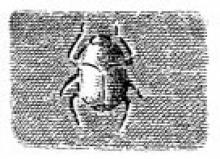
scarab A kind of dung beetle that was worshipped by the Egyptians. Scarab amulets were thought to give great protection. The scarab was the creature of the god Khepri (see the Gods and Goddesses section).
spiny-tailed lizard A kind of lizard that lives in the deserts of Egypt.
Temples of a Million Years Another name for the mortuary temples on the west bank of the Nile.
tomb-chapel The little chapels that were built over a person’s tomb, especially at Set Maat, where relatives could visit, pray and make offerings.
vizier The ancient Egyptian kings’ second in command, who often presided over important trials.
Gill Harvey, The Spitting Cobra