The Spitting Cobra, page 10


The priest beckoned them, and they shyly stepped forward to stand at his side. He put an arm around each of them. ‘I have worked in the tombs with Seti, and Tiya has entertained us at many of our parties,’ he carried on. ‘This is a close community. I was sad when Tiya broke her arm – and concerned when Seti started to seek out cobras. But I was very interested to discover Hopi’s remarkable gift, which he willingly used to help Seti. Unfortunately Seti did not follow Hopi’s advice; the goddess showed her displeasure and Seti was blinded. But only briefly, for Hopi once more used his gift – this time to save Seti’s sight.’
‘But why?’ asked Paneb. ‘Why would your goddess do this?’
‘I have thought about this,’ said Rahotep. ‘As you know, our gods often reveal themselves in riddles. Seti, perhaps, has been a symbol for our village. We have all been blinded, in a sense. Blinded to the evil among us. It was Isis and Hopi who discovered the open tunnel to the tomb, and they who discovered who had built it. It was their discoveries that opened our eyes . . . just as Hopi opened Seti’s.’
‘Well, well,’ said Paneb. He gave a rueful smile. ‘Our visits are not usually so eventful.’
‘This one was destined to be so,’ said Nakht. ‘We . . .’ he corrected himself, ‘I planned a party in the hope that we would discover the robbers. The plan succeeded, but not in the way I expected. I must thank you, even if it is with sorrow in my heart, for Foreman Baki is my oldest friend.’ He sighed heavily. ‘And now you must return to Waset. I have doubled your payment for the role your troupe has played. May the gods travel with you. Farewell.’
Nefert and Paneb were clearly delighted, but tried not to show it. Nakht turned and left, his head bowed.
‘You must be getting on your way,’ said Rahotep. ‘But before you leave, I have something to give Hopi. Khonsu, you are a scribe. Would you bring me a piece of papyrus, and one of your writing sets?’
Khonsu did as he asked, and with everyone watching, Rahotep quickly wrote a letter in the hieratic script. He allowed the ink to dry, then rolled up the papyrus and handed it to Hopi.
‘It is a letter of introduction,’ said Rahotep. ‘Take it to Menna, on the eastern fringes of Waset. He is the greatest priest of Serqet in the town, and I know he seeks an apprentice. We are old friends, and I have written to him of your gift. He will be only too glad to accept you.’
.
Hopi felt as though he were walking on a cloud. For once, he barely noticed his bad leg, because his heart was bursting with happiness. As they drew closer to the River Nile, he gazed at the town of Waset eagerly. He could hardly wait to get there, and get started. An apprentice! So he had a future, after all . . . and a future that involved his favourite creatures. It was incredible.
‘Well done, Hopi,’ said a quiet voice at his side. It was Mut.
‘Oh, thank you, Mut,’ he said. ‘I still can’t believe it, to be honest.’
‘I can. You rescued me from the scorpion. You’ll make a great priest of Serqet,’ she said.
‘That was nothing.’ Hopi grinned.
‘I didn’t think so.’ Mut’s voice was grave. ‘I was terrified.’
Hopi looked at Mut, and saw that she seemed a little nervous. ‘Well, it’s all over now,’ he said.
‘Not quite,’ said Mut. ‘There’s something else.’
Hopi raised his eyebrows. ‘And what’s that?’
Mut chewed a nail. ‘I have to apologise to Isis.’
Isis was up ahead, leading Happy the donkey with Ramose and Kha on board. Hopi guessed she’d been avoiding Mut. ‘And is that terrifying, too?’
Mut nodded.
Hopi laughed. He knew Isis inside out. The moment she heard an apology, she’d melt.
‘How about I come with you?’ he offered.
Mut’s shoulders relaxed. ‘Yes, please,’ she whispered.
‘Right,’ said Hopi, ‘let’s go.’
.
CAST OF CHARACTERS
Chronicle Characters
Hopi The thirteen-year-old brother of Isis. Ever since surviving the bite of a crocodile in the attack that killed their parents, Hopi has had a fascination with dangerous creatures, particularly snakes and scorpions.
Isis The eleven-year-old sister of Hopi. She is a talented dancer and performs regularly with Nefert and Paneb’s troupe. Her dance partner is Mut.
Mut The eleven-year-old daughter of Paneb and Nefert, and dance partner to Isis.
Paneb Husband of Nefert, father of Mut, Ramose and Kha, and the head of the household where Isis and Hopi live. He organises bookings for the dance and music troupe.
Nefert Wife of Paneb, mother of Mut, Ramose and Kha, and sister of Sheri and Kia. She plays the lute and is head of the dance and music troupe.
Sheri One of Nefert’s widowed sisters, and a musician in the troupe. She has a particularly loving nature.
Kia The second of Nefert’s widowed sisters, also a musician living with the troupe. She is slightly more cold and distant than Sheri, but is hardworking and practical.
Ramose Eldest son of Nefert and Paneb, aged five. Mut’s brother.
Kha Younger son of Nefert and Paneb, aged two. Mut’s brother.
Menna A priest of Serqet in the town of Waset. (A priest of Serqet was someone who treated snake bites and scorpion stings.)
.
Other Characters in This Story
Nakht One of the two foremen who supervise the work in the royal tombs. Each foreman has his own team of workers. Nakht is also a village elder of Set Maat.
Baki The second of the two foremen, and a village elder.
Khonsu The principal scribe for the work in the royal tombs, who makes a note of the workers’ attendance and equipment. A village elder, widowed.
Seti A young painter who has just finished his apprenticeship in the royal tombs.
Rahotep The village priest of Serqet in Set Maat, who treats snake bites and the stings of scorpions. He also works as a draughtsman in the royal tombs.
Heria The twelve-year-old daughter of Khonsu.
Tiya One of the village dancers of Set Maat, and Heria’s friend.
.
.
FASCINATING FACT FILE ABOUT ANCIENT EGYPT
The World of Isis and Hopi
The stories of Isis and Hopi are based in ancient Egypt over 3,000 years ago, during a time known as the New Kingdom. They happen around 1200–1150 BC, in the last great period of Egyptian history. This is about a thousand years after the Old Kingdom, when the pyramids were built. Waset, the town in which Isis and Hopi live, had recently been the capital of Egypt, with an enormous temple complex dedicated to the god Amun. By 1200 BC, the capital had been moved further north again, but Waset was still very important. Kings were still buried in the Valley of the Kings on the west bank, and the priests of Amun were rich and powerful. Today, Waset is known as Luxor; in books about ancient Egypt, it is often referred to by the Greek name of Thebes.
.
A Little Bit About Cobras
Cobras are easily recognised because of their habit of rearing up and spreading their ‘hoods’. The cobra found by Hopi and Seti is a red spitting cobra, the only kind of spitting cobra that exists in Egypt today. The cobra’s colouring varies. In Egypt it is generally olive brown, with a dark patch below the eye, but south of Egypt (in Kenya, for example), it tends to be red, which is how it got its name. When threatened, spitting cobras squirt a stream of venom at their victim’s eyes. Hopi did exactly the right thing by throwing liquid into Seti’s face. If the venom is not washed out, it damages the cornea and the person can go blind.
I chose this snake because of the villagers’ beliefs about Meretseger. There are accounts of people pleading with the cobra goddess to restore their sight, having been struck blind. Eye complaints were common in ancient Egypt, but it occurred to me that there might have been spitting cobras around the village. In fact, though, red spitting cobras tend to live in semi-arid areas where there is some vegetation, so on the whole they would be found closer to the Nile.
As well as spitting cobras, there would have been plenty of Egyptian cobras in the area. These snakes were greatly feared. They don’t spit, but they bite, and their venom is deadly.
In case you’re wondering, the snake found by Hopi at the beginning of the book is a diadem snake that feeds mostly on rodents. Diadem snakes are perfectly harmless to humans. Today, some people keep them as pets.
There were a number of cobra goddesses in ancient Egypt. As well as Meretseger and Renenutet, who are both mentioned in the story, there was Wadjet, the goddess who protected Lower Egypt (the Delta area and the north). Nekhbet, a vulture goddess, protected Upper Egypt, so this is why there was always a cobra and a vulture on the crowns of Egyptian kings.
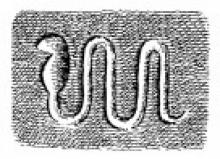
Several hieroglyphs are based on cobras. There’s one of a cobra rearing up with its hood spread out, one rearing up from a basket, one wriggling along the ground, and a number of others.
.
Set Maat and the Great Place
Set Maat (which means the ‘Place of Truth’) and the Great Place still exist today. The ruins of Set Maat, the tomb-builders’ village, are now called Deir el Medina, while the dry desert valley that holds the kings’ tombs is called the Valley of the Kings. The village was created specially as a place for the kings’ craftsmen to live in while they worked on the royal tombs. Ancient Egyptian history spans about 3,000 years, but this village thrived for only 400 of them – very roughly, from 1500–1100 BC, during the New Kingdom. Before and after that, Egypt’s kings lived further north and were buried there, too.
The craftsmen of Set Maat were well paid by the government, so they could afford to live well. If you look at a book about the Valley of the Kings, you can see how beautiful their work was – many of the tombs have survived, along with their amazing paintings. Some of the villagers’ own tombs have also survived. They are smaller, but perhaps more interesting – while royal tombs are covered in formal paintings of the gods, the villagers’ tombs have beautiful, brightly coloured paintings of the life they hoped to live in the Next World.
Probably the most famous tomb built by the villagers is the tomb of Tutankhamun. It is famous because it was discovered in 1922 with many of its treasures intact, including the king’s stunning gold mask. By the time of this story, the boy king was already lying safely in his tomb. Very few Egyptian kings were lucky enough to lie undisturbed for so long.
.
Tomb Robberies in Ancient Egypt
You may be surprised to learn that many tombs were robbed by the ancient Egyptians themselves. Everyone knew that royalty and wealthy people were buried with lots of treasure and, as far back as the Old Kingdom, robbers found a way to steal it. In fact, the reason the Great Place existed at all was to hide the kings’ tombs away from robbers. The kings thought that in this dry, desert valley, tucked away from public view, their rock-cut tombs would be safe.
They were wrong. And what’s a little bit shocking is that even the villagers of Set Maat were involved in some of the robberies. There are several accounts of villagers being put on trial, accused of stealing royal goods; in one case, it seems that a group of thieves from Waset actually murdered a villager who was in on their plot.
At first, robbers targeted private tombs or the tombs of queens and lesser royals, because they were less heavily guarded. In some cases, they broke through the tomb door; in other cases, they tunnelled through the rock, as they do in this story. But it was only a matter of time before gangs of thieves set to work on the kings’ tombs, too.
When the robbers got inside, the tombs were ransacked and their contents hacked to pieces. Furniture was stripped of its gold, sarcophagi were tipped over, and mummies were ripped apart or even burned so that the thieves could take the precious amulets hidden among the wrappings.
Towards the end of the New Kingdom, the priests of Amun in Waset decided to move some of the kings’ bodies, give them a new set of wrappings and hide them outside their tombs to keep them safe. So the mummies of some of Egypt’s most famous kings – Seti I, Ramesses II and III, for example – were actually found jumbled together in a tomb-shaft high in the cliffs, near the mortuary temple of a famous queen called Hatshepsut. What’s also probable, though, is that moving the kings was a good excuse for the priests to open up their tombs and take some of the treasure themselves.
.
GODS AND GODDESSES
Ancient Egyptian religion was very complicated. There wasn’t just one god, but hundreds, each symbolising something different. Many of them were linked to a particular animal or plant. The Egyptians believed that their king or pharaoh was one of the gods, too.
Not everyone worshipped the same gods. It would have been very difficult to worship all of them, because there were so many. Some gods were more important than others, and some places had special gods of their own. People would have had their favourites depending on where they lived and what they did.
These are some of the most important gods of the New Kingdom, and all the special ones that are mentioned in this book.
.
Amun The great god of Waset (Thebes), a creator god and god of the air. When Waset became very powerful in the New Kingdom, he was combined with the sun god Re and became Amun-Re. He was shown with tall feathers on his head, or with a ram’s head.
Anubis The god of mummies and embalming. He was usually shown with a jackal’s head.
Apep The great snake god of darkness, chaos and evil. He was usually shown as an enormous serpent, but sometimes as a crocodile or even a dragon.
Bes A god who was worshipped in people’s homes, rather than at shrines and temples. He was shown as a bearded dwarf, often with his tongue sticking out, and was believed to protect people’s houses, pregnant women and children.
Hathor A goddess of fertility, love, music and dancing. She was usually shown as a cow, or a woman with a cow’s head, or a woman with a cow’s ears and horns.
Horus The falcon-headed king of the gods, who fought and won a battle with his evil uncle Seth. The reigning king of Egypt was believed to be the embodiment of Horus.
Isis The mother of Horus and wife of Osiris, the goddess of motherhood and royal protection. She was associated with the goddess Hathor.
Khepri The scarab god, the god of the rising sun. It was believed that he pushed the sun up every morning in the same way that a scarab pushes its ball of dung.
Khonsu The moon god of Waset, worshipped in the great temple complex there. He was the adopted son of Mut.
Ma’at The goddess of truth and justice, balance and order, who helped to judge people’s hearts after their death.
Meretseger A cobra goddess worshipped by the villagers of Set Maat, who believed that she lived on the mountain behind the village. She was seen as a vengeful goddess who would punish the villagers if they did wrong.
Mut The great mother goddess of Waset, worshipped with Amun and Khonsu. Because Waset is often called Thebes, these three are known as the ‘Theban Triad’.
Osiris Husband of Isis, father of Horus and brother of the evil god Seth. He was the king of the underworld, so he was usually shown as a mummy.
Re (or Ra) The sun god, who travelled across the sky every day in a barque (boat).
Renenutet The cobra goddess of fertility, of nursing children and of the harvest. Farmers in particular would make offerings to her so that she would protect their crops.
Serqet The goddess of scorpions. She was believed to cure the stings and bites of all dangerous creatures like snakes and scorpions.
Seth The brother of Osiris, the god of chaos, evil and the Red Land. He was shown with the head of a strange dog-like creature that has never been identified.
Sobek The ancient Egyptian crocodile god. On the whole, he was feared by the Egyptians, but he was sometimes seen as a god of fertility, too. There were two big cult temples to Sobek – one in the north, and one south of Waset at a place that is now called Kom Ombo.
Tawaret A hippopotamus goddess who protected children and women, particularly during childbirth. Like Bes, Tawaret was worshipped in people’s homes rather than in temples.
Thoth The god of writing and scribes. He was shown as an ibis, or with the head of an ibis.
GLOSSARY
acacia A small, thorny tree. Some types of acacia grow particularly well in dry, desert regions.
alabaster A whitish stone that is quite soft and easily carved. The Egyptians used it to make many beautiful objects.
amulet A lucky charm, worn to protect a person from evil.
Black Land The rich, fertile land close to the Nile, where the ancient Egyptians felt safe. They lived and grew their crops here.
carnelian A reddish stone used by the Egyptians to make jewellery.
cowrie A kind of shell used widely across Africa since ancient times. It has been found in ancient Egyptian tombs and is believed to have symbolised fertility.
emmer wheat The type of wheat that was grown in ancient Egypt. Barley was the other main food crop.
faience A sort of ceramic with a coloured glaze (often blue), used to make jewellery and amulets.
fat-tailed scorpion A very dangerous scorpion that is usually yellow with a wide tail. There is also a black variety. Its sting has been known to kill people.
flax An important Egyptian crop that provided oil (linseed oil) and cloth (linen). The ancient Egyptians made almost all their clothes from linen.
Great Place The ancient Egyptian name for what we now call the Valley of the Kings.
hieratic A shorthand version of hieroglyphics, which simplified the hieroglyphs to make them quicker to write.
hieroglyphics The ancient Egyptian system of picture writing. Each individual picture is called a hieroglyph.
Kingdom of the Dead Generally speaking, the west bank of the Nile was seen as the Kingdom of the Dead because the sun sets to the west.