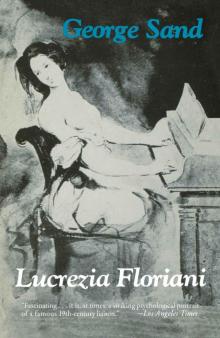
Lucrezia Floriani, page 26


If you insist on it I shall not take long and I shall cause you no surprise, since I have always promised not to. They loved each other a long time and lived very unhappily ever after. Their love was a desperate struggle as to which would consume the other. The only difference between them was that Lucrezia would have liked to modify the character and calm the spirit of Karol so as to make him as happy as anyone else, whereas he would have wished to recreate the being he adored in order to assimilate her to himself so that she should enjoy with him an impossible happiness.
To be sure, if one wished to follow and analyse everything, it would require ten more volumes, one for every year they endured attached to the same chains. These ten volumes could be instructive but would risk becoming even more monotonous than this one. In short, Lucrezia suffered all the injustices of her lover with unbelievable perseverance, and Karol failed to recognise the devotion of his mistress with incredible obstinacy. Nothing could cure him of his jealousy, because it was not in the nature of his passion to enlighten itself and grow mellow. Never was a woman more ardently loved and at the same time more slandered and vilified in the heart of her lover.
She had always asked God to make her meet a soul exclusively devoted to love, like hers was. Her wish was only too well fulfilled; Karol’s love poured over her inexhaustible torrents of love and gall.
What Salvator had predicted for them came true in certain respects. The world discovered Madame Floriani’s retreat and came to greet her there. Her former friends came flocking to her, there were all kinds of them. Boccaferri had his turn and, incidentally, it turned out that Boccaferri was seventy years old. None of them gave the slightest cause for jealousy to Karol, yet all were the object of his mortal jealousy and his irreconcilable aversion. Lucrezia fought bravely to preserve the dignity of those who deserved her consideration; some, with a laugh, she abandoned to Karol’s lashing tongue and others she avoided as best she could. However she did not wish to be cowardly and, in order to humour him, drove away unhappy beings who were worthy of interest or pity. He regarded such things as unpardonable crimes on her part and ten years later when their names came back in conversation he exclaimed with a conviction which would have been comical if it had not been deplorable: ‘I’ll never forget the harm that that man did me!” And all the harm he had done was not to have been shown the door by Lucrezia.
She tried to distract him, make him travel, even leave him for a few brief hours in the year. He trailed his jealousy everywhere, he loathed postilions and innkeepers and never slept a wink when he was travelling for fear that someone was forever about to steal his treasure from him. He threw money about in handfuls, but in love he was miserly to the point of madness. When he was away from Lucrezia for some weeks, devoured by anxiety he fell ill because he did not wish to confide it to anyone and was unable to make its bitterness fall on the one who was innocently causing it. She was compelled to call him back. He regained his health and life as soon as he could make her suffer.
He loved her so much, he was so faithful, so absorbed, so fettered, enchained, he spoke of her with so much respect that it would have been a glory for a vain woman. But Lucrezia did not hate anyone sufficiently to wish him or her that kind of happiness.
He ended by triumphing, as always happens to a will bent on a single goal He brought Lucrezia back to the villa which was still the most secluded place they could find and there he succeeded in isolating her so effectively that people thought she was dead long before she actually was.
She was extinguished like a flame deprived of air. Her torture was slow and without respite. It requires years to destroy with pinpricks a being physically and morally robust. She grew accustomed to everything. No one knew better than she how to renounce the satisfactions of life. She always yielded, even while she appeared to be defending herself, the only thing she would have resisted was caprices which would have made her children unhappy. But Karol, in spite of what he suffered from this division of affection never tried to alienate them for a single moment from their mother. He employed all the self-control he possessed never to let them see that she was the victim and that he assumed over her the right of absolute ownership.
The play was so well acted and Lucrezia was so calm and resigned that nobody suspected her unhappiness. The children had ultimately learned to love the prince, that is, all except Celio, who was polite to him, but avoided speech with him.
Lucrezia, thus reduced to solitary confinement, did not regret the world and her friends. She had left them once to please herself and now she was leaving them again to please another, but still without bitterness. She loved retreat, hard work and country life, devoted herself exclusively to the education of her children and taught Celio dramatic art for which he showed a passionate vocation.
But Karol, finally deprived of subjects for jealousy, now turned his attack to Lucrezia’s ideas, studies and opinions.
He persecuted her politely and gracefully in all things; he did not share her taste or opinion on any subject. Inaction devoured him. Having dedicated all his will power and every moment of his existence to the possession of one woman, he was morally the most ruthless despot, just as physically he was the most vigilant jailer. Poor Lucrezia saw her last consolation poisoned when the spirit of contradiction and the bitterness of childish, irritating controversy pursued her into the purest and most innocent sanctuary of her life.
“She was wrong to consent that Celio should be an actor, it was an infamous occupation. She was wrong to teach Beatrice singing and Stella painting women should not be too artistic. She was wrong to let old Menapace amass money …” In short, she was wrong not to oppose the vocation and instincts of all her family – not to mention that she was wrong to love animals, be fond of scabious, prefer blue to white, etc, etc; whatever she did she was always wrong.
And suddenly Lucrezia Floriani was forty. She was no longer beautiful Despite the fact that she was condemned to an inaction which was inimical to her need for activity, she lost her fullness of figure. Her complexion had become sallow and if not for her beautiful eyes, her distinction and grace and her open and frank smile, she would have been painful to behold – she who had been the most beautiful woman in Italy. As for the prince, the older and uglier he made her, the more seductive did he find her and the more dangerous to other men. He was as much in love with her as on the first day, he could not persuade himself that young men would not fall madly in love with her if by some misfortune they set eyes on her.
Lucrezia suddenly felt weary of being overtaken by the sufferings and infirmities of a premature old age without gathering its fruits, without inspiring confidence in her lover, without winning his esteem, without ceasing to be loved by him like a mistress and not as a friend. She sighed as she told herself that she had striven in vain in her youth to inspire love and in her mature age respect Yet she felt that at these different ages she had deserved what she was looking for. She embraced her children one night and said to them in a tone which startled them in the midst of their habitual serenity: “You are everything to me and if I wish to live a few more years it is for you alone.”
Indeed, she no longer loved Karol. He had filled the measure to overflowing, doubtless with a single drop of water, but the cup was brimming over, the vase that is too full and is compressed must break. Lucrezia remained silent even with Salvator who had finally come to see her without however reconciling himself too cordially with the prince. She felt that she was breaking, but she was brave and refused to believe death imminent. She at least wanted to see Stella married and Celio started on his stage career. The day before she died she made the most beautiful plans imaginable for them; but alas! love was her whole life. In ceasing to love she was to cease to live.
In the morning she went to sit in her father’s cottage. Celio had accompanied her. She appeared better in health because her face had become fuller. She uttered no complaint for fear of worrying her children. She teased Biffi on his Sunday suit. On hearing the lunch bell she got up. All at once she gave a cry, clutched Celio’s shoulder and fell back smiling, on to the same chair where as a little peasant girl she had sat so often with her distaff, spinning flax.
Celio, who by now was twenty-two, had grown into a tall, handsome, strong young man. He lifted his mother in his arms, thinking that she had fainted. In this way he walked towards the park, but as he was about to go through the iron gates he found himself face to face with Karol and Salvator Albani who had just been looking for Lucrezia. Karol did not understand and stood like a statue. But Salvator understood immediately, and coldly, without pity, for he knew that Lucrezia’s death was the result of Karol’s relentless doing, he said in a low voice, pushing him back “Run to the other children. Take them away. It would kill them. Their mother is dead.”
This last word struck Celio to the heart. He looked at his mother’s face and saw that she was indeed dead although her eyes were still open and calm and her mouth was smiling. With the corpse still in his arms he fell in a faint.
Karol saw nothing of what was happening. An hour later he was alone, still standing before the iron gate petrified and dazed. His eyes were staring at a stone which happened to be immediately in front of him and he was reading a verse written on it which time and rain had been unable to erase:
Lasciate ogni speranza, voi ch ‘entrate!
He re-read it and tried to remember in what circumstances he had already seen it. He had lost the power of feeling any grief.
Did he die or did he go mad? It would be too easy to dispose of him thus; I shall say no more about it … unless I am minded to start another novel in which Celio, Stella, the two Salvators, Beatrice, Menapace, Biffi, Tealdo Soavi, Vandoni and even Boccaferri will play their parts around Prince Karol. It is quite enough to kill the principal character, without being compelled to reward, punish or sacrifice all the others, one by one.
George Sand, Lucrezia Floriani