

Complete Works of George Moore, page 1


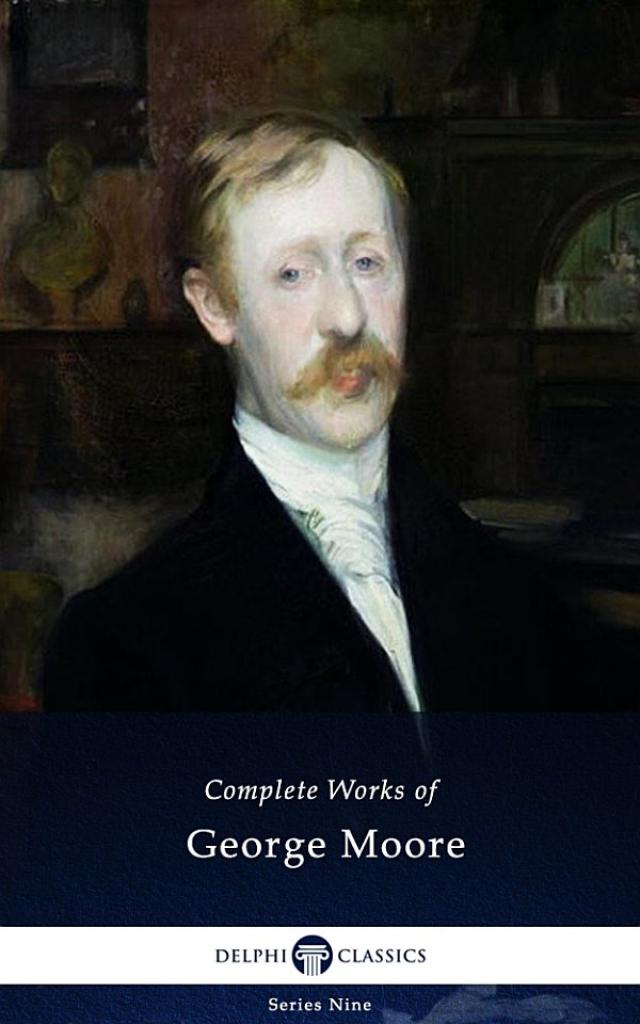
The Complete Works of
GEORGE MOORE
(1852-1933)
Contents
The Novels
A Modern Lover
A Mummer’s Wife
A Drama in Muslin
A Mere Accident
Spring Days
Mike Fletcher
Vain Fortune
Esther Waters
Evelyn Innes
Sister Teresa, 1901 version
Sister Teresa, 1909 version
The Lake
Muslin
The Brook Kerith
Lewis Seymour and Some Women
A Story-Teller’s Holiday
Heloise and Abelard
Ulick and Soracha
Aphrodite in Aulis
The Short Story Collections
Celibates
The Untilled Field
In Single Strictness
Celibate Lives
Uncollected Short Stories
The Short Stories
List of Short Stories in Chronological Order
List of Short Stories in Alphabetical Order
The Plays
The Strike at Arlingford
The Bending of the Bough
Diarmuid and Grania
The Poetry
Flowers of Passion
The Non-Fiction
Modern Painting
Preface to ‘Piping Hot!’ by Émile Zola
The Memoirs
Confessions of a Young Man
Memoirs of My Dead Life
Hail and Farewell
The Delphi Classics Catalogue
© Delphi Classics 2018
Version 1
Browse our Main Series
Browse our Ancient Classics
Browse our Poets
Browse our Art eBooks
Browse our Classical Music series
The Complete Works of
GEORGE MOORE
with introductions by Gill Rossini
www.gillrossini.com
By Delphi Classics, 2018
COPYRIGHT
Complete Works of George Moore
First published in the United Kingdom in 2018 by Delphi Classics.
© Delphi Classics, 2018.
All rights reserved. No part of this publication may be reproduced, stored in a retrieval system, or transmitted, in any form or by any means, without the prior permission in writing of the publisher, nor be otherwise circulated in any form other than that in which it is published.
ISBN: 978 1 78656 104 6
Delphi Classics
is an imprint of
Delphi Publishing Ltd
Hastings, East Sussex
United Kingdom
Contact: sales@delphiclassics.com
www.delphiclassics.com
Parts Edition Now Available!
Love reading George Moore?
Did you know you can now purchase the Delphi Classics Parts Edition of this author and enjoy all the novels, plays, non-fiction books and other works as individual eBooks? Now, you can select and read individual novels etc. and know precisely where you are in an eBook. You will also be able to manage space better on your eReading devices.
The Parts Edition is only available direct from the Delphi Classics website.
For more information about this exciting new format and to try free Parts Edition downloads, please visit this link.
Explore Edwardian literature with Delphi Classics
For the first time in digital publishing history, Delphi Classics is proud to present the complete works of these important authors.
Explore Edwardian era authors
The Novels
The ruins of Moore Hall, abandoned after being burnt down by the IRA in 1923 — Moore’s birthplace. George Moore’s family had lived in Moore Hall, near Lough Carra, County Mayo, for almost a century.
Lough Carra, a limestone lake of 4,000 acres, eight miles south of Castlebar. The lough was part of the estate of the well-known Moore family of Moore Hall.
A Modern Lover
Moore’s first novel was published to positive reviews in 1883 by William Tinsley, although it had previously been rejected by Bentley and Sons. Despite the action taking place largely in London, it is a fascinating insight into Moore’s years as a resident in Paris and in that sense, it is semi-autobiographical. The novel is regarded as the first published English novel directly influenced by the traditions of French realism and it triggered a fashion for looking to France for narrative style. Indeed, Moore himself claimed to have been influenced by Balzac, Zola and Goncourt when writing the novel. Lewis Seymour, “hero” of A Modern Lover and Lucien Rubempre, hero of Balzac’s Les Illusions Perdue, bear strong similarities, both having stunning good looks, patronesses and similar choices of work. Moore was “inspired” by Zola (La Curée) when it came to other aspects of Lewis’ personality.
Structurally, too, Moore emulates the ebb and flow of French realistic novels, drawing in and out of the detail of a scene as the narrative builds to a crescendo – the ballroom episode is a good example of this technique. Zola’s influence is also seen in Moore’s close attention to colour, the nuances of light and the human senses, especially scent. It is little surprise then, that Moore has been described by the academic Anna Robins as “Zola’s English disciple”.
Also during Moore’s fifteen year sojourn in Paris, he cultivated his lifelong interest in the French Impressionists. Art historians have studied Moore’s autobiographical references in this novel – his meetings and conversations with the artists and descriptions of paintings he viewed at the Impressionist exhibitions of 1877, 1879 and 1882. He used his personal experiences, stories and gossip he overheard in the Parisian cafes, to create the “Moderns”, a school of artists based on Impressionists such as Cézanne, Degas and Monet. One of the closest portraits is Thompson, in the novel a Scotsman with a red beard, but modelled in many ways on Édouard Manet. The novel could be used in parallel with the memoir Confessions of a Young Man, to give a more rounded picture of the artistic life in Paris at that time.
Modern Lover was regarded as having immoral content by two of the leading circulating libraries, Mudies and Smiths, and was withdrawn from their stock, lest their readers complain about what would now be seen as rather tame expressions of affection in the story. Moore was infuriated that his book had been relegated to the status of an “under the counter” book, only handed out to borrowers that specifically requested it and that a total of only fifty copies were in circulation in the lending libraries as a whole.
Moore rewrote the story as Lewis Seymour and Some Women, published by Heinemann in 1917, although it would seem he was not entirely happy with the revision. In a letter to Edmund Gosse in March 1917, he wrote “To weed a garden so thoroughly that no weed is left behind is impossible and the reviser of an old text is much the same.” Such a revision was a commonplace occurrence for Moore, who spent his professional life rewriting and re-editing his published works.
Lewis Seymour is a young man of “exquisite beauty” and “feminine grace” with “soft winning ways”, but at the beginning of the story, his charm is not enough to persuade Bendish, the art dealer, to purchase more of his appealing, but pedestrian watercolours. With only one shilling to his name, Seymour must walk away with nothing, but the knowledge that even the paintings he has previously sold to Bendish are simply not selling to customers. Seymour used to be a “Modern”, one of a school of highly masculine painters in London regarded as avant garde, living only for their art and often described as “fools and madmen”; Seymour’s talent “was neither original nor a profound one”, nor does he have the resilience, masculinity or commitment to be this kind of artist. In need of a good meal and in arrears with his rent, he half -heartedly contemplates throwing himself in the River Thames, but then remembers sixteen-year-old Gwynnie Lloyd, a shop girl that lives in the same boarding house as him; she will be more than willing to share her meagre wages with him. It is “part of Lewis’s nature to believe that women were in love with him”, so getting a pretty woman to pay his expenses seems much more convenient than trying to manfully make his own way in the world. Gwynnie is passionately attached to Seymour and will do anything for him. His luck really seems to be changing when that very evening, he is commissioned to paint a picture. The devout and modest Gwynnie loves Seymour enough to forgo her principles and agree to sit nude for the painting; however, she is so overcome with shame at doing this that she runs away.
Seymour delivers the painting to the dealer who commissioned it and there meets Mrs Lucy Bentham, an affluent, attractive older woman. She has an income of £7,000 per year, a considerable sum in the nineteenth century and was separated from her husband due to his cruelty. Intrigued by Seymour and attracted to him, Lucy Bentham offers him a commission worth several hundred pounds, to paint murals in a room in her country house in Sussex; consumed with his own ambition, Seymour swiftly puts his promise to marry Gwynnie out of his mind in order to concentrate on his future artistic and personal endeavours.
Seymour settles into country life at the home of Lucy Bentham, relishing the artistic challenge of his commission, but equally revelling in being an honoured household member, dining with guests and waited on by the household servants. Seymour also hopes to capitalise on Lucy Bentham’s attraction to him, which could be extremely useful; then, at a social gathering which comprised the well born elite of the county, Seymour encounters the beautiful, bl onde, wayward, Lady Helen and there is a strong mutual attraction between them also. Lucy Bentham cannot help feeling jealousy at this new friendship of Seymour’s, but at the same time cannot bring herself to commit to him. Seymour Lewis seems to be making more of a career as a “befriender” of women than as an artist of renown…
There are some strange notions in the novel; Seymour is described as having “too developed” hips which are a sign of a “weak and lascivious nature”. This physical shape is in fact a description of Moore’s own physique, which included not just wide hips, but narrow shoulders uncharacteristic of an “alpha male” type, which he detested and which was partly responsible for his questioning of his gender identity. Moore would have been aware that such a body shape was widely associated in the “real” world with the aesthetic type, much lampooned in journals such as Punch; it was therefore a useful device to indicate what kind of person Seymour Lewis is. Both this physique and aesthetes in general were regarded as effeminate and degenerate, a perfect summary of the character of Lewis and therefore the perfect literary construct for Moore. Perhaps also through Lewis and his artist endeavours Moore is reflecting on his own aborted artistic “career”, which never really took off.
This is a strong first novel, as Moore employs his personal experiences to create an atmospheric tale. His own background in landed Irish gentry must have informed the descriptions of up-market house parties and yet he also had personal experience of a very different type of life – that of the artist in “bohemian” circles. Lewis is a deeply unpleasant, sociopathic character, who lives in the imagination long after the story is finished and one wonders who he is based on! A worthy first novel.
The second edition’s title page
CONTENTS
CHAPTER I.
CHAPTER II.
CHAPTER III.
CHAPTER IV.
CHAPTER V.
CHAPTER VI.
CHAPTER VII.
CHAPTER VIII.
CHAPTER IX.
CHAPTER X.
CHAPTER XI.
CHAPTER XII.
CHAPTER XIII.
CHAPTER XIV.
CHAPTER XV.
CHAPTER XVI.
CHAPTER XVII.
CHAPTER XVIII.
CHAPTER XIX.
CHAPTER XX.
CHAPTER XXI.
CHAPTER XXII.
CHAPTER XXIII.
CHAPTER XXIV.
CHAPTER XXV.
CHAPTER XXVI.
CHAPTER XXVII.
CHAPTER XXVIII.
CHAPTER XXIX.
CHAPTER XXX.
CHAPTER XXXI.
CHAPTER XXXII.
CHAPTER XXXIII.
CHAPTER XXXIV.
CHAPTER XXXV.
CHAPTER XXXVI.
A drawing of George Moore in Paris by Édouard Manet, c. 1878
Édouard Manet (1832-1883) was a French painter and one of the first nineteenth century artists to paint modern life. Manet was the model for the character Thompson in the novel.
CHAPTER I.
A PICTURE COLLECTOR.
“I’LL LET YOU have it for fifteen shillings.”
“I dare say you will, but I don’t intend to buy any more water-colours of you.”
“I am very hard up; give me ten shillings.”
“No, I really can’t; I have at least a hundred and odd drawings by you, and half of them aren’t even numbered: it will take me a week to get through them.”
“I’m nearly starving.”
“So you have often said before.”
The last speaker was an old, wizened little creature, with a grizzled white beard; the other was a young man of exquisite beauty, his feminine grace seemed like a relic of ancient Greece, saved by some miracle through the. wreck and ruin of ages. He leaned against an oak bureau, placed under a high, narrow window, and the pose defined his too developed hips, always, in a man, the sign of a weak and lascivious nature. His companion looked nervously through a pile of drawings, holding them up for a moment to the light, then instantly throwing them back into the heap which lay before him. He was evidently not examining them with a view to ascertaining their relative value, nor was he searching for any particular one; he was obviously pretending to be busy, so that he might get rid of his visitor.
The day died gloomily, and the lateral lines of the houses faded into a dun-coloured sky; but against the window the profiles of both men came out sharply, like the silhouettes of fifty years ago.
Pictures of all sizes and kinds covered and were piled against the walls; screens had been put up to hang them on, but even then the space did not suffice.
Pictures had gradually thrust almost everything else in the way of furniture out of the room; the sofas and chairs had been taken away to make place for them. The curtains had been pulled down to gain more light, only the heavy gold cornices remained, and the richness of these precluded the idea that the place was the shop of a vendor of cheap lodging-house art. Besides, the work, although as bad, was not of that kind. It was rather the lumber of studios, heads done after the model posing for a class, landscapes painted for some particular bit, regardless of composition. And what confusion! Next to an admirable landscape you would find a Virgin in red and blue draperies, of the crudest description; then came a horrible fruit piece, placed over an interesting attempt to reproduce the art of the fourteenth century; and this was followed by a whole line of racing sketches, of the very vulgarest kind. Yet in the midst of this heterogeneous collection there was a series of pictures whose curious originality could not fail to attract the eye.
Before them the Philistine might shake with laughter, but the connoisseur would pause puzzled, for he would see that they were the work of a new school that had broken with the traditions of all time and country, and was striving to formulate a new art. Bar girls, railway trains, and tennis players flared in the gayest colours, and, in the hope of interesting the old man, Lewis examined and rapturously praised a flight of ballet girls which hung on the opposite wall. The ruse was so far successful that Mr. Bendish joined eagerly in the conversation, and explained that if the new school who called themselves “The moderns” ever succeeded in gaining the public taste, the Fitzroy Square collection would excite the envy of the dilettante of Europe. As he spoke, his little wizen face lightened up, and his eyes sparkled with enthusiasm.
Lewis looked at him and wondered. Here was a man who talked of a new artistic movement, and at the same time bought every conceivable kind of rubbish that was brought to him, provided the seller came down to his price. London is a strange fashioner of tastes, and Bendish was a curious example of what she had done in this respect. Being utterly ignorant, not knowing a Millet from a Corot, a Raphael from a Rubens, he bought pictures as an old clothes man buys second-hand pocket-handkerchiefs. He spoke volubly, and predicted the millenium in art, when the traditions, of which he knew nothing, would be overthrown, and Mr. Bendish would possess the finest collection in the world. Lewis listened, patiently awaiting an occasion of getting back to the subject of his water-colour drawings. At last his chance came: in the course of conversation, the old man asked him why he had deserted the new school? This, Lewis explained, was not so; and to prove his case he referred to his drawings. But immediately Mr. Bendish relapsed into silence, and showed that he took no further interest in the question. He evidently was determined not to buy anything more that day. His fancies were as varying as the wind; and there were times when he would look at nothing, and would turn away from the most tempting bait like a sulky trout This was one of his worst humours; and even Lewis, with his soft, winning ways, could not get him to give fifteen shillings for a pretty water-colour.
From Lewis’s hesitating manner, it was clear that he saw that there was not much hope of getting anything out of the old man. But his necessities were so pressing — he had only a shilling in the world — that they forced him to try again.


