Death in High Provence, page 1
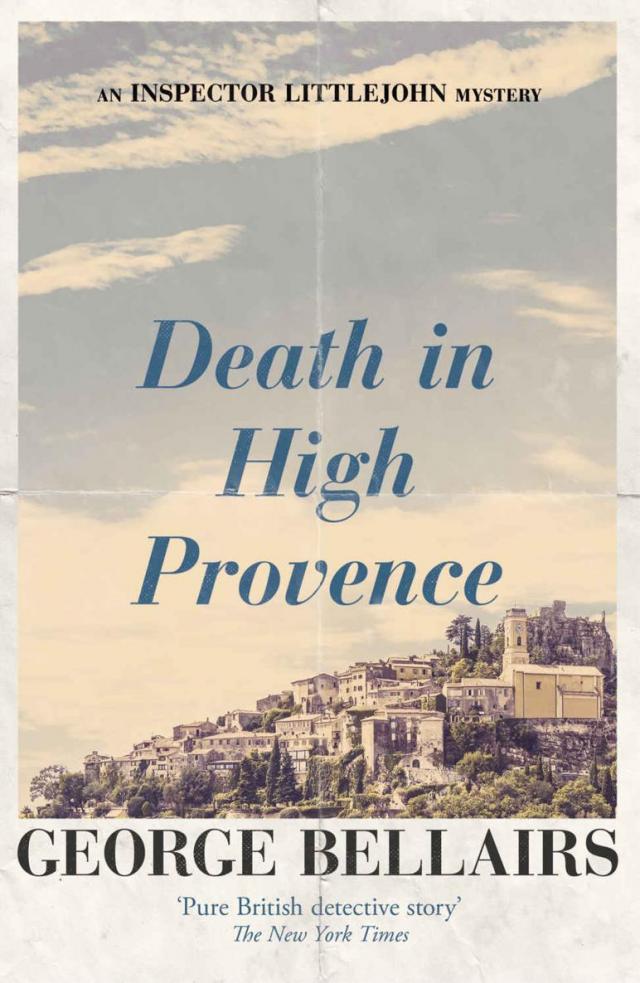


Death in High Provence
An Inspector Littlejohn Mystery
George Bellairs
About the Author
George Bellairs was the pseudonym of Harold Blundell (1902-1982). He was, by day, a Manchester bank manager with close connections to the University of Manchester. He is often referred to as the English Simenon, as his detective stories combine wicked crimes and classic police procedurals, set in quaint villages.
He was born in Lancashire and married Gladys Mabel Roberts in 1930. He was a devoted Francophile and travelled there frequently, writing for English newspapers and magazines and weaving French towns into his fiction.
Bellairs’ first mystery, Littlejohn on Leave (1941), introduced his series detective, Detective Inspector Thomas Littlejohn. Full of scandal and intrigue, the series peeks inside small towns in the mid twentieth century and Littlejohn is injected with humour, intelligence and compassion.
He died on the Isle of Man in April 1982 just before his eightieth birthday.
Also in the Inspector Littlejohn Series
The Case of the Famished Parson
The Case of the Demented Spiv
Death in Dark Glasses
Half-Mast for the Deemster
Corpses in Enderby
The Cursing Stones Murder
Death Treads Softly
Death in High Provence
Death Sends for the Doctor
Corpse at the Carnival
Murder Makes Mistakes
Bones in the Wilderness
Toll the Bell for Murder
Death in the Fearful Night
Death of a Tin God
The Tormentors
Death in the Wasteland
Death of a Shadow
Intruder in the Dark
Death in Desolation
The Night They Killed Joss Varran
This edition published in 2016 by Ipso Books
First published in 1957 in Great Britain by John Gifford Ltd. and in the Unites States, by Penguin (1963).
Ipso Books is a division of Peters Fraser + Dunlop Ltd
Drury House, 34-43 Russell Street, London WC2B 5HA
Copyright © George Bellairs, 1957
All rights reserved
You may not copy, distribute, transmit, reproduce or otherwise make available this publication (or any part of it) in any form, or by any means (including without limitation electronic, digital, optical, mechanical, photocopying, printing, recording or otherwise), without the prior written permission of the publisher. Any person who does any unauthorised act in relation to this publication may be liable to criminal prosecution and civil claims for damages.
TO
FRED AND LOTTIE FARAGHER
Visit from A V.I.P
As was his custom on arriving outside his flat in Hampstead, Littlejohn knocked out his pipe against the street-lamp by the door. It was a mild evening in early summer, and he paused to sniff the fresh air of the Heath, which smelled good after the petrol-laden atmosphere of London itself. He was a bit late home and the church clock at the end of the road struck seven as he started to climb the stairs to the first floor.
He knew right away that something unusual was going on in the flat. Meg, his bobtail sheep-dog, which usually greeted him joyfully in the vestibule, began to bark apologetically from the kitchen at the sound of his steps, which meant there was somebody there who found her de trop.
As he took his key from his pocket, the door opened and his wife met him. Instead of the usual cheerful smile, she gave him a grave, almost comic look which signified that callers had interrupted their evening meal.
“There’s a V.I.P. here...”
She even forgot to ask the usual question about what he’d had for lunch.
Inside the dining-room a man was standing examining the Toulouse-Lautrec which hung over the fireplace and which Littlejohn’s friends of the Paris Police Judiciaire had given him as a memento of their war-time association. He turned to face the Chief Inspector as he entered.
A tall, athletic man, with a strong nose and chin, heavy determined lips, dark pouched eyes, and a fine head of dark brown hair. He was apparently in his mid-fifties. He wore a loose-fitting suit of fine grey worsted with elegance and, as he turned to greet Littlejohn, he removed the black horn spectacles and gave him the half-haughty, half-surprised look which the caricaturists captured almost every day. It was Spencer Lovell, the Minister of Commerce.
The dog barked again, and Littlejohn understood why. Lovell, a bachelor, owned half-a-dozen cats and had written a book about them. He had openly confessed his contempt for dogs.
“I’m sorry to disturb you so late and in your leisure, Littlejohn.”
“That’s all right, sir. Sit down, please.”
Mrs. Littlejohn entered with the sherry. She wore her hat and coat.
“Don’t let me drive you out, Mrs. Littlejohn.”
“You’re not doing, Mr. Lovell. I’ve a call to make.”
Littlejohn gave his wife a grateful look, rose, and let in the dog. He had, in the past, visited the Minister in his own flat in connection with a burglary, and had emerged covered in cat hairs. Lovell’s cats hadn’t been locked up on that occasion! Meg entered, altogether ignored the V.I.P., and, after greeting her master with a friendly butt in the knees, stretched quietly by his side and started to snore.
Lovell lolled in his chair, sipping his sherry.
“Cigarette, sir?”
“I prefer my pipe, if I may.”
They both started to smoke.
“You’re a bit surprised to see me here?”
They smiled at one another. They were the same build and about the same age, and they got on comfortably together.
“Listen, Littlejohn. No use beating about the bush. We’ve only met casually before, and all I know of you is through the newspapers and from what I hear of you.”
“The same applies to me, sir.”
The Minister raised his eyebrows in surprise for a minute and then smiled.
“We understand one another, then. I want your help, and I couldn’t very well ask you over to the Ministry. All the world knows what goes on there, and this is personal and private. Your wife was good enough to telephone Scotland Yard to enquire about you and they said you’d left. So I waited.”
He puffed his pipe and turned his head to see how Littlejohn was taking it.
“I’ve not put in an official request about you. The Commissioner, however, knows I’m calling and what it’s about. But you are quite free to say yes or no after I’ve told you my story.”
Littlejohn refilled the glasses.
“Your very good health.”
“And yours, sir.”
“It’s very difficult to begin.”
Littlejohn felt a bit surprised. Lovell’s reputation as a parliamentarian and politician was high and he had a name for quick thinking. A former barrister in the Northern Circuit, he had been born within twenty miles of Littlejohn’s native town, and had risen rapidly after his election to parliament.
“Did you ever hear of my brother, Christopher?”
Who hadn’t? The death of Christopher Lovell and his wife in a motor accident during holidays in the south of France had been one of the sensations of the year. It had happened in February and had cut short a distinguished career in the Foreign Office.
“Yes. I read about his untimely death in the newspapers.”
Lovell nodded his head.
“That’s why I’ve called to see you. I’m not satisfied about the way my brother and his wife died.”
There was a pause and complete silence, punctuated by the snores of the dog. Lovell’s eyes were fixed on the picture over the fireplace, as though he’d forgotten what he’d been talking about.
“You think there was foul play, sir?”
“I don’t know. I just don’t know. Did you follow the affair in the papers?”
“Superficially, that’s all.”
Lovell rose and paced the rug uneasily.
“I’m so afraid of starting a mare’s nest, Littlejohn. It might be that Chris and his wife just met their deaths through speeding along dangerous roads. In such an event, it would only be wasting your good time asking you to look into it. I can only, therefore, leave the decision to you. He was my only brother and we were very close. There were only three years between us in ages and I was the elder.”
He paused, obviously trying to keep sentiment out of it and seeking words to express his thoughts reasonably.
“Candidly, I don’t like it at all. The accident occurred at St. Marcellin... The Commissioner tells me you know Provence.”
“I was there with a friend, an Inspector in the Sûreté at Nice, studying the Dominici affair last autumn.”
“Ah... Then you may know the place. It’s a village between Aix-en-Provence and Manosque, just off the main road, near the southern tip of the Forest of Cadarache. The nearest town, Manosque, is twenty miles away. Know it?”
“Not exactly, but I visited the neighbourhood. We spent a night in Manosque.”
Already Littlejohn felt a vague sense of uneasiness. He and his colleague, Dorange, of Nice, had made their unofficial tour of those parts, and they were decidedly grim. The natives, a secret and clannish lot, had proved most unhelpful. How another unofficial enquiry, this time on his own, would fare, he’d no idea, but he could guess.
“I see you’re already vaguely aware of what you’re up against, Littlejohn. I’ve tried it myself, witho ut success.”
“You’ve been there already, sir?”
“To bring home my brother’s and his wife’s bodies. In the brief time at my disposal I tried to get precise details of how it occurred. Nobody seemed to know. It was like beating my head against a stone wall. You have methods of your own, and a professional knows what to look for and how to do it. I’m no good as an amateur detective.”
Littlejohn could well understand it. He still remembered the hard eyes, the secret exchange of queer looks between one man and another, the dreadful feeling of being an utter stranger among strange folk... He caressed the soft ears of his dog and thought it nice to be home among his own people, people he understood.
“Why do you think there was foul play?”
The Minister sat down again and stretched his legs and re-lit his pipe.
“The place, to begin with. Chris used to visit the identical village before the war. He began his career in the army and was a military attaché at the British Embassy in Paris. Whilst there, he made a bosom friend of the Marquis de St. Marcellin, and spent a lot of time at his château. St. Marcellin was in the French army and they’d much in common. Whilst staying with him one time at the château, Chris met Elise de Barge, who later became his wife.”
“And the Marquis is still at St. Marcellin?”
“No. He died just before the war. A shooting accident. Chris was there at the time and it upset him frightfully. So much so, that he never went again. He and Elise were married in Paris, he came home shortly afterwards, the war broke out, and that ended Chris’s relations with the St. Marcellin family. Then, they both met their death in the very village... I don’t know what they were doing there or why they went.”
“Do the family still occupy the château?”
“Arnaud de St. Marcellin succeeded his brother, Bernard, after the accident. I met Arnaud when I was there. A very decent chap and frightfully cut-up about it all. He couldn’t help.”
Lovell was on his feet again, pacing the room nervously.
“There was a proper official enquiry into Chris’s accident and it was found to be due to a skid on a greasy road. The police were quite satisfied. The car hit a tree at high speed. There were no witnesses, but all the experts concurred. They seemed quite surprised that I should continue asking questions.”
“They would be!”
“I see you know all about those parts and the French officials. It was a complete dead end.”
Lovell continued his pacing, smoking a cigarette now, seeking words to express his feelings.
“I’m a lawyer, Littlejohn, and used to evidence. On the face of it, the thing was obvious. A plain, straightforward accident. I ought to accept it as such. All my training says it’s logical to do so and reasonable to accept the verdict.”
He threw out his arms in almost a gesture of despair.
“I’ve never believed in the supernatural, or whatever you like to call it. Two and two make four to a lawyer like me. But the thought of Chris won’t let me rest. I can’t sleep for it. I want to know. Did he die with his wife, both of them smashed to pieces in a fast car, or did somebody kill them both?”
He poured himself another glass of sherry and drank it off without even asking Littlejohn or looking for the Chief Inspector’s glass.
“What were they doing at St. Marcellin at all, and why, of all places in the world, should they die there?”
“Did your brother’s wife come from those parts?”
“No. She came of a family at Cap Ferrat, near Nice, and they still live there. She happened to be a guest of the St. Marcellins at the time Chris met her.”
“Do you know anything of her background, sir?”
“I met her people at the time of the accident. Her father is a retired banker and she was their only child. They were at the wedding, too, but never visited England. Very nice people indeed.”
“And after Bernard’s death and his own marriage to Elise, your brother never visited his old haunts again?”
“No. They went to stay with the de Barges at Cap Ferrat regularly, but they always went by air to Nice until this year. Then they decided to take the car and go through High Provence and return by the Rhône Valley.”
Dusk had fallen and the two men in the firelight could hardly see one another. Littlejohn didn’t want to put on the lights; the dimness of the room was conducive to conversation.
“Did you go through your brother’s papers after his death?”
“Yes.”
“You found no hint or reason for their breaking the journey at St. Marcellin?”
“No. Nor did I find any diary or record of his connections with the Marquis in times past.”
“It might appear that your brother wished to forget them?”
There was a significant pause.
“What do you mean?”
“Don’t you think it strange that your brother, after the death of his friend, Bernard, and his marriage, should suddenly shun St. Marcellin and his friend’s family? It looks as if they and the place had become distasteful to him. For example, did his wife break some previous romance when she met your brother?”
There was another silence, as though the Minister had either fallen asleep in the twilight or else had been struck by some truth too dreadful to comment upon. The dog snored softly, now and then crying in joy at her dreams, and the electric clock hummed like a fly exploring the room.
“I never thought of that. And I was never aware that any such thing occurred. They were a happy couple... very happy. And yet...”
Lovell paused as though exploring in the archives of memory for some record, some sign which might give him a clue about his brother’s thoughts and habits before he died.
“Come to think of it, something must have happened before he left St. Marcellin for the last time. He was always a bit of a harum-scarum in his youth and rather wild as a young man. His escapades were almost legendary in his days at Cambridge, and even in the army... I thought when he met and married Elise that he had simply settled down. He was fond of women before he married and his name was coupled with quite a few. Just wild oats... nothing more. He calmed down after he married. But looking back...”
Again a pause, with the hiss of the gas fire and the regular breathing of the dog alone disturbing it.
“Looking back, there did seem to be a kind of sadness in him, as though he’d suddenly become disillusioned. You’d find him thinking about something else as you talked, and he wasn’t listening to you at all. And his wife, if she was there, would gently touch the back of his hand and give him a kind of secret smile, as though she knew what held him and wanted him to know she was with him and understood.”
The Minister struck a match and held it to his cold pipe, puffing softly, his cheeks moving like a pair of bellows.
“You’re a good listener, Littlejohn, and thanks for your patience and for sparing me the time to tell you all about it. It’s most unusual for me to grow imaginative or sentimental. I think we’d perhaps better have the light on. This firelight and the half-darkness around make me almost feel that Chris is here listening to us.”
Littlejohn switched on the table-lamp at his elbow. The spell was broken. There were the old familiar pieces of furniture, the Toulouse-Lautrec on the wall, the portrait of Letty, his wife, on the mantelpiece, and an unframed snapshot of himself tucked behind the clock. It showed him smiling and walking along the promenade at Cannes, dressed in flannels and an open-necked shirt. A tout had photographed him on his way to see a dead body, and his wife said it was the best and happiest photograph he’d ever had taken.
“So you see what I’m asking of you?”
Littlejohn awoke from his own reveries with a jerk.
“If you’ll undertake it, I’d like you to go to St. Marcellin, find out what you can, and try to put my mind at rest. If you return and say you’re as much in the dark as I am, I’ll let it go at that. We’ll at least have tried and my conscience will be easier. If you find it was an accident pure and simple, that will close the affair. If on the other hand...”
Littlejohn looked up.
“Yes?”
“If it proves not to be an accident, I shall have to see about re-opening the case with the information you provide.”