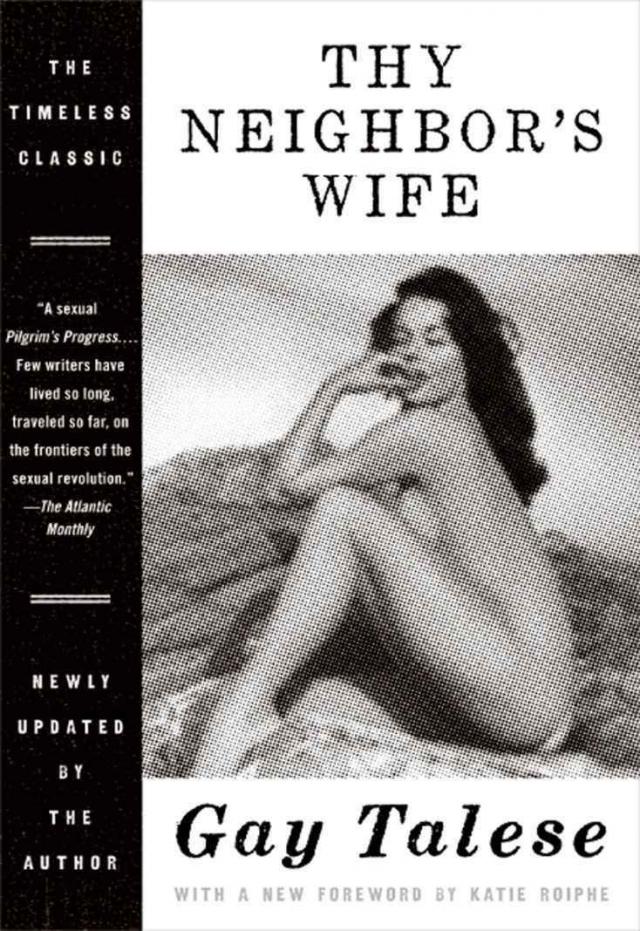
Thy Neighbor's Wife, page 59


Gay Talese, the well-known journalist who has a knack for taking on projects that others would believe to be awesomely difficult, if not impossible (the workings of the Mafia, for example) now offers us a report (the result of no less than nine years of work) on just how far some of us have willingly, gladly strayed not only from 19th-century morality, but from the kind that most of the 20th century has taken for granted. His method of inquiry is that of “participant-observation” as a matter of fact, I doubt that any so-called “field worker” can claim to have surpassed Mr. Talese with regard to personal involvement. He talked with men and women who have embraced uninhibited or unconventional sexuality, but he also became a distinct part of a world he was trying to comprehend. That is, he not only worked in Manhattan’s massage parlors, he became a beneficiary of their favors. He joined, briefly one gathers, a nudist camp. He did not fail to get at least some pleasure out of the activities (“communal sex”) that took place at Sandstone, near Los Angeles.
Yet this long narrative will probably disappoint those with prurient interests. It is not an exhibitionist’s confession; it is not a journalist’s contribution to pornography. Mr. Talese will be made a good deal richer than he already is by this book, but one suspects a substantial number of his readers will find him surprisingly restrained. He has a serious interest in watching his fellow human beings, in listening to them, and in presenting honestly what he has seen and heard. He writes clean, unpretentious prose. He has a gift, through a phrase here, a sentence there, of making important narrative and historical connections. We are given, really, a number of well-told stories, their social message cumulative: A drastically transformed American sexuality has emerged during this past couple of decades.
In 1981 the paperback edition of Thy Neighbor’s Wife sold well enough, but then it and other books about the sexual revolution fell from favor as readers concentrated on the well-publicized medical reports announcing the nationwide spread of genital herpes and AIDS—diseases in the 1980s that many people attributed to the sexual permissiveness introduced in the 1960s. This opinion was not only shared by individuals favoring tighter controls over liberal expression and behavior but it was also believed by such outspoken defenders of freedom as the essayist and academician Camille Paglia, who in the 1960s was a student activist but who later wrote in one of her books (Sex, Art, and the American Culture):
The Sixties attempted a return to nature that ended in disaster. The gentle nude bathing and playful sliding in the mud at Woodstock were a short-lived Rousseauist dream. My generation, inspired by the Dionysian titanism of rock, attempted something more radical than anything else since the French Revolution. We asked: why should I obey this law? and why shouldn’t I act on every sexual impulse? The result was a descent into barbarism. We painfully discovered that a just society cannot, in fact, function if everyone does his own thing. And out of the pagan promiscuity of the Sixties came AIDS. Everyone of my generation who preached free love is responsible for AIDS. The Sixties revolution in America collapsed because of its own excesses.
But did it really collapse? Like everyone else, I have read numerous newspaper accounts in recent years based on poll-takers’ surveys indicating that, due to AIDS, single’s bars were no longer such promising preludes to sex, married couples were now less prone to adultery, erotic novels were less successful commercially, New Puritanism was pervading the consciousness of the country. In 1984 there was a cover story in Time with the headline: “Sex in the ’80s—The Revolution Is Over”; and in 1986 there was the report of Attorney General Edwin Meese’s Commission on Pornography, which hinted at the arrival of a new moral militancy across the land, the revival of traditional values, and the spirited efforts of citizens groups and law-enforcement officials to curb the distribution and sale of pornographic literature and also girlie magazines.
While it is true that the proprietors of Wal-Mart refuse to sell Playboy and other men’s magazines in its stores, and that the Playboy enterprise itself has toned down its covers (no longer displaying completely nude models) and now wraps its newsstand issues in cellophane hoping to discourage underage browsers, it is also true that Playboy’s cable television station has become decidedly hardcore in recent years (showing copulating couples, erect penises, sexual penetration, fellatio, cunnilingus, et al).
In addition to this, there is the burgeoning use of the Internet, and it seems to me that there are now few controllable restrictions on the citizenry of this nation that the writer John Updike has identified as “the paradise of flesh.” On the Internet there are daily and nightly solicitations of masseuses, swinging couples clubs, and admittedly lonely men and women—heterosexual, homosexual, bisexual—seeking long-term or short-term relationships. I recently read a New York Times article (May 19, 2008) describing the ninth annual Father-Daughter Purity Ball in Colorado Springs, Colorado, which affirmed the girls’ sexual abstinence until they wed. Months later I watched the televised broadcast of the Republican National Convention in St. Paul, Minnesota, at which crowds of spectators gave a cheering welcome to the unwed and pregnant seventeen-year-old daughter of the GOP’s vice presidential nominee, Sarah Palm.
“Americans have always wanted it both ways,” wrote Time magazine’s Richard Stengel back in 1986. “From the first tentative settlements in the New World, a tension has existed between the pursuit of individual liberty and the quest for puritan righteousness, between Benjamin Franklin’s open road of individualism and Jonathan Edwards’ Great Awakening of moral fervor. The temper of the times shifts from one pole to the other, and along with it the role of the state. Government intrudes; government retreats; the state meddles with morality, then washes its hands and withdraws. The Gilded Age gave way to the muscular governmental incursions of the Age of Reform. The Roaring Twenties gave rise to the straightlaced Hays Office of the ’30s. The buttoned-up ’50s ushered in the unbuttoned ’60s. And, most recently, a reaction to the sexual revolution spurred a spirited crusade to reassert family values that helped sweep Ronald Reagan into the presidency.”
And, I might add, a lack of family values in the 1990s almost swept Bill Clinton out of the presidency!
Still, if one were to assume that President Clinton’s near removal stemming from his dalliances with a female White House intern should have discouraged other politicians from indulging in sexual misconduct, one must concede that this did not happen—and it is evident in such recent news items as:
The 2008 acknowledgment of infidelity by Democratic presidential aspirant and former senator from North Carolina John Edwards, who had an affair with a female campaign worker.
The 2008 exit from office of the governor of New York, Eliot Spitzer, a self-promoting family-values man and ardent campaigner against vice, who was revealed to be a frequent patron of a call-girl service that advertised on the Internet.
The admission by Spitzer’s political successor, David A. Paterson, who voluntarily informed the press that in years past he had been unfaithful to his wife—while she, too, as she conceded in a separate interview, had been unfaithful to him.
In 2008 the gay boyfriend of New Jersey’s former Governor Jim McGreevey told the press that he and the governor (who resigned in 2004) participated in threesomes with the governor’s wife (now estranged). Although she denied it, the ex-governor did not.
In 2007, Senator Larry Craig (Republican, Idaho)—a longtime married man and strong proponent of family values—was accused by eight gay men of having sexual encounters with them. He vehemently denied this shortly after he had been arrested for lewd conduct in the men’s bathroom at the Minneapolis—St. Paul International Airport. In 1989, when it seemed that Massachusetts Democratic Congressman Barney Frank might be expelled or censured from office because of his dealings with a male prostitute, Senator Craig had been among those calling for Mr. Frank’s ouster. The latter survived the scandal and remains a strong voice in Congress.
More than a quarter of a century ago, as I was finishing Thy Neighbor’s Wife, I wrote in the final chapter: “…despite the social and scientific changes relevant to the Sexual Revolution—the Pill, abortion reform, and the legal restraints against censorship—there were millions of Americans whose favorite book remained the Bible, whose marriages were unadulterous, whose daughters in college were still virgins…and though the national divorce rate was higher than ever, so was the rate of remarriage.”
Today, I believe that this remains fundamentally true. And yet I believe as well that what Richard Stengel wrote in Time magazine in 1986 is true: “Americans have always wanted it both ways.” And so what I am suggesting, essentially, is that contrary to publicized opinion garnered by poll-takers, I doubt that the America of the twenty-first century—with all due respect for the trepidation and fear over AIDS—is subjecting itself to a New Puritanism that is curbing the temptations and prerogatives that seemed so shocking when they went public in the ’60s and ’70s. More true, I think, is that what was defined as novel in those days has become so integrated into the mainstream that it remains “new” only to those news editors who are new to their jobs—or who are so guided by the daily pressures of their profession that they’re driven to pinpoint as “trends” aspects of personal behavior that have long been the practice of people in private.
And so, in one sense, Thy Neighbor’s Wife is about the sexual revolution of the 1960s and 1970s. It is about the men and women who personified that revolution. It is specific to certain people and certain places. But in another sense the information is timeless and placeless. For what can it tell about temptations and tempests between men and women that has not been told before, and lived before, in eons going back to the Dark Ages and companionship in caves? Since men and women first comingled, there has been an ongoing conflict between the sexes, an eternal love-hate relationship that predates the Babel over languages; for men and women have always spoken and understood separate languages. These languages are beyond translation and interpretation—whether spoken in a law office once occupied by Supreme Court Justice Clarence Thomas and his ex-colleague and accuser, Anita Hill, or spoken in a garden occupied by Adam and Eve.
And so there is nothing new in Thy Neighbor’s Wife.
Nor is there anything old.
—Gay Talese
2009
AN UPDATE ON PEOPLE & PLACES FEATURED IN THY NEIGHBOR’S WIFE
(Presented in the order of appearance in the book)
CHAPTER 1
Harold Rubin, the Chicago-born teenager who had a masturbatory love affair during the 1950s with photographic images of a young nude figure model in Los Angeles named Diane Webber—who later inspired him to open a Chicago massage parlor serviced by balm-palmed masseuses who were regularly arrested in police raids—died in Chicago of natural causes in January 2007. Mr. Rubin was sixty-seven. Divorced from his only wife, he is survived by a son, Jules Rubin, who was quoted as saying in the Chicago Tribune’s obituary that his late father had lived and died believing that the U.S. Constitution guarantees every citizen the right to having access to pornography.
CHAPTER 2
Diane Webber, whose ambition as a nudist was certainly not to become one of the nation’s premier dream goddesses for masturbating men, rather naively believed that while posing nude for art photographers in the 1950s she was viewed and appreciated solely as an exemplar of bodily art that was far removed from the lust it aroused in such unqualified appraisers of art photography as young Harold Rubin of Chicago. Now in her mid-seventies, she continues to reside in Los Angeles, often in the nude.
CHAPTER 3
Hugh Hefner, who dwells in the Playboy Mansion in Los Angeles and who in 1955 selected Diane Webber to appear as a Playmate in the May issue of his magazine, is now eighty-two. When I last visited him in April 2008 he was contentedly sharing his vast residential quarters with three buxom blondes who also join him as regular guests on his popular television series called The Girls Next Door. Despite his age and extracurricular preoccupations he steadfastly retains final authority over the editorial content of the magazine he launched in 1953.
CHAPTER 4
Anthony Comstock, who gained prominence more than a century ago as the nation’s leading petitioner against the sale and distribution of erotic pictures and publications, was such an uncontrollable masturbator as a teenager in Connecticut that he saw no solution to his problem other than to remove from the nation’s newsstands and postal system anything that might prompt him into a state of tumescence. He gradually became a control freak and vigilant censor who attained the power to imprison most of the publishers and freethinkers who opposed his restrictive policies. One who stood up to him, and landed in jail, was the underground publisher D. M. Bennett.
In 2006, Prometheus Books of Amherst, New York, released a biography of Bennett—D. M. Bennett: The Truth Seeker, by Roderick Bradford.
Books about Comstock (who died in 1915) include: Imperiled Innocents: Anthony Comstock and Family Reproduction in Victorian America, by Nicola Beisel (Princeton University Press, 1997), and Weeder in the Garden of the Lord: Anthony Comstock’s Life and Career, by Anna Louise Bates (University Press of America, 1995).
CHAPTER 5
Hugh Hefner’s early years as a married man and Playboy editor are discussed in this chapter. He married for the first time in 1949 a fellow Northwestern student from Chicago named Mildred Williams. In 1952 the couple had their first child, Christie. The couple’s second child, David, was born in 1955, but their ten-year marriage would be terminated in 1959. While Mildred would soon discover her second husband in the attorney who helped with her settlement, Hugh would remain a bachelor for the next three decades, although he had sustained relationships with such Playmates as Barbi Benton and Karen Christy (both described in Chapter 24 of this book). But in 1989 he married a Playmate named Kimberley Conrad and sired two sons—Marston Hefner, born in 1990, and Cooper Hefner, born in 1991. Even though Kimberley and Hugh Hefner separated in 1999 she continues to live with their boys in separate quarters on the mansion’s property.
Since Hefner’s breakup with Kimberley—to whom he said he was faithful during their decade of marriage—his roommates have rotated with such frequency that it is difficult to identify any one of them as the First Lady of the Mansion. Among the triad currently claiming his affections is a singularly outspoken twenty-eight-year-old Playmate named Holly Madison, who in February 2008 told a reporter from Us magazine that she and Hefner were trying to have a baby. Mr. Hefner would not comment.
CHAPTER 6
Samuel Roth, an erudite pornographer with an unerring sense of literary merit but with a predilection for the penitentiary because of his reckless disregard for obscenity laws, died in New York in 1974 at the age of eighty. He spent a fifth of his adult life in jail for publishing dozens of books and magazines containing sexually explicit material, among them such novels as Ulysses in the 1920s and Lady Chatterley’s Lover in the 1930s, both sold underground without the permission of the authors. In 1957 the U.S. Supreme Court affirmed an earlier conviction against Roth but did so in language that liberalized the definition of obscenity. As a consequence much that had been previously forbidden was now made available to the public in libraries and on the shelves in bookstores.
A biography about Samuel Roth is currently being written by Jay A. Gertzman, an emeritus professor of English at Mansfield University in Mansfield, Pennsylvania.
CHAPTER 7
Barney Rosset, the avant-garde publisher of Grove Press, in 1959 capitalized on the Supreme Court’s newly liberalized (Roth-inspired) obscenity ruling by publishing (legally for the first time) such works as D. H. Lawrence’s Lady Chatterley’s Lover, Henry Miller’s Tropic of Cancer, and other sensuous novels and films that would be distributed by Grove Press from the late 1950s through the 1960s.
In November 2008, at the age of eighty-six, Barney Rosset received the Literarian Award at the fifty-ninth annual National Book Foundation dinner in New York in recognition of his career in the forefront of literary freedom. Earlier in 2008 he was similarly honored at an event sponsored by the National Coalition Against Censorship. He recently completed an autobiography scheduled for publication in 2009 by Algonquin Books.
CHAPTER 8
John Bullaro, an insurance executive in Los Angeles whose adulterous affair with a female colleague during the 1960s is not only recounted in Chapter 8 but serves as a reference point through most of the remaining chapters of Thy Neighbor’s Wife, is now seventy-six years old and long retired from the insurance business. He lives with his second wife, Cynthia, in northern California. He does, however, maintain friendly relations with his first wife, Judy, whom he regularly visits in Los Angeles as part of family reunions usually involving their son, now forty-four, and their forty-two-year-old daughter. John Bullaro has long been out of touch with his onetime inamorata, Barbara Williamson.
CHAPTER 9
Barbara Williamson, whose forty-five years of nonpossessive marital love with John Williamson has never in the least been affected by her intimacies with John Bullaro nor her many other lovers, has traveled extensively around the United States with her husband since they sold their free-love Sandstone community in Los Angeles in 1973. In recent years they have settled down in Fallen, Nevada, where they preside over a nonprofit organization dedicated to the study of their many resident cats, which range in size from tabbies to tigers. Their organization is called Tiger Touch.