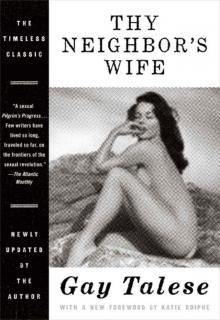
Thy Neighbor's Wife, page 58


It was the first time that he had been so directly sought out by a sexually aggressive woman, and there was no doubt in Talese’s mind or body that he was receptive to the experience. After she had finished, and only after she had finished, Barbara Williamson began to talk freely, confiding in him for the first time since he had arrived at Sandstone. While not apologizing for her husband’s sullenness, she sought to explain that a number of business reversals concerning the sale of the property had constantly frustrated her husband’s desire to resettle in Montana. But, she added, John Williamson was, like most dreamers, a man given to exaggerated despondence, and she recalled that back in 1970—after his adoring Oralia Leal had run away with David Schwind and gotten married in Elyria, Ohio—he had brooded in his bedroom and had barely spoken to anyone at Sandstone for nearly two months.
As Talese listened with interest, and prompted her with questions, Barbara Williamson began to tell him the story of how Sandstone had begun, recalling her affair with John Bullaro, and her husband’s later relationship with Bullaro’s wife, describing as well the dramatic weekend at Big Bear Lake in which the two couples had shared a cabin and each other’s spouses. Although John and Judith Bullaro a year later had quit Sandstone and had ceased living with one another, they had subsequently become partners in an open marriage, Barbara said, adding that the couple was still friendly with the Williamsons and that, if Talese wished, she would arrange for him to meet them.
A week later, this was done; and during the next two years, as Talese flew back and forth between New York and California, he often visited the Bullaros in Woodland Hills, where he gradually gained their confidence and permission to write about them, and to make use of the diary and other notes that John Bullaro had kept during those traumatic days when Judith had been lured away by Williamson and the group that would form Sandstone’s charter membership.
During this time, Talese’s own marriage, which had been in existence since 1959, and which now included two young daughters, was responding adversely to the flagrance of his research, its attendant publicity, and his recent agreement to be interviewed at length by a reporter from New York magazine about the challenges and difficulties Talese was confronting in his new project. The reporter was a friend, someone he had known for years, a journalist he thought would write more about the method of his work than his intimate involvement with the subject; and so Talese felt confident that there was little in his life he would need to hide.
One evening, with the reporter at his side, Talese returned home to find his house quiet and an envelope awaiting him on the dining room table. Opening it, he read that his wife had left the house and she did not say when she would return. Her right of privacy, which she valued like few other possessions, was being violated, she declared, by his unwitting willingness to discuss with the press what was none of its business; and she warned further that his candor on the subject of sex, while it might titillate some magazine readers, would only bring ridicule upon himself.
Distressed by her departure, but eager to conceal the contents of the letter from the New York reporter who stood silently next to him, waiting to accompany him to a restaurant to conclude the interviews that had been going on for days, Talese put the note in his pocket. Repressing his emotions, Talese spent the next few hours in the restaurant conversing with the reporter, hoping that the tension and anxiety he felt was going unnoticed.
It had been a Friday when he received the note, and on the following Monday she was back without explanation. She did not volunteer where she had been, nor did he feel he had the right to ask. Their marriage continued through the fall of 1973 and winter of 1974 with an uncertain aura of reconciliation. That the marriage survived at all was due not only to their love but more to the fact that through the years they each had developed an insight into the labyrinth of one another’s ways, a special and not-always-spoken language, a respect for one another’s work, a history of shared experiences good and bad, and a recognition that they genuinely liked one another. There are times in marriage when it is more important to “like” than to “love”—and thus the marriage continued and deepened through a second decade; and during the summer of 1974 Talese returned, as he did each year with his wife and children, to the Victorian beach house he owned in his hometown of Ocean City, New Jersey.
The negative reaction to his publicized “research” had, as his wife predicted, preceded his arrival and had become the subject of an unflattering editorial in the weekly newspaper where he had begun his journalistic career as a high school sportswriter. This editorial, more than all the gossip and articles in the big-city dailies and national magazines, most offended his parents, who still resided in the town, and who for a half century had exemplified the moral propriety that had characterized at least the surface of this small seaside city. While Talese was at first irritated and made self-conscious by the effect his book-in-progress was having on his family, he gradually ceased to care about what people thought of him personally. He had now found a way to begin the book, his first chapter was completed, and during midday breaks from his work he would walk through the town, visit the local newsstand and casually thumb through the racks of men’s magazines, and continue to explore the changing sexual mores that surrounded him—both in his hometown and in the larger resort of nearby Atlantic City, and in the extended area of provincial farms and villages.
Twenty miles from where Talese had been raised, concealed deep in the woodlands along the Great Egg Harbor River, there was a nudist park that he had been aware of since his boyhood, but, as a young man, had never dared to enter. It was called Sunshine Park, and had been founded in the mid-1930s by a stocky, volatile, controversial minister named Ilsley Boone, who was recognized by a small group of shameless adherents of nudism as the father of the movement in America. A onetime pastor of the Ponds Reformed Church in Oakland, New Jersey, Reverend Boone discovered nudism in 1931 during his travels through Germany, where, until closed down by Hitler, there had been a number of private parks used by naturists who believed that the removal of clothing in the outdoors was liberating and healthy for both the body and spirit. Although Reverend Boone’s first attempt at founding a naturist settlement in Schooley’s Mountain in central north Jersey was terminated by an eviction notice from the landlord, he did succeed in acquiring eighty acres of forest land in south Jersey from a German-American family living in the community of Mays Landing; and in 1935, driven by a messianic fervor and assisted by his followers, Boone built within the shading of tall oak trees and cedar and clusters of pine, a riverside retreat he called Sunshine Park. He erected a large white frame house, in which he lived with his wife and children, and also smaller houses and cabins, an auditorium, and a school. He published a nudist newsletter and a picture magazine called Sunshine & Health, which, though regularly banned by the local postmaster in Mays Landing, was just as regularly defended in countersuits by Boone himself, who asserted in an editorial: “Until the ‘moral’ leaders of America accept reality in the body and allow the hoi polloi to become perfectly familiar with the body’s complete physical appearance, a more or less feverish interest in the ‘forbidden’ parts of the body will continue.”
A “feverish interest” in the body’s “forbidden” parts—no phrase was more appropriate to Talese’s boyhood in Ocean City; and while he always lacked the nerve to inquire if Sunshine & Health magazine was available for sale under the counter at the corner cigar store, where the most indiscreet publication on display was the Police Gazette, he listened with unabated interest whenever his school chums discussed the daring possibility of sneaking into the park at night and climbing the trees and hiding until daylight brought its promised view of naked female splendor. And whenever he was taken to baseball games in Philadelphia, and was driven along the riverside road that led past Sunshine Park’s stone gate and its bold white billboard sign, he looked into the blurring trees futilely searching for a forbidden sight. He had also heard that there were boat owners in his town who, particularly on weekends, sailed or motored their vessels along the Great Egg Harbor River and anchored opposite the shoreline of Sunshine Park in order to catch the wondrous view of the wicked bathers sprawled along the wooden pier and tiny beach.
One summer weekend, returning to Ocean City after a few days’ visit to Sandstone, Talese drove alone through the treelined road leading to Sunshine Park. Noting that the park’s familiar white sign had been unchanged since his boyhood, he turned into the entrance and followed a long, winding dirt road that led past thick trees and bushes, and finally ended at a log-cabin gatehouse where an elderly nude man sat in the sun behind a rustic wooden desk. The man welcomed Talese, handed him a registration card to be filled in, and accepted a fee. In reply to Talese’s question, the old man said that he was not Ilsley Boone, who died in 1968, but added that he had helped Boone build the park, which, except for the motor homes, still looked essentially as it did when it was opened forty years ago. After the man had waved him through the inner gate, Talese drove along a sandy roadway toward the river, where he could now see dozens of people of all ages, shapes, and coloring, strolling or lying nude in the sun, and swimming in the river. There were parents holding babies, old folks with tan sagging skin, young women with—or lacking—beautiful bodies, men who were muscular, flabby, frail, and teenagers of both sexes who lay next to one another on beach towels or stood talking in a casual manner.
After parking his car and removing his clothing, Talese walked slowly toward the water, feeling unselfconscious and pleasant. It was a sweltering July afternoon, but the shaded ground was cool under his feet, and the cedar-colored water, when he entered it, was warm and soothing. He waded in the water toward a wooden ladder leading up to the pier; and when he climbed up and mingled with a crowd of other nudists, none of whom he had ever seen before, he noticed that a few of them were facing and waving toward a number of sailing vessels and motorboats that were anchored beyond the long extended line of rope that separated the park property from the common sea.
Painted on the stern of most of the boats beneath the declaration of their names was the lettering of their locale: “Ocean City, N.J.” and seated on the decks were people wearing Bermuda shorts and sailing caps, bathing suits, straw hats, and dark glasses; and in their hands they held cans of beer, thermos bottles, transistor radios, and handkerchiefs that they waved at the nudists. There were also some catcalls coming from the boats, whistles and cheers; and after watching for a few moments, Talese stepped forward on the deck, separating himself from the other quiet nudists, and he faced the boats, recognizing a few of the sailing ships and, he thought, some of their passengers. He also noticed for the first time that many of the passengers held silvery telescopes and dark binoculars, and they sat rigidly on their decks and swayed in the water and squinted in the sun. They were unabashed voyeurs looking at him; and Talese looked back.
AFTERWORD
THE COMPLETION of Thy Neighbor’s Wife in 1980 marked the best and worst year in my life as a writer.
The book became a sensational bestseller, garnering four million dollars in advanced earnings even before the first copy was sold in a store, but the sensationalism surrounding the book’s publication drew readers’ attentions away from what I wrote to how and why I wrote it, and particularly why I cheated on my wife while gathering information about the accelerating trends toward infidelity and sexual experimentation in modern-day America.
The fact that my wife publicly supported me throughout my nine years on the book, and later accompanied me on talk shows to explain that our marital love had remained unthreatened while I conducted research in New York massage parlors and a hedonistic nudist colony in Los Angeles, seemed only to heighten the wrath and ridicule that I and my book received from such reviewers as Jonathan Yardley in The Washington Star (“a slimy exercise”); Ken Adachi in the Toronto Star (“he ought to take a bracing cold shower”); Dale L. Walker in the El Paso Times (“disgusting”); Mordecai Richler in New York magazine (“subversive”); Paul Gray in Time (“painful”); Anatole Broyard in The New York Times (“how can we expect him to make sense out of sex?”); and John Leonard, a Times employee and author of several novels who accepted the assignment to review my book in Playboy, and began: “When at last we take leave of Gay Talese, he is naked, no longer an altar boy but a young God, about to brave the cedar-colored waters of the Great Egg Harbor River, somewhere in surprising New Jersey. It is certainly time for a bath.”
While I know that little is gained from quarreling with critics once their negative reviews have appeared in print, I felt compelled to strike back at John Leonard. We had previously met at social gatherings in New York and our relationship had never been friendly, especially after I had objected to an erroneous column he had written in the Times a year before my book was published claiming that I had written the copy for a full-page newspaper advertisement that had favorably compared the embattled pornographer Larry Flynt with political freedom fighters in the Soviet Union.
I immediately wrote to John Leonard asking for a correction. He ignored my request and later, in his critique of my book in Playboy, he repeated the false information. I sent him a second angry letter, which he again ignored, and when a reporter from People called to get my reaction to the negative reviews I was receiving from Leonard and the other writers, I replied: “There’s a lot of envy in these writers who can’t write successfully at book length. Leonard is a terrible writer. And he’s a man who had an affair and ran off with his friend’s wife—and here he is, reviewing Thy Neighbor’s Wife.”
As I recount this now, more than twenty-five years after the publication of Thy Neighbor’s Wife, I wish that I had been less defensive about the criticism. But in those days there was so much pettiness and petulance attached to the publication that I was not always able to control my frustration over the fact that what I had actually written and observed in the book was being ignored or diminished in the wake of all the publicity speculating on the state of my marriage, on my personal involvement with certain people in the book, and on the huge financial sums invested in the book even before it was released to the general public. There was the $50,000 that Esquire magazine paid for a prepublication excerpt, the advance of $1 million from paperback and foreign editions, and the $2.5 million that Hollywood spent in acquiring the movie rights.
After obtaining and reading bootlegged copies of the manuscript while it was being circulated to magazine editors for excerpt consideration, several studios competed for what eventually went to United Artists for $2.5 million—the highest amount ever paid for the rights to a book. The sum eclipsed the $2.15 million that the Zanuck-Brown partnership had paid for the rights to Peter Benchley’s The Island, and far exceeded such recent book-to-movie sales as William Styron’s Sophie’s Choice ($500,000), Christina Crawford’s Mommie Dearest ($650,000), and Robin Cook’s Sphinx ($1 million).
Although The Denver Post’s book editor, Clarus Backes, wrote that Thy Neighbor’s Wife was “certainly not a $2.5 million book,” the United Artists spokesman, Steven Bach, a senior vice president who helped negotiate the deal, said that as many as three films could be made from the stories described in the book. He suggested that one film might focus on the chapters dealing with the very conservative vice president of the New York Life Insurance Company and the attractive and aggressive young saleswoman with whom he has an affair; a second film could be inspired by the fantasy romance associating a beautiful pinup girl in Los Angeles and a schoolboy in Chicago who falls in love with her photograph; and a third film could center around the days and nights of ecstasy and angst as lived by Hugh Hefner in his Playboy Mansion.
“I think it’s going to be the book of the year,” Steven Bach predicted in an interview with The New York Times, adding, “It is about the most explosive topics in contemporary life, sexuality and morality, and the personal relationships are described with enormous insight.” His film company hired a Pulitzer-winning playwright, Marsha Norman, to do the script while working with the acclaimed director William Friedkin.
But, alas, the film was never completed.
A year after buying and paying for Thy Neighbor’s Wife, the studio collapsed in the aftermath of the release of one of its films called Heaven’s Gate, which had been budgeted for $7.5 million but ended up costing $36 million. The film, directed by Michael Cimino, would not survive beyond opening night. Most of the studio’s top executives, including Steven Bach, were soon fired, and the completed script of Thy Neighbor’s Wife would thereafter gather dust in the archives of the no longer functioning film company.
The book itself sold well throughout 1980—a bestseller for three months, and number one on The New York Times list for ten straight weeks; but again I believe that many readers bought the book for the wrong reason. They had been drawn to it because of the prepublication publicity, but this publicity had little to do with what was written between the covers. And so people expecting a shocking or “dirty” book were undoubtedly disappointed by Thy Neighbor’s Wife’s understated literary tone and its lengthy depiction of people and places that in my opinion represented the dramatic shift in moral values occurring in the United States between my college years in the early 1950s and when I started researching this book in the early 1970s. One of the few positive reviews that Thy Neighbor’s Wife received in 1980 appeared in The New York Times Book Review under the byline of Robert Coles, the author and professor of psychiatry and medical humanities at the Harvard Medical School, who wrote: