Belonging to Heaven, page 9
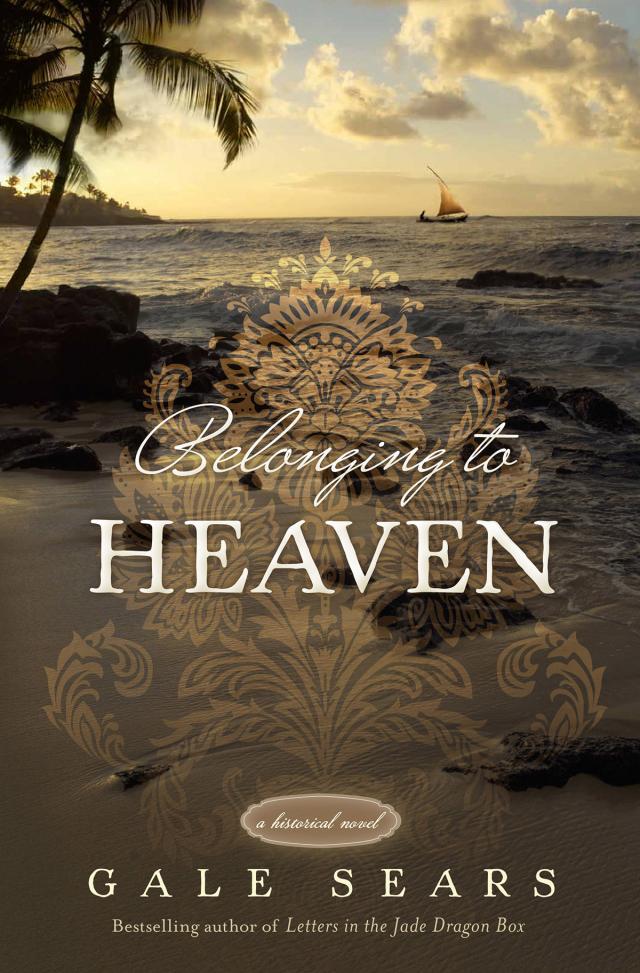


George put down his pen and went to the door of the hut to look out at the alluring and remarkable world. Earlier in the day the clouds had swirled down the mountains to fill the narrow valley with white mist. The trees had become shadowy outlines, and birdsong came eerily to the ear as though from a long distance away. Now, a heavy rain beat on the shrubbery with such intensity that the leaves of a nearby plant lay flat on the muddy red earth, and rivulets of water made small gorges in the ground around the hut. George closed his eyes and breathed deeply, the smell of wet soil and vegetation filling his senses. He knew that years later he would remember that smell and it would bring him back to this very time and place. He looked across the yard to another hut, blurred by the rainfall and the late afternoon gloaming, where his host, Mika, was spending the day with his brother’s family. George had sat up late the night before, conversing with them in broken Hawaiian about the gospel. He had gone to bed displeased with his feeble attempts, but just before sleep took him, he’d overheard the family talking about him in a favorable manner. George smiled at the thought and closed his eyes again, listening to the drumming of the rain on the broad leaves.
Thank you, Father, for this beautiful part of your vineyard and for the privilege I have of meeting your sons and daughters on this island. I know you have prepared someone to receive the truth, and though I have never seen them in the flesh, I know that when I meet them they will not be a stranger to me. I have tried to be aware of any prompting from the Spirit, but I don’t think I have found them yet. I will keep looking. He opened his eyes. I will keep looking.
He turned from the doorway and went back to finish his letter.
Before closing this letter, Mary, I want to tell you about a great blessing I have received from the Lord. It is something that I have been praying about for a long time. I have told you about poi and my inability to even smell it without gagging. It is a staple food in the diet of the Hawaiian people and in their generosity, whenever one eats at their table they always offer poi. Often there is little else for them to give. I have wanted to be able to eat this food so I won’t offend them with refusal. The second night I was on this trek, I stopped at a house and they offered to feed me. They offered me poi and it smelled very sour when the calabash bowl came to me. I said a prayer and asked the Lord to make it sweet to me. My prayer was heard and answered. I ate a bowlful, and I positively liked it. It has been sweet to me ever since. I find it a marvel that the Lord is aware of such a small thing.
Depending on the weather, I will try to make it into Wailuku today. There is a town there, and it will seem somewhat like the end of my trek. I have learned much on this journey, but I also know there is much still to do to magnify my calling.
Love to Ann, Angus, David Henry, and Leonora. The best to Charles. I will post this when I return to Lahaina, which should be a week or two. Perhaps I will have other letters to send you at that time. Thank you for your letters, they bring me close to you.
Love,
Your brother, George
***
George was roused from sleep the next morning by Mika’s two nephews. They stood outside the hut and threw pebbles through the open doorway at George’s sleeping form. At first he thought he was dreaming of the rain coming through the thatch of the hale and pattering on his head, but then an oversized pebble grazed his nose and he sat up abruptly, shaking himself awake. His vision cleared just in time to see the youngest lad lift his hand to launch another rock.
“Kolohe pua ‘a maiki!” he yelled at them playfully, and they squealed and ran away.
Mika came into the hale, chuckling. “Good morning, George Cannon.”
It was difficult for him to say George’s name, and George smiled at the attempt. “Good morning, Mika.”
Mika was a man over six feet tall, with broad shoulders and long dark hair, which he tied back with a braided strip of kapa. He had a wide smile and very white teeth. His voice was low and rumbling like distant thunder. His character was affable, and George felt completely calm in his presence.
“You are right to call those boys naughty little pigs. They have been into trouble all morning. They are happy and full of mischief because there will be sun later today.”
George thought carefully about how to say the words. “There will be sun today?”
Mika smiled at him and handed him some dried octopus and poi for breakfast. “Yes, sun. But we are not happy, because that means you will be leaving us.”
“Leaving?” George tried to find the reply. He nodded. “Yes. Sun today. I will go. I will go to Wailuku.”
“And I will go with you part of the way. I will carry you across the streams, and I will carry your bag.”
George stood quickly to mask his emotion. He had just met the man the night before but was aware immediately of his temperate manner. He figured that Mika was in his thirties, but his spirit was that of a child. George discerned that the man’s heart was filled with kindness, and his open expression spoke of acceptance and a lack of guile that George had never seen in another human being.
George headed for the doorway. “I need to go out.”
Mika laughed. “Of course, it is morning. Go out and add your water to the rain.”
***
It was late in the afternoon when the two unlikely traveling companions descended into the deep gorge and came upon the fourth stream of their journey. George sat down on a rock and took out his canteen. He looked at the bottoms of his light-colored suit pants and saw that they were permanently stained with the reddish mud of the island. He looked over at Mika. How much more sensible was his outfit: no shoes, a kapa skirt, and a shirt given to him by the Protestant missionaries.
“Mika?”
“Yes, George Cannon.”
“You spoke little last night. I want to hear your story. You said you believed in Jesus?”
“Oh, yes. My mother was one of the first to join the Christian church when the missionaries came. When she was a young woman she was taken into the house of a sailor in Lahaina . . .” He looked George straight in the face. “You understand this?”
George nodded.
“When the missionaries found her, she was nearly dead with drinking and from the beatings of the man she stayed with. The missionaries taught her of Jesus, and Jesus saved her. She walked away from Lahaina. She walked and walked until she came to our village and met my father.” He smiled that guileless smile. “And then she stopped walking. You understand?”
“I understand all the words.”
Mika drank water from the stream. “You are very smart, George Cannon, to know so many of our words in such a short time.”
“The Lord has helped me.” George stood. “But, I’m afraid my ears are smart, but my mouth is not so smart.”
Mika laughed. “My ears or my mouth are not smart to speak the English.”
George smiled, and watched a small black and white bird flit down to the stream for a drink. “And your mother, Mika, where is your mother now?”
“She has walked the rainbow, George Cannon. She and my father both.”
George was puzzled. He thought he understood the words but not the meaning. “What does that mean, Mika?”
The man came and sat beside him. “When you leave this world, you walk the rainbow to the next—to the land of spirits.”
George felt warmth flood his body as the Spirit testified of the truth inherent in that beautiful image. “I know that is true, Mika.” He felt the power of testimony enter his heart. “My mother and father have also walked the rainbow.” Tears fell. “This gospel of Jesus that I teach, it shows how we can be a family together when we have walked the rainbow. All of God’s children. Ohana. One family.”
Mika laid his hand on George’s shoulder. “Those are good words. I promise to think much about what you have taught, and when you come again to see us, I will ask many questions.” He stood and looked to the western mountain and the gathering of dark clouds. “Very soon the sun will hide behind the mountain and drop into the water, and the rain will come again. You must be on your way and I on mine.” He took George’s suitcase and hunched down to the ground. “Come, I will carry you across one more stream.” George climbed onto his back, and the big Hawaiian man stepped down into the rain-swollen current.
George felt lonely at the parting. When you come again to see us, Mika had said. He wanted those words to be true, but wondered whether circumstance would comply. “Thank you for food and a place to stay,” George said in halting utterance.
“Thank you for the words about Jesus. We find you very brave to take a dangerous journey to bring us your words.”
“And I find you good.”
Mika grinned. “Now go and be well, George Cannon.”
George nodded. As a distant growl of thunder broke over the pali, he picked up his valise and turned down the path toward Wailuku. He knew that rain and darkness would come long before he reached his destination, but he did not fear. He heard the mellow voice of Mika chanting an oli of parting, and his heart felt strong, filled with the mana of water and sky and friendship.
Note
The reference to George Q. Cannon’s dislike for poi and the subsequent miracle of it being made sweet to him were actual happenings recorded in his journal.
Chapter 12
Wailuku, Maui
March 8, 1851
George awoke, not to the sound of rain, but the crow of a rooster. A cool breeze blew in through the open window, and he lay awake with his eyes closed, listening to the sound of palm branches clattering in the light wind and chickens clucking in the yard. He hardly remembered where he’d finally stopped for the night, knocking at the door of a house on the outskirts of the town and praying for a hospitable host. The old woman and her daughter had brought him in, given him bread, and then gone to a neighbor’s to sleep. At least that’s where he thought they said they were going. He’d been too exhausted to make sense of it. He barely remembered laying his head on the pillow and pulling a quilt up over his shoulders.
George ran his fingers over the hand stitching and opened his eyes to see the intricate Hawaiian pattern worked into the soft cotton fabric. For a moment he was back in Nauvoo, watching Mary place one of his mother’s quilts over Ann and Leonora as they snuggled into the carved hickory bed his father had made them. Loneliness and loss caught in George’s heart. Left behind. All of those things had been left behind: the hickory bed, the family, his mother and father. He took a deep breath to stop the tears and asked the Lord to comfort him. The pain lessened, and a feeling of calm replaced the loneliness. George rubbed his face and stretched. He winced at the soreness in his muscles and berated himself for not stopping at one of the houses in the small village of Waiehu, instead of pressing on to Wailuku. He had walked in the darkness and rain, stumbling in exhaustion over slick stones and tree roots that snarled the path.
George stood and looked down at his disheveled appearance. What would your mother think of you now, George Cannon? He vowed, if the sun were out, to find a hidden bathing area in a stream and give himself and his clothing a good scrub.
Since the sun had not quite risen, and no one was about, George left a coin on the table and snuck out into the still morning. He set off along the track that led into the town of Wailuku, trying to find cheer in the fact that it was not raining. But even with the promise of a clear sky and the delightful smell of flowers on the breeze, George was unable to shake off a feeling of melancholy.
“I’m just tired,” he mumbled to himself. “It’s been a tiring journey.”
After fifteen minutes, George came to a stream, and the track ended. He sat down in the grass and retrieved the map from his valise. He looked up to the deep cleft in the high mountains, and then back to his map. His finger traced along the coastline and up into the mountain. “Iao Valley. Wailuku Stream.” He put the map back into the valise and evaluated the stream. With all the rain of the past week, the Wailuku Stream looked more like the Wailuku River. “And no Mika to help me in crossing,” George mumbled again. He peeled off his shoes and socks and crammed them into the valise. He held his valise in his right hand and balanced his satchel on the other side. He studied the water once more, hoping that he’d chosen the best crossing point. He stepped into the stream. The chill of the water made him catch his breath, and he momentarily lost his footing. He righted himself and pushed forward. When the water reached past his knees, the current came with greater force, and George found it nearly impossible to keep his balance. He swung his arm back and heaved Brother Bigler’s valise to the opposite shore. He gave an inward cheer when the suitcase rolled and tumbled onto the grass, but his celebration was short-lived. The next moment his feet went out from under him, and he hit the water—hard. Head under, body writhing, George scrambled to get his footing and stand, but the current kept pushing him downstream. He was not a great swimmer, and he was not prepared for the coldness of the water. He struggled toward a calmer bit of water and got his feet under him. He steadied himself and pushed through to the shallow eddies, until he could grasp some tree roots and haul himself onto the shore. He lay on the grass for a long time, catching his breath, and vowing that his journey was over. He would not stop in Wailuku as planned, but head directly back to Lahaina. He was done. He was tired and sore. He wanted only to be back at his little hut with his missionary companions to cheer him. A shadow fell across his face. George jerked to a sitting position and found a grinning Hawaiian boy standing there holding his suitcase.
“I speak little bit some English. You speak English?”
“Yes. I speak English.”
“Where you been?”
George didn’t want to try and explain his entire journey so he just said, “Waihee.”
“How come?”
“I’ve been walking about. I’m a missionary.”
“We have plenty missionaries here!”
George stood, ringing water from the bottom of his suit coat and squeezing water from his hair. “Yes, I know. I want to meet some of them.”
The boy’s eyes widened as he took in George’s appearance. “Like that? Why you wet? You want for to go swim?”
“No. I fell down.”
The boy laughed. “You pretty bad swimmer. But you good throw bag.”
“Thank you.” George took off his suit coat and twisted it. “You saw that, did you?”
The boy nodded. “What name, you?”
“My name?” George asked. The boy nodded enthusiastically. “George. What’s your name?”
“David Alama Curtis.”
George looked at him straight on. “I have a brother named David. David Henry.”
“Good name.”
“Yes, a very good name.”
“You hungry? You come my house for eat. My mother cooks ono. Where you go?”
“I’m going to Lahaina.”
“Oh, very long walk. You eat first.”
“Yes, mahalo. I would like that.”
David brightened. “You speak some my talk.”
“A little.”
“I teach more. My mother just marry British man. He teach me talk English. I teach you talk Hawaiian.” George nodded and reached for his valise, but David pulled it back. “Oh, no, George. I carry.” With that he took off for the town, pointing at things, and calling out their Hawaiian names. George followed, barefooted and smiling. He was familiar with most of the objects, but was so enchanted by his young teacher that he did not interrupt him.
***
It was the best breakfast George had eaten in years. There were oranges, bananas, sweet muffins, and butter. There was bacon and coconut pudding. He kept thanking her, and Mrs. Curtis kept smiling and putting food in front of him. David’s mother was a lovely Hawaiian woman who had learned to cook many of her British husband’s favorite foods mixed with island flavors. Mr. Curtis worked for a British trade company and was ready with a strong opinion on commerce, agriculture, and the Christian faith. He would not give pause to hear George preach of a book other than the Bible, and he kept making loud oaths about false prophets and being aware of wolves in sheep’s clothing. He was so fixed in his opinion that George finally changed the subject and talked about Liverpool. The conversation went well after that, with the two men talking about memories of home. When it was time for George to leave, Mrs. Curtis put food into a cloth bag and insisted he take it.
“Mother says you are too thin,” David announced, pressing the bag into his hands.
George had understood those words. He smiled and thanked her sincerely for the food. When he went to the door, David went with him.
“You go see other missionaries. You talk Bible with them.”
George smiled. “They may have the same thoughts about my doctrine as your father.”
David didn’t quite catch the meaning of these words. “They missionaries from America. They like hear your stories.” He pointed to the road leading up toward the Iao Valley. “Just up there past the church. Pretty white house.”
George picked up his valise. “I will think about it. Thank you, David, for helping me.” He moved down the path to the road
“You learn swim better,” the boy called after him.
George chuckled. “I will.” Just then David’s mother called him.
“Oh, I must go work. Aloha, missionary George.”
“Aloha, David.” George went out to the road and hesitated. He looked up toward the mountains and said a prayer. He opened his eyes and began walking toward the Iao Valley.