The Tragedy of Errors and Others, page 1
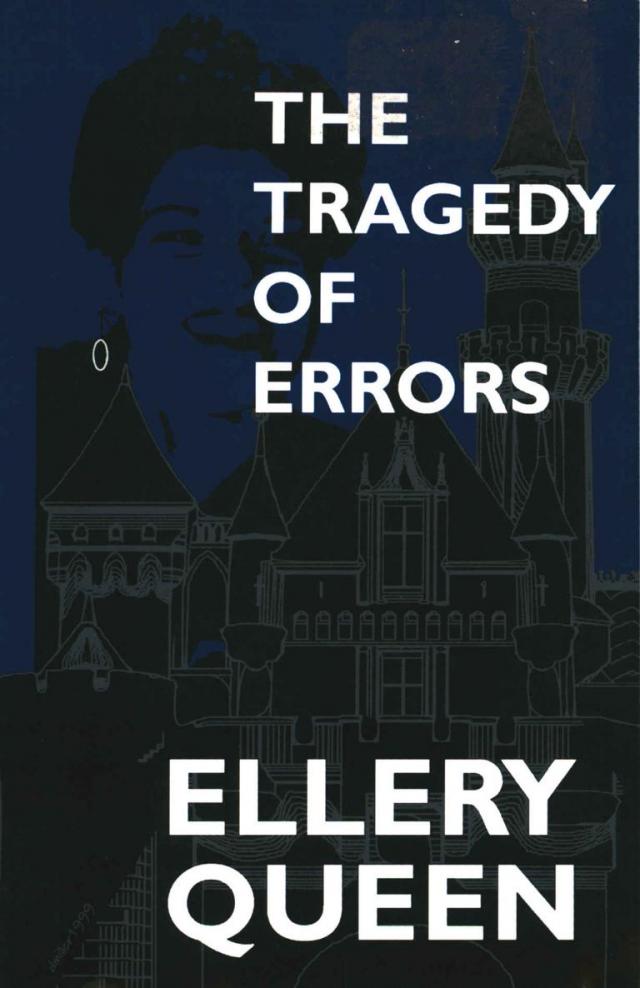


THE
TRAGEDY
OF
ERRORS AND OTHERS
ELLERY QUEEN
With Essays and Tributes to Recognize Ellery Queen's Seventieth Anniversary
Crippen & Landru Publishers
Norfolk, Virginia 1999
“The Tragedy of Errors” is first published in this book. It is copyright © 1999 by The Frederic Dannay Literary Property Trust and The Manfred B. Lee Family Literary Property Trust; all rights reserved.
“Terror Town,” first published in Argosy, August 1956, copyright ©1956 by Ellery Queen, renewed;
“Uncle from Australia,” first published in Diner's Club Magazine, June 1965, copyright © 1965 by Ellery Queen, renewed;
“The Three Students,” first published in Playboy, March 1971, copyright © 1971 by Ellery Queen, renewed;
“The Odd Man,” first published in Playboy, June 1971, copyright © 1971 by Ellery Queen, renewed;
“The Honest Swindler,” first published in Saturday Evening Post, summer 1971, copyright © 1971 by Ellery Queen, renewed;
“The Reindeer Clue,” first published in National Enquirer, December 23, 1975, copyright © 1975 by Ellery Queen.
Cover design by Deborah Miller
Crippen &. Landru logo by Eric D. Greene
ISBN: 1-885941'36-6
Crippen &. Landru Publishers
P. O. Box 9315
Norfolk, VA 23505 USA
Email: Info@crippenlandru.com
Web: www.crippenlandru.com
TABLE OF CONTENTS
Preface by the Publisher
THE TRAGEDY OF ERRORS
Letter From Frederic Dannay To Manfred B. Lee
SHORT STORIES
Terror Town
Uncle From Australia
The Three Students
The Odd Man
Note by Edward D. Hoch
ESSAYS AND REMINISCENCES
LEGACY
THE TEMPLE OF HIS WORD: GROWING UP WITH ELLERY QUEEN
THE AUTHORSHIP OF THREE LATE ELLERY QUEEN NOVELS
FRED DANNAY AND MANNY LEE
TRIBUTE TO FRED DANNAY
FREDERIC DANNAY, BSI
ELLERY QUEEN—MAN OF GOD
WE MAY AS WELL CONTINUE BEING CARROLLISH: A BOW BEFORE THE QUEEN
LEGACY OF AN EDITOR
A TRIBUTE
EQMM
AVOIDING MR. QUEEN
A LETTER FROM AN ARCHANGEL
ELLERY QUEEN: ONE OF THE MOST POPULAR MYSTERY WRITERS IN JAPAN
QUEEN'S GAMBIT: THE LIFE AND TIMES OF ELLERY QUEEN
CONCLUSION
THE ADVENTURE OF THE MURDERED MOTHS
Preface by the Publisher
Seventy years ago, two cousins, Frederic Dannay (1905-1982) and Manfred B. Lee (1905-1971), chose "Ellery Queen” both as their joint pseudonym and as the name of their detective, and their first novel, The Roman Hat Mystery, was published. During the next decades Ellery Queen became the most popular detective in America, and his creators two of the most influential mystery writers. Queen appeared not only in novels and short stories, but on the radio, in movies, on television, and even in comic books. Queen as scholar and editor wrote a number of critical books and articles on the detective story, and he assembled many anthologies and founded Ellery Queen’s Mystery Magazine, which has been published for almost sixty years. The Tragedy of Errors and Others, the first new Ellery Queen book since 1971, is published in honor of Queen’s seventieth anniversary.
A few words should be said about the contents and structure of this book. The title story is a detailed plot synopsis for the final but never completed Ellery Queen novel. As a general rule, Frederic Dannay devised the complicated plots of each Queen novel and story, and Manfred B. Lee did the actual writing—setting, character development, and much of the dialogue. Dannay completed his work on “A Tragedy of Errors," but Lee died before he could turn it into a full-length novel. The second section of the book contains the six hitherto uncollected short stories by Ellery Queen. "Terror Town,” which many experts consider one of Queen’s finest tales, has never previously been published in a Queen book probably because it does not feature the character Ellery Queen. The remaining stories are lesser efforts, but include typical Queen gimmicks especially dying messages and word play. The final story, "The Reindeer Clue,” was actually ghostwritten by Edward D. Hoch, but since it was published during Frederic Dannay’s lifetime and approved by him, we have included it to complete the Queen saga.
The third section is made up of essays, tributes, and reminiscences about Dannay and Lee and their contributions to the mystery story. The essays begin and end with surveys from different viewpoints of the cousins’ accomplishments, and there is a rudimentary grouping of the other essays around major topics, which the reader will quickly recognize. The reader will also note that because Frederic Dannay outlived Manfred B. Lee by more than a decade and, because as editor of Ellery Queen’s Mystery Magazine he was a more public person, we have more essays about Dannay than about Lee. Manfred B. Lee was, however, just as important in the Queen story, and (as Jon L. Breen points out in his opening essay), it is time that a complete study be done of these two extraordinary men.
1 would like to add a personal note. As someone who grew up reading and admiring the works of Ellery Queen, it is an honor to publish this book.
THE TRAGEDY OF ERRORS
outline of a new novel by
ELLERY QUEEN
CONTENTS
Prologue: Elsinore castle
ACT I
Scene I. Curtis’ law office
Scene II. Elsinore castle
Scene III. The same
Scene IV. The same
Scene V. Headquarters
Scene VI. Elsinore castle
Scene VII. Curtis’ office
Scene VIII Elsinore castle
Scene IX. Dr. Rago’s office
Scene X. Headquarters
ACT II
Scene I. A prison cell
Scene II. A courtroom
Scene III. Ellery’s hotel room
Scene IV. Elsinore castle
Scene V. A courtroom
ACT III
Scene I. Curtis’ office
Scene II. The same
Scene III. Paloma Beach
Scene IV. Elsinore castle
Scene V. Headquarters
ACT IV
Scene I. Ellery’s apartment
Scene II. A banker’s office
Scene III. Curtis’ office
Scene IV. En route to Elsinore castle
Scene V. Headquarters
Scene VI. Ellery’s hotel room
Scene VII. Curtis’ office
ACT V
Scene I. A safe-deposit vault
Scene II. Headquarters
Epilogue: A prison cell
DRAMATIS PERSONAE
MORNA RICHMOND (nee Mary Louise Ravich) was born on October 6, 1901. This story begins on April 3, 1967, so Morna is 65-plus. She was a superstar of the silent movies, world-famous throughout the decade of the 20s. She earned fabulous salaries and lived the fabulous Hollywood life of that era. When talkies came, in 1927-28, Morna was lucky—in fact, luck is really the keystone of her success. She was one of the most beautiful women in the world in the 20s, but she had almost no acting talent. Her voice proved to be sexy for the early talkies, so she easily made the transition from the silent screen to sound. But no director could change her stagey, exaggerated acting, which had been suited to the old silent pictures but was embarrassing in the new medium. Her beauty, reputation, and popularity carried her for the first few years of talkies, and then her career came to an almost abrupt end. She “retired.”
Morna had been consistently lucky in financial matters. On the advice of her late business manager she had invested in Los Angeles real estate, and when the boom came, she sold out for huge profits. At the time this story begins, she is living in her castle known as Elsinore on a 100-acre hilltop overlooking Hollywood—a veritable castle with turrets, ramparts, an honest-to-goodness moat (in which swans still glide), a gatekeeper’s lodge, and all modern conveniences including a swimming pool in the courtyard and an attached 8-car garage housing 4 autos— “his” and "her” sports cars (Morna’s rarely used), a long black limousine (for “shopping”), and a long white Rolls-Royce (for “state occasions,” which no longer occur). Morna bought the castle in the early 20s from an oil tycoon. In addition to Elsinore and a considerable fortune in jewelry, Morna, as of April 1967, has $ 10,000,000 in tax-exempt bonds which bring her about $500,000 a year in tax-free income, permitting her to continue living in the style to which she has become accustomed.
Morna is essentially a shallow person. She indulges herself emotionally, and nearly every upset sends her frantically to her psychiatrist, Dr. Rago, whom she often sees daily, and sometimes sees more than once a day. She has a sort of rough-diamond petty shrewdness or cunning that shows itself occasionally; but basically she is “temperamental,” dramatic, sometimes imperious, suggestible, absent-minded and forgetful; she constantly protests her "impracticality”—she can’t be bothered by business or household details; but she is keenly aware of every dollar coming in and going out. She is a mess of nerves and fears —emotionally disturbed about “getting old,” about her faded beauty, about her lost fame.
BUCK (known socially as STUD) BURNSHAW (ne Bernard Perkins) was born on July 6,1937. When this story begins, he is nearly 30—o ne-half Morna’s age. A small-part actor in low-budget Westerns, Buck is an ambitious, self-deluded, unscrupulous hustler who never made it in pictures, who blames his failure to be a star on bad luck instead of errors of judgment and actions, and who is willing to do anything to hit it big. Basically he is simple-minded, impulsive, often rash. He is easily influenced, gullible, unstable, always leaping before he looks and having no control of his vicious temper when things inevitably go wrong.
Morna and Buck first met in I960, and quickly came to an arrangement. Morna needed a handsome, virile young man to satisfy her still-active physical desires and to feed her ego and vanity. Buck needed a situation that promised him a big score. There is no marriage—Morna would never even consider it—but they live together in Elsinore castle. For a year Elsinore rang with fabulous parties; news cameras caught the lovers’ frequent personal appearances and gossip columns even hinted at Morna Richmond’s “return” to films. But all attempts by Morna and her newly hired press agent to recapture the glamorous days of the 20s were doomed to failure. Neither Morna nor Buck has any real friends, and soon the hangers-on and freeloaders drifted away or were sent packing, leaving the two lovers alone in the Class-B-horror-film castle. (Morna is emotionally dependent on her psychiatrist, Dr. Rago; she confides everything to him, and in the sense that he helps her nearly every day, in a visit or by telephone, he is a friend.)
Morna’s days have become routine: breakfast never earlier than noon; afternoons spent in perpetual cosmetizing and sunbathing at the pool— she is a sucker for any new lotion, cream, or whatnot, and a fanatical sun worshiper (vain attempts to halt the ravages of time—she is 65, insists she is 55, and looks 70); evenings glued to the television, which she says she detests, but really loves; sleepless nights watching late-late-late shows, especially old movies, hoping that some of her own will miraculously come to life; and nearly every day—bitter, recriminating quarrels
with Buck, most of them followed by desperate visits to Dr. Rago.
Buck, who by now has invested seven years in this "main chance” and who will put up with anything to save his investment, hangs around, alternating between catering to Morna and treating her with bursts of contempt. Whenever he can’t stand it any more, he drives off at reckless speed in "his” sports car to find solace with his girl friend, Cherry O’Hare. Morna’s and Buck’s lives are not ones of quiet desperation: their life together is violently loud and filled with cruelty and mutual hate.
CHERRY O’HARE is an ex-starlet reduced to B-girl, a go-go girl, or any other kind of girl who can make a fast or an easy buck. O’Hare is her real name, and she was christened Margaret. As a starlet she called herself Scarlett O’Hare, and when this didn’t help she changed her first name to Cherry (suggested by Buck). She keeps turning up throughout the story like a bad penny—a frank opportunist constantly on the make.
DION PROCTOR is a young coal-black unproduced playwright. He wears a modified Afro-style haircut and conservative-style clothes. He seems to be passive and detached, interested only in his work; he is always cool, expressionless, self-protectively aloof, low-voiced, and he speaks only when he has to. Morna is his patroness: she gives him a monthly allowance and the use of the small renovated gatekeeper’s lodge situated quite for from the castle, out of earshot, where the county road ends and the private road to the castle begins. Morna thinks Proctor is a second Shakespeare, and she has promised to finance the production of his first play, which he has been rewriting for years. Dion has no car— he gets around on his motorcycle. He never has visitors, and when he wants to socialize, he goes to an ethnic coffeehouse in L.A.
SERVANTS at Elsinore castle: cook, three maids, handyman- gardener, and chauffeur-butler.
THEODORE (Ted) CURTIS, JR is an ambitious, aggressive lawyer. His father, Old Theodore, was also a lawyer, and in the 20s through the 50s he was a Hollywood character. Some of the most celebrated and/or notorious film people were the old man’s clients. With a spectacular practice Old Theodore had lived like a motion-picture superstar. But this high living and a series of expensive wives (and even more expensive community-property settlements) and a string of careless investments finally brought the old man to suicide—in 1964. Ted inherited the remnants of his father’s practice. Most of the old clients were dead, and those who weren’t had little lucrative legal work left. One of the old clients is Morna Richmond, and Ted handles all her financial and business affairs, which really don’t amount to much in actual legal fees. At the beginning of this story the once spectacular legal practice is reduced to a staff of two in a small suite of offices in a second-rate building, and for the past three years Ted has been scrounging and scratching for new clients.
DR RAGO is in his early forties. His typical psychiatrist's (Freudian) beard almost makes him look older. He wears fashionably long hair, semi-mod clothes, and is a chain pipe smoker. His professional manner can be gently and compassionately persuasive, but usually he talks with authority, and always with a contemporary point of view.
ARNOLD KOLISHER is a publicity-minded criminal lawyer.
REED HARMON—see outline.
LIEUTENANT PEREZ is a lieutenant of Homicide, LAPD.
NOTE: The Prologue, the 5 acts, and the Epilogue—each to begin with an epigraph—a believe-it-or-not or shocking or incredible or really wild news story, in quotes and with source, from 1967. Also consider having a similar but much shorter quotation at the beginning of each scene.
PROLOGUE
Elsinore castle. “Sudden and quick in quarrel”
Monday, April 3, 1967: Morna and Buck have the most violent quarrel in their seven years of living together. It starts in the living room when Morna produces another woman’s handkerchief, with the name Cherry stitched on it, which Morna found a week ago in one of Buck’s twenty sports jackets. Morna demands to know who Cherry is. Buck says he knows nothing about the handkerchief or how it got into his pocket, and doesn’t know anyone named Cherry. Morna laughs: does he think she’s a fool? As soon as she found the handkerchief she hired a private detective to follow Buck. This morning she received the detective’s report. She knows the girl’s full name, Cherry O’Hare, where the tramp lives, how often Buck has visited her apartment, how long he stayed each time. Buck has broken his promise—he has been cheating on Morna.
Buck laughs: Cheating? He reminds Morna they are not married. And look who’s talking about breaking promises? What about the large sum of money that Morna promised him seven years ago, or her promise to make out a will and name him her heir? The quarrel quickly degenerates to name calling and a double catalogue of all the complaints they have against each other.
Before the fight reaches its climax, there is a near-interruption. Dion Proctor has motorcycled from the gatekeeper’s lodge to the terrace outside the living room. Morna and Buck are too deeply involved in their accusations and counter-accusations to hear the motorcycle. Dion is about to enter the living room when he hears the quarrel. He listens for a few moments, his face expressionless, then shrugs, starts his motorcycle—Morna and Buck are still oblivious of any outside noise— and drives back to the lodge.
Just after Dion’s departure, Morna hits the peak of her rage and says the one unforgivable thing. Buck’s left leg is slightly shorter than his right and he wears a special built-up shoe. Morna calls him a cripple. Buck loses his temper, seizes Morna by the throat, and begins to strangle her, yelling over and over again: “I’ll kill you! I’ll kill you!”
Morna’s screams bring in the servants, who separate the two. When Morna recovers she goes to her bedroom and locks the door behind her. A little later, when Buck cools down, he tries to enter Morna’s bedroom, but she calls out “Go away." Buck, desperately afraid he has gone too far this time, tells her through the door that he didn’t mean it, that it will never happen again, to let him in to prove how sorry he is. He wheedles, cajoles, then slyly suggests, and finally Morna opens the door. Buck lifts her in his arms and carries her to the bed. He possesses one irresistible means of reconciliation. He whispers, caresses, excites .. .