The Tragedy of Errors and Others, page 12


Through the forties, radio and its business details were primarily Lee’s bailiwick. Lee never wrote a novel on his own, though he reportedly had a standing offer for one from Random House editor Lee Wright; two collections of magazine true crime articles published under the Queen name were his sole work, though based on research material provided by the magazine.
In 1941, the same year Dannay produced the landmark anthology 101 Years’ Entertainment, he launched Ellery Queen’s Mystery Magazine, still the premier periodical in its field. The great first decade of the magazine was a difficult, sometimes tragic one for Dannay in his personal life: a serious traffic accident late in 1940 that had left him hospitalized for weeks was followed by recurring health problems, the death from cancer of his first wife, and (following his marriage to his second wife) the long illness and eventual death of his third son, Steven. While all this was going on, Dannay’s playful, informative, and enthusiastic story notes in the magazine and anthologies celebrated the joys of book collecting, editorial discovery, and games playing.
Manfred Lee made occasional editorial contributions to EQMM and their contract with publisher Lawrence E. Spivak specified he would take over the editorship in the event Dannay died or (during World War II) was drafted. But in reality and in the eyes of the mystery field, the magazine was Dannay’s. At one point, Lee groused about the fact that his money was being used to pay Joseph T. Shaw, legendary former editor of Black Mask, to find potential reprints for the magazine, work that Lee could have been doing (and indeed later did for a time) himself.
As early as 1950, the team contemplated recruiting and training a stable of ghost writers, and they had earlier used ghosts on some juvenile adaptations of Queen movies and radio shows (Anthony Boucher taking over the plotter’s role from Dannay) and on the series of juvenile mysteries signed Ellery Queen, Jr.—the author of the latter aroused the ire of Lee by farming out the writing of some of the books to a sub-ghost. In the sixties, with Lee suffering from writer’s block (among other psychological and physical ailments), science fiction writers Theodore Sturgeon and Avram Davidson were brought in as uncredited third collaborators to turn Dannay’s outlines into new Queen novels. Meanwhile, totally non-Queenian paperback originals, written by various ghosts and edited by Lee, appeared on the market to confuse fans. The team’s efforts to keep the ghosting secret tested the loyalty of the New
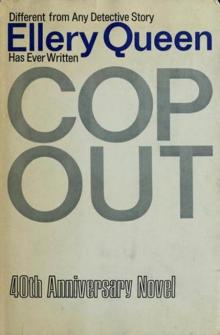
York Tims critic, EQMM columnist and longtime Queen friend and admirer Anthony Boucher, who at one point wrote to Dannay to warn him that a coming Tims column would have harsh words about the ghosted paperbacks. Apparently informed by Dannay of Lee’s precarious health and the bad effect such an attack in print might have on him, Boucher wired reassurances that the column had been killed. However, soon came the shattered Boucher's news that the column had run after all without his knowledge, though with some of its bitterest passages editorially cut—in the interest of length, not content. Though Lee finally conquered his writer's block, returning to the traditional collaboration for the last few Queen novels, the authorship of the very atypical fortieth-anniversary novel Cop Out (1969), which Dannay swore was the work of the cousins alone, has spurred controversy among Queen devotees because of its marked difference in style and approach from other genuine Queen novels.
After Lee’s death in 1971, Dannay carried on his editorial duties but produced no more fiction. A last paperback original and a single EQ short story for National Enquirer were the work of Edward D. Hoch. The year after Lee’s death, Dannay for the second time lost a wife to cancer.
In his last decade, Dannay married for a third time and became more visible, lecturing publicly for the first time in thirty years at a San Diego mystery writers’ conference and even being interviewed on television by Dick Cavett. Shortly before his death in 1982, he retired from the magazine he founded—ironically, for commercial reasons, EQMM included no obituary nor any recognition of his passing, apart from a brief tribute in the present writer’s book review column.
Why is the Ellery Queen story so dramatic and significant? The two cousins lived through many of the great events of the twentieth century, being affected by and responding to them in ways that were sometimes typical of their generation, sometimes surprising. They were associated with many of the significant writers of their time, both in and out of the crime-fiction genre. Apart from writing some of the most ingeniously plotted detective novels of their time (and all time), they created one of the few Golden Age detective heroes who grew and developed from book to book. They demonstrated an ability to adjust to changes in the field, to experiment with theme and subject matter, without sacrificing the qualities that made their work unique. The influence of Queen (primarily the Dannay half) on the development of the detective story in the century through discovering and encouraging new writers cannot be over-estimated.
The story of Ellery Queen is both a landmark in American literary history and a fascinating human story of the sometimes troubled face behind the enthusiastic and playful mask. While other seminal figures in crime fiction (Arthur Conan Doyle, Dorothy L. Sayers, Agatha Christie, John Dickson Carr, Ngaio Marsh, Margery Allingham, Dashiell Hammett, Raymond Chandler, Jim Thompson, James M. Cain, Rex Stout, S.S. Van Dine, Ross Macdonald) have been the subject of major biographical works, Ellery Queen, as significant and biographically interesting as any of them, has not. Apart from Francis M. Nevins’s two book-length studies, they have also been comparatively neglected critically. A combination of factors has worked against them. In literary criticism, there is a general bias in favor of individual creation and against collaboration. The multi-faceted Queen has been viewed as a brand name (or even, with the sixties use of ghostwriters, a house name) rather than an author. For whatever reason, the full story of these two remarkable men remains to be told.
Legacy
by Douglas and Richard Dannay
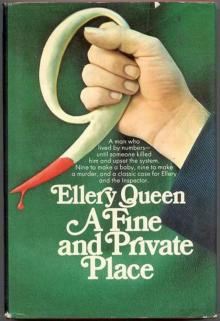
Of course, there were the novels (Ten Days' Wonder, Cat of Many Tails,. . .), the short stories (The Adventures of Ellery Queen, Calendar of Crime,...), the anthologies (101 Years’ Entertainment, The Misadventures of Sherlock Holmes, ...), the scholarship (Queen’s Quorum, The Detective Short Story), the radio show (CBS, NBC, . . .), the television show (Dumont, NBC, . . .), the magazines (Mystery League, Ellery Queen’s Mystery Magazine), and the Grandmaster’s award given by the Mystery Writers of America. The legacy to the detective story genre is undeniable, but there was more . .. The Golden Summer, an autobiographical fiction of a ten year old’s summer in 1915, was written by one Daniel Nathan ... It wouldn’t take Ellery Queen very long to deduce where the name Dannay originated: the DAN from Daniel, the NA from Nathan, the Y for sound and good looks. The Frederic would require some investigation before an admiration for Chopin was uncovered. The Golden Summer ended with these lines of poetry:
May there be Forever in your heart A country stream,
Forever in your dreams A wind that lifts,
A field that sings.
Thirty-one years later came 0 Lost and Lonely Star, a difficult collection of poems exploring the relationships among family, friends, acquaintances, and religion, unpublished. It contained the following poem:
One hot day our gardener, a walnut-man in his seventies,
came in to fret about the chinch bugs.
He found me at my desk, facing a typewriter,
an unweeded manuscript growing wild.
When he left he said,
“I don’t see how you do it— if my life depended on it, I couldn’t think up a story.”
One cold day in winter
I saw the gardener shoveling our walk
free of snow. That wrinkled, hard-shell man,
past his biblical time,
tossed snow effortlessly,
singing loud opera in the flurried air.
I said to myself,
"I don’t see how he does it— if my life depended on it, I couldn’t clear away that snow.”
Luckily, he didn’t have to and could spend his time weeding and taming EQ manuscripts.
But the personal legacy was books, the love of a book not only for its content but as a physical object of beauty, a collector's love. We absorbed his feeling for books, his attitude toward them, his reverence, and, surrounded by their wonder, we too became collectors—not that we could ever approach what our father had built.
First there was the detective short story on which he was probably the world’s leading expert. His collection provided raw material for Ellery Queen's Mystery Magazine and for Queen's Quorum, acritical judgment of the best of the detective short story, an indispensable cool for collecting the detective short story, and still quoted in rare book catalogues because being included in Queen’s Quorum enhanced a book’s collectibility. His collection contained the marvels of the field: Poe’s Tales in the original wrappers, A Study in Scarlet in the original wrappers of Beeton's Christmas Annual, The Adventures of Sherlock Holmes inscribed, The Memoirs of Sherlock Holmes in the dust jacket, the manuscript of “A Scandal in Bohemia.” But Dupin and Holmes were joined by Jacques Futrelle’s Thinking Machine (the book inscribed), Maurice Leblanc’s Ars&ne Lupin, Freeman’s John Thorndyke (the book signed), Chesterton’s Father Brown (the book signed), Post’s Uncle Abner, Philip Trent, Hercule Poirot, Lord Peter Wimsey, Charlie Chan, The Saint, Sam Spade, Perry Mason, Philip Marlowe, and, of course, Ellery himself, all represented in the mysterious first editions, a collector’s Shangri-La.
The books were sold to The University of Texas. What else was there to add? And so our father then began putting together an incredible poetry collection, the greatest books by the greatest poets. These first editions would also be his, allowing him now to touch the greatness of a literary form he also loved.
His poetry collection was auctioned at Christie’s in 1983: Beaudelaire, Browning, Byron, Chaucer, Coleridge, Crane, Dickinson, Eliot, Housman, Hughes, Keats, Kipling, Masefield, Masters, Omar Khayyam, Poe (an old friend!), Robinson, Rosetti, Sandburg, Shakespeare, Shelley, Tennyson, Thomas, Whitman. Masefield's Reynard the Fox was illustrated with 54 pen-and-ink and watercolor drawings in the margins, on blank pages, on endpapers. His copy, inscribed and with these wondrous illustrations, was one of only three such copies known: one had belonged to King George V, the other to Masefield's wife Constance. Even the poets might have difficulty appropriately describing such a book. This special book was auctioned again at Christie’s and now once again belongs to our family.
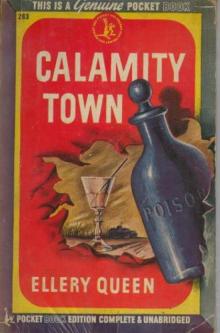
In a sense, our serious collecting began with four books of poetry from that spectacular collection: to one of us, Housman and Robinson; to the other, Sandburg and Masters. It was Spoon River Anthology that inspired the creation of Wrightsville, which first appeared in Calamity Town. But why the books of Housman, Robinson, and Sandburg? Mystery is not unique to the detective story. It also lies at the heart of great poetry and at the heart of one’s response to it.
Although our father’s archive of manuscripts and correspondence is housed now in the rare book library at Columbia University, the Ellery Queen/Barnaby Ross books themselves, the physical books, were going to remain in the family. Still, they had to be divided between us. Much choosing followed, coin flipping over the piles of books we had brought to the dining room table in the Larchmont house, a Danny-Nathan-like golden summer activity. Negotiations went on easily as the books found new shelves in different homes. Perhaps, the most difficult moment arose over the nine digest-sized paperback collections he edited of the Dashiell Hammett short stories. They made an important contribution to a revival of interest in Hammett after the political quagmire he had fallen into, but the books were not all that valuable and wouldn’t be all that hard to obtain in the rare book market—except that seven of the nine were inscribed by Hammett to our father. Inscribed! And one of the inscriptions said: "For Fred—and, Jesus, was I glad to see him again” So, which of us would get four? Not exactly a problem equivalent in difficulty to the one offered by Frank Stockton in “The Lady, or the Tiger?’’ (a Queen’s Quorum title, by the way). But a seventh inscribed Hammett! What balanced that? Well, Stockton never did open that door.
So, now we're both into the hunt that was such an important part of our father’s life, trying to fill in the gaps in his own Ellery Queen/ Barnaby Ross collection—inexplicable gaps for a great collector to endure, like The French Powder Mystery in dust jacket which he did not have. Maybe we’ll succeed, but every book collector knows that even if you get every title you want, there’s always a copy out there in better condition, a signed copy, an inscribed— Well, we’re sure that there never were inscribed copies of those other two Hammett collections. We’re absolutely sure, absolutely . . .
And why wasn't there a copy of The French Powder in dust jacket? Who knows? All any good mystery needs is a good detective. Ellery would be perfect, stepping into the heart of the mystery from a distant golden summer when it all began . . .
The Temple of His Word: Growing Up With Ellery Queen
by Rand B. Lee
My father, Manfred B. Lee, died of a heart attack around 8 p.m., Eastern Standard Time on April 3, 1971. He died in the upstairs dressing room of our big white house on South Street in Roxbury, Connecticut, lying on the floor’s bare oak planking. When he and my mother had moved into the house in 1931, the oak had been shamed by a coat of grey deck paint; they had stripped it together, inch by inch, marveling at the blockheadedness of anyone who could not comprehend the glory of old oak. I was not a year old. When my father lay dying, I was just twenty.
I was not present at his passing. I was in college, far away in Maryland, thrashing through thickets of sexuality and philosophy and self-doubt. My brother, Manfred B. Lee, Jr., had returned from serving with the Marine Corps in Viet Nam not long before. My sisters, Jacquelin, Patricia, Anya, and Christopher Rebecca, were scattered around the East Coast, with husbands or children or Greenwich Village cats. Not even my mother was present when my father died. Anthony Joseph and Jeffrey Robert, my eldest and youngest brothers respectively, were in the house that day, and they sent her downstairs to the kitchen so that she would not have to witness my father's death throes. Jeff said that Dad died quickly, without a word uttered; as my brothers knelt beside him, they witnessed the light of his sharp, wary intelligence fading from his eyes by perceptible degrees. “It was at that moment,” Jeff told me, “that I knew human beings have a soul.”
It was many years before I heard this version of my father’s death. At the time of the actual event, the story Jeff and Tony told us was that our father had died in an ambulance rushing him to the hospital in nearby New Milford, nine miles away from little Roxbury. From the first, my mother insisted this was untrue. Her version of the story was that Dad had died in her arms in their bedroom, whispering, “Help me.” It must
have comforted her to think so.
The truth is probably an amalgam of all three tales: that Dad had his heart attack in the bedroom he shared with Mother; that after my brothers sent Mother downstairs, Dad became unconscious on the floor of the dressing room, Jeff kneeling beside him; and that he achieved brain death on the ambulance ride. But the mystery doesn't stop there. Now, twenty-eight years later, seventy years after my father and his cousin published their first book under the pseudonym of “Ellery Queen,” everyone who was in the house that day is dead: Tony of a heart attack while jogging in 1987; Jeff, of AIDS in the spring of 1990 while—in an eerie replay of the events that claimed our father—an ambulance sped him toward a hospital in Cork Gty, Ireland; Mother in 1991 at that same hospital, while my sister Christopher and a cousin were taking a short break from their days-long vigil in the ward. One would, by this juncture, be deeply suspicious if these events had taken place in an Ellery Queen novel.
I must have been ten or eleven when I first found out my father was famous. We lived on 63 Vi acres in rural Roxbury, Connecticut, which in those days was virtually undiscovered. Our house, the house Dad died in, had been built in 1792. About a hundred yards from the kitchen door stood a second dwelling, a remodeled colonial school building that we called the Little House. My sister Christopher, whom we always called “Kit," lived in one half, and Dad had his study in the other.
Dad's study was normally off-limits. You were only officially permitted to go there when he was present, and his presence did not ensure your entry; you had to knock, timidly, first, and gauge by the tone with which he replied whether or not it was safe to cross the threshold. If my mother was Juno, passionately nurturing and vengefully possessive by turns, my father was Jove: autocratic, a good provider, brooding, sensual, and pleasure-loving. He thundered from on high when he was angry, brooking no back talk. That day he was gentle, and invited me inside. I passed into dimness.
I had been there before, of course, this sanctum sanctorum of dark wood and the scent of pipe tobacco, but the walk up the old carpet to my father’s big, paper-littered, glass-topped oak desk seemed longer than usual. My father sat behind his desk looking like a benign pope. He was short and heavyset, with a full grey-and-black beard and a rich bass voice, and the whole place was full of his hierophantic presence. A lot of people thought he resembled Ernest Hemingway, and in fact, several days after the news wires were flooded with reports of that writer’s death, Dad was walking through Grand Central Station in New York when a passing businessman raised a hat to him and remarked, “Good morning, Mister Hemingway.” Dad nodded graciously and continued on his way, but he came home chortling to Mother, “Til bet that guy got a shock when he told his wife whom he had met!”