The Torch in my Ear, page 37


It turned out that each of the girls was willing to come, but only after they were again reassured that the paralyzed man wasn’t sickly. They also wanted to know his name, and both his first and last name had a cozy ring for them. A girlfriend of theirs in the tavern was also named Marek. They asked Professor Gomperz to pick one of their willing number, the one he liked best, for “Thomas” (they were already calling him that). Now, all of them were pretty, though in different ways. The professor didn’t have such an easy time making his choice, and when he subsequently told Thomas about his adventure, Gomperz dubbed it his “Judgment of Paris.”
However, the professor wasn’t present the first time the girl came; he said he didn’t want to spoil their fun with his gray beard. The girl was warm and zealous, and Thomas got what he had so intensely wished for. He was beside himself with joy and, in his exalted state, he forgot to remind the girl about the payment lying on the dresser. She, in turn, was so absorbed by her new task that she neither looked for the money afterwards nor asked for it, and she promised of her own accord to come back on the following Saturday at three in the afternoon. She came punctually, never missing a Saturday. Thomas had to remind her about the money for her first visit. She did take it; but after being with him, she would never take money, and when Thomas asked her to take it, she said, “Don’t worry about it! I’ll visit you for fun.” And a whole week had to go by before she could bring herself to go over to the dresser and pick up her pay, which had, after all, been agreed upon.
This continued for more than six months, and he always had to remind her about the money. In his heart, he wished she would leave it there, and his wish was so strong that he always devised new ways of talking about it. “Someone’s poured out his purse on the dresser,” he said. “Could you pick it up, please!” Or, “Why do people have to leave their money here! I can’t stand it! Am I a beggar?” It had to happen right when she came; for later on, there was no way of getting her to take it. On Saturday, when he wanted to look forward to her arrival, the moment came when that silly matter occurred to him and he had to concoct something new. Also, it offended him that the whole business was connected with the professor, as if Gomperz were still taking care of it after all those months. If Thomas was in a bad mood and wanted to hurt the girl, he said: “Your friend, the professor, sends his best.” Or, “Did the professor show up again in your tavern?” The girl was simple; she obeyed him because she didn’t want to displease him. He was obstinate, he wouldn’t let up, and she didn’t dare come near him before doing what he reminded her to do. She would have preferred to bring him something herself, but when she tried to give him small presents, she got nowhere. “There’s the present,” he said vehemently, twitching his head toward the dresser. “Only the professor gives presents here.”
Had she divined his true wish, everything could have gone on nicely; but his pride gave him no peace; he forced her to take what she didn’t even want; and what was initially excessive gratitude turned into resentment. During the week, he might sometimes think of her with hatred. He lay in his wagon, basking in the sun, a woman went past with an appealing walk, and he thought with hatred about the impending Saturday visit. He told me how they had broken off, and he didn’t seem to regret it. He viewed it as a manly action, worthy of a free spirit, especially since he had no one for quite a while after that. He had said to her, rather gruffly, “You’ve forgotten something again!” He waited until the despised thing was in her purse and then he said: “You don’t have to come anymore.” He refused to explain. As she stood in the doorway, turning to him with a querying look, he hissed: “I have no time. I have to study more.” She wrote him a letter, awkward and full of mistakes, a love letter such as I have never seen—if only I had memorized it.
He let me read it. He observed me as I read it. He seemed untouched; it had been some time ago. Nevertheless, he had kept the letter, and when he wanted to see it, he said to his mother in the terse way that he felt sufficed for her, “Give me the letter!” He didn’t explain which letter, but she knew the one he meant. I read it and understood what had happened. It was obvious how unfair he had been to the girl. He remained adamant, and the last thing he said about it was: “Then she should have sent it back to Gomperz, all of it!”
Meanwhile, he had learned how to impress women, and in conversations he let on that he was experienced in amorous matters. He was visited by women, who were allowed to sit out in the sun by his wagon, telling him about their unhappy marriages and what they suffered from their brutal husbands. He listened to them, and they felt understood. Sometimes he gave them advice, which they followed; they came back and thanked him; the advice had worked. If he didn’t like the way a woman walked, he refused to converse with her. He would then signal to his mother, and she would take in the wagon with him, thus breaking off the session, which hadn’t really begun.
The miracle he was waiting for occurred after we became friends. A female physician, whose office was located in Ober Sankt Veit, once visited him to treat him for a feverish cold. She came driving up in her little car and was instantly taken to him in his bedroom, so that he didn’t even see her walk. The fever made him somewhat numb, and he was dozing. Suddenly, she stood before him and identified herself as a doctor. Even in this condition, he did not fail—as was his wont—to slowly open his eyes wide, and he achieved the usual effect. The doctor fell in love with him on the spot and, when he was healthy again, she invited him on short drives in her car. Whenever she had time and the weather was nice, she came to pick him up.
Initially, she lifted him out of the wagon with his mother’s help and placed him in the car like a bundle. Then she asked him what he would like to see; he could select anything he wanted. The drives, brief at first, grew longer and longer, ultimately going as far as Semmering. He intoned his own song when he was lifted into the car for such a drive. I witnessed it several times: I wanted to visit him, and though I already saw the doctor’s car in front of his house, I didn’t turn back. I approached them, supposedly to say hello, but actually to hear the happy breath of his voice, which was trying to rejoice because the world was opening up to him. The physician, who handled him very cautiously, spending every free moment on these drives, became his mistress; and she remained his mistress all the time I knew him.
Kant Catches Fire
After moving out to my hill at the edge of the city, Vienna, between Veza’s home on Ferdinandstrasse and Hacking, that is, Vienna at its broadest, became my province. When I came home from Veza’s late at night, I didn’t take the urban railroad (the shortest connection) to the last stop, Hütteldorf-Hacking. There were two trolley lines not far from the urban railroad and running parallel to one another through a more densely populated neighborhood. I hopped a trolley. It was a very long ride; somewhere along the way, wherever I felt like it, I jumped out and then walked up and down the dark streets. Throughout this large district, there was no street, perhaps no house, that I didn’t get to see during my scouting trips. And quite certainly, I visited every tavern that stayed open late at night.
After my return to Vienna, I was much more eager to go on these trips. I was filled with a deep distaste for names; I wanted to hear nothing about names; I would have preferred to bash away at them all. Having lived in the midst of the big name-kitchen—three months the first time and six weeks the second time—I had an afflicting sense of disgust at names. I felt (a vision of horror since my childhood) like a feeder goose, incarcerated and force-fed with names. Your beak was held open and a gruel of names was stuffed into it. It didn’t matter which names were mixed in, so long as the gruel contained them all and you thought you were about to choke on it. I opposed this united affliction and harassment by names, I resisted it by means of every person who had no name, everyone who was poor in name.
I wanted to see and hear everyone, for a long time, over and over, hear everyone even in the endlessness of his repetition. The freer I became for this and the more time I devoted to it, the greater my astonishment at this variety, and right in the poverty, banality, the misuse of words, not in the braggadocio and bumptiousness of the writers.
If I entered a nocturnal tavern that offered me a favorable opportunity to hear, I would remain for a long time, until the place closed at 4 A.M., I would surrender to the stream of entering, departing, returning figures. I enjoyed shutting my eyes as though half asleep or turning to the wall and only listening. I learned how to distinguish among people purely by hearing. I didn’t see a person leaving the place, but I missed his voice; and as soon as I heard his voice again, I knew that he was back. If one didn’t shy away from repetition, if one took it in fully and without disrespect, one soon recognized a rhythm of speaking and replying; scenes took shape out of the ebb and flow, the movement of acoustic masks, and these scenes, in contrast to the bare shrieks of self-assertion by those names, were interesting—that is, not calculating. Whether achieving their effect or not, the scenes recurred—or perhaps it would be more accurate to say that the purview of their calculation was so narrow that they were bound to appear unsuccessful to the listener, and hence futile and innocent.
I liked these people, even the most hateful among them, because they were not given the power of speech. They made themselves ridiculous in words, they struggled with words. They gazed into a distorting mirror when they spoke; they demonstrated themselves in the distortion of words, which distortion had become their alleged likeness. They made themselves vulnerable when they courted understanding; they accused one another so unsuccessfully that insult sounded like praise and praise like insult. After my experience of power in Berlin, which I had perceived up close in the deceptive guise of fame, and in which I had thought I would suffocate, I was understandably receptive to any form of powerlessness. It seized hold of me, I was thankful to it; I was unable to sate myself with it, and it was not the openly declared powerlessness with which others like to operate selfishly: it was the hidden, dyed-in-the-wool powerlessness of individuals who remained apart, who couldn’t get together, least of all in speech, which separated them instead of binding them.
There were many things that attracted me to Thomas Marek, most of all his daily strain to overcome his powerlessness. He was worst off of all the people I had ever known; but he spoke, and I understood him. And what he said had meaning. It occupied my mind not only because it cost him such an effort to form words out of his breath. I admired him because with his intellect he had gained a superiority that transformed him from an object of pity into a person to whom people made pilgrimages. He was no saint in the traditional sense, for he was open to life and loved every aspect of it, most intensely those aspects that were denied him. In his childhood, he had begun with involuntary asceticism, and now everything that had happened in years of unspeakable toil was devoted to acquiring the faculties and facilities that other people took for granted.
I asked him whether it didn’t make a stronger impact on him to be read to rather than to read for himself. That had been true earlier, was his answer: when he had been younger, his sister had read to him: poems, stories, plays. That was how their friendship had started, that was how they had become inseparable. But then this had no longer been enough for him, he had wanted to get to more difficult things, which his sister didn’t understand. Should she have read to him mechanically without knowing what the sentences meant? He considered his sister too good for that, and she considered herself too good for that. Reading something to him, she communicated it to him. It had to be equally important for both of them; he didn’t want to demean her into a mere reading parrot. Also, he felt the need to reflect calmly at times and, if he couldn’t recall the exact wording, he wanted to look it up, as it were, and ascertain it. For both reasons, it became indispensable for him to read on his own. Did I have anything to criticize in his method of doing so?
Certainly not, I said. On the contrary, he had solved the problem so cogently that it seemed like the most natural thing in the world.
Which it was, and yet I never could get used to it. And whenever he read to me (perhaps just one sentence or even a whole page), I always felt as if I were experiencing it for the first time. I felt more than respect: I was ashamed that I had always had such an easy time reading, and I looked forward to what would come out with his method. Each sentence that he formed in this way with his breath sounded different from any other sentence that I had ever heard.
In May 1930, when I began visiting Thomas, I had already spent six months on my sketches. All eight characters of my Human Comedy of Madmen existed, and it appeared certain that each one would be the center of an individual novel. They ran about side by side; I preferred none. In rapid alternation, I focused now on one, now on another; none was neglected, nor did any predominate; each had his specific speech and his specific way of thinking. It was as if I had split into eight people without losing control of them or myself. I was apprehensive about giving them names; I designated them (as I have already said) with their dominant characteristics, and I restricted myself to the initials of these characteristics. So long as they had no names of their own, they didn’t notice one another. They remained free of residue, were neutral, and did not try to gain the upper hand over what they didn’t perceive. There was a huge leap from the “Enemy of Death” to the “Spendthrift” and from the latter to the “Book Man.” Yet the road was clear; they themselves didn’t block it. I never felt pressured; I lived with an élan and elation such as I have never known since then—the lone arranger and surveyor of eight remote, exotic territories, always traveling from one territory to another, sometimes even changing my place en route, never held anywhere against my will, never overpowered by anyone, a bird of prey, calling eight territories his own instead of one and never landing anywhere in a cage of caution.
My conversations with Thomas were about philosophical or scholarly subjects. He had quite a bit to say and enjoyed saying it, but he also wanted to know what I was occupied with. I talked to him about the civilizations and religions that I was investigating for any traces of crowd phenomena. Even now, during the period of my literary sketches, I devoted several hours a day to this project. He found out nothing about my literary doings; a sure instinct told me that my characters had something that was bound to offend him, whether because their far-reaching motion would strike him as hopelessly unattainable or because their limitations would remind him of his own. I made a point of keeping quiet about my sketches, and it wasn’t very difficult, for this way something inexhaustible was left over for our conversations: a work that came into my life at the same time as Thomas and that acquired cardinal importance for me, Jacob Burckhardt’s History of Greek Civilization. Thomas had familiarized himself with the Greeks long ago, but he had encountered them on the orthodox scholarly route of his period. He could explain to me in what ways the then new scholars deviated from Burckhardt; yet Thomas showed a fine sense for Burckhardt’s incomparably deeper interpretations. We agreed that Burckhardt was the great historian of the nineteenth century, and we felt that he should now come into his own.
This conversation was important to me, but I participated with only part of myself. However, I sensed that my relationship with Thomas, our frequent meetings, also had an effect on my other part, which I concealed from him.
There was more for me here with Thomas than with all other people I knew. This was due not only to the incomparable nature of his existence; he also surprised me with things I couldn’t expect. In some ways, he was like one of the characters I had invented: when you knew the condition on which he depended, then everything that happened with him was definite and consistent, nothing could have been any different from what it was. You felt that his conduct was lucid and graspable. He became the heart of my Human Comedy and, without appearing in it himself, the crowning evidence of its truth. But because he was so different from my characters, he seemed more alive than any of them. Nor could he be killed: his three suicide attempts, all very serious, had washed over him without a trace; things that would have killed anyone else had had no effect on him. He was now protected against all self-surrender; he knew it and was agreeable to it. Whenever he didn’t feel badly off, he was even proud of it; everything he gained from others, even from me, served to strengthen him.
He was more than the characters that I was filled with; for, in his independence, he procured his own life. Even in his condition, he was capable of unpredictable metamorphoses; this was what he surprised me with most. You thought you knew him, and yet he turned out to be unpredictable. I believe that, precisely because he was so much stronger and more mysterious, he would have caused the destruction of the eight characters with whom he clashed inside me. He didn’t know them; they knew him, and, being nameless, they were at the mercy of his name.
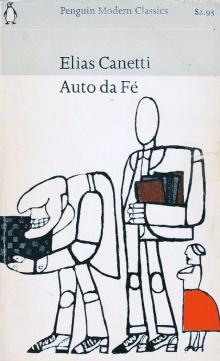
But he himself, who, in the course of just a few months, had become a silent, incessant danger to my project, who had innocently found entrance into every character, hollowing them out from the inside and weakening them—Thomas himself became the cause of a salvation. Seven of the characters perished; one survived. The immensity of my enterprise contained its own punishment; yet the catastrophe in which it ended was incomplete; something—today it is titled Die Blendung [Auto-Da-Fé in English]—has remained.
Thomas often asked me about experiences that were denied him, and once he even insisted on a precise description of the events of the Fifteenth of July. I told him everything straight out, in details that I had never pulled up and presented together. I felt how vivid this day still was in me after three years. His sense of it was different from mine: it didn’t terrify him; the swift movement, the frequent change of location had a stimulating impact on him. “The fire!” he said, over and over. “The fire! The fire!” He seemed almost tipsy. I told him about the man who had stood away from the crowd, clutching his hands over his head and repeatedly and woefully shouting: “The files are burning! All the files!” And Thomas was overcome with mirth, tempestuous laughter; he laughed so hard that his wagon began to roll and took off with him. Laughter had become a driving force; since he couldn’t stop, I had to dash after him and catch hold of him, and I felt the powerful thrusts that his laughter gave the wagon.