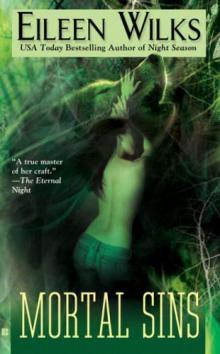
Mortal Sins, page 18
part #5 of World of the Lupi Series


Half the color drained out of the chief’s face, leaving it blotchy. “You—you—”
Brown had a particularly nasty smile. He used it now. “Now, Horace, I know what you’re thinkin’. Agent Yu isn’t one of us. She’ll head back off to D.C. or the West Coast or somewhere. But I won’t. I’ll still be in Charlotte, less than a hundred miles from here. You might want to think about stayin’ on good terms with your local FBI office.”
Ten minutes later, the door closed behind the chief and his detectives—who hadn’t been precisely thrilled to learn that Brown would be handling the coordination of city, county, and federal officers.
Deacon paused on his way out. “You think that’s a good idea, putting him in charge?” A jerk of his chin indicated Brown, still seated at the conference table.
“Agent Brown assures me he’s good at working with the locals. Though I’ll admit,” she said with a glance his way, “at the time I made the decision I hadn’t realized he was referring to the use of blackmail.”
Brown actually had a real smile. His lips curved up and his eyes lit with amusement. “Don’t know what you’re talking about.”
“Marianne Potter?” Deacon cocked an inquisitive eyebrow.
Brown waggled a hand. “Friend of a friend.”
“Your friend is a friend of the owner of a, ah, real well-known escort service?”
At this interesting point Lily’s phone buzzed. That meant a call forwarded from her official number. She grabbed it. “Yu here.”
“I sure am,” a cheery male voice said. “How’d you guess?” A chuckle. “I suppose you’ve heard that before. My sense of humor is, alas, very basic. Oh, this is Dr. Alderson. I conducted the autopsy on your dogs.”
“Right. Thanks for calling, Doctor.” She glanced at her watch. “You’ve learned something? Given the way magic screws up lab results, I wasn’t sure how much you’d be able to find out.”
“Your dogs weren’t intrinsically magic, so the magic still present doesn’t seem to be interfering with tests. And of course the visual exam is unaffected.”
“But you did treat the bodies as biohazards?”
“Oh, yes. Quite a nuisance, but I don’t want to catch whatever those poor beasts had. I’ll skip the gross physical findings for now, save to confirm that they had indeed ingested human remains prior to death. Oh, and there was a chip in one animal—the Doberman—so we were able to get a name and address for the owner, or at least the person who owned him at one time. Do you want that now?”
Hot damn. “Absolutely.” Lily grabbed a pad and pen. “Shoot.”
He gave her the name and address—a Halo address—then said, “The part I thought you might find interesting concerns the brain damage.”
“Brain damage.”
“Oh, yes. There’s significant generalized damage superficially similar to that caused by encephalitis, most extensive in key structures—the hippocampus, the prefrontal lobe, the frontal and temporal cortexes, with lesser damage to the amygdala. Specimens from those regions exhibit intrusions strikingly similar to Negri bodies, though the dFA was negative, precluding rabies.”
She understood the last two words. “So it wasn’t rabies.”
“That’s what I said. We’ve just begun the lab work, but there seems to be significant alteration in rostral linear nuclei and in periaqueductal gray neurons. Also, there is a notable loss of Purkinje cells—a condition that, in humans, is associated with ocular motor apraxia.”
“You do realize I have no idea what you’re saying, right? Except the ocular part. That means eyes.”
“Oh, dear.” He chuckled. “The layman’s version, then. I found extensive inflammation of the brain which was particularly severe in the regions associated with memory and emotional control. I understand the dogs attacked you? Poor things had no choice. They would have been flooded with rage.”
“And the part about the eyes?”
“There’s damage in the area of the brain that controls movement of the eyes.”
“Blinking?” she said, suddenly urgent. “Could it cause someone to blink a lot, or not at all?”
“Hmm.” He was silent a moment. “Possibly. One study suggested that synaptic plasticity occurring in Purkinje cells might be involved in—oh, dear, I’m descending into technobabble again. Suffice it to say that we don’t know enough about the brain and blinking to be sure, so my answer must be ‘possibly.’ I’m sorry I can’t be more definite,” he said, his relentless good humor momentarily eclipsed by apology. “I was reluctant to call with such a preliminary report, but your Mr. Brooks assured me you’d want to know.”
“My Mr. Brooks was right.” Ruben usually was. “You’ve already told him about this?”
“Yes, and faxed a copy of—oh, that’s right. He wanted me to tell you he’d see that Georgetown University Hospital received a copy of my preliminary report. He assumed you would know what that meant.”
“Yeah, the obvious is finally biting me in the ass. Give me a minute to think this through.” She tapped her fingers on her thigh, scowling, as she did just that. “Okay. One more thing I need you to do,” she said. And told him.
He agreed, asked a couple of questions, and refined her original suggestion. Lily disconnected.
“That’s just gross.”
The agent who’d spoken was almost as short as Lily and ten years older, with fluffy blond hair and twenty extra pounds. She was also named Brown—Mirabelle Brown—and the others called her Brown Two.
“It is,” Lily agreed. “But it’s the surest way to find out if my initial assumption about those dogs was wrong.”
Brown Two’s nose wrinkled. “And feeding bits of them to some other poor animal will tell you what, exactly?”
“Whether the death magic can be ingested along with the flesh.” She glanced at Deacon, who still hovered near the door, determined to hear whatever she’d learned. Looked like she owed him one. “I assumed that’s what happened to the dogs.”
“I recall that,” he said levelly.
“Unfortunately, we all know what ‘assume’ makes of ‘u’ and ‘me.’ The vet who autopsied them is going to—”
At that moment the fax machine began chattering.
“The vet is quick,” she said wryly. “Very briefly, Dr. Alderson found a pathology in the dogs’ brains that relates to symptoms exhibited by Roy Don Meacham. I want to know where those dogs came from.”
“Oh, sure,” Brown Two said dryly. “Two of them had collars, but no tags. Be a cinch to find out who owned dogs that lack tags.”
Lily mentally gave the woman points for attention to detail—and verbally gave her another assignment. “No tags when we found them doesn’t mean their owners didn’t register them. That’s why you’re going to talk to Animal Control. Get a list of all the registered dogs in the area and start tracking owners of those particular breeds. But first, talk with these people.”
She handed Brown Two the name and address Dr. Alderson had given her. “They owned the Doberman at one time. Had a microchip in him. The rest of you …” She gave them a quick scan. “Even untagged pets can be loved and missed, so I want all of you to ask about animals matching the descriptions of these dogs when you ask about missing pets. You’re also going to share Dr. Alderson’s report with the other vets and ask about animal attacks on humans or on other animals, particularly where one animal killed another.”
No one said anything for a moment. Then Deacon did, softly. “Shit.”
The obvious had just taken a chunk out of his ass, too. Lily gave him a level look. “Pretty much, yeah.”
“I’m not following you,” said the youngest agent—a man who, thank God, was not named Brown.
“If you’ve read my report about finding the first bodies, you know Rule Turner was attacked, but not killed, near the bodies.”
“Yeah,” Brown One said, the usual grumpy expression on his plump face. “Doesn’t fit. Why was the perp even there?”
“Exactly. My consultant suggested some kind of spell-trap near the bodies, but that’s not a very satisfying explanation. Why didn’t the dogs spring it? Why even have a trap? But if we toss out some assumptions, it starts making sense. Maybe the perp was there because that’s where he hangs when he’s between murders. Maybe he made Turner for lupus after initiating the attack and decided to go after something easier to kill, like me and Deacon.”
Brown’s mustache twitched with what might have been excitement. Or it could have been the urge to sneeze. “The dogs. You think the perp was possessing or controlling the dogs, and he wanted them to kill you and the sheriff.”
“Yeah, I do.”
“All of them at once?” Brown Two was skeptical. “You think we have multiple perps possessing animals?”
“Maybe. Or we may have someone who can control or possess more than one animal at a time. And yes, that’s supposed to be impossible, but this case is just crammed with impossibilities.”
“So how do we decide what to pursue?” Brown Two said, frustrated. “If everything’s equally impossible …”
“That’s why it’s such fun working on Unit cases. We get to make it up as we go along.” Lily sent her gaze around the room. “For now, we’re focusing on the animal vics. Those dogs tried to kill me and Deacon for the same reason Meacham bludgeoned his family and Hodge decided to blast away at neighbors and strangers—because they were possessed by something that feeds off death. Which means that people in this community may be in danger from the family pet.”
TWENTY-TWO
A shower had swept in, washing the air with the best smells in the world. Toby sat in his bed with the window open, which Grammy wouldn’t like because the covers might get wet.
He didn’t care. He didn’t care what she liked or what anyone else liked or didn’t like. They could all just leave him alone.
Especially her. She’d never had a problem doing that before.
He’d heard her. He’d been about to come downstairs and get some breakfast and see if Dad wanted to do something, maybe kick the ball around or go to the park so he could practice corner kicks. Then he heard her talking to Dad. His stomach had seized up and his throat had closed, almost as if he were scared.
He wasn’t, dammit. He tried the word out in a whisper. “Dammit.” It didn’t make his stomach feel any better.
His door opened. Toby looked around, scowling. It was Dad, and he hadn’t even knocked. “You’re supposed to knock.”
“Knocking implies I’d go away if you didn’t give me permission to enter. I’m not waiting on permission. I’m not Grammy.”
A worm of guilt squirmed around in Toby’s gut. He’d yelled at Grammy to go away when she knocked. Tough on her. She always takes Mom’s side. “I don’t want to talk to her or you or—or anyone.”
“Anyone meaning your mother, I take it.” Dad came over and sat on Toby’s bed—again without waiting to be asked. “You will apologize to Grammy.”
Toby just scowled. He probably would. Just not yet. “You’re gonna make me go down and be nice to Mom.”
Dad shook his head. “No, I’m going to make you apologize to Grammy.”
Surprise wiggled in so fast he couldn’t stop it. “So it’s okay if I don’t want to talk to Mom?”
“I don’t tell you what to want or not want. I sometimes tell you what you must do or not do. I’ve decided this one is your choice.”
Curiosity made it hard to keep his anger hot, so he scowled extra. “How come?”
“More or less the same reason I allowed you to choose to speak with the press. If it’s a mistake, it’s one you can learn from.”
“I hate her.” His stomach roiled unhappily. “I’m pretty sure I do. What does she want, anyway?”
“She wants to talk with you. That’s all I know.”
“It’s about the hearing, I bet. She didn’t tell you why she’s here?”
“She won’t speak of her intentions until you come down.”
And they needed to know. They needed to know why she was here, if she’d changed her mind about custody, what she was going to do. Toby’s chin set stubbornly. “You could make her tell.”
Dad’s face turned hard, as if Toby had insulted him. “I do not make women do things against their will.”
Shame added itself to the unhappy mix in his stomach. “You think she’ll go away if I stay up here? Or come up and knock on my door and …” And that’s who he’d wanted to yell at, he realized. Not Grammy. He’d wanted Mom to come to the door so he could yell at her to go away.
“I don’t know. My guess is that she isn’t leaving without speaking to you, but you can wait here and see.” Rule paused. “I assume you’ve thought about the consequences of this choice.”
He hadn’t. He didn’t want to think about her at all, but he couldn’t make himself stop. “I don’t want her here. I don’t want to talk to her or look at her or—or anything.” He wanted to keep hating her, but he might not. If he saw her, he might not hate her enough to … to keep from feeling other things.
“You’re very angry with her. She hasn’t put your needs first. But she’s given you the chance to have those needs met by others, especially Grammy. She’s spent time with you, but she’s never stayed with you. She’s let you down.”
She hadn’t come for Christmas. Toby swallowed and looked away.
He didn’t need her to live here with him and Grammy, not all the time, but she hadn’t come home for Christmas. That had been the one thing he could count on her for—that she’d be here, and she’d bring presents, and they’d eat turkey and dressing together, and she’d stay a few days. For a few days they’d all be a family like they were supposed to be.
Last Christmas, she hadn’t come. She’d gotten a fancy new position with the AP on the other side of the world, and she hadn’t come. And for all the months since Christmas, she hadn’t come. When Grammy broke her leg, Dad and Lily had come and helped. Uncle Mark and Aunt Deirdre had, too. Mom had called, sure, but she hadn’t come.
Now she had.
Toby looked down at his feet, which were up on the bed with the rest of him, on covers that were, maybe, a little damp. His stomach hurt. He couldn’t think of what to say.
“You’re in a place where none of your choices feel good, aren’t you?” Dad had sympathy in his voice. Not pity, not poor-little-boy stuff. Just sympathy.
That sympathy unwound him and stuff burst out. “I just feel so much! It’s too much. I don’t know what to do with it all, and it’s all mixed up! I wish I could shut it off, or barf it all up and get it out of me!”
Dad nodded as if that made sense, but he didn’t answer. Instead, he pulled Toby close against him and sat still. Not talking, not holding on tight. Just being there with his whole body.
Toby leaned his head on Dad’s chest and listened to his heartbeat, and after a while he felt a little better. Not a lot, but some. He sighed. “We need to know what she wants. Why she’s here.”
“It would help.”
“I don’t know what to do. I guess I should go down there, but I don’t know what to do when I see her.” He might start yelling at her, which would upset Grammy. But if he didn’t yell … What if he cried? He blinked fast. He was not going to cry. “Dammit,” he whispered, his head still on Dad’s chest.
“Would you like a suggestion?”
“I guess.” Dad must have heard the “dammit,” but he hadn’t said anything. For some reason that made it okay to straighten himself up and look at Dad, full on, for the first time since Dad came in.
Dad’s eyes were real serious, not angry or worried or disappointed in him. “Don’t plan out how you need to act when you see her. Plans like that come undone when the other person doesn’t behave the way we’d pictured them behaving. And they usually don’t.”
That made sense. “Okay.” Toby nodded and said it again. “Okay, let’s go see what she wants.” But he reached for Dad’s hand so it would be them going downstairs, not just him.
She looked the same. That was all the think Toby could manage when he went into the den, where she’d been sitting on the couch beside Grammy. She’d stood up when he came in with Dad and now she stood there, smiling at him, but like it was hard to smile.
Maybe her hair was shorter than the last time he’d seen her. She had real dark hair, almost black. A lot darker than his. Dad’s hair was dark, too. Grammy said Toby’s hair probably came from her because she’d had light brown hair before it turned gray, so her genes had mixed in and lightened up Toby’s hair. Mom had dark eyes, too, and was taller than Grammy or Lily. She was a pretty woman.
Her eyes were shiny and damp. “Hello, Toby.”
Her voice made something inside him shaky. “Don’t you cry.” His own voice came out gruff. “You’d better not start crying.”
“No promises.” She laughed, but not like she thought she was funny. “Not that you’d believe me if I did promise, I suppose. I understand that you’re angry with me about Christmas.”
That made him mad. She didn’t deserve to understand him. He tried to make his face stony, the way Dad did sometimes, though hardly ever at him.
“Well.” She smoothed down her shirt, which was made of something stretchy the color of tomatoes. “Maybe we should sit down, then. I have some news,” she added, doing what she’d said and sitting on the couch.
Toby went to sit on the hearth, which was low and had some pillows in Grammy’s favorite colors—blue and green—and faced the couch. Dad sat beside him and spoke in that polite way he used when he was determined not to be mad. “I’m certainly interested in your news, Alicia. Is it about the custody hearing?”
“In a way.” She rubbed her hands on her skirt this time, as if her palms were damp. But it was Grammy she looked at, not him and Dad.
“Then maybe you’ll stop dragging this out.” Grammy’s voice was crisp as a potato chip. Salty like one, too. “We haven’t even had breakfast yet.”
Hurt flashed over Mom’s face. Maybe she didn’t like it that Grammy hadn’t asked her to eat with them. She smiled brightly. “I think I’m allowed to make this particular announcement my own way.”