Written on Water, page 23


That is why I felt such great sorrow.
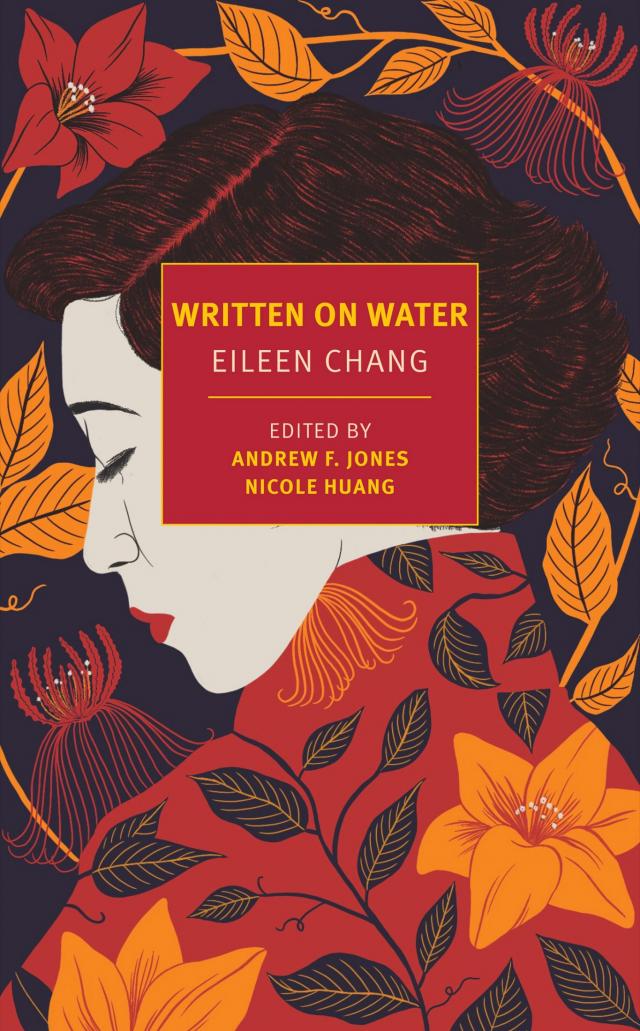
Perhaps it’s because of H.G. Wells’s prognostications that I often think of things like this. I used to think they lay very far in the future, but now they don’t seem so very distant at all. And yet it’s autumn now, as clear as water and as bright as a mirror, and I should be happy. For the second edition of the book, I’ve used Yanying’s design for the cover, which resembles the cloud tendrils coiled atop ancient brocade or a noisy cascade of sea spray softly falling from a dark and massive wave. If you look carefully, they’re mostly made of little interlocking jade rings, in twos and threes, inseparably linked. There are a few single rings, like little moons, sufficient unto themselves. Others are in pairs, standing mildly next to one another, although what’s done is done, and the scene has already changed: there’s no reason they cannot stand in as symbols for the connections between the characters in the book.
Yanying only did a draft sketch. Struck by the strength and beauty of her line, I was more than happy to trace methodically over her lines to make a copy. Life’s a little like that as well, no? It possesses the pattern, and we only get a copy. And so they have a saying in the West: “Let life come to you.” That sort of submission resembles very little the uncomprehending, wretched, unsightly, and clumsy submission of the characters in my fiction, yet it is just as desolate.
ON MUSIC
I don’t like music very much. Colors and smells often make me happy, but music is always sad. Even so-called light music is the same: its bounce seems superficial, a little artificial. But colors: indoors in summertime with the curtains down, old pajamas neatly folded and piled on bamboo mats. An azure blue summer top, and sea-green silk pants. Next to one another, the blue and the green have a layered, delicate beauty. Not a beauty that necessarily reminds you of anything. But in the dimness of the room, they carve out a space and quietly pervade it with a sort of joy. I sit to one side, catch sight of them without having intended to look, and they make me happy for a long while.
There was another time when I had put a new air-raid cover over the bathroom light. The dim greenish light shone coldly onto the surface of the bathtub, green seeping into the white, black seeping into the green, laminating the tub with a glossy coat of color, simplifying everything. Gazing into the bathroom from outside the door, it looked exactly like a modernist painting, an altogether new and different dimension. It seemed to me that one could never pass into that alien dimension, but somehow I managed to go in anyway. It was as if I had accomplished an impossible feat. I felt happy and a little scared all at the same time, and just a little numb, as if I had been shocked by electricity, and I came out almost as soon as I had gone in.
In short, colors are only desolate when they lose their luster, but when they can attract your attention, they are always something to be celebrated, because they make the world seem that much more real.
Smells are the same way. I like a lot of the smells that other people don’t like: the slight scent of mildew in the mist, dust moistened by the rain, scallions and garlic, cheap perfume. Take gas, for instance. Some people feel dizzy when they smell gas, but I like to sit next to the driver on purpose or stand behind cars so that when the engine starts with a chug, I can smell the exhaust from the tailpipe. When we used to wash clothes with a little butane once a year, the room would fill with its bright, steely, stainless aroma. My mother never wanted me to help her, because I would work as slowly as I could so that as much butane as possible would evaporate into the air.
When milk burns or matches burn down, the smoky smell makes me hungry. The smell of oil-based paint, precisely because it seems so aggressively brand-new, is like celebrating New Year’s in a new house: sterile, fresh, jubilant. When ham or salted meat or peanut oil have sat for a long time and start to turn, there’s a kind of greasy smell that I like a lot, too, because it makes the oil smell even oilier, ripe to bursting, almost rotten, like the “rice spoiling in the granaries” of ancient times. During the Battle of Hong Kong, all the food we ate was cooked in coconut oil and smelled strongly of soap. At first, it was hard to accustom oneself to the smell, and it made you want to vomit, but later I realized that soap has a certain cold fragrance all its own. During the war, there wasn’t any toothpaste, but I didn’t mind brushing my teeth with the coarse, fatty soap you usually use to wash clothes.
Smells are always ephemeral, coincidental. Even if it was possible to smell one thing for a long time, you wouldn’t be able to stand it. In that sense, smells are only a minor diversion. Colors are right there in front of you, which is why they make one feel at ease. Perhaps the joy of colors and smells has something to do with this quality. Music is different. Music is always on its way somewhere else, and no one can determine exactly where. Once it gets there, it’s already gone, and all that is left is to search for it. Music leaves you alone and at a loss.
The violin is the worst. I’m frightened of the way it always flows away like water, taking all the things in life you would like to grasp hold of and cherish along with it. The Chinese two-stringed violin is much better, because as bleak as it sounds, when it reaches some sort of conclusion it always “comes around again to the beginning,” as northerners like to say, circling and perambulating its way back to the world as we mortals know it.
When someone plays the violin, there is always a moment of high musical drama and innumerable melodramatic twists and turns, all of which are much too clearly intended to elicit the audience’s tears. The violin is the tragedienne of musical instruments. I think a play should have a female lead, a foil, and a female supporting role. There’s no need for a tragic part, a femme fatale, or a commentator (in the “civilized plays” of the early Republic, there was always an old commentator on hand to supply a political message).
Nor do I like violin and piano duets or even small groups of instrumentalists centered around the piano and the violin. There’s nothing there to hold on to; everything’s in bits and pieces, and the awkward way in which the separate parts come together makes you feel uneasy. It all turns out a little like those Chinese paintings that several people work on together. Someone paints a beautiful woman, someone else adds some flowers, and yet another person paints in the pavilions and scenery behind her, but often the picture as a whole lacks any particular atmosphere, and nothing approaching harmony emerges from the effort.
A full-scale orchestra is another thing altogether. It comes at you with all the grand bombast of a May Fourth Movement, transforming each individual’s voice into something altogether different from what it was in the beginning. The whistling and scraping on all sides become your own voice, and you are shocked by the depth, volume, and resonance of the sound you are making. It’s a little like the moment after you wake up in the morning: someone calls your name, and, unsure whether the voice is someone else’s or your own, you feel a vague kind of terror.
And since writing orchestral music is so very complex and composers have to undergo such arduous training, they often end up drowning in lessons and are unable to extricate themselves from their influence. That’s why orchestral music is so often afflicted by too much formalism. Why do they always have to keep coming back to the same old bag of tricks? The orchestra will suddenly grow tense; with heads bowed and teeth clenched, they enter the penultimate phase of the battle, urged on by the timpani, which pounds out its drumbeat over and over, determining the orchestra’s destiny: to overwhelm and annihilate the audience completely. And all the audience can do is put up silent resistance to the orchestra’s attack. Most of them are from the upper classes and schooled in the ways of classical music. They’ve sat through countless concerts before, and they know full well from previous experience that this music, too, shall pass.
I am Chinese, so I know how to appreciate noise and clatter. Chinese drums and gongs descend heedlessly on your head with an ear-splitting clatter, all at once, and I can take as much noise as they can dish out. But an orchestral assault is mounted slowly, painstakingly, allowing time for each weapon—tubas and trumpets, pianos and violins—to be set in place for one ambush after another: that kind of premeditated conspiracy frightens me.
I came into contact with music for the first time when I was eight or nine years old. My mother and my aunt had just come back to China. My aunt practiced piano every day, extending her tiny hands toward the keyboard, her wrists tightly encircled by the narrow sleeves of her knitted blouse, its bright red weave shot through with silver threads. Flowers were usually blooming in the glass vase atop the piano. What emerged from the piano was another world, and yet it wasn’t another world at all, just the world in the mirror that hung on the wall across from the piano, reflecting the civilized elegance of an apartment equipped with hot running water.
Sometimes, my mother would stand behind my aunt, one hand resting on her shoulder, singing scales: “La, la, la, la.” My mother was learning to sing purely because her lungs were so weak and the doctor had told her that singing would be good for her health. No matter what song she sang, it always sounded a little like she was reciting poetry (she was in the habit of chanting lines from Tang dynasty poems in her drawling Hunanese accent). And her intonation was always one half-pitch lower than that of the piano, but she would just smile apologetically and offer charming excuses for being out of tune. Her clothes were the soft crimson color of fallen autumn leaves, and a corsage of crimson flowers would hang from her shoulder, forever threatening to drift down to the floor.
I would always stand to one side and listen, less because I liked the piano music than because I enjoyed the atmosphere. I would exclaim with real feeling: “I’m so envious! I only wish I could play that well!” And thus the adults came to believe that I was a child who was unusually sensitive to music, and since it would not do to bury this rare talent, they immediately started me on piano lessons. Mother told me, “Since you are starting off on a lifelong pursuit, you need to learn first of all how to take loving care of your instrument.” Each of the piano keys was as white as snow, and I was not allowed to touch them without first having washed my hands. Every day, I would wipe the dust from the piano with a square of parrot-green felt cloth.
When my mother first took me to a concert, she warned me over and over before we even arrived, “Whatever happens, don’t make a sound, and don’t say a thing. Don’t let them say Chinese people don’t know how to behave properly.” And indeed I sat silently, without so much as moving a muscle, and did not fall asleep. During the ten-minute intermission, my mother and my aunt whispered to each other about a red-haired woman: “Red hair is so awkward! It really limits the kinds of things you can wear. Reds and yellows clash. That just leaves green. When someone with red hair wears green, now that’s something . . .” In the dimly lit auditorium, I combed the crowd in vain for a glimpse of this red-haired woman. And as we rode back in the car after the concert, I wondered the whole way home whether it was really possible for someone to have bright red hair? It was all terribly perplexing.
After that, I never once took it upon myself to go see a concert. In fact, I wouldn’t even consider sitting in the park on a summer night and listening for free to the orchestral music coming from the bandstand in the distance.
My piano teacher was a Russian woman whose wide, prominent cheekbones were covered with golden peach fuzz. She would always lavish me with praise, her excitable blue eyes filling with tears as she held my head in her hands and kissed me. I would smile politely, note exactly where her kisses had landed, and, after a discreet interval, wipe them away with a handkerchief. My family’s old maid would accompany me over to my teacher’s house. I still didn’t really know English, and yet I somehow managed to talk with her quite a lot, and even the old servant sometimes joined in our conversations. One weekend, when she had just come back from swimming at Gaoqiao, she proudly and happily opened her collar to show us the pink sunburnt skin on her back. Although it had already been a day since she had returned, I thought I could still smell a powerful aroma of sunshine and sweat coming from her body. The walls of her parlor were hung with lusterless, old brown carpets and fitted with green painted screen doors. Each time we entered or exited, her husband would very politely hold the door open. I was always very reserved and never actually looked at him, so that after several years I still had no idea of what he was like, merely a vague impression of a face that seemed never to have seen the sun. His wife made a living teaching piano, but he didn’t do anything at all.
Still later, when I started going to school, I had a piano teacher who would always get angry with me, flinging sheet music onto the floor in exasperation and bringing her hand down on the backs of my hands so hard that they slammed into the keyboard cover and my joints ached. The more she hit me, the lazier I grew. I lost all interest in the piano, and whenever I was supposed to be practicing, I would sit on the floor behind the piano and read novels instead. After the piano teacher got married, her temper improved considerably. Her face powder didn’t so much float above her skin; it seemed to protrude an inch beyond it. Wrapped loosely in this voluminous layer of white powder, she would manage to smile in my direction and say, “Good morning!” But I was still afraid of her, and before each class, I would stand by the door to the music room and wait for the bell to ring, trembling and wanting to go to the bathroom instead.
The several years I had spent learning the piano were like investing money to open a shop. It would have seemed a shame to give it up without any return on the investment, so I kept at it for quite a while longer, until I finally had to quit. At the time, I was living at boarding school and often had to pass by the music building, which was made up of lots of little rooms filled with lots of people prodding and plucking at their instruments. The sounds of all the various instruments seemed to sway and scatter forlornly on the ground, like rain at the dawn of a day that seems as if the sun will never rise. With an almost unbearable emptiness, the sounds strike hollowly against the aluminum siding of the Western-style building. When some student happened to step on the piano pedal, the scattered instruments would merge together for an instant, but that was merely like the wind whipping the rain into a fine mist. Once the wind had passed, the pitter-patter of scattered notes would start to drip down once more.
Playing an instrument is like being in a skyscraper. You run up the back stairs reserved for servants and coolies and salespeople. The gray cement steps and black iron handrails are enclosed by gray cement walls, and the landings are piled with Western-style red metal buckets and garbage that is cold and gray and doesn’t smell because it’s winter. You don’t see a single other person on your whole way up; all you can do is keep moving into the teeth of the dark, cruel winds of the tower.
Later, when I had left the misery of learning piano well behind me, I did listen to some orchestral music (but mostly on a gramophone, because records are mercifully short), but I always disliked the rousing declamatory style and overly self-important manner of that sort of music. I much prefer the courtly music of the eighteenth century. Those exquisite little minuets dance gingerly on cloven hoofs, as if they’re afraid to break something underfoot. In fact, the Europeans of that era were fascinated by Chinese porcelain. Even the furniture in their houses was made of porcelain; dainty little porcelain chairs were embossed with gold on a white background. My favorite classical composer isn’t a romantic like Beethoven or Chopin but Bach, who came a little earlier. Bach’s compositions are not as finely woven as courtly music. They have neither churchly airs nor heroic gestures. The world inside the music is heavy, even cumbersome, but it fits comfortably in one’s hand and pleases the heart: a clock hangs from the wall inside a wooden house, ticking as its pendulum sways back and forth; people drink sheep’s milk from wooden bowls; women curtsy as they take their leave; thoughtful cows and sheep move across green fields under unthinking white clouds; ponderous joy sets the gilded bell of matrimony to ringing. Just like the line in Browning’s poem: “God is in his heaven— / All’s right with the world.”
Operatic sorts of things can be precious, but that’s the extent of their appeal. The stories in opera are usually quite puerile. Jealousy, for instance, is the most primitive of emotions, and, in opera, even the simplest kind of jealousy is blown a thousand times out of proportion by its luxuriant expression in music of the utmost sophistication and complexity. And precisely because of this discrepancy, the whole thing becomes overwrought. Big is not necessarily great. Chest-pounding, wildly gesticulating heroes are annoying. Still, we must grant them the occasional moment of grandeur: when the singer’s golden voice reaches calmly for the heights under the overbearing pressure of the music and each instrument has anxiously submitted to the tide, the man stands above the stormy waters of life, and you suddenly realize that he’s very tall indeed, that his face and his voice give off enough light to rival the stars. If you hadn’t seen him stand up, you wouldn’t have realized that he’s usually crawling on the ground.
As far as foreign popular music goes, I dislike those half-old, half-new sorts of songs the most. Collections like One Hundred and One Classic Songs carry with them the air of a nineteenth-century parlor, a feeling of dull contentment, gently refined and suffocating. Perhaps this stuffy feeling has to do with the vogue in those times for tight corsets, when everyone ate far too well. Their sadness seems less like sadness than gloomy discomfort. There’s a love song called “At Dusk”: “At dusk, When you remember me / Don’t hold a grudge, my dear.” From the sound of it, this is the voice of a proper lady who rejected a suitor many years before, for his own good, and for her own good as well. Without giving the affair much thought, she lives alone and grows old alone. Although her pride and her self-respect remain intact, she begins to feel apologetic as the end nears. That might be a gentle and lovely sentiment, if only we could ignore the years of slow death and decay in between. As it is, we can feel only annoyed by her belated emotional logic.