There's Only One Danny Garvey, page 1
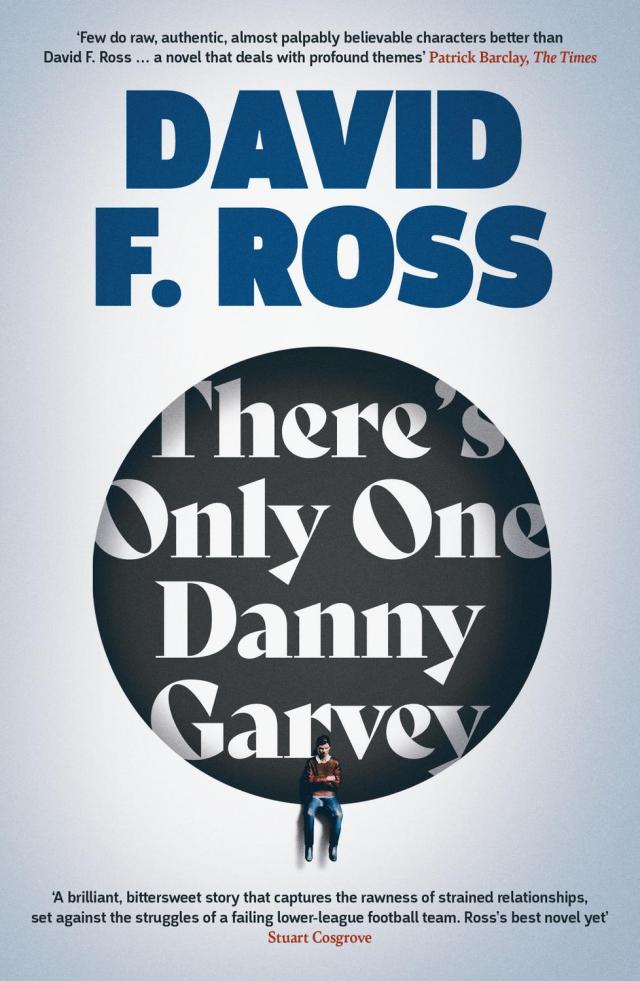


Danny Garvey was a sixteen-year-old footballing prodigy. Professional clubs clamoured to sign him, and a glittering future beckoned.
And yet, his early promise remained unfulfilled, and Danny is back home in the tiny village of Barshaw to manage the struggling junior team he once played for. What’s more, he’s hiding a secret about a tragic night, thirteen years earlier, that changed the course of several lives. There’s only one Danny Garvey, they once chanted … and that’s the problem.
A story of irrational hopes and fevered dreams – of unstoppable passion and unflinching commitment in the face of defeat – There’s Only One Danny Garvey is, above all, an unforgettable tale about finding hope and redemption in the most unexpected of places.
There’s Only One Danny Garvey
DAVID F. ROSS
For Nathan Ross,
and everyone who cares about the grass roots.
‘Mother I tried please believe me, I’m doing the best that I can. I’m ashamed of the things I’ve been put through, I’m ashamed of the person I am.’
—Joy Division, ‘Isolation’
‘A man who gives a good account of himself is probably lying, since any life when viewed from the inside is simply a series of defeats.’
—George Orwell
Contents
Title Page
Dedication
Epigraph
One: Higgy
Two: Damo
Three: Nancy
Four: Raymond
Acknowledgements
About the Author
Copyright
‘Aul’ Jock Reid … he’s no’ right in the heid. His wife’s a hoor, an’ his daughter’s deid.’
Groups of youngsters and seagulls are rummaging around on the site of the old Barshaw tip. Piles of discarded rubbish are spread into every corner, only prevented from spilling outside the perimeter of the tip by a chain-link fence, which is straining with the effort. The tip is on the edge of the village and has long been abandoned by the local council, but its unlocked gates allow random dumping to continue unchecked.
An elderly man, familiar to the small humans, wanders in. He is barefoot and wearing pyjamas, although it’s midday. That cruel and senseless refrain sings out. Chanted to get a rise out of a troubled old man prone to unpredictable outbursts that make the Barshaw youngsters laugh, that briefly relieve them of the interminable boredom of summer holidays.
The chant follows him around. But the old man takes no notice of it, or of us; the tuneless, baiting choir. He is – as always in recent months – miles away. Most likely, I can now appreciate, in a private, painless world where he doesn’t have to deal with his granddaughter’s abduction; or the terrible torment of knowing the entire community is convinced he was responsible for it.
Presumed dead. Unsolved child murder.
Or his daughter’s subsequent suicide.
He is smiling, I notice. Something else has caught his attention. He ambles towards a partially hidden, upright wooden box. He clears it of the debris and black bin bags that conceal it. His feet submerged in a brown puddle of sludge, he gently lifts a hinged panel. He starts massaging the black and white keys. The most majestic, mournful, colourful sound drifts across this swampy wasteland. It has me transfixed. Even the squawking birds fall silent. It is the first music to make me cry without my understanding why.
The others jeer. Make fun of me. Call me a daft wee fucken lassie. We get a chasing from clumsy policemen. They have arrived with the old man’s concerned wife and a blanket to wrap him in. They drive him away. Through the rear passenger window, he is still smiling.
It’s a recurring memory that has stayed with me, haunting me since I left this place thirteen years ago. And yet, something about that illusion is more real, more tangible and more pivotal to me than every moment since.
I was eight when he played the piano for me. I’m twenty-nine now.
One
Higgy
May 1996
—Christ almighty, this ground’s a dump. For the semi-pros, I mean … obviously not in comparison to ours back in Barshaw. Compared to The Barn, it’s like fucking Wembley or something. Haven’t been here for, what, five years? Since the last time they got in touch. It seems like less. He knows I’m coming, but he’ll act like he didn’t. Part of the game, me begging. Begging for him to come back. To come home.
I see it immediately for what it is; my complicated past and my short-term future, amalgamating in human form and sweating profusely in a garish green shell-suit. Stumbling down the old, empty ash-and-gravel terracing. Unsure of itself. Hesitant and anxious. A nylon-clad fire hazard. If only I’d been quicker to realise. If only I’d sparked a careless match. Might’ve saved a lot of trouble.
But, unavoidably, Higgy’s here. Here to reclaim me. To drag me backwards. Backwards in time. Back to the bridge.
‘Hullo son. How’ve ye been this last … what’ll it be? Five year?’
—I came because his bosses asked me to. Danny didn’t want me here. He never does. It was a dark time for him back then, five years ago. One of many.
He was here three seasons ago. Trying, then as now, to persuade me to return. Time passes more rapidly at his stage of life, so I don’t correct him. He shows up when he’s hiding from something or running from it. It’s a pattern. ‘About that, aye,’ I say.
‘Ye’ve no’ changed.’ He’s talking about appearances.
‘Bollocks. We’ve aw changed. Some just fucken hide it better, that’s aw.’
That’s undeniably true. After twenty-five, the mould’s set for everybody. For all he has aged, it’s still obviously, outwardly him. The same man I’ve known my whole life. Inside? Well, that remains to be seen.
‘Ye headin’ up north? Plannin’ on doin’ a bit ae hikin’ around the Cairngorms?’ I see him puzzled. Then it dawns on him that I’ve clocked his rucksack. He sighs, then attempts a smile.
—I’ve brought a bag. Figured it might take a few days to get him to trust me. Trust was always something hard-earned with Danny.
‘They treatin’ ye awright?’ he asks, as if I was in my brother Raymond’s shoes.
‘Nae complaints.’
‘What’s gonnae happen next season? There’ll need tae be cuts tae the budget, club goin’ down, an’ that.’
‘Probably. Cross that bridge when ah come tae it.’ Another bridge. The direction of my life’s been influenced by bridges. Particularly the one in Barshaw, the tiny Ayrshire village where I was born. Where I’m now urged to return, tail somewhat between my legs.
‘Look son, can we go somewhere? Get a wee chat goin’?’
‘Here’s fine. Ah’ve got the nets tae bring in anyways.’
‘Can ye no’ make the team dae that for ye?’
‘It’s part ae ma job. Ah dinnae mind it.’
He laughs. Nervously. He’s reaching. Looking up. Searching for a foothold. He thinks he’s found one.
‘The young boys played well. Good movement off the baw, an’ that.’
‘Aye.’
‘Last game ae the season, tae. Minds usually on bloody Benidorm, eh?’
—He’s always been a difficult person to reach. He was always a quiet kid. You never knew what he was thinking. Always somebody you had to drag the words out of, even in the good times. The silent insolence, his ma used to say. Keeping all that in … it can’t do him any good. When things get difficult, he hides … withdraws into himself like a wee bear going into hibernation. When the wee girl in his primary-school class disappeared – must’ve been around 1972 – it was a major thing around here. She was never found. Danny went missing the same day. Somebody in the crowd out looking for both of them found him down under the Barshaw Bridge. He’d been out all night. Libby was absolutely frantic. The police were furious at us for wasting their time.
Raymond rattled Danny’s jaw when he got hold of him, and Danny didn’t speak to anybody for months and months after that. About a year, in fact. They had these social workers coming around constantly, right at a time when Libby was struggling badly, too.
We had teachers, doctors, therapists, even a child psychologist all look at him. Some nights, you’d listen at the door and you’d hear him, in his room, talking away to himself. Talking to her: to wee Louise-Anne, the missing girl. But he’d say nothing to anybody else. Not a word. Then, just when I thought he’d be taken off Libby, he suddenly opened up as if nothing had happened. It was strange. Things were fine then. Until the next time.
I look at him. He’s wondering what to say next. Stumbling over the words like a drunk with amnesia trying to recite a poorly rehearsed soliloquy.
—I should’ve tried to get him more help back then. But I was too wrapped up in looking after his ma. Trying to keep the worst of it from the social workers, to keep them together, him and his brother. To not have them split up and put into care. I often wonder if we did the right thing by him.
‘Ye must be right chuffed wi’ aw the attention, despite everythin’ else.’
‘It’s no’ about me.’ I say this and mean it. Football is about the players; that’s until their manager fails them. Until he loses the dressing room. But this unexpected cup run has brought uncomfortable exposure. Scouts from the big clubs are following our progress. Looking to swoop in and land the young talent we’ve groomed.
—It still staggers me that he’s doing this; developing youngsters. Imparting knowledge. Showing leadership. And doing it well, too. He’s a good coa
The football was always his coping mechanism. Regardless of the domestic carnage that was going on around him, Danny always focused on the pitch. Watching him play, you’d never have known about the problems he had; about the overdoses he witnessed, or those endless bouts of screaming at his brother.
‘But ye’ll be lookin’ forward tae takin’ them at Hampden, eh?’
I nod at this. Pointless denying that it’s satisfying to have navigated ten emotional, sometimes tortuous, rounds to reach the national youth-team final.
I’d always been told I was special. Not by my closest family, obviously. But by Higgy, and others who watched me play. Never questioned it. Not when barrelling around the muddy pitches of Scotland as a lauded and sought-after youth player. Not when the big clubs turned up on the doorstep with S-forms and a pen, and bouquets for my mam. Not even when Deek Henderson asked me to touch his cock the week before my debut for the Bridge. And certainly not when scoring in the cup against Auchinleck Talbot when I was sixteen. Whenever I pulled on the number-ten shirt, I was special. They all said it.
I look across the rutted turf. Sigh deeply. I turn to look down at the stooping, stunted shell I spent my teenage years calling uncle.
‘Look, Higgy, nae offence but ye could’ve phoned tae bum me for tickets tae the final. Why the fuck are ye really here?’ I say it with more anger than I intended. He’s just Raymond’s fucking messenger after all.
—Fuck me, it’s freezing up here. He can’t be wedded to this, surely? I want him to come back. Back to the Bridge. It’ll do him good, ultimately. People here are worried about him just like they were before. Five years ago, during the summer break following his first season as Arbroath’s youth team coach, Danny was found to be defacing books at the local library. He was finding it hard to get over the injury that ended his professional chances. He needed real help back then, but we weren’t close enough to him to see it. He’d been ripping pages out of novels and sellotaping them into medical textbooks. Scoring out names in books and writing ‘Louise-Anne Macdonald was here’ all over them. He got caught and charged. He told the club’s directors that he was just bored; it was something that had passed the time. The club paid the fine. Made it go away. His young team was very successful, but few considered or cared about the mental toll the job was taking on him. They didn’t want their wee boat rocked. The club doctor thinks he’s overworking himself again, that he needs a clean break. I think he just needs to see his ma, his brother. Focus on helping our village club. I suspect he knows this, but he’s making me work for it.
He doesn’t answer. A floodlight bursts into life. It isn’t dark but the sudden dull sound of it kicking in takes us both by surprise. A weekend test of the electrical circuits following the embarrassment of last week’s cup-tie cancellation. He takes off his bunnet. The wind lifts the wispy strands from one side of his head and wafts them straight up like a flip-top bin lid. He quickly scratches the scalp. Skin flakes. He pulls the hat back on, maybe hoping that I haven’t noticed.
‘Ah’ve mind ae a match here … must’ve been sixty-seven or that.’ He’s reaching for another ledge, another branch that he must hope won’t come away by the roots. ‘You’d just been born. Me an’ Deek brought Raymond.’ My face offers no clues about either man’s name being raised. ‘It was his first-ever game. Away tae fucken Arbroath. In torrential rain. Jesus! If that’s no’ enough tae put ye off fitba for life, ah dunno what is.’
I look at my boots. I conceal a smile as I remember Raymond telling me years later how much he hated that game. The cold. A thunderstorm. Daft auld Higgy telling him that was just God rearranging his furniture. Then him gagging from the sickening, stale smell of the smokies that polluted the car on the long journey back home.
‘It was bloody Baltic back then anaw. We were leavin’ the ground in the rain an’ walkin’ back tae the motor. Despite his fingers bein’ blue wi’ the cold, wee Raymond asked for a pokey hat. The smile on his face when the boy handed it down tae him. He was that excited; like Santa Claus himself had gie’d him it. Then he turns an’ trips ower a kerb. It was aw ower his jacket. Ah don’t think he’d even licked the bloody thing. Poor wee bastard. He’s lyin’ there, in the mud, covered in ice cream. Greetin’. He just wouldnae get up. Stubborn as fuck, even then. Aw these strangers watchin’. Ah was affronted.’
Jesus Christ. Fighting every impulse not to, I reach out an arm. I put it around my uncle’s shoulder. I resign myself to this; knowing what’s coming. His voice is breaking.
‘That fucken ice-cream cone … why did ah no’ just go back an’ get him another one?’
At regular intervals – typically following another of Raymond’s lapses in judgement – Higgy would drag out the ice-cream cone defence; the pivotal point at which he believed Raymond’s destructive life course was set. It conveniently shifted responsibility for his actions from my brother and placed them at the feet of the principal martyr to the cause: Saint Higgy of the Blessed Bridge. My brother disappeared the night they got back from the match in Arbroath. Squeezed himself out of the bedroom window at Higgy’s place. He was missing for twenty-four hours. A policeman found him asleep under the Barshaw Bridge. He was suffering from mild hypothermia.
—Raymond doesn’t even know I’m here. I didn’t even discuss my suggestion of the Barshaw Bridge manager’s position with him. But it might pay to let Danny think I did. There’s a lot of unfinished business between the three of them, Danny, Raymond and their ma. I just wanted to bring Danny home.
‘Why could ah no’ take better care ae the two ae ye’se?’ he wails.
‘Cos it wisnae your fucken responsibility!’ I yell in response.
‘The poor wee fella. His da’d just beat it … an’ Libby wis done. Ah shouldae stepped in, like ah did wi’ you.’
He has a skewed view of the history. Libby is our mother; Raymond and me. She’s the love of Higgy’s life, God fucking help him. He’s not our real uncle; it’s just easier for us to call him that – it avoids more painful truths. We are four points of a compass determinedly pointing away from the centre. Trying to escape that centrifugal force that periodically drags us back to confrontation. Only Higgy seems unable to resist it.
‘Fuck off, Higgy. Libby’s always been her ain worst enemy,’ I say. ‘Olympic-level selfishness, hers is.’ Sackcloth and ashes. Both of us. What a fucking pair. I pity him his cloistered existence in a tiny working-class village where fuck all happens and the only thing you have is time; to regret, to relive, to put the few ‘what-ifs’ on a pedestal. But am I any better? The environment is different, that’s all. Isolation takes hold of me now in colder air.
Words ricochet around my head, flipped incessantly like a steelie in a pinball machine. Ashamed of the things I’ve been put through. Ashamed of the person I am.
A headache is forming. Starts at the base of the skull and quickly works its way towards the temples, like an amphibious army invading a pristine beach. I haven’t had one of them in a while and I silently curse this old bastard for bringing it on.
‘We’ve missed ye, Danny. We need … we want ye tae come back, son. Back tae the Bridge.’ It’s a rehearsed statement. Planted there by a Janus-faced cunt with a PhD in advanced manipulation. I withdraw the arm. Raymond’s behind this. I know it.
‘That’s no’ gonnae happen,’ I tell him. He knows why. Same reasons as the last time he tried.
‘Jesus, Danny, it was donkey’s years ago, son. Water under…’
I rummage around in the pocket of my tracksuit. I retrieve a pack of cigarettes and my tiny lighter. I’m trying to give up but failing heroically. It takes a few sparks, but I light the small, white nicotine stick. I fleetingly visualise a smoking pile of green nylon ashes, but I dispose of the lighter, fulfilling its destiny. His tone changes.
‘Danny, the Bridge needs a new manager. It’s gonnae be a tough season ahead, nae doubt, but it’s a good opportunity for somebody.’