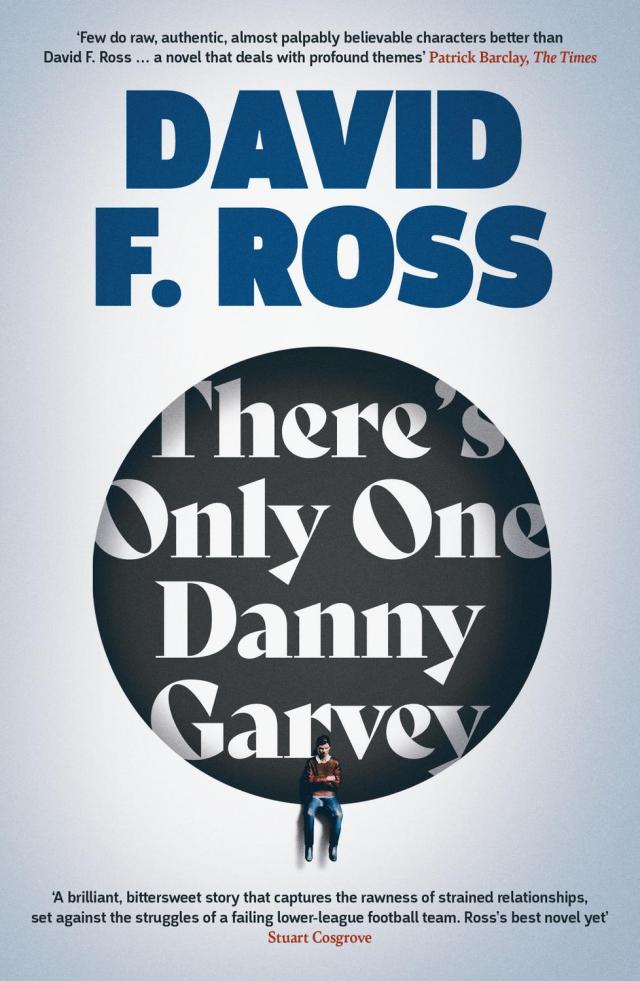
There's Only One Danny Garvey, page 15


Loneliness is aloneness without choice. And it suddenly strikes me that I came back because I needed that solitude to be recognised. To choose not to be alone. To feel connected to something – someone – vital to my existence.
Barshaw Bridge 3-3 Largs Thistle
(Finnegan, O’Halloran 2)
Drongan 4-1 Barshaw Bridge
(Smith)
Cumnock Juniors 7-0 Barshaw Bridge
Barshaw Bridge 2-2 Ardeer Thistle
(Gilhooly, Bruce)
Three sombre weeks. Two home draws and an away defeat in the league. A miserable midweek hammering away at Cumnock in the cup. Josey Monsanto is proving to be more Andy Pandy than Andy Goram. He must have compromising photographs of Alan Rough, mid-perm. McIntosh’s return can’t come quickly enough.
Our play has been disjointed and desperate. Training is half-arsed. Apathy reigns. Harry Doyle can only do so much. The whole squad is looking to me for direction. Higgy tips me off that Billy the Kidd wants a quiet word. He feels my mind hasn’t been on the job lately. He’s pin-point accurate in his assessment.
I approach the next game with complete indifference. I tell Higgy about the Sunday at Nancy’s house. And about Damo. It’s a cover for the truth; that Jock Reid and his missing grand-daughter are occupying every waking thought. He warns me to get my head out of my arse. He tells me that too many people are depending on me.
Torrential driving rain reflects the mood. A Saturday afternoon home game. Touch and go if it’ll be on at all. Winton Rovers are the visitors. They’ve made a reasonable start to the season. We don’t even have a match-day programme today, because I haven’t created one. I expect us to lose. I should be motivating my players. Analysing weaknesses that we can exploit. But I can’t get them out of my head, these ghosts that haunt me.
‘Look, son,’ says Billy the Kidd, ‘we never had any big expectations about this season, ye know that. But after the pre-season games, an’ the Lugar win, ah thought we might be buildin’ on that. Whit’s goin’ wrong, Danny?’
He won’t sack me. We don’t have any paying supporters calling for my head. The Troon bookie hasn’t committed yet, so there’s no sponsors making things so awkward for him that he must act. It’s worse than that. Nobody gives a fuck. And he thinks that includes me. I ponder whether Anne Macdonald will be the one despatched to fire me, come the day.
‘Had a bad run, Mr Kidd,’ I tell him. ‘Keeper gettin’ injured affected the back line. We huvnae recovered fae that really.’ He knows there’s more to it than this. I consider adding nothing else. But the chairman is blocking the door to his office. Not aggressively so, just looking for some comfort. Something to cling to. Hope for the ninety minutes to come. My hope is for a waterlogged pitch and a ref with somewhere better to be.
‘We’re tryin’ somethin’ a wee bit different today,’ I lie. It seems to calm him. ‘A few things we worked at in trainin’.’
He smiles. ‘Good stuff.’ He edges away from the door. My appraisal is coming to an end. ‘We’re aw pullin’ for ye, son. We know ye’ll get it right.’ The dreaded vote of confidence. When playing for greater stakes than this, a sacking invariably follows one. Billy the Kidd will be hoping I know the significance of it, that it’s a warning. I want to care as much as I know I should. As much as I thought I did after the Lugar game. As much as my employer does. When I played, I could compartmentalise everything and focus solely on the game. That’s far harder from the sidelines. As he opens the door to allow me to join my players, I resolve to do better.
‘Right, listen up. Josey in goals…’ McIntosh is back, but he hasn’t trained yet. He’s annoyed but I’ve always stuck by the rule that players who don’t train don’t play. ‘A back three: Russell, Gilhooly, Smith. Midfield four ae Lorimer, Mickey Minns, O’Halloran and Dib Ramage.’ The names are going on the board. ‘Billy, Franco … in the hole behind…’ I see Huck Finnegan getting up off the bench. ‘Dougie Wilson up front.’ They all look surprised. None more so than Wilson himself. Finnegan says ‘Whit?’ It’s certainly the change that I’d warned Billy the Kidd about. Although I only rehearsed it in my head in the subsequent walk along the corridor. No-one speaks. The shock is still settling. Dougie Wilson came from Glenafton but has so far showed little in training. Has barely spoken to anyone since signing.
Higgy opens the changing-room door. ‘Can ah bring the wee fella in?’ He has Damo with him. His visor’s open. I’m so pleased to see him. I half expect Nancy to be behind them. But of course, she isn’t.
‘Hi, wee man,’ I say.
‘Aw, thank fuck!’ says Billy Gilmour. He looks like he might cry.
‘I’m here,’ Damo says, with no emotion, and then, in a monotone: ‘Thank fuck!’
It breaks the ice. Everyone laughs, except Damo, naturally. Even Huck Finnegan smiles.
‘Better no’ let yer ma hear that,’ I say, ‘or ah’ll be in big trouble.’
‘Big trouble,’ says the boy.
‘What happened,’ I ask Higgy.
‘Coupla days ago, ah took that Stretch Armstrong toy round that ye got him. Telt Nancy it wis fae Raymond for Damo’s birthday. She wis askin’ how it was goin’. Wi’ you … here, an’ that.’ He stops himself, leaving me wondering if there was more. ‘Just felt it wisnae fair for the wee man tae miss out oan the fitba while aw the grown-ups around him act like weans.’ Evidently, I’ve told him more about the situation than I thought I had.
‘Right boys … let’s go. Hard workin’, right fae the start! The three points are ours.’ Harry Doyle is tempering his volume and cuts out the profanities. But everyone gets it. And somehow, suddenly, there’s something; a shared ambition. A collective determination.
Billy Gilmour makes the entire team – plus substitutes – kiss Damo’s helmet. As they do so I hear him say softly: ‘Abbott, Ainsley, Baird, Bruce, Davidson, Demarco, Forrest, Garvey, Macdonald, Melville, Ross, Sinclair, Walkinshaw.’ And I swear I nearly have a fucking heart attack.
‘What d’you say?’ Higgy looks at me and holds out his hands as if to say why are you shouting at him? And I didn’t think I had but the whole dressing room is staring at me.
And then Damo says: ‘Schmeichel, Gough, Laudrup, Ravanelli, Shearer, Juninho, McManaman, Redknapp, Beckham, Gascoigne, Gullit, Zola, Vialli.’
It’s a turgid first quarter. Both teams struggle with the conditions when the ball goes out wide. Consequently, it has spent so much time in the air, NASA could’ve strapped a satellite to it. The hundred or so hardy souls who have braved the elements deserve better. Gradually, they get it. With ten minutes until half-time Gilmour forces a series of corners. A barely audible voice from behind me:
‘Winton Rovers lost sixty-eight percent of goals from set pieces last season.’
I look around. It’s Damo. I look at Higgy. He shrugs.
Another corner. Gilmour floats a lovely cross to the back post.
Russell heads it back across the goal. Dougie Wilson adjusts his position well to knock it in.
—Winton Rovers lost sixty-eight percent of goals from set pieces last season.
Half-time:
Barshaw Bridge 1-0 Winton Rovers
(Wilson)
‘Fucken telt ye’se aw,’ says Billy Gilmour, outstretched arms, a halved orange in his hands. ‘That wean, swear tae God … he’s a lucky mascot, man!’
‘I’m Mascot Man,’ Damo whispers without looking up from his bagged squad of tiny players.
—Mascot Man, me.
‘Just need to keep an eye on the rain,’ says the ref, to me and my Winton Rovers opposite number. We trudge back out.
‘Aye, no’ sure we’ll see this yin out, eh?’ A hopeful prompt from the losing manager, but I’m not rising to it.
Five minutes into the second half, and we’re two goals up. Another set piece. Dougie Wilson again. It’ll look to my chairman that training-ground routines are the reason for this change in fortunes. But we haven’t practised them. It’s simply the spontaneous nature of the game.
There are ten minutes remaining. We’re leading six-nil. And to exacerbate the unusual circumstances, the sun has come out. This game isn’t getting abandoned now. ‘Winton Rovers lost sixty-eight percent of goals from set pieces last season,’ Damo repeats, and it strikes me that five of ours today will have increased that statistic.
I stare at Damo. I’m trying to penetrate his internal circuits; to understand this aptitude for analysing probabilities he must surely struggle to comprehend. He isn’t even watching the game.
I let Higgy take Damo home, ensuring that he’s back before the previously designated 5.00 pm deadline. No point in fanning any embers that might still be burning.
‘Well done, son,’ says Billy the Kidd. ‘See ye at The King’s? Ah’m buyin’.’
‘Naw, ah’m gonnae head,’ I reply. The Rovers team and management follow our chairman towards the pub for the restorative warmth of the soup and pies we’ve laid on for them.
‘Well played, Danny,’ says the ref. ‘Ah did wonder about callin’ it off,’ he admits. ‘The ball stuck quite a bit in the corners.’
‘Aye. Ah know. Couldnae really have complained if ye had. Thanks though.’ I hand him his money. ‘Linos’ are in there too.’
‘Ach, let’s keep schtum about that though, eh?’ He winks. ‘They two did bugger all out there anyway.’
He leaves. And then I’m alone. Just me and the seagulls flapping about in search of the last scraps of food before the diminishing light finally disappears. I sit in my office, watching them through the cracked window for more than an hour – until a rap on the front doors alerts me.
‘Didnae think ye’d be here,’ he says.
‘Why?’
‘Didnae think ye actually meant it.’
‘Ah told ye ah’d be here, didn’t ah?’
‘There’s loadsa folk’ve gie’d me promises ower the years. Doesnae mean they kept them.’
I’m taking a massive risk. Letting Scud Meikle into The Barn to clean himself in the showers, to sleep in my office every night; I doubt the chairman would understand the motivation behind my benevolence. My need to absolve myself of my guilt.
The bedraggled man comes in. The stench coming off him is terrible. Like someone who’s lain in their own piss and shit and vomit for days. I’ve picked up some food and toiletries. I’ve looked out some of my clothes. When I hand them to him, he’s like a child leaving the Christmas grotto at Fraser’s, having just visited Santa. And then he cries, and I don’t know what to say to him. So, I leave him to it, telling him not to come out of my office, and that I’ll be back for him first thing in the morning.
I walk to Higgy’s still lost in my ongoing preoccupations. But with fresh ideas about how I might honour them. It’s amazing how a win changes my perspective. Football’s ability to shut out the darkness. The pain behind my eyes lifts.
Higgy is still out when I reach his place. I find a note telling me there’s some corned beef in the fridge, and to go and see yer mam.
Rather than putting on a record, I put on Higgy’s TV. My new best friend. Match of the Day will be on shortly. I might learn something.
‘Fancy seein’ you here.’ The voice is upbeat. But I don’t recognise it.
I’m on my knees and find myself looking up, the low-lying late-autumn sunshine around the body stood in front of me like an intense Ready Brek glow, making it difficult to determine the features.
‘Gardenin’, is it?’
I adjust position. The ruddy face of Sandy Buchanan, the Standard journalist, comes into focus. My sighs can, I’m sure, be heard at Kilmarnock Cross.
‘Just helpin’ out.’
‘Part ae yer community outreach programme?’ he sniggers.
‘You’re a bit far fae the white heat ae the action, are ye no’?’
‘What d’ye mean?’ he asks. It sounds like his feelings are hurt by the obvious sarcasm.
‘Nothin’. Is it me yer after, then?’
‘Naw, Brian Clough, as it happens, it isnae.’
I wait for his follow-on, but he walks past me. He rings the bell. He maintains his stare until he reaches the front door. I try to work my way behind it. To burrow in and understand what is driving him. How he seems to know more about me and – perhaps more directly – Raymond than I’d want him to. Sandy Buchanan has covered more of our games this season for his local newspaper than any other team. While the lingering stink of last season’s shame might attract a casual interest, Barshaw Bridge is a tiny, second-division junior team fallen on hard times of its own making, penalised and consequently dropping down the divisions. We’re hardly Glasgow Rangers.
‘Can ah maybe help ye?’
He turns to face me. ‘You the aul’ woman’s butler tae then?’ he says, self-satisfied smirking in a way that would prompt my brother to deliver a swift fucking battering. The door opens.
‘Yes?’
‘Mrs Reid?’
‘Yes.’
‘My name’s Buchanan. Sandy Buchanan. Ah wonder if ah might ask a couple ae questions about yer husband, Mr Jock Reid?’
She looks past him, towards me, for a sign, perhaps. As if I’m her advisor. I become aware of shaking my head. My attempts at telepathy fail.
‘A lot ae questions about my Jock lately.’ She smiles, but there’s an edge to the way she phrases the words.
Buchanan leans in closer. I’m thirty feet or so away from them, pulling the last of the year’s weeds out of the soil, so I can’t hear what they say. But minutes later, Buchanan is inside the house, the door shut behind him. And my anxiety grows, sprialling out of me like uncontrollable vines. My paranoia creating scenarios in which new evidence has been found. A regional weekly newspaper now investigating an unsolved death, which will inevitably lead them to me. I think of Nancy; of how I’d be able to explain it away. And of Mrs Reid, the poor old woman I can see moving behind the net curtains. And then logic gets back in the driving seat and my heart rate returns to a more manageable level.
Buchanan remains in the house as I pack up. I put the tools back in Jock Reid’s shed and leave with the refuse sacks full without letting them know I’m finished. If there is any accounting to be done, I’ll know it soon enough. And it may even alleviate some of the weight I’ve been carrying.
Half an hour later, I’m outside the bakers.
—I see him. Outside the shop. Peering in. He’s pretending to look at the cakes, but I see him. Looking for me. The cakes are just a cover. It’s quite funny.
I pause outside, like I’m weighing the value of a cream doughnut against an empire biscuit. But I’m looking beyond the display. Past the man in the comical white hat and through to the back shop. I see her. She’s there.
—Despite my earlier uncertainty, he’s not at all like his brother. He feels safe, somehow. He’s not painful on the eye. A wee bit like Noel Gallagher, but at least his eyebrows don’t meet in the middle. He’s shy and quiet and awkward, and I find it … I don’t know … endearing somehow. The Raymond years were exciting at first, but the mental torment just became too much. It’s just a diversion from the everyday, small-town monotony, I know that, but everyone craves a wee bit of favourable attention every now and again, don’t they?
‘A cream doughnut, an’ an empire biscuit, please.’
‘Sure thing, Danny,’ says Ernie, the village baker. Without taking his eyes from me, he lobs the treats in a bag and twirls it around expertly to tighten the corners. I wonder how many thousands of times in his life he has done that. The Ronaldinho of the sugary-dough fraternity.
‘She gets a break in about ten minutes, ye know.’
‘Eh?’
‘Nancy, son.’ He nods towards the corner. ‘Hing about ower there an’ ah’ll let her know ye’re waitin’ for her,’ he says, winking at me; acknowledging my embarrassment.
—I’m curious about him. He doesn’t seem at all like the difficult kid Raymond used to tell me about. Raymond always had a softness for his brother … even in the midst of the pain that he said both had to endure. ‘If I didn’t look after him, who else would have?’ Raymond would say. It was admirable, and the one thing that excused his other faults: Raymond was prepared to take the punishment for his brother, for something that wasn’t his own doing, to give Danny a chance at a better life. I still find Raymond’s unfailing loyalty to his family surprising and inspiring in equal measure. I’m not sure I’ll be able to maintain the same standards.
He walks through the doorway that I’ve barely removed my gaze from since I was outside the shop. My breathing quickens like a fucking teenager at a school disco, waiting for a girl’s pals to return with the thumbs up or down.
—It’s a surprise, after the way I treated him at the house. I felt really terrible about that. He just showed up at a really bad time … Mam nagging away at me. Picking at a scab that hasn’t fully healed over, and then the blood and the pus starts weeping again, you know?
But I’m glad he’s here. I’m pleased to see him. Apologising doesn’t come easy for me, not after all those years attempting to defend his brother. Pleading for my mam to give him another chance. That the next time, it’d be different. Rent-a-fucking cliché, eh? ‘Aw men are selfish bastards, especially when ye need tae depend on them … wi’ the responsibility ae a wean. Happy enough tae be at the conception … blah blah blah!’ – Mam, speaking for the essence of female suffering just because it fitted her experience. Raymond was never like that, I’d protest. ‘No men are ever like that,’ she’d say, all world-weary, ‘…until they are.’ And it kills me to concede that she was probably right.