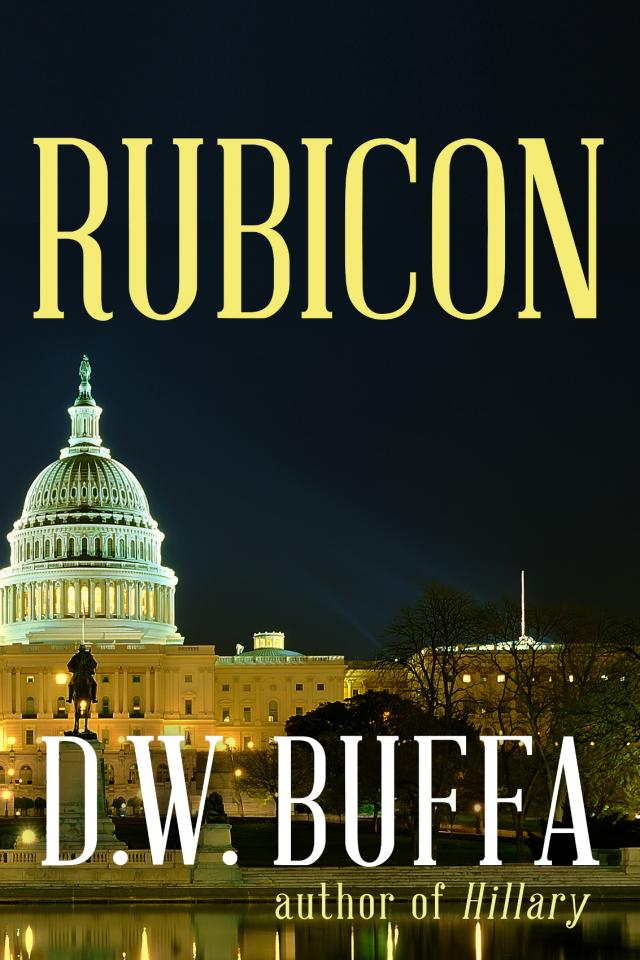
Rubicon, page 7


He got a beer from the refrigerator and decided that, for a while, before he crawled into bed next to her, he would see what was on television.
If he had turned it on five minutes later, he would not have heard about it until morning. It was a short, straightforward report, not even the lead item on the local news.
“And in the national news, a tragic accident has claimed the life of the deputy director of the CIA, Raymond Caulfield. Caulfield was apparently on his way home in suburban Maryland when he lost control of his car.”
Bobby Hart did not believe it for a minute. Raymond Caulfield had been murdered.
Chapter Seven
“How long had the deputy director lived in the same place?”
Ronald Townsend looked at the senator as if he did not quite understand the question. Hart looked back at him as if he had better be quick with an answer.
“The same place, Director Townsend. You’re the director of the CIA. Are you going to sit there, in front of this committee, and tell us that you don’t where the deputy director of your agency lived or how many years he had lived there?”
With small pointed ears and a mouth that seemed to quiver with disapproval, Townsend had the manner of a librarian whose patience was about to give out.
“I will answer - if you will let me. Mr. Caulfield had been with the agency for more than forty years. He would have retired from the agency in approximately four months, if I’m not mistaken. As to the question of where he lived, and how long he might have lived there....” He reached back for a file folder an assistant had started to hand him. “I’m sure we have it here somewhere.”
“You don’t know where he lived? You were never a guest in his home?”
“I’m afraid I never had that pleasure,” said the director in a dull monotone. He looked up from the file that now lay open in front of him. “Yes, here it is.” He announced the address as a fact of no importance. “As to how long he lived there.... It appears it is the only address he ever had, I mean since he began at the agency, forty...no, forty-two years ago.”
“Long enough, I take it,” said Hart with an acid look, “that he probably knew the road home. Raymond Caulfield was trained as a field operative, wasn’t he? As a matter of fact, he was, for many years, the head of covert operations at the agency.”
“Yes, I believe that is correct.”
“You ‘believe’ that is correct, Mr. Townsend? You don’t know that to be correct?”
A figure of speech, senator. You’re right,” he said, glancing at the folder in front of him. “He was head of -”
“But you didn’t know him then, did you?”
“I became director just eighteen months ago.”
“After spending most of your life in the private sector - the defense industry, to be specific.”
“That’s correct. I was -”
Hart waved it off.
“I’m familiar with your resume - and its limitations. But we’re not here to discuss your management of the agency. We’re here to find out what you are doing to investigate the death of your own deputy director. My question may strike you as irrelevant, a waste of your time, but does it not seem just a little odd that Raymond Caulfield, who had been driving that same route home for forty years would suddenly lose control of his car and plunge down a ravine to his death? Doesn’t it seem odd that someone that careful - he was deputy director of the CIA, for God’s sake - would be that careless?”
“The local police investigated. It was their conclusion that it was an accident, senator. There is no reason to think that it was not. Unfortunately, things like this happen all the time.”
“I sent you a letter asking that you come prepared to answer certain specific questions. I see that you have it with you.”
Townsend pulled it from a second folder. He did not bother to look at it.
“Yes, senator; the answer to all three questions is no.”
“If you don’t mind, Mr. Townsend, I’ll ask them anyway,” said Hart with a flash of anger. Then he changed his mind. He tossed the pencil he had been holding between his fingers on the table and sat back. “Your testimony is that the deputy director of the CIA was not working on anything connected with the recent rumors of an attempted political assassination?”
“That’s correct. There are certain definite lines of authority inside the agency. Mr. Caulfield had no responsibility for investigating this kind of domestic threat.”
“Domestic threat? You mean because it would take place on American soil, though carried out by foreign nationals?”
“Yes, of course, that’s what I meant.”
“But even though it may not have been his responsibility, as deputy director he could have involved himself in the investigation had he wanted to.”
It was clear that the senator did not understand the basic rules of organizational efficiency.
“No organization, if it is going to function properly, can afford to have anyone act outside the established lines of authority. Once that starts to happen, then no one can be sure who is in charge of what.”
“He was the deputy director.”
“It was not his job. He would not have been allowed -”
Hart shot forward. “Not allowed? By whom? By you? Are you telling me - are you telling this committee - that the director of the CIA expressly prohibited his own deputy director - who had been with the agency for forty-two years – from looking into, or even asking questions about, a plot to disrupt the election?”
“As I’ve just finished telling you, senator, there are clear lines of authority and responsibility. I didn’t tell Mr. Caulfield that he couldn’t do something. I didn’t have to. He knew what he was there to do.”
“Because that had been made clear to him, when you took over, a year and a half ago....” Hart picked up the pencil and tapped it on the table. “And what about you, Director Townsend? Have you been involved in the effort to find whoever might be planning an assassination? Or is that outside your line of authority?”
Townsend bristled at the suggestion.
“I’ve been directly involved every step of the way.”
“You have regular meetings, you’re constantly kept up to date - you have a chance to ask questions of everyone involved?” Hart asked this with apparent indifference as he glanced down at a document.
“Yes, of course, senator; every day.”
Hart raised his eyes. A thin smile creased his mouth.
“But Raymond Caulfield wasn’t included in those meetings. Was that perhaps because there were things you didn’t want him to know?”
“No, that’s absurd. Why would I -?”
“The decision to keep the deputy director out of those meetings, to make sure he didn’t know anything about what the agency was doing -”
“I have to object to that characterization, senator. That was not the intention.”
“The decision to keep Raymond Caulfield out of those meetings - was that your decision or did it come from someone at a higher level?”
“I’m in charge of the CIA! Look, senator, the fact is that Raymond Caulfield was ready to retire. We’ve gone through a major reorganization; things aren’t done the way they used to be. I was brought in to make the kind of changes needed to make the agency better able to respond to the challenges of the world we live in, the world as it is since 911. I had great respect for Raymond Caulfield, for everything he had done, his long years of service; but he was not going to be part of the agency’s future.”
“So you cut him out - or you tried.”
“It was not a question of cutting him.... Tried? I’m not sure I know what you mean.”
“In Mr. Caulfield’s last appearance before this committee, he was asked to find out what certain intelligence services in the Middle East, particularly the Syrians, might have heard.”
Townsend understood at once. There was only an apparent contradiction.
“He wrote a full report of his testimony before the committee. The question about what the Syrians might have learned was passed on to me. Mr. Caulfield was always quite thorough.”
“And what did you find out?”
“Nothing more than what we knew already: rumors of an assassination.”
“Nothing about the time period within which this is supposed to happen? Nothing beyond the obvious point that if this is an attempt to disrupt the election it would have to take place before the election?”
“No, nothing like that.”
Hart leaned back. “I asked you, in that letter I sent, whether the agency had any current information on a former East German agent named Gunther Kramer.”
“No, nothing current, but there is no reason we should. He died in l989. Is there some particular reason why the senator had an interest in someone who has been dead that long?”
“I’m not in the CIA, Mr. Townsend. How would I have known that he was not still alive? The reason I was interested is that I was once told that no one knew more about the Middle East. I thought it might be helpful to find someone who not only knew something, but would actually tell us the truth about it. But you’re sure he’s dead? There was a rumor that he had not died, that he was living in Damascus, and still had very good contacts on the Arab street.”
“We have no knowledge of anything like that. But even if that rumor were true, why would you think a former East German agent would be willing to help us?”
“Because he was also working for the CIA. Gunther Kramer was a double agent, working for the west. That should be somewhere in your files, unless for some reason those files have been destroyed. But let me ask you another question, Mr. Townsend, again about Mr. Caulfield.”
Hart chose his words carefully. He did not want to trap Townsend in a lie; he wanted to find out how much he knew.
“As I’m sure he must have mentioned in that report he submitted, the last time he appeared before the committee I told him privately, after the session ended, that in addition to the rumors I had been hearing about an assassination, that this plot had a name.”
“A name, senator? I don’t recall that he mentioned -”
“Rubicon.”
Townsend eyes narrowed into a concentrated stare. His mouth twitched at the corners. He nodded twice and then looked straight at Hart.
“Yes, now I remember. He did say something about that; but we haven’t found anything to confirm it.”
“He reported that to you? It was not something that he tried to check on himself?”
“No, senator. As I tried to explain earlier, the deputy director was not involved -”
“Thank you, Mr. Chairman, I have no further questions of the witness,” announced Hart abruptly.
Caulfield had not known anything about Rubicon until just days before his death. He might have said something to the director, but Hart tended to doubt it. Townsend was just trying to give Hart the answer he thought he was looking for, tell a lie that would keep the senator satisfied.
The chairman was bringing the hearing to a close. “Unless someone else has a question for the director, the committee will -”
“I have a question for the director. Maybe several.”
Charlie Ryan bent forward so the chairman, with half a turn, could see him. The chairman, who had other things to do, did not hide his disappointment.
“Yes, all right, senator, but please keep in mind that this is a short week. With one convention starting this weekend and the other one the week after that, senators of both parties have only a limited amount of time and....”
“I’ll be brief. Mr. Townsend, Senator Hart asked you whether the decision to keep the deputy director out of the loop -”
“That’s not how I would characterize -”
“- out of the loop, was your decision or whether it came from someone at a higher level. Your answer, to quote you directly, was: ‘I’m in charge of the CIA.’” Ryan fixed him with a lethal smile. “Which of course was no answer at all. So I will repeat the question, though, with all due deference to my friend, the distinguished senator from California, in a slightly different way. Was the decision to keep the deputy director out of the meetings when this potential assassination plot was being discussed made in consultation with anyone outside the CIA?”
“Not as the principal subject of discussion.”
Charles Thomas Ryan had spent years as a federal prosecutor. In a series of corruption cases, he had taken on the political establishments of both parties. Nothing made him happier than taking apart a witness for the other side. He looked at Townsend and laughed out loud.
“‘Not as the principal subject of discussion.’ The answer, in other words, is yes.”
“Of course I have regular conversations with the head of the Department of Homeland Security, and others in the administration, about the changes being made in the agency, about -”
“‘Others in the administration?’ You mean the president and the vice-president? Neither of whom apparently objected that Raymond Caulfield, who had been with the agency longer than anyone else, who knew more about the way it worked - the way it was supposed to work - than probably anyone alive, be kept away from learning anything about this plot. But I think you have already answered that question. So tell me next, what did you do when you were told about Rubicon? We know you didn’t ask Mr. Caulfield to do anything about it. So what did you do? Have a meeting?” Ryan searched Townsend’s eyes, almost daring him to lie. “Or did you employ all that advanced technology you’ve told us would make all the difference and try to find out if that word Rubicon came up in all that chatter you can supposedly now intercept and decipher?”
The face of the director grew more rigid the longer he listened.
“I believe I answered the question earlier. We have found nothing to suggest that the name is in usage.”
“That was not my question, Mr. Townsend. I asked about your methods. Never mind. There is only one question that matters at this point. Someone out there is planning to kill someone - perhaps the president, perhaps someone else - and we still don’t have any idea who it is. Is that a fair statement of the situation, Mr. Townsend?”
“Yes, senator, I’m afraid it is.”
The hearing was over. Cursing under his breath, the director gathered up his neatly filed documents and left. The chairman and the other members of the committee hurried on to the next thing on their schedules. Ryan caught up with Hart in the hallway just outside.
“What’s going on, Bobby? You know something the rest of us don’t. You didn’t tell Caulfield anything in private - you never mentioned Rubicon. You and I left together the day that hearing was over. You never spoke to Caulfield. You know something, Bobby. Tell me what it is.”
Hart pulled him off to the side, away from anyone who might overhear.
“Right after the last election, they bring in Townsend and start another reorganization. Why?”
“To cover themselves,” replied Ryan without hesitation. “To clean things up, get rid of things that might prove that they knew a lot more than they said they did, that some of the things that happened they knew about from the start. Townsend is someone they can trust. He used to work for the vice-president when they were both in the private sector. He was always one of their biggest contributors - must have given millions over the years. He’ll make sure there’s nothing left, nothing anyone could use to prove that any of it - the torture, the secret prisons – ever existed, and he’ll do it with a clear conscience because the president and the vice-president were only trying to save the country. Why? Do you think there was another reason?”
“We can’t talk here. There isn’t time. I’ve got a Judiciary Committee meeting and a dozen different things I have to do after that, and....” He looked at Ryan with a sudden, puzzled expression. “What are you doing here, anyway? Why aren’t you home in Michigan, campaigning?”
“I’m here because you called me and told me it was urgent, that I had to be at the committee today, that you knew that Caulfield had been murdered.”
“I did, didn’t I? He was, too - I’m sure of it.”
“I know what you said in there, but....”
“Too many coincidences - I know that isn’t proof - but Raymond Caulfield was just about the most careful man alive. I’ll explain when I see you. Later today - dinner?” he asked as he started down the hall.
“Sure, why not? Why let a little thing like an election stand in the way of trying to unravel a conspiracy that no one but you thinks exists? Maybe you’ll loan me a couple points of your lead,” he shouted after him. “Where do you want to meet?”
“I’ll come by your office,” Hart yelled back. “Around six.”
The Judiciary Committee meeting was already underway when Hart slipped into his seat in the second row in back. The attorney general had just finished reading his prepared remarks. Alvin Roth of Pennsylvania, the chairman of the committee, now in the middle of his fifth term in the senate, did not look pleased.
“It’s your contention, then, Attorney General Lopez, that for all practical purposes there are no effective limitations on presidential power.”
He spoke slowly, with a great sense of each word’s importance, listening to the way they echoed back as if, once he had spoken them, they took on a life all their own.
“That isn’t what I said, Mr. Chairman. That isn’t what I said at all.”
Antonio Lopez had a pleasant, almost boyish face, but when challenged on any, even the smallest point, he looked right through you.
“Well, I could have sworn it was, Mr. Lopez; I could have sworn it was. You said - and I’m quoting now - that ‘in a time of war there is no constitutional impediment to whatever the President, acting as commander in chief, decides is necessary to do.’ Is this not what you said, Mr. Lopez? I’m not trying to put words in your mouth.”
“In a time of war, Senator Roth - that, it seems to me, makes all the difference. Any limitation on the power of the president in a time of war is a limit on the power of the president to win that war.”