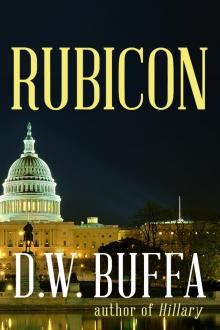
Rubicon, page 19


“He’s going to say that al-Farabi was a known terrorist and that anyone who would believe what he said - that what happened in Los Angeles was some kind of government plot - is not only out of their minds but is giving aid and comfort to the enemy and that everyone ought to know it.”
“First I’m crazy; now I’m a traitor. Ask him this: If what happened in Los Angeles was the kind of terrorist attack he says it is, then who hired Henry Lattimore and Frank DeStefano? Who sent them to my house to kill Dieter Shoenfeld and murder me? Then ask him what he knows about Rubicon - Ask him whether all these murders happened at his direction!”
When he finished the call with Burdick, Helen could tell he was upset.
“They only know how to do one thing,” he explained.
They were in the room off the kitchen, the sitting room with the long view of the ocean. Helen had put on a nightshirt. She sat on the sofa, her legs pulled up and her arms wrapped around her knees. Bobby opened one of the French doors and took a deep breath.
“They only know how to do one thing,” he repeated. “Attack. Everyone is a traitor who does not agree with them. Given all the things that have happened - the number of people who have been killed – the government should be all over this: the FBI working overtime, every investigative agency sifting through every piece of evidence, trying to find out what really happened in Los Angeles and whether that was the end of it or just the beginning. But no one is doing anything.”
He looked at Helen as if he suddenly understood something. He stood up and started to walk back and forth. A bitter smile cut hard across his mouth.
“Political assassination: disrupt the election, cause everyone to question whether democracy is even safe; instill such a deep fear in everyone that they won’t think to question whatever someone in power tells them has to be done. That must have been why Gunther Kramer, and then Dieter, thought there would be more than one attack; why Los Angeles was just the beginning of....”
Helen knew from the look in his eyes that he was holding something back.
“You know who it is, don’t you? You know who started all of this.”
“Raymond Caulfield told me, but I wasn’t smart enough to see it. He told me about the people around the vice-president, the ones who talked about an American empire, who believed that we had the power to remake the Middle East. He told me something else that at the time I didn’t understand: that for all their reputation as brilliant intellectuals their knowledge of history, serious history, was almost nonexistent. It all fits,” he said with a dismal stare.
“But it’s all come apart, hasn’t it?” asked Helen. “Everything they tried to do has failed.”
“If everything had gone the way they expected, there wouldn’t have been any need of something like Rubicon. That’s what I’ve only gradually come to understand. The worse things got, the more certain they became that they were right, and the more determined to see it through. They’re the ones who have the courage and the foresight to stay with something for as long as it takes. They think we would have won in Vietnam if we had stayed longer, if we hadn’t lost our nerve. That’s why Rubicon was necessary: to bring back all the fear that let them start this misadventure in the first place.”
“But do you think the vice-president…?”
“Someone who divides the world into friends and enemies; someone who does not think twice about suggesting that anyone who criticizes a policy he supports is giving aid and comfort to the enemy; someone who talks about a war of civilizations that will go on for a hundred years. Do I think that someone like that would tell the people around him that they had to do everything that was necessary, that the greatest threat to the security of the country were the people who were trying to stop them, that the future of the country and the world depended on it? You bet I do. It has to be the vice-president. He’s the only one who could have pulled it all together. The only problem is that I can’t prove any of it; not yet, anyway.”
Bobby glanced at the clock. It was nearly ten, one in the morning in Michigan.
“I wonder why Charlie hasn’t called?”
The next day Helen insisted on watching the vice-president’s press conference on television.
“It won’t be pretty,” Bobby warned her. He was used to the combat, the sometimes vicious combat that had come to dominate political campaigns. He could take the best, or the worst, of whatever the other side could do. It was something else again when his wife had to hear it. Or at least he thought he would be upset, until he realized that he had seriously underestimated both Helen’s resiliency and her sense of humor.
The vice-president’s prepared remarks were delivered in a flat monotone that, like the voice of an accountant, made what he had to say seem more factual. He may have been accusing a member of the United States Senate of consorting with the enemy, but he made it sound as if there were nothing personal in it.
“It’s because he can destroy someone and never think twice about it,” explained Bobby.
“That’s because for him everything is an abstraction. He doesn’t have a sense of the specific,” said Helen, her eyes focused on the screen.
“He doesn’t...?”
“He was never in the service. He never saw men dying. He’s always been a bureaucrat, whether he was in politics or not. He only knows how to see the world in numbers and categories. The only things he can understand are quantifiable. Everything is mechanical, even the way he talks. It is all analytical. There is no judgment.”
At that very moment, the vice-president was rattling off the numbers of those who had died fighting the war on terror.
“Thousands of Americans, brave young men and women in uniform, have given their lives in this cause. For someone in a responsible position - a member of the United States Senate - to take the word of a known terrorist and make the claim that the murder of Governor Alworth was part of some domestic conspiracy, is either the result of a disturbed mind or an unprecedented disregard for truth and decency.
“Mohammed al Farabi was detained upon credible information supplied by a friendly government. He was sent back to his country of origin where he was later reported dead - mistakenly, as it turns out. He continues his work against the United States, against the spread of democracy, only now he has the assistance of one of the leading members of the Democratic Party. It seems to me, given what this country has gone through, that the leadership of the Democratic Party, as well as that party’s presidential candidate, should either denounce the actions of Senator Hart or explain to the American people why they prefer to take the word of a self-proclaimed terrorist over the word of every credible law enforcement authority in the country.”
The first question came from Quentin Burdick.
“So you dismiss out of hand even the possibility that the Los Angeles attack was part of a domestic conspiracy?”
“Categorically.”
“And this is based on whose investigation?”
“You’ve seen the videotape the terrorist made. You have now been given copies of the documents that prove Farabi was a terrorist, though I should have thought the fact he was held at Guantanamo was proof enough of that.”
“According to Senator Hart, those documents were forged, a way of getting Mr. Farabi, who was a newspaper publisher in Cairo, sent back to the Middle East. You misstated the facts when you said he was sent back to his country of origin. He was sent to Syria where, again according to Senator Hart, his release was obtained through bribery.”
Bristling at the suggestion, the Vice-president denied that he had misstated anything.
“I said he had been sent back to the Middle East where he came from. But with respect to your question, the suggestion is absurd. Why would anyone forge documents to prove they were guilty?”
He turned to a reporter with one of the more reliably conservative cable channels. The question was not what he expected.
“There is still the question, Mr. Vice-President, about how to explain the fact that it was Senator Hart who was the target of an assassination plot? Armed men broke into his home, murdered Dieter Shoenfeld, a German publisher many of us knew. The police now have identified the two killers. Frank DeStefano, a New Jersey mobster, has been murdered. Henry Lattimore appears to have had some previous contact with members of the government. There are reports, so far unconfirmed, that Lattimore was someone the CIA once hired for what they are calling ‘special assignments.’”
“There is no connection between the two events,” said the vice-president. A terrorist - a suicide bomber - was responsible for what happened in Los Angeles. We have the video tape. We know who he was and we know why he did it. The break-in at Senator Hart’s home in Georgetown - two men, now identified, shot and killed Mr. Shoenfeld and left Senator Hart unharmed. Why they came to his house, what they were there to do -”
“Rubicon, Mr. Vice-President!” shouted Quentin Burdick, determined to bring the questioning back around. “A number of people, including your own deputy director of the CIA who started looking into what was apparently the code name for the attack in Los Angeles, have died. Are you suggesting that all these deaths are simply coincidental?”
“I’m not suggesting anything, except that there is no evidence whatsoever to back up Senator Hart’s fantastic and harmful allegations. Not only is there no evidence to support them, the evidence I’ve given you today proves that Mohammed al Farabi was, and is, a terrorist.”
“Do you think then that Senator Hart should resign from the Senate? He said he would if the claims he made were proved wrong.”
The vice-president never missed an opportunity to say what someone else should do. He looked straight into the camera.
“That’s what a man of his word would do.”
Minutes after the press conference ended, the telephone started to ring. The first call was from David Allen.
“When I draft the resignation statement, do you want to give yourself a couple of months or shall I make it for immediate effect?” he deadpanned. “Seriously, what do you want me to say? We need to put out something by way of a reply.”
Hart held the receiver away from his mouth. He looked at Helen.
“David wants to know what we should say. What do you think?”
“Those documents he talked about, the ones he said prove the man you met was a terrorist - Say that with all the vice-president’s experience with making things up, you would think he would know a forgery when he saw one.”
“Helen suggests....”
“I heard. It’s better than anything I could have come up with. Bobby, listen, there is one other thing. He must have got wind of what the vice-president was going to do. He put out a release the second the press conference ended.”
“What are you talking about? Who put out a release? ”
“Senator Ryan. It says that anyone who thinks that Senator Robert Hart would ever give aid and comfort to an enemy of the United States does not deserve to hold public office.”
“Did he really? Charlie always did know how to start a fight.”
He talked for a few more minutes with Allen about the reply that should be made to the vice-president’s attack. Then he called Ryan. He reached him between campaign stops just outside Detroit.
“Thanks, Charlie, but you didn’t need to do that.”
“It’s the reason I didn’t call back last night. The vice-president’s office sent that statement out to every Republican candidate for the house and senate. I’m afraid there is going to be a loud chorus of support among all the other No-Nothings. I thought I’d get in a first shot the other way. But don’t get the wrong idea. This was pure political calculation on my part.”
“Calculation?” Hart laughed, waiting for the zany logic by which Ryan could make a generous act seem a monument to his own, purely selfish, motives.
“Several, actually. First, a fairly large percentage of my constituents despise the vice-president. A public disagreement with him can’t hurt. Second....” There was a stifled pause, as if he could scarcely keep from laughing. “Second, in a close race like this, the one thing certain to lose it is to have my wife file divorce papers before the election, which she promised to do if I didn’t say something in public about that stupid bastard. And third....” This pause was serious, and full of significance. “There wasn’t any choice. He’s wrong, wrong about all of it. Rubicon is just what you said it is. All these murders are connected. And you’re right about the rest of it. It isn’t over. I can feel it. I keep thinking about what Gunther Kramer wrote, those notes of his, and that diagram. Rubicon was not just a plan to disrupt the election, to make it easier for one side to win; there’s something bigger, much bigger, at stake. Remember what he wrote: assassination, the case for war, then more assassinations. I can feel it, Bobby; someone else is going to be killed.”
Chapter Nineteen
For all the charges and the countercharges, for all the poisonous rhetoric, the race for the presidency did not change. Arthur Douglas continued to hold a lead over his Democratic challenger which, though somewhat diminished, was still greater than the margin of error.
“The debate could decide this thing,” said Jeffrey Stone with a look of frustration. He turned to Hart, sitting in the passenger seat next to him. “Taylor is a better candidate than Alworth - looks and sounds like a president should. He should be up six or seven points. Douglas is a blowhard, a fool. I don’t understand it.”
“Of course you do,” replied Hart, gazing out the window at the long row of glass buildings on Wilshire Boulevard. “Douglas plays on patriotism and fear. In the Fifties there were people like Joe McCarthy who thought there was a communist under every bed; now there are people like Douglas and the vice-president who think a terrorist is waiting around every corner.”
Hart began to watch the sunlight reflecting off the different colored glass on the buildings that towered up from the street. There was something almost majestic in the way that, together, the tall angular structures formed a long sweeping line that seemed perfect for the place. It reminded Hart of how the country, at its best, was supposed to work: the parts not always everything you would hope for, but, taken together, a remarkable achievement.
“Until the earthquake,” he said out loud.
“The earthquake?” asked Stone, confused.
“Sorry,” said Hart, turning to him. “I was just thinking of something.”
“You were talking about communists in the fifties, and terrorists now,” Stone reminded him.
“My father tried to explain to me what it was like. People had to sign loyalty oaths - as if someone bent on subversion would refuse to sign something like that. Anything the least bit unusual, the slightest deviation from what was considered normal, became a cause for suspicion. Sometimes out of fear, sometimes out of false patriotism, sometimes out of the worst kind of ambition, people reported on each other, became informers. A friend of my father’s, a hero in the war, a man who had been with the agency from the beginning, was forced to resign because when he was a student in the thirties he had belonged to a student group that advocated aid for Russia after Germany invaded the Soviet Union.”
Hart checked his watch. They were right on schedule. He pulled out the speech he was about to give at the Los Angeles City Club.
“This is all I’ve been doing, explaining over and over again why I think I’m right and the vice-president and the rest of them are wrong. But there is still no proof; everything is circumstantial.”
“Most people believe you.”
“No, most people believe that the government is hiding something, most people believe there should be a thorough investigation. But on the question whether what happened in Los Angeles was a terrorist attack of the same sort that happened on 911 or whether it was part of some domestic conspiracy, there aren’t that many willing to believe it could have been done by someone here.”
Stone knew the polling numbers. Hart had left out something important.
“It’s true only about a third are willing to say they think you’re right, but the number on the other side isn’t that much greater. All the rest are undecided; which means it wouldn’t take much more in the way of proof to convince them that you’re right.”
They were almost there when Hart’s cell phone rang. It was Leonard Coleman. Hart listened and did not say a word.
“Thank you, lieutenant,” he said at the end. He put the cell phone back in his pocket, and immediately began to scribble changes on the speech he was going to give.
The City Club was packed. The entire back of the room was lined with television cameras. Reporters crouched wherever they could find an open spot. Hart sat at the head table, next to the lectern, still working on the speech while everyone else was eating lunch. He glanced at it one last time as he was being introduced, and then slipped it into his jacket pocket.
“At the height of the Great Depression, with millions out of work, Franklin Roosevelt in his first inaugural spoke those much needed and now famous words, that the ‘only thing we have to fear is fear itself.’ Thirty years later, at the height of the Cold War, John F. Kennedy, in his first inaugural address, reminded the country that in dealing with our adversaries ‘We should never negotiate from fear, but we should never fear to negotiate.’ Two presidents - two great presidents - both understood that fear only makes a problem worse. Today, however, there are those who believe that fear is the only way they can govern.
Hart reminded his audience what had happened, how the Democratic candidate for president had been assassinated, and how, a short time after that, Dieter Shoenfeld had been murdered in Hart’s home just as he was about to tell him what was involved in the Los Angeles attack and who was behind it.
“A few days later I kept an appointment that Dieter Shoenfeld had made. I met with Mohammed al Farabi, who had been held at Guantanamo, and learned from him how terrorists were brought to this country to carry out the plan known as Rubicon.