A Few Bicycles More, page 5
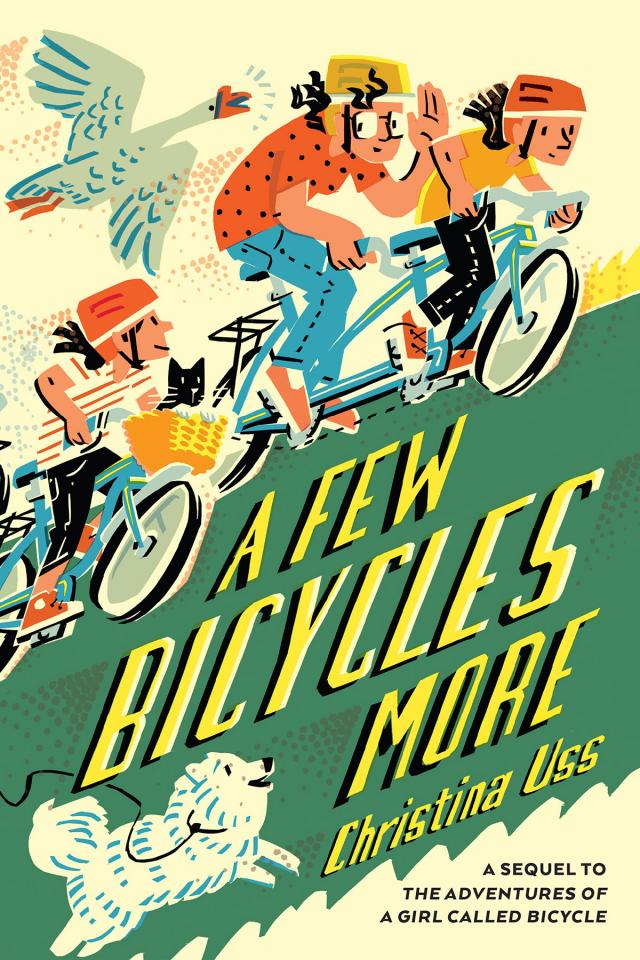


Sister Wanda and Bicycle did their best to explain how she’d shown up on the steps of the Mostly Silent Monastery and all the adventures she’d had since. No one remembered the pink BICYCLE T-shirt she’d been wearing the day she was found—they thought maybe she’d borrowed it from another family’s laundry basket. Everyone laughed to learn that pink shirt was the reason Sister Wanda began calling her Bicycle. They agreed that while they’d never know exactly how Bicycle had ended up at the monastery, everyone was thankful she did. Lunchtime loomed when they’d finished covering the basics.
The nuns offered the group plates of sandwiches and potato chips. The Kosroys kept chatting away, not seeming to notice that they were the only table in the dining room using more than eight words. Stella and Alex explained to Sister Wanda that the maintenance on the old Twintopia Mall property had become too expensive, so the commune had picked up and moved into an empty school building here in West Virginia. Dad said, “Our new apartment is a former classroom, but it works for us. Most days, we homeschool the girls in the mornings and get our work done in the afternoons.” He turned to Bicycle and said, “Just think, tonight you’ll be sleeping in your own bunk bed with your sisters!”
Bicycle lost her grip on a chip. “Oh,” she said. It hadn’t occurred to her that she was meant to go live with these people. There was no doubt in her mind that this was her birth family and that the story they’d told was true. But did going home with them mean she’d never return to the monastery? Was she supposed to change her life completely in no time flat?
Sister Wanda appeared to have heard every bit of Bicycle’s anxiety inside the word “Oh.” The nun said, “We are so happy to have found you, but surely you understand that this will be a big adjustment for Bicycle. Perhaps it would make the most sense for her to stay the night with you but then return to the monastery with me to pack and prepare for her move.”
“Out of the question,” Mom said. “I’m never letting Bicycle out of my sight again.”
“You’d be very welcome to come to the monastery with us,” Sister Wanda said.
“That’d pose a bit of a problem,” Dad said. “All the families share one car at Twintopia, and our turn to drive it won’t come up for several more weeks.”
“I see,” Sister Wanda said. She cleared her throat. “Then I propose this: I will go with you to Twintopia to see Bicycle settled in, and when I return to the monastery, I will mail her belongings. As soon as you are able, I would be most grateful if you could bring Bicycle to the monastery. She has many people there who love her and will want to wish her well in this next chapter in her life.” She put an arm around Bicycle and said in a low voice, “I’ve had you for so long, it wouldn’t be fair not to share you with your family. It’s the right thing to do.”
So. Bicycle’s life was changing completely in no time flat. She felt as if a river had suddenly burst out of the ground before her and was sweeping her away in its current. Sister Wanda and her parents were telling her not to swim against it, or try to get back to dry land, but to let it take her where it would. She hoped this wasn’t what sisterhood and daughterhood would permanently feel like.
The swept-away-by-the-current feeling accompanied Bicycle while she and Sister Wanda loaded their bikes onto the front-mounted rack of a shuttle bus and climbed aboard with the Kosroys. As the bus wheezed up a hill, her mother peppered her with questions about her habits and her favorite things. She then turned her attention to Bicycle’s recent cross-country trip. “How on earth did Sister Wanda agree to you riding across country by yourself?” Her mother shivered. “I can’t bear to think of what might have happened!”
“I didn’t exactly get a chance to agree to that plan,” Sister Wanda said drily. “Rather than attend a friendship-making camp in which I’d enrolled her, Bicycle set out by herself to make her own friends on her bike ride.”
Mom’s questions continued as they disembarked from the bus and walked across a parking lot, up a street, and down a half-circle driveway surrounded by overgrown grass.
Bicycle noticed the Fortune blinking, Please ask your mother how literally she meant her statement about never letting you out of her sight again. Will she choose not to sleep? Will she follow you at all times while asking questions?
Bicycle figured she’d find out soon enough. They arrived at the front double doors of a sprawling brick building. The block letters glued to the bricks announced it was the Jefferson County Junior-Senior Regional High School. In one window someone with very neat handwriting had taped up a piece of paper that said WELCOME TO TWINTOPIA!
Dad waved at the paper and said, “There’s still a lot of work to do, like getting a new sign made and mowing the playing fields, but we had to get the inside set up first.” He unlocked the door and held it open with a grin. “Come and see your home sweet home.”
A SISTER FOUR TIMES OVER
“I’ll lead the tour,” said Bernice-Banana, turning to walk backward and pointing in different directions down the locker-lined hallways. “The shared nursery where all the littlest littles go is in the gym. The band rehearsal room is the shared playroom. The cafeteria’s where we have common meals. There’s fifty families here, so around three hundred people total.”
Bicycle wondered where everyone could be. The hallways were so quiet, it reminded her of the Mostly Silent Monastery, where there were at most sixty monks at any given time. But then Bernice-Banana said, “This is the afternoon lull—lots of the littles nap now, and there’s always a group activity in the playroom, like storytime, book club, family yoga, sing-alongs, or this thing called Crafternoon that’s a free-for-all with paper, glue, markers, cardboard boxes, and glitter.”
Each classroom door had a narrow vertical window; a piece of construction paper with a last name on it, like MARTIN or SOWSIAN or FALALU; and a welcome mat in front of it. Some of the doors were decorated for the season with witches on broomsticks or Indian corn bundles, and a few families had put out jack-o’-lanterns. Each hallway looked like a miniature neighborhood.
Bicycle followed her family through so many sets of doors and turned so many corners that she lost track. She murmured to the Fortune, “Can you make a map of this place?”
I am already doing so.
“You’ll always be able to find our apartment by following the states,” Apple told Bicycle. She pointed at the floor, where Bicycle’s sneakers scuffed across a yellow painting of Louisiana with a star labeled BATON ROUGE. “They’re in alphabetical order and lead in a loop starting from the cafeteria. The students who used to attend this school did it as an art project using special paint that won’t wear off for a hundred years or something. We live next to Missouri.”
Bernice-Banana said, “I feel a song coming on.” She threw her arms wide and chanted the opening words to the song “Fifty Nifty United States.”
“Alabama, Alaska, Arizona, Arkansas,” Cookie took up the tune.
“California, Colorado, Connecticut,” Daff chimed in. She clapped twice. “Take it, Yoof!” She looked at Bicycle.
Were there more C states or was D next? Bicycle thought. The Fortune saved her by playing a chorus of kids’ voices singing, “Delaware, Florida, Georgia, Hawaii, Idaho.”
“What a neat trick,” Cookie said. “Can your bike play other songs, too?” The Fortune responded by playing the Sesame Street song “C Is for Cookie.” The family laughed.
“My bike is pretty special,” Bicycle told them. “It has tons of features, and uses this computer screen to communicate by writing out words.”
“A bike that can write? Who can keep up with technology today?” asked Mom, shaking her head in disbelief.
“If I had a bike like that, I might be convinced that we need to learn to ride,” Apple said.
“You don’t know how to ride a bike?” Bicycle asked, looking at Apple and then the rest of her family. “Any of you?”
Dad said, “I learned as a kid, but I haven’t done it in years.”
“I never learned to ride or drive,” said Mom. “I’m as near-sighted as a rhinoceros, which is about as near-sighted as it gets.”
Before Bicycle could absorb these facts, Mom stopped and bent over to unlock a classroom door. Seven tissue-paper ghosts made a frame around the construction-paper label THE KOSROYS.
“Here we are. Please excuse the mess.”
The classroom was divided in half by a thick green-and-blue-striped curtain that reminded Bicycle of a circus big top. The half of the room where they now stood was crowded with furniture. It had three couches pushed together to make a U-shape around a braided rug. One wall had several jam-packed bookcases and two tall cabinets standing against a blackboard. In the far corner near the windows was a kitchenette with a sink, a mini fridge, a microwave, and a table and chairs. Near the curtain sat a cubbyhole desk piled with papers and pens, and a piano topped by a leaning stack of music books.
A tall basket filled with jumbled pairs of shoes sat next to the door. Every available space on the walls had been covered with hooks from which hung coats, bags, and droopy-fronded spider plants. Things were messy, but in an agreeable way that invited you to make yourself comfortable.
“I believe in having a place for everything and everything in its place, but it’s a smaller space than we used to have,” Mom said, fluttering her hands like she wanted to tidy the whole apartment at once. She scooped a blanket off the rug and draped it on the back of a couch.
“It’s charming,” said Sister Wanda. “I assume the bedrooms are behind that curtain?”
“Exactly,” Dad said. “Girls, can you show your sister and Sister Wanda your room?” He tugged his wife away from arranging couch pillows toward the mini fridge. “We’ll be there in a minute.”
“Park your bike here,” Apple suggested. “Our bedroom doesn’t have much space to spare.”
Bicycle patted the Fortune’s handlebars. “I’ll be right back,” she told it.
I’ll be right here, blinked the Fortune.
Apple wasn’t kidding about the lack of spare space. Four chests of drawers spewing clothes surrounded a set of regular bunk beds and a set of triple bunk beds. Hooks were hung with stuffed animals, including a serenely smiling sloth. The braided rug in here was covered by piles of DVDs and notebooks, a robotics kit, and a box of modeling clay. Three wardrobes had been set up to create a divider between the girls’ bedroom and that of their parents.
Cookie hurriedly moved a stack of books off the bottom bed of the triple bunk and added them to a pile on the floor. She smoothed the coverlet. “This one’s yours. It’s clean. We always make your bed with fresh sheets the same time we make ours. Mom made it part of our routine. I guess she wanted to be ready for you coming back.”
“Where’s Yoof’s pillow?” Bernice-Banana asked, scanning the other beds. “Ha-ha, Apple, you thief. How come you didn’t foretell Yoof coming home with your all-seeing eye and leave her bed alone?” Bernice-Banana handed Bicycle her missing pillow and said, “Apple’s got the most mind-reading power. It can be pretty annoying.”
“I do not have an all-seeing eye,” Apple said. “I can just feel what’s going on with my sisters. Which, you should know, can be pretty annoying in its own way.” She explained to Bicycle, “Quint Sense is not like mind-reading. If we continually absorbed one another’s thoughts and feelings, our brains would be chaotic messes. A feeling has to be big for us to pick up on it, or we have to focus really hard.” She cocked her head. “You really don’t remember us?” Her brown eyes were penetrating.
Bicycle shook her head. Dad called out from the other side of the room, “We’ve got a surprise, c’mon back over here!”
Once she parted the curtain, Mom and Dad started singing to her, “Welcome home to you! Welcome home to you! Welcome home, dear Euphemia-now-Bicycle! Welcome home to you!”
Daphne took out her camera. Dad held up a frozen cheesecake from which a porcupine’s worth of lit candles bristled. “This is all the candles we have in the house. It’ll have to represent all the birthdays we’ve missed with you.”
“If you had enough candles to cover every birthday she’s missed with our family, it’d be three plus four plus five plus six plus seven plus eight plus nine plus ten plus eleven plus twelve, so seventy-five total,” said Apple. “Hey, I bet you don’t know when your—our—birthday is.”
Bicycle shook her head again.
“It’s November twenty-ninth, which is easy to remember because eleven and twenty-nine are both prime numbers.”
Dad said, “Sorry, we can’t eat the cheesecake quite yet because it just came out of the freezer. Whoo! Hold on.” He put it down on the table. “Got a little toasty there. Maybe the candle flames will defrost it faster. Anyway, come over and make a wish.”
“Make ten wishes!” said her mom, clasping her hands together.
Bicycle approached the blaze with a lot of thoughts, but no single clear wish, let alone ten of them. She looked at her mother and father, and thought with her first puff: I have parents. She looked at Apple, Bernice-Banana, Cookie, and Daff, and thought with the second puff: I’m a sister four times over. She looked at Sister Wanda with the third puff: Do I really belong here? The fourth through the ninth puffs: Please let me figure this out. The final puff: Please.
Everyone cheered.
It turned out that the candles did speed up defrosting. After the cake was consumed, Sister Wanda thanked the Kosroys for their hospitality but said she had to be going and push her pedals hard if she was going to make it home before dark. “I haven’t raced the sunset in years, but it’s what my body wants to do today.”
Bicycle walked stiffly to the door with the nun, regretting that she hadn’t used her candle wishes to make Sister Wanda stay the night. And the day after that. And maybe for another couple of months, you know, until she got the hang of living here.
They walked into the hallway for a moment of privacy.
Bicycle cut right to the chase. “How am I supposed to do this? Am I supposed to apply my friend-making rules to reuniting with family?” But this was so different, she thought. Family you didn’t have a choice about. They were yours and you were theirs whether you got along or not.
Sister Wanda touched Bicycle’s cheek. “Open your heart to them. They clearly have been longing for your return, and I am certain they will take good care of you.”
“How do I open my heart?”
“What have the monks and I been teaching you your entire life? You start by listening.” Sister Wanda wrapped her arms around Bicycle. The familiar smell of lilac soap enveloped her. It was much different from being enthusiastically squeezed by people who felt like strangers. “The Mostly Silent Monastery will always be your home, too. We’ll have you back soon for a nice long visit. I promise.” She then released Bicycle and looked up at the ceiling, blinking rapidly. “I must go. I will call you every day.”
She strode off. Bicycle knew that a piece of her heart, open or not, went with her.
The Kosroys’ door opened so quickly that Bicycle suspected someone had been peeking through the curtain in the window.
“Come on back in, we want to show you the photo albums!” said Mom.
WHAT ANIMAL WOULD YOU BE?
Bicycle looked at pictures of herself as a pink, squinch-faced newborn. How did they tell us apart? she wondered with each new photograph of five babies in a crib, five babies sucking thumbs, five babies on a quilt. She tried to take Sister Wanda’s advice and practice her listening skills. Instead, she had to answer a hundred more questions about herself and her life up until now.
Mom began asking how one addressed monks at the monastery but abruptly interrupted herself. “Oh my goodness. Does it feel difficult for you to call us Mom and Dad? Since you don’t remember us? How can we make it easy for you? I mean, you don’t have to say it until you are comfortable, but how can you get comfortable if you don’t say it?”
Dad said, “Hey, that’s a good point. Maybe you could start by calling us Alex and Stella—no, scratch that, that’s too weird for me.”
Before this, Bicycle had been thinking she’d try addressing them as Mom and Dad and see how it went—maybe it’d be like donning a much-too-large, my-name-is-Euphemia-sized hat and maybe it wouldn’t—but now she was put on the spot and wasn’t sure what to do.
Bernice-Banana held up her hands. “Here, I’ll teach you. You pronounce them like this: Mo-om, Da-ad!” She stretched out the words with a groan in the middle.
This made everyone laugh, and before she could overthink it, Bicycle let the words tumble out. “Mom and Dad, Dad and Mom. I think it won’t be a problem, but I’ll let you know if it is.” Whew. No wrong-hat sensation at all, she thought. Since she’d never called anyone those names before, it felt like using any new names for any new people in her life. Her parents both beamed at her, then launched into their next hundred questions.
That evening, the family headed to dinner in the cafeteria with the rest of Twintopia. Mom explained that everyone was on their own for breakfast, but when it was their turn, four families joined together to prepare lunch or dinner—gigantic meals that fed everyone. This wasn’t an unfamiliar idea to Bicycle, since the Mostly Silent Monks also rotated kitchen duty, making big vats of stew, massive pans of casseroles, and towers of pancakes on breakfast-for-dinner night. Maybe fitting in here will be a little easier because I’m used to living with lots of people already, she told herself.
However, as she followed her family through the now-crowded halls, she knew this was a whole new world. Families were chatting and kids were running in all directions to greet one another. A few rode scooters or pulled stuffed animals in wagons. Some girls were banging locker doors open and shut, and some boys were jumping rope and chanting about Miss Lucy and the lady with the alligator purse. Bicycle couldn’t remember seeing more than a handful of monks in the monastery hallway at any one time. And they barely said anything. And they never jumped rope.