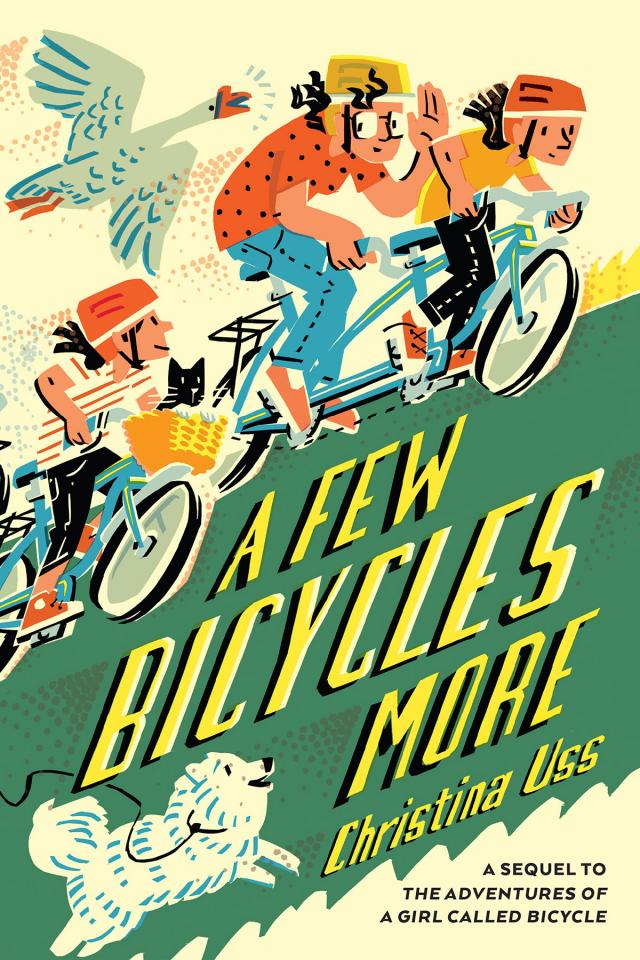
A Few Bicycles More, page 4


“We never gave up hope,” said the man.
Bicycle took a good look at him. Short dark-blond hair, bushy-ish eyebrows, round face. She couldn’t tell if he was familiar at all. He looked nice, though. And stunned.
“Have you been here in Harpers Ferry the whole time?” he asked Bicycle.
“No,” Bicycle said. “I came here because my bike—” She stopped. How could she even begin to explain why she was here? “Have you been here in Harpers Ferry the whole time?” she asked back.
He said, “No, we just moved here this month. Our new home is near the parking area where shuttle buses bring tourists to the historic section of town. We caught one of them today to get a few treats, because some mornings are better faced with a chunk of chocolate.” Bicycle made a surprised little sound, which he misinterpreted. “Right, why am I talking about chocolate? It doesn’t matter. I bet you have oodles of questions, and we do, too. We should go back home and ask our oodles until we’re done.”
“Yes,” agreed the woman.
The woman—My mom? Bicycle suddenly thought—released her. Bicycle looked up into her face. Warm brown eyes swam behind bottle-thick glasses. Did she know those eyes?
Sister Wanda, flustered, said, “Hold on, before we go anywhere, I’d like some proof that you are who you say you are.”
The woman said, “You must be looking out for our girl here, and I appreciate that, but there’s no need to protect her from us, of all people. Look at her! And them!” She swept her hands in front of the four girls standing together. She said, “Really look at them! If you didn’t already know which one was which, would you know?”
Bicycle clenched a hand, wanting Sister Wanda to glance at the group and say in her no-nonsense tone, Of course I would, I’d know my Bicycle anywhere.
Instead, the nun studied the five faces in silence. She blinked an excessive number of times. “We certainly do have a lot of questions that need answering.” She looked over her shoulder at the Nearly Silent Nunnery. The sight of the place seemed to steady her. “Please humor me. Let’s go in there to talk first. I’m certain they can find a space for us.” She started up the sidewalk as if sure everyone would follow her. Everyone did.
As they walked over, one of the girls said, “I guess we should introduce ourselves. I’m Apple.” She was holding a Twix bar.
Bicycle hoped they wouldn’t eat their candy bars or put them down too soon, because it seemed like a good way to keep track of who was who. She then realized she’d somehow lost the last bite of her own Malty Melty in the crazy hug.
“Apple’s the smart one. I’m the one who doesn’t look before I leap,” said the next girl, the one with the candy bar in the blue-and-white wrapper. Almond Joy—that was the name of that bar, Bicycle’s mind chattered. If only her other questions could be answered so easily.
“We’re equally smart,” argued Apple. “I just happen to work hardest on my homeschool assignments.” She told Bicycle, “The name of this leaping-before-looking person is—sort of—Banana. Sometimes, though, she’s called anything but Banana. Do you have a different name today?”
Anything-but-Banana said with a regal air, “Today I would prefer to be called Bernice. Now allow me to introduce your sister Cookie, the girl covered in way too many pockets.”
“I like pockets! I sew extra ones on all my clothes. And I like my name, not like Banan—er, Bernice,” said Cookie. “I think my name makes me sound friendly, which I am. Our sister behind the camera lens is Daphne, who goes by Daff.”
Bicycle turned to check what Daff’s candy bar was (a Kit Kat) and saw Daff had whipped out a small camera as they entered the nunnery. Daff said, “This is how the reunion began. Say hi for posterity, Yoof.”
Bicycle waved awkwardly at the camera. “Hi.”
In the foyer, Sister Wanda said a few words to the nun who silently greeted them. They were then ushered into the empty dining hall.
Before they sat down, the woman—Mom? Bicycle tried out the name again when she looked at her—stuck her hand out for Sister Wanda to shake. “We adults should introduce ourselves. I’m Stella Kosroy, and this is my husband, Alex. Wait, what am I doing? If you’ve been taking care of our girl all this time, you’re practically family!” She yanked on Sister Wanda’s hand to pull her in for a hug.
“Oof—well, yes, I suppose that’s so. I’m Sister Wanda Magdalena. I’ve been your daughter’s guardian since she turned up on my doorstep when she was no more than a toddler. Please, sit.” They all did so. Bicycle parked the Fortune at the end of the table.
Alex Kosroy—Dad? Bicycle thought—said, “We’ve been missing our daughter Euphemia here for nearly nine years.”
“What did you call me?” Bicycle asked.
“Oh yeah, we’ve got to explain the names, Mom,” said Daff. “In fact, let me get it on video.”
“Who should start the story?” said Bernice-Banana.
Bicycle wondered how often she changed her name.
“Me, because I’m the firstborn,” said Apple.
“How about Mom, because she was there for all of it, even before we were born,” said Cookie.
“Dad was, too,” said Apple.
“We all know the story backward and forward. Any of us could tell it,” said Bernice-Banana.
Daff leaned in. “All right, a historical family film moment, captured by Daff Kosroy. Here’s Euphemia, back from wherever she’s been. She’s about to learn the story of her name, because she’s never heard it before.”
“Once upon a time, twelve long years ago,” began Apple, “Mom gave birth to five perfect identical quintuplet girls. And even though she’d known for months she was going to give birth to these quintuplet girls, she and Dad had not planned out names for any of them.”
Mom took over. “Because I believed since the universe had given us such a special and unexpected gift, the universe would step in and tell me your names when it was time for me to know them.”
Bicycle saw the Fortune’s screen blink: Less than one in fifty-five million births are quintuplets.
Bernice-Banana began talking next. “Apparently, the universe was feeling bonkers, because when the nurse came over to Mom to ask her for our names, she said—”
Dad jumped in, “In this deep, resounding voice, not like her normal voice at all—”
Bernice-Banana continued, “In this deep, the-universe-is-speaking voice, Mom said our names were Apple, Banana, Cookie, Daphne, and Euphemia.”
Cookie said, “Dad asked her if she was sure about all of the names, if she didn’t want to think about it a little bit, since these were quite uncommon names, especially if you think about them as a group, and she should remember that their daughters would carry them through their whole lives. I’m glad what Mom said next was—”
“THE UNIVERSE HAS SPOKEN,” Daff said, turning the camera on herself. “Dad said he’d never seen Mom look like that, or talk like that, before or since. He said any woman who had just given birth to quintuplets should have the right to name them whatever she wanted.”
Bicycle kept turning this way and that to follow what they were saying. It was as if the Kosroys were tossing a conversational ball back and forth between them.
Apple took up the story next. “We personally can’t help but think the alphabet wallpaper in our old nursery may have had some effect on Mom’s mind, since it had ‘A is for Apple, B is for Banana, C is for Cookie’ repeated around the room.”
“If the alphabet wallpaper had that much power over me, then why didn’t I name Daphne ‘Drumstick’ and Euphemia ‘Egg’?” asked their mother.
Bernice-Banana jumped in. “Because even someone hypnotized by wallpaper knows deep down that naming a child ‘Drumstick’ or ‘Egg’ would be . . . bananas.”
Daff said, “You told us you read every Scooby-Doo comic book in Dad’s vintage collection on sleepless nights when you were pregnant. That had an effect on your mind, too, and inspired you to name me after the brave and well-dressed teen detective Daphne Blake.”
Their mother shook her head. “I’m telling you, the universe spoke through me. The name Euphemia didn’t come from any wallpaper or comic book. None of you have ever been able to explain the origin of Euphemia’s name.”
Sister Wanda murmured to Bicycle, “You know, Saint Euphemia was the founder of my order of nuns. Maybe the universe knew you would end up with one of us.”
“I’m Euphemia Kosroy?” said Bicycle, trying it on to see if it seemed familiar. It actually felt like a much-too-large hat.
“Don’t worry, you’ve got a nickname,” said Cookie. “Yoof.”
Bicycle puzzled it out for a minute and realized that the first syllable of “Euphemia”—“Euph”—was pronounced “Yoof.” She said, “I think I’d like to stick with the name I’ve had for as long as I can remember: Bicycle.” She was still a little dizzy from following the conversation that had jumped back and forth among the Kosroys, and she definitely didn’t want to agree to anything as major as a new name or nickname right now.
“Ooh!” said Bernice-Banana. “That’s a good one! Mom, why couldn’t you have bought nursery wallpaper that said ‘B is for Bicycle’?” She directed her next question at Bicycle. “Can I trade names with you?”
“Oh . . . no, thanks,” said Bicycle.
“No one wants to be a Banana,” sighed Bernice-Banana.
Sister Wanda seized control of the conversation’s bouncing ball. “So how did you lose your fifth child? How did she end up on our steps in Washington, D.C.?”
Dad said, “D.C.? This is the first time we’ve known for sure what city she ended up in.” He and Mom looked at each other, pain in their eyes.
Mom said, “The police were searching, the FBI was searching, everyone was searching everywhere as soon as we realized Yoof was missing. We’re not wealthy people, but we also hired private investigators over the years to try to piece it together. We never once stopped looking.” She briefly pressed her hands to her lips. “A big part of the problem was that we weren’t sure when you disappeared. There were so many possibilities to chase down.”
“We’ve been telling Mom and Dad the whole time that you were okay,” said Apple. “I bet you’ve heard of identical twins sharing each other’s emotions. Well, we’ve got that times five, so all of us know when any one of us is hurt.” She tipped her thumb at Bernice-Banana. “I knew the minute she tripped and scraped her arm yesterday. So while everyone’s been looking for you, we’ve known beyond a doubt that, somewhere, you were safe and pretty happy. It’s been awful not having you with us, but at least we knew that much.”
“Do you remember us?” asked Mom.
“What’s your Quint Sense been telling you?” asked Bernice-Banana. “Was it letting you know your big ol’ family was somewhere that you weren’t?”
The Kosroys locked six pairs of eyes on Bicycle while she tried to organize her thoughts. When she was young, she’d sometimes imagined that she was a lost princess and would be found by her royal relatives coming to the doorstep in a horse-drawn carriage. As she’d gotten older, she’d sometimes dreamed that she might be related to different famous bike racers. But in all the times she’d imagined her family finding her, had they looked anything like this? She had to be honest.
“I’m sorry,” she said. “But no. I don’t remember anything about you.”
SOFT HIDING PLACES
Bicycle thought her statement might silence the group, but everyone started talking at once, including Sister Wanda. Bicycle couldn’t make heads or tails out of any of it, so she just watched them. She used the opportunity to commit to memory that Cookie was the pocket girl, Daff was the one with the camera, Bernice-Banana had a scraped elbow, and Apple had an aura of confidence about her, like she could come up with an answer for anything.
Sister Wanda raised her voice until no one else had any choice but to listen to her. “You mentioned before you didn’t know when Bicycle disappeared. What did you mean by that?”
Their mom’s eyes welled up with tears again. “I want to make sure you know how much I love you,” she said to Bicycle. “I love all my girls the same. I never meant for this to happen. I—we—just needed so much help.”
Sister Wanda softened her tone and said, “I’m sure this has been very hard for you.”
Mom wiped a finger under each side of her glasses and nodded. “It’s been a nightmare. And it happened partly because we got all the help we needed, and then some.”
“When the girls started to walk,” said Dad, “it became clear that two people raising them was never going to be enough. But I edit math textbooks and Stella writes crossword puzzles, so there was no way we could afford day care or nannies. Then we got lucky. We were invited to live at Worldwide Twintopia in Paramus, New Jersey.”
“Not the best name for a place that also has families of triplets, quadruplets, and quints,” said Apple.
“Better than its original name, though: the Worldwide Global Goods MegaMall! Deals Too Big for Just One Continent,” said Bernice-Banana in a voice like a television game show host. “We lived with a whole bunch of other families with multiples—you know, two or more children born at the same time—in this mall that got converted into a commune.”
“Commune?” asked Bicycle, unsure of what the word meant.
Mom explained. “A cooperative community, where we share everything. We share the work, we share expenses, and we help take care of each other. The owner was a twin himself, and he knew it can be hard for parents to raise multiples. When his mall property wasn’t showing a profit, he decided to convert the stores into apartments for families with twins or more who were struggling to find enough money or time or both to take care of their kids. He made the food court into a big shared dining hall and meeting room. He turned the mall office space into a giant day care with an attached doctor’s office. We were so lucky to be able to move in. Except . . .”
Dad said, “Except we had one daughter who loved to roam her new home.” He smiled at Bicycle. “You’d climb into other kids’ cribs in the big nursery when you wanted someone to play with; you’d wander into other people’s homes and take naps; you’d join other families’ tables during lunch or dinner. You never had a fear of strangers. You thought everyone was there to welcome you. But that’s the thing about Twintopia—that’s how it’s supposed to be! All us parents were outnumbered, we needed more loving, helping hands to keep our children safe, so every one of us pitched in when anyone’s kids needed attention.”
Mom’s eyes were streaming. “That’s why we weren’t sure when you went missing. You were often off somewhere else, napping, snacking, playing. Both Alex and I were sleeping very strange hours. Even with support, we were still blearily beyond exhaustion. Our girls’ schedules were all over the map, and often they’d sleep in the big nursery. I was so grateful for the help, I stopped being vigilant for a little while. I stopped doing the best job keeping track of everyone. I didn’t count my girls every day.” Her voice got hoarse. “We think it could have been a week before we realized our Yoof was gone.”
Apple, Bernice-Banana, Cookie, and Daff moved at the same time, but Cookie made it to Mom first to give her a hug. Bicycle wanted to help comfort her, too, somehow. At least she knew now that she’d been misplaced, not intentionally given away.
A tiny memory poked up its nose from the ocean of her early childhood. “Did I go looking for nooks, corners, places I could hide?”
“Laundry baskets!” said her mother, laughing through fresh tears. “Baskets full of clean laundry were your favorite, but you’d also burrow into closets and pull down winter coats to make a nest, or climb into dry bathtubs with a bunch of towels. You loved small, soft places.”
“When Bicycle appeared on our doorstep, I guessed she was about three years old,” said Sister Wanda. “How close was I?”
“She went missing right before their third birthday,” Dad said. “We wanted to get them together for a group photo, and we were able to round up all the girls except Yoof. We searched the whole place, up and down. It was just after we’d had weeks of visitors arriving at Twintopia: deliveries, donations coming in, plus these moviemakers who were doing a documentary on families of multiples. That was the worst day of our lives.” Dad rubbed his eyes with one hand while Mom clasped his other. “We still don’t know what happened. We think Yoof found a cozy spot in one of the delivery boxes. We’d had shipments of pillows, couches, bread, clothes—so many piles of soft stuff—and someone drove off with her by accident to their next delivery location. We called the delivery companies, but no one had seen Yoof. The FBI, police, and private investigators tried to trace the deliveries, but didn’t come up with anything. I can’t imagine how she made it from New Jersey to Washington, D.C.”
“Did she talk to you?” Mom asked Sister Wanda. “When you found her? She was a late bloomer when it came to talking, so we worried that she couldn’t tell someone her name.”
“It took some doing to get her to speak to me,” admitted Sister Wanda.
“We always spoke for Yoof,” said Apple.
“Yeah, she didn’t have to talk because we knew what she wanted and would help her get it,” said Cookie.
“We knew her favorite foods, her favorite stuffed animals,” said Bernice-Banana.
“Her favorite clothes, her favorite books,” added Daff.
“We’ve always known everything about each other,” finished Apple.
After having watched the six members of her family volley their sentences back and forth, Bicycle wasn’t surprised that she hadn’t spoken as a child. She may have been trying to interject some silence into the conversations.
“Now you know all we know,” said Dad. “Maybe you can tell us what life has been like on your end, Yoof—that is, Bicycle. Can you start with your name?”