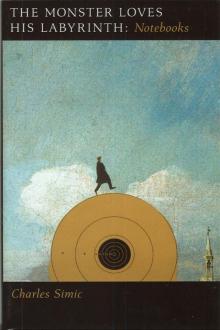
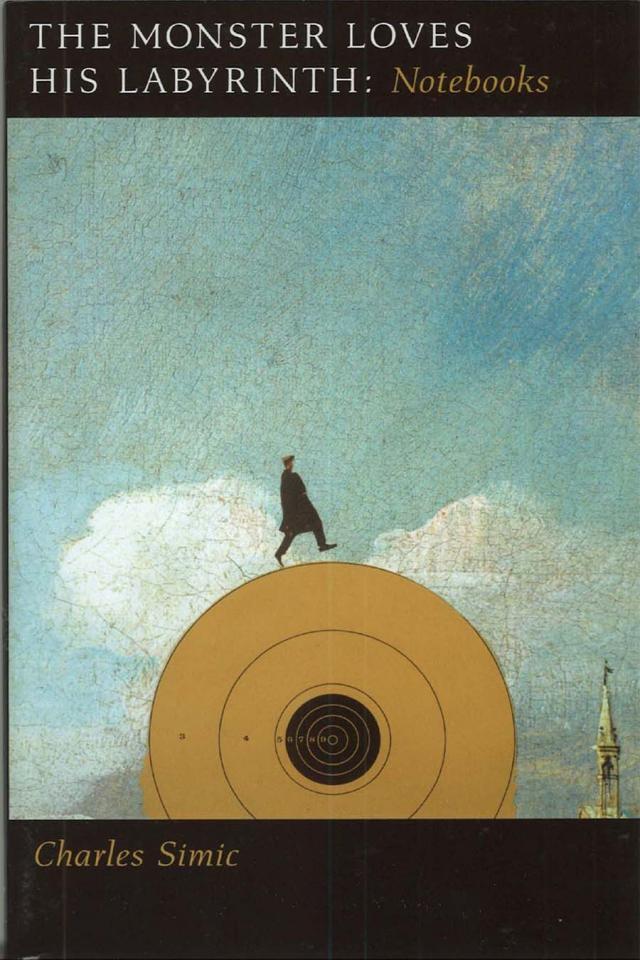
The Monster Loves His Labyrinth, page 5


Even birds detest poetry, it seems. The beauty of the sunset over the quiet lake made them holler. Even the leaves, shushing each other into sleep, grew agitated. The grandeur of the sky lasted just as long as it took them to make their complaints, and then they were done.
The identification of what remains untouched by change has been the philosopher’s task. Art and literature, on the contrary, have been delighted with the ephemeral— the smell of bread, for instance.
Centuries ago, when the king’s advisers and seers gave wrong predictions as to the outcome of military campaigns, they were tortured and publicly executed. In our days, they continue being called “experts” and appear on TV.
Deterrence by example. Let’s bomb X so that Y and Z will realize we mean business and behave. By that logic, why not hang a few crooked politicians and bankers so that others may be warned?
Always the foreigner, the stranger, someone a bit fishy. Even the smiling dummies in store windows eyed me with suspicion today.
Rubbing against so many strangers in so many places and aping their ways to pass for a native has made you incomprehensible even to yourself.
“We lost everything,” my mother used to say. She was right. Everything we ever had in terms of possessions and identities was no more. One day we were folks next door and the next we were riffraff without a country.
Nietzsche: “That the lie is permitted as means to pious ends is a part of the theory of every priesthood.”
American writers have been lucky that the rich and powerful have had no interest in making them their concubines. Our so-called intellectuals have not been so fortunate.
The unbelievers say with the scientists that the morning light has no consciousness; the believers know it does.
Orphan factories and scapegoat farms are the Balkans’ chief economy.
Wary of every enthusiasm, ready to run away at the first opportunity. Only on the subject of the absolute scumminess of politicians do I feel completely confident.
At night frequently I have the same dream: A border guard steps with his boot on my passport.
How to kill a lot of people and sleep like a baby continues to be the statesman’s ideal. That’s why he needs intellectuals to divide murderers into good and bad, to explain that we are doing evil to these people for their own good. Brutality and violence always require a new, superior morality.
Nationalism is the love of the smell of our collective shit.
Any ideology or belief that doesn’t have hatred as spice has no chance of becoming popular. To be a true believer you have to be a champion hater.
Here’s my contribution to the politics of nostalgia: The servants of the rich (our politicians and journalists) should wear doorman’s uniforms. Let flunkies be instantly recognized from the distance, as in the old days.
The silent laughing chorus behind all ideas of progress.
Every poetic image asks why is there something rather than nothing, as it renews our astonishment that things exist.
There’s a tradition of wonderful misfits in literature, unclassifiable writers and poets, like Michaux and Edson, suspicious of literature, who are at the same time its biggest addicts. Only a style that is a carnival of styles seems to please them. A poetry, in short, that has the feel of the circus, a sideshow, vaudeville, facts stranger than fiction, fake miracles and superstitions, dream books sold at supermarket counters, etc.
I never “write.” I just tinker.
The prose poem is like a dog that talks.
It is possible to make astonishingly tasty dishes from the simplest ingredients. That’s my aesthetics. I’m the poet of the frying pan and my love’s little toes.
To preserve the standpoint of the individual is the continuous struggle. The tribe is always trying to reform you, teach you some manners and a new vocabulary.
For any conspiracy theory history is a sham. Every public event is a guise behind which true events take place. Conspiracy, in that sense, is a theory of representation. What you see is really not what is truly there.
Free will is an illusion. In conspiracy theory, the law of gravity is absolute. Planes cannot fly.
The world is always old. There are no new events because conspiracy is etermal.
Conspiracy is the only true theology. All other theologies are part of the great conspiracy.
You think all this is funny? Your laughter, Simic, is a sign of foolishness. You’re a dupe, a gullible hayseed when it comes to the dark forces of conspiracy playing all around you.
Wittgenstein Bubble Gum: Trying to say that which cannot be said. Endeavoring, exerting myself daily—and how!—to woo, to throw a net over, to grapple and scuffle with that which cannot be voiced, intoned, ventriloquized as to its content, even in a ghastly stammer, and is, perhaps, given only in small hints by a hand gesture, a shrugged shoulder, a long sigh. Humdinger! Language is a monkey wrench.
American identify is really about having many identities simultaneously. We came to America to escape our old identities, which the multiculturalists now wish to restore to us.
The muses are cooks. Poetry is a kind of cookery. I divide my poems between appetizers, stews, and desserts.
On the invisible line between sayable and the unsayable—the lyric poem.
If music is about the use of time and painting about the use of space, in lyric poems they’re brought together. Image brings space into language (time), which the language then fragments into space.
Poetry like the movies worries about sequence, framing, montage, and cutting.
Not all innocent victims qualify as innocents, I’ve concluded, reading the daily papers for the last forty years. The ethnic group has first to become fashionable as an object of pity before their innocence as victims is accepted. Otherwise, forget it.
Stupidity is having a national revival. All you need to do is turn on the TV to see its big, friendly smile.
A fierce competition is in progress as to who is the biggest victim among us. Right now, the children of privilege are winning and the poor and the unlettered are losing. Money buys even victimhood.
A poem like a holy icon, painted in secret hope that some day a god may come to inhabit it miraculously.
Didn’t Joyce call poetry “soul butter” somewhere?
I miss phrenology. It would be nice to have someone feel the bumps on the heads of our presidential candidates while they address the nation.
Ambrose Bierce: “That immortal ass, the average man.”
It’s getting dark and I’m showing my teeth to the hell-hound running behind me on the road to nowhere.
Soon we’ll all be returning to Emily Dickinson’s dark closet. Funambulist of the invisible, make it quick, start your walk.
The ideal place to teach creative writing is a used bookstore, says my friend Vava Hristic.
I’m writing for a school of philosophers who will feast, who will be remembered for asking for a third and fourth helping of the same dish while discussing metaphysics. Philosophers who seek those moments in which the senses, the mind, and the emotions are experienced together.
My hunch that language is inadequate when speaking about experience is really a religious idea, what they call negative theology.
The ambition of much of today’s literary theory seems to be to find ways to read literature without imagination. What all reformers and builders of utopias share is the fear of the comic. They are right. Laughter undermines discipline and leads to anarchy. Humor is anti-utopian. There was more truth in jokes Soviets told than in all the books written on the USSR.
My old poems on Geometry (The Point, Triangle, Euclid Avenue, The Ballad of the Wheel) are my attempt to read between Euclid’s lines.
New York City is much too complex a place for just one god and one devil.
The most original achievement of American literature is the absence of an official literary language.
Where time and eternity intersect my consciousness is the traffic cop holding up a STOP sign.
Ethics of reading. Does the critic have any moral responsibility toward the author’s intentions? Of course not, say all the hip critics. What about the translator? Isn’t the critic, too, a translator? Would we accept a translation of Dante’s Divine Comedy which would disregard the poet’s intentions?
Gombrowicz, too, used to wonder, how is it that good students understand novels and poems, while literary critics mostly talk nonsense.
The ambition of literary realism is to plagiarize God’s creation.
Seeing is determined not by the eye but by the clarity of my consciousness. Most of the time the eyes see nothing.
In their effort to divorce language and experience, decon-structionist critics remind me of middle-class parents who do not allow their children to play in the street.
Lately in the United States we have been caught between critics who do not believe in literature and writers who believe only in naive realism. Imagination continues to be what everybody pretends does not exist.
Many of our critics read literature like totalitarian cops on the lookout for subversive material—for instance, the claim that there is a world outside language.
Poetry tries to bridge the abyss lying between the name and the thing. That language is a problem is no news to poets.
Poets worth reading usually believe things the age they live in no longer does. Poets are always anachronistic, obsolete, unfashionable, and permanently contemporary.
Can a timeless moment of consciousness ever be adequately conveyed in a medium that depends on time, i.e., language? This is the mystic’s and the lyric poet’s problem.
A good-tasting homemade stew of angel and beast.
One point of agreement between Eastern and Western philosophy: men live like fools.
Wisdom as measure, as a sense of proportion, as middle ground. If it’s defined that way, one sees why there are only a lew examples of wisdom in the entire history of the world.
If Derrida is right, all that the poets have ever done is whistle in the dark.
Like many others, I grew up in an age that preached liberty and built slave camps. Consequently, reformers of all varieties terrify me. I only need to be told that I’m being served a new, improved, low-fat baked ham, and I gag.
It’s the desire for irreverence as much as anything else that brought me first to poetry. The need to make fun of authority, break taboos, celebrate the body and its functions, claim that one has seen angels in the same breath as one says that there is no god. Just thinking about the possibility of saying shit to everything made me roll on the floor with happiness.
Here’s Octavio Paz at his best: “The poem will continue to be one of the few resources by which man can go beyond himself to find out what he is profoundly and originally.”
The sense of myself existing comes first. Then come images and then language.
Being is not an idea in philosophy, but a wordless experience we have from time to time.
Suppose you don’t believe in either Hobbes’s notion that man is evil and society is good, or Rousseau’s that man is good and society evil. Suppose you believe in the hopeless and messy mixture of everything.
I know a fellow who reads modern poetry only in the john.
Here’s a quick recipe on how to make a modern poem out of an old one. Just take out the beginning and the end; the invocation to the Muses and the nicely wrapped up final message.
I still think Camus was right. Heroic lucidity in the face of the absurd is about all we really have.
Fourier, who planned a model of perfect human society, was known never to laugh. There you have it! Collective happiness under the steely gaze of a murderer.
A true confession: I believe in a soluble fish.
A school where the best students are always kicked out, there you have the history of the academy’s relationship to contemporary art and literature. (I think Valéry said something like that.)
The prose poem is the result of two contradictory impulses, prose and poetry, and therefore cannot exist, but it does. This is the sole instance we have of squaring the circle.
First you simplify whatever is complex, you reduce reality to a single concept, and then you start a church of some kind. What surprises me endlessly is how every new absolutism, every one-sided worldview is instantly attractive to so many seemingly intelligent people.
My soul is constituted of thousands of images I cannot erase. Everything I remember vividly, from a fly on the wall in Belgrade to some street in San Francisco early one morning. I’m a grainy old, often silent, often flickering film.
Only poetry can measure the distance between ourselves and the Other.
Form in a poem is like the order of performing acts in a circus.
One writes because one has been touched by the yearning for and the despair of ever touching the Other.
We call “street wise” someone who knows how to look, listen, and interpret the teeming life around him. To walk down a busy city block is a critical act. Literature, aesthetics, and psychology all come into play.
Nationalists and religious fundamentalists all hate the modern city because of its variety and spontaneity. Stupidity and ill will easily rule in a small community, but in a city one has many ways of eluding their grasp.
Hopscotch. Pierre leapt from Stalin to Mao to Pol Pot to Saddam. I hope after the experience of this century that no one in the future will still believe in the myth of the critical independence of the intellectuals.
The lyric poem is often a scandalous assertion that the private is public, that the local is universal, that the ephemeral is eternal. And it happens! The poets turn out to be right. This is what the philosophers cannot forgive the poets.
How many literary theorists and teachers of literature truly understand that poems are not written merely for the sake of oneself, or for the sake of some idea, or for the sake of the reader, but out of a deep reverence for the old and noble art of poetry.
We speak of rhyme as a memory aid, but not of striking images and unusual similitudes that have a way of making themselves impossible to forget.
I love Mina Loy’s “No man whose sex life was satisfactory ever became a moral censor.”
Since democracy does not believe in the exclusive possession of truth by one party, it is incompatible with nationalism and religion, I tell my Yugoslav friends.
My aspiration is to create a kind of nongenre made up of fiction, autobiography, the essay, poetry, and of course, the joke!
A theory of the universe: the whole is mute; the part screams with pain or guffaws.
I would like to write a book that would be a meditation on all kinds of windows. Store windows, monastic windows, windows struck by sunlight on a street of dark windows, windows in which clouds are reflected, imaginary windows, hotel windows, prison windows . . . windows one peeks out of or peeks in. Windows that have the quality of religious art, etc.
Rushdie’s case proves that literature is the dangerous activity, not literary criticism and its currently fashionable notion that literature is merely the propaganda of the ruling ideology.
Here’s the totalitarian theory of literature from Plato to the Inquisition to Stalin and all their followers:
Separation of content and form, ideas from experience. Literature is primarily its content.
The content needs to be unmasked, revealed for what it truly is. The cop slapping the young poet and demanding to know who ordered him to write like that is the secret ideal.
Literature is clever propaganda for a particular cause.
Literature on its own terms is socially dangerous. Pure art is a blasphemy against authority.
The poet and the writer are never to be trusted. Trust the critic and the censor for their constant vigilance.
What is the difference between a reader and a critic? The reader identifies with the work of literature, the critic keeps a distance in order to see the shape it makes. The reader is after pleasure, the critic wants to understand how it works. The erotic and the hermeneutic are often at odds and yet they should be companions.
A New Hampshire high school student reading an ancient Chinese poem and being moved—a theory of literature that cannot account for that commonplace miracle is worthless.
Another large group of cultural illiterates we are stuck with: college professors who do not read contemporary literature or know modern art, modern music, theater, cinema, jazz, etc.
Eternity is the insomnia of Time. Did somebody say that, or is it my idea?
If poems were the expression of one’s ethnicity they could remain local, but they are written by individuals in all cultures, which makes them universal.
Both imagination and the experience of consciousness affirm that each is all and all is each. Metaphors (seeing resemblance everywhere) are internationalist in spirit. If I were a nationalist, I’d prohibit the use of a metaphor.
The identification of what remains untouched by change has been the philosopher’s task. Art and literature, on the contrary, have been delighted with the ephemeral— the smell of bread, for instance.
Centuries ago, when the king’s advisers and seers gave wrong predictions as to the outcome of military campaigns, they were tortured and publicly executed. In our days, they continue being called “experts” and appear on TV.
Deterrence by example. Let’s bomb X so that Y and Z will realize we mean business and behave. By that logic, why not hang a few crooked politicians and bankers so that others may be warned?
Always the foreigner, the stranger, someone a bit fishy. Even the smiling dummies in store windows eyed me with suspicion today.
Rubbing against so many strangers in so many places and aping their ways to pass for a native has made you incomprehensible even to yourself.
“We lost everything,” my mother used to say. She was right. Everything we ever had in terms of possessions and identities was no more. One day we were folks next door and the next we were riffraff without a country.
Nietzsche: “That the lie is permitted as means to pious ends is a part of the theory of every priesthood.”
American writers have been lucky that the rich and powerful have had no interest in making them their concubines. Our so-called intellectuals have not been so fortunate.
The unbelievers say with the scientists that the morning light has no consciousness; the believers know it does.
Orphan factories and scapegoat farms are the Balkans’ chief economy.
Wary of every enthusiasm, ready to run away at the first opportunity. Only on the subject of the absolute scumminess of politicians do I feel completely confident.
At night frequently I have the same dream: A border guard steps with his boot on my passport.
How to kill a lot of people and sleep like a baby continues to be the statesman’s ideal. That’s why he needs intellectuals to divide murderers into good and bad, to explain that we are doing evil to these people for their own good. Brutality and violence always require a new, superior morality.
Nationalism is the love of the smell of our collective shit.
Any ideology or belief that doesn’t have hatred as spice has no chance of becoming popular. To be a true believer you have to be a champion hater.
Here’s my contribution to the politics of nostalgia: The servants of the rich (our politicians and journalists) should wear doorman’s uniforms. Let flunkies be instantly recognized from the distance, as in the old days.
The silent laughing chorus behind all ideas of progress.
Every poetic image asks why is there something rather than nothing, as it renews our astonishment that things exist.
There’s a tradition of wonderful misfits in literature, unclassifiable writers and poets, like Michaux and Edson, suspicious of literature, who are at the same time its biggest addicts. Only a style that is a carnival of styles seems to please them. A poetry, in short, that has the feel of the circus, a sideshow, vaudeville, facts stranger than fiction, fake miracles and superstitions, dream books sold at supermarket counters, etc.
I never “write.” I just tinker.
The prose poem is like a dog that talks.
It is possible to make astonishingly tasty dishes from the simplest ingredients. That’s my aesthetics. I’m the poet of the frying pan and my love’s little toes.
To preserve the standpoint of the individual is the continuous struggle. The tribe is always trying to reform you, teach you some manners and a new vocabulary.
For any conspiracy theory history is a sham. Every public event is a guise behind which true events take place. Conspiracy, in that sense, is a theory of representation. What you see is really not what is truly there.
Free will is an illusion. In conspiracy theory, the law of gravity is absolute. Planes cannot fly.
The world is always old. There are no new events because conspiracy is etermal.
Conspiracy is the only true theology. All other theologies are part of the great conspiracy.
You think all this is funny? Your laughter, Simic, is a sign of foolishness. You’re a dupe, a gullible hayseed when it comes to the dark forces of conspiracy playing all around you.
Wittgenstein Bubble Gum: Trying to say that which cannot be said. Endeavoring, exerting myself daily—and how!—to woo, to throw a net over, to grapple and scuffle with that which cannot be voiced, intoned, ventriloquized as to its content, even in a ghastly stammer, and is, perhaps, given only in small hints by a hand gesture, a shrugged shoulder, a long sigh. Humdinger! Language is a monkey wrench.
American identify is really about having many identities simultaneously. We came to America to escape our old identities, which the multiculturalists now wish to restore to us.
The muses are cooks. Poetry is a kind of cookery. I divide my poems between appetizers, stews, and desserts.
On the invisible line between sayable and the unsayable—the lyric poem.
If music is about the use of time and painting about the use of space, in lyric poems they’re brought together. Image brings space into language (time), which the language then fragments into space.
Poetry like the movies worries about sequence, framing, montage, and cutting.
Not all innocent victims qualify as innocents, I’ve concluded, reading the daily papers for the last forty years. The ethnic group has first to become fashionable as an object of pity before their innocence as victims is accepted. Otherwise, forget it.
Stupidity is having a national revival. All you need to do is turn on the TV to see its big, friendly smile.
A fierce competition is in progress as to who is the biggest victim among us. Right now, the children of privilege are winning and the poor and the unlettered are losing. Money buys even victimhood.
A poem like a holy icon, painted in secret hope that some day a god may come to inhabit it miraculously.
Didn’t Joyce call poetry “soul butter” somewhere?
I miss phrenology. It would be nice to have someone feel the bumps on the heads of our presidential candidates while they address the nation.
Ambrose Bierce: “That immortal ass, the average man.”
It’s getting dark and I’m showing my teeth to the hell-hound running behind me on the road to nowhere.
Soon we’ll all be returning to Emily Dickinson’s dark closet. Funambulist of the invisible, make it quick, start your walk.
The ideal place to teach creative writing is a used bookstore, says my friend Vava Hristic.
I’m writing for a school of philosophers who will feast, who will be remembered for asking for a third and fourth helping of the same dish while discussing metaphysics. Philosophers who seek those moments in which the senses, the mind, and the emotions are experienced together.
My hunch that language is inadequate when speaking about experience is really a religious idea, what they call negative theology.
The ambition of much of today’s literary theory seems to be to find ways to read literature without imagination. What all reformers and builders of utopias share is the fear of the comic. They are right. Laughter undermines discipline and leads to anarchy. Humor is anti-utopian. There was more truth in jokes Soviets told than in all the books written on the USSR.
My old poems on Geometry (The Point, Triangle, Euclid Avenue, The Ballad of the Wheel) are my attempt to read between Euclid’s lines.
New York City is much too complex a place for just one god and one devil.
The most original achievement of American literature is the absence of an official literary language.
Where time and eternity intersect my consciousness is the traffic cop holding up a STOP sign.
Ethics of reading. Does the critic have any moral responsibility toward the author’s intentions? Of course not, say all the hip critics. What about the translator? Isn’t the critic, too, a translator? Would we accept a translation of Dante’s Divine Comedy which would disregard the poet’s intentions?
Gombrowicz, too, used to wonder, how is it that good students understand novels and poems, while literary critics mostly talk nonsense.
The ambition of literary realism is to plagiarize God’s creation.
Seeing is determined not by the eye but by the clarity of my consciousness. Most of the time the eyes see nothing.
In their effort to divorce language and experience, decon-structionist critics remind me of middle-class parents who do not allow their children to play in the street.
Lately in the United States we have been caught between critics who do not believe in literature and writers who believe only in naive realism. Imagination continues to be what everybody pretends does not exist.
Many of our critics read literature like totalitarian cops on the lookout for subversive material—for instance, the claim that there is a world outside language.
Poetry tries to bridge the abyss lying between the name and the thing. That language is a problem is no news to poets.
Poets worth reading usually believe things the age they live in no longer does. Poets are always anachronistic, obsolete, unfashionable, and permanently contemporary.
Can a timeless moment of consciousness ever be adequately conveyed in a medium that depends on time, i.e., language? This is the mystic’s and the lyric poet’s problem.
A good-tasting homemade stew of angel and beast.
One point of agreement between Eastern and Western philosophy: men live like fools.
Wisdom as measure, as a sense of proportion, as middle ground. If it’s defined that way, one sees why there are only a lew examples of wisdom in the entire history of the world.
If Derrida is right, all that the poets have ever done is whistle in the dark.
Like many others, I grew up in an age that preached liberty and built slave camps. Consequently, reformers of all varieties terrify me. I only need to be told that I’m being served a new, improved, low-fat baked ham, and I gag.
It’s the desire for irreverence as much as anything else that brought me first to poetry. The need to make fun of authority, break taboos, celebrate the body and its functions, claim that one has seen angels in the same breath as one says that there is no god. Just thinking about the possibility of saying shit to everything made me roll on the floor with happiness.
Here’s Octavio Paz at his best: “The poem will continue to be one of the few resources by which man can go beyond himself to find out what he is profoundly and originally.”
The sense of myself existing comes first. Then come images and then language.
Being is not an idea in philosophy, but a wordless experience we have from time to time.
Suppose you don’t believe in either Hobbes’s notion that man is evil and society is good, or Rousseau’s that man is good and society evil. Suppose you believe in the hopeless and messy mixture of everything.
I know a fellow who reads modern poetry only in the john.
Here’s a quick recipe on how to make a modern poem out of an old one. Just take out the beginning and the end; the invocation to the Muses and the nicely wrapped up final message.
I still think Camus was right. Heroic lucidity in the face of the absurd is about all we really have.
Fourier, who planned a model of perfect human society, was known never to laugh. There you have it! Collective happiness under the steely gaze of a murderer.
A true confession: I believe in a soluble fish.
A school where the best students are always kicked out, there you have the history of the academy’s relationship to contemporary art and literature. (I think Valéry said something like that.)
The prose poem is the result of two contradictory impulses, prose and poetry, and therefore cannot exist, but it does. This is the sole instance we have of squaring the circle.
First you simplify whatever is complex, you reduce reality to a single concept, and then you start a church of some kind. What surprises me endlessly is how every new absolutism, every one-sided worldview is instantly attractive to so many seemingly intelligent people.
My soul is constituted of thousands of images I cannot erase. Everything I remember vividly, from a fly on the wall in Belgrade to some street in San Francisco early one morning. I’m a grainy old, often silent, often flickering film.
Only poetry can measure the distance between ourselves and the Other.
Form in a poem is like the order of performing acts in a circus.
One writes because one has been touched by the yearning for and the despair of ever touching the Other.
We call “street wise” someone who knows how to look, listen, and interpret the teeming life around him. To walk down a busy city block is a critical act. Literature, aesthetics, and psychology all come into play.
Nationalists and religious fundamentalists all hate the modern city because of its variety and spontaneity. Stupidity and ill will easily rule in a small community, but in a city one has many ways of eluding their grasp.
Hopscotch. Pierre leapt from Stalin to Mao to Pol Pot to Saddam. I hope after the experience of this century that no one in the future will still believe in the myth of the critical independence of the intellectuals.
The lyric poem is often a scandalous assertion that the private is public, that the local is universal, that the ephemeral is eternal. And it happens! The poets turn out to be right. This is what the philosophers cannot forgive the poets.
How many literary theorists and teachers of literature truly understand that poems are not written merely for the sake of oneself, or for the sake of some idea, or for the sake of the reader, but out of a deep reverence for the old and noble art of poetry.
We speak of rhyme as a memory aid, but not of striking images and unusual similitudes that have a way of making themselves impossible to forget.
I love Mina Loy’s “No man whose sex life was satisfactory ever became a moral censor.”
Since democracy does not believe in the exclusive possession of truth by one party, it is incompatible with nationalism and religion, I tell my Yugoslav friends.
My aspiration is to create a kind of nongenre made up of fiction, autobiography, the essay, poetry, and of course, the joke!
A theory of the universe: the whole is mute; the part screams with pain or guffaws.
I would like to write a book that would be a meditation on all kinds of windows. Store windows, monastic windows, windows struck by sunlight on a street of dark windows, windows in which clouds are reflected, imaginary windows, hotel windows, prison windows . . . windows one peeks out of or peeks in. Windows that have the quality of religious art, etc.
Rushdie’s case proves that literature is the dangerous activity, not literary criticism and its currently fashionable notion that literature is merely the propaganda of the ruling ideology.
Here’s the totalitarian theory of literature from Plato to the Inquisition to Stalin and all their followers:
Separation of content and form, ideas from experience. Literature is primarily its content.
The content needs to be unmasked, revealed for what it truly is. The cop slapping the young poet and demanding to know who ordered him to write like that is the secret ideal.
Literature is clever propaganda for a particular cause.
Literature on its own terms is socially dangerous. Pure art is a blasphemy against authority.
The poet and the writer are never to be trusted. Trust the critic and the censor for their constant vigilance.
What is the difference between a reader and a critic? The reader identifies with the work of literature, the critic keeps a distance in order to see the shape it makes. The reader is after pleasure, the critic wants to understand how it works. The erotic and the hermeneutic are often at odds and yet they should be companions.
A New Hampshire high school student reading an ancient Chinese poem and being moved—a theory of literature that cannot account for that commonplace miracle is worthless.
Another large group of cultural illiterates we are stuck with: college professors who do not read contemporary literature or know modern art, modern music, theater, cinema, jazz, etc.
Eternity is the insomnia of Time. Did somebody say that, or is it my idea?
If poems were the expression of one’s ethnicity they could remain local, but they are written by individuals in all cultures, which makes them universal.
Both imagination and the experience of consciousness affirm that each is all and all is each. Metaphors (seeing resemblance everywhere) are internationalist in spirit. If I were a nationalist, I’d prohibit the use of a metaphor.