The Monster Loves His Labyrinth, page 3
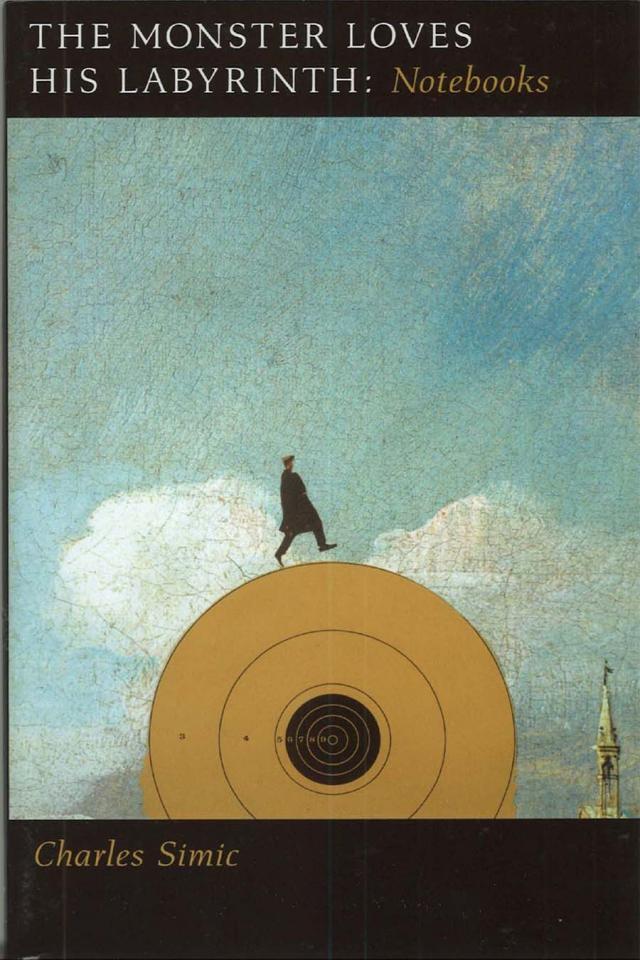


Short poem: Be brief and tell us everything.
Utopia: A rich chocolate cake protected from flies by a glass bell.
Slaughterhouse workers on their lunch hour sporting their bloody aprons.
When the children are asleep, the mice nibble the golden crumbs that have fallen on their covers.
Time, the voiceless, needs your big mouth tonight.
He took tipsy conventioneers to a funeral home with a promise that they’d see a live sex show and left them waiting among the coffins.
It happens that a cricket enters an abandoned house at the end of a road rarely traveled to sing as the night is failing.
An old man huddled over a urinal with a doomsday sign on his back.
He described his miserable life to a small white dog who sat with perked ears, wagging his little tail from time to time.
The waiter’s name was Bartleby—or it should have been. He brought me two pieces of burnt toast on a cracked plate.
They led the small boy by the hand down the long row of brand new coffins.
I remember my father saying, “Let’s have another bottle of wine so that when we rise from the table we can feel the earth turning under our feet.”
Missing Cats Found by a Professional Medium, the card pinned on a bulletin board said. There was a phone number and the name Adele.
More tabloid news:
SHAKESPEARE’S DOG ATE HIS BEST, NEVER-PERFORMED PLAY.
THE BONES OF ADAM AND EVE HAVE BEEN FOUND IN THE ACT OF EMBRACING.
A MAN CHANGED HIMSELF THROUGH AN OPERATION BACK INTO AN APE.
HELL IS SO OVERCROWDED, THE NEW ARRIVALS ARE BEING SENT TO HEAVEN.
Another sleepless night. I could hear the faucet drip in the city morgue.
Little girl feeding pigeons breadcrumbs in the park and cautioning them not to be so greedy.
A quartet playing free jazz in a club with a drunk customer shouting, “How about a polka next?”
“This is the kind of place,” my wife says, “where you want the waiters to sit down with you and talk.”
In the cards, Irene, I see a wedding dress for you, a shoebox full of money and some murky goings-on with a bow-legged man in a fish-house on a frozen lake.
The role of every patriotic journalist is to justify the crimes our president and his administration have committed.
We are the envy of the world. Our devils all go to church on Sunday.
The crows like one bare tree in my yard more than any other bare tree. Even the kids throwing rocks at them can’t make them change their minds and lose their cool.
He prayed to God who couldn’t wait for him to die so he can roast him over a slow fire.
“You can not shoe a flea,” Russians say. Whoever coined the proverb forgot about poets.
At the tanning salon on Route 9, Regina, the Pizza Hut girl, lies naked with shades on.
The sunset sits down to a feast over the rooftops as the homeless make their beds in the streets.
The poet sees what the philosopher thinks.
Creaky old bedsprings, one-man blues-band.
The old jew took me in the back of his store and showed me a drawer full of stained, old watch faces.
Death passing my door, jingling his passkeys.
An angel pinned in a box of dead butterflies.
This morning opening the papers I caught a whiff of evils to come.
A carpet worn out by the pacings of a local Hamlet selling cheaply at a yard sale.
In my grandmother’s time all one needed was a broom to get to see the world and give the geese a chase in the sky.
A life of vice starts in the cradle. He loved crawling under the skirts of his big sister’s friends. One of them let him stay there till he was an old man.
To lovers even their first names are poetry.
Softly now, the fleas are awake.
Today my shoes were shined by a hunchback who survived one of Stalin’s labor camps.
A sign in Alabama. Love Power Church. Music and Miracles.
The servants of the rich and powerful are convinced that the rest of us envy them their servitude.
I’m the child of the rainy Sundays of my youth.
Like a cat, the heart sees far in the dark.
The magician folded the sheet of paper with my question over and over until no trace of it was left in his hand.
In an office of a business on the verge of bankruptcy, three mummified beings surrounded by antiquated adding machines and filing cabinets, their backs and graying heads bent obediently as if waiting for a reprimand from a superior who is about to arrive. Even the light falling on them is dusty.
A plague of clocks in cities where chance rules.
I knew a woman who collected black buttons she found in the street. Some years there’d be only one or two. When I asked her what for and why only black buttons, she shrugged her shoulders. She kept them in a jar on the coffee table. They seduced the eye. One button even had some thread left as if it had been torn in a hurry. A violent scene took place, a burst of passion on some dark doorway, and then she came along the next day and found the button.
Did anybody hear me sing today?
Nothing to do tonight but listen to hair grow on my head.
A window with a candlelit table. A couple in love left in a hurry for one of the dark bedrooms without first bothering to clear the plates.
The fresco of a young Sybil on a ceiling of a monastery in Florence. She appears frightened by what she knows.
“God has a plan for America,” the preacher on TV said just as you came to bed carrying a bowl of cherries against your naked breasts.
A lone cloud stumbling across the sky like a beery accordionist in a German tavern.
There’s a fortune to be made in America manufacturing cages for human beings.
The roadside stand
Was the place to be.
With you in a ditch
Squatting down to pee
And your skirt hiked
Way above your knee.
My old mother, exchanging whispers at dawn with a saint shot full of arrows.
The imagination has moments when it knows what the word “infinity” means.
A narrow street with windows weakly lit at dinner time and Self-absorbed men and women standing around and an occasional child who eats alone looking at nothing.
Old woman stammering excuses to the pigeons for frightening them.
I made a paper plane out of my sadness. It flew around your lovely head and fell into your bowl of pea soup.
We are all stowaways on a ship of fools.
Ease your troubled spirit on a park bench, dear Sir. Exchange the phantoms of worldly success for the eyes of an adoring mutt.
Venus catches a cold without wine. Her nose is red and she has sniffles. “Drink up, drink up,” I tell her, “and have some rat cheese.”
He told me of a toy shop owned by an undertaker.
I saw a priest walk past a homeless woman sprawled on the sidewalk and look away. I regret not running after him and giving him a kick in the ass.
All my life I strove to make a small truth out of an infinity of errors.
Phone sex with Persephone in Hell, the ad said.
My conscience: A girl in white communion dress slumped over on a flophouse bed.
A waiter with a white napkin over his eyes. He starts toward our table with two bowls of soup and loses his way until he crashes into a wall. We are stunned, outraged and about to leave when another waiter with a white napkin over his eyes emerges from the kitchen carrying our steaks.
As far as I can tell, the universe has no visible means of support.
In the zoo I came across many animals as bored with life as I was.
One of the older of the gravediggers wore a black overcoat with a fur collar that may have once belonged to a fudge or a bank president.
Four poets reading. “My pain is greater than yours,” they kept shouting all night.
As a child, I saw faces on walls, ceilings, doorknobs and spoons. Then, one day, they were all gone.
The couple next door couldn’t stop laughing all night. What’s so funny? I wanted to shout through the wall, but was afraid they’d fall silent and leave me alone with my thoughts.
The beauty of a fleeting moment is eternal.
At the Inferno Amusement Park, the Tunnel of Love is under new management.
Birds sing to remind us that we have a soul.
Children running after a ball over a mass grave keep running.
They give me coffee,
They give me tea,
They give me everything
But the jailhouse key.
In a house closed up since last summer, the phone won’t stop ringing.
Thatched myself over with words in the dark. Night after night, thatched myself anew against the infinite.
Millions were out to kill me. They fired cannons, dropped bombs, set villages on fire and shot my dog in the street. It’s that mutt I still miss.
A tree full of dark leaves eager to tell us its dreams.
Free the guppies.
Night of the Hunter is being shown followed by A Night at the Opera and The Night of the Living Dead.
I bark back at the dog and he wags his tail at me.
In the park the grass was matted where two unknown lovers lay.
In that wedding cake grand hotel she had her purse stolen.
The madman with shaved head and intense glare who looked like the Russian poet Mayakovsky. He walked the avenue screaming at the top of his voice.
I’m willing to relocate to a rock in the sea.
Gravedigger, the truth is dark under your fingernails.
I’m everywhere and nowhere. A passenger on a ghost ship.
Cassiopeia and her retinue in full view over the astrologer’s house.
I heard of a mind reader who could read what a lit match feared as it entered a dark house.
Torturers with happy faces, you made a prisoner strip naked and stand strung with electric wires like a Christmas tree while we sat sipping beer, one eye on the TV set, the other on the bartender who refills our glasses.
Black cat in the snow outside the house of the dead.
How to Make Bad Wine Good. 1000 recipes. Send $19.95 to Box 192, Fool’s Paradise, NH.
I dreamt that God asked me for a blurb for his creation.
III
—They’re not really object poems.
—What are they then?
—They are premonitions.
—About what?
—About the absolute otherness of the object.
—So, it’s the absolute you’ve been thinking of?
—Of course.
Form is the visible side of content. The way in which the content becomes manifest. Form: Time turning into space and space turning into time simultaneously.
I admire Claude Levi Strauss’s observation that all art is essentially reduction and Gertrude Stein’s saying that poetry is vocabulary.
Chance as a tool with which to break up one’s habitual associations. Once they’re broken, use one of the pieces to launch yourself into the unknown.
We name one thing and then another. That’s how time enters poetry. Space, on the other hand, comes into being through the attention we pay to each word. The more intense our attention, the more space, and there’s a lot of space inside words.
Connotations have their non-Euclidean geometries.
A song sung while understanding each word—the way Billie Holiday or Bessie Smith did it.
Vitrac called chance a “lyric force.” He’s absolutely right. There’s a kind of dreamy exhilaration in not knowing where one is going.
Seeing with eyes open and seeing with eyes closed. That’s what Elizabeth Bishop’s poem “The Fish” is about.
For imagination, inside every object there’s another object hidden. The object inside is completely unlike the outside object, or the object inside is identical to the outside object, only more perfect. It all depends on one’s metaphysics, or rather, whether one leans toward imagination or reason. The truth probably is that the outside and the inside are both identical and different.
My complaint about Surrealism: It worships imagination through the intellect.
Form thinks, not the content.
What the hell does that mean?
But, if form is time and time thinks . . .
The poem I want to write is impossible. A stone that floats.
Duncan’s profound words: “The mysteries of here and there, above and below, now and then, demand new figures of me.”
Avant-gardism: Seeing the history of art and literature as “progressing,” the future being superior to the past, etc. For literary conservatives it’s the other way around. There was once a Golden Age, and so on. We are just dwarfs on the back of giants, etc., etc.
Some twentieth-century intellectual types: Those who welcome the philosophical contradictions, those who ignore them, and those who despair because of them.
Form is not a “shape” but an “image,” the way in which my inwardness seeks visibility.
Artaud: “No image satisfies me unless it is at the same time knowledge.”
My ambition is to corner the reader and make him or her imagine and think differently.
The time of the poem is the time of expectation. I believe some Russian Formalist said something like that.
I’d like to show readers that the most familiar things that surround them are unintelligible.
There is a weather report in almost every folk poem. The sun is shining; it was snowing; the wind was blowing. . . .
The folk poet knows that it’s wise to immediately establish the connection between the personal and the cosmic.
Poetry is a way of knowledge, but most poetry tells us what we already know.
Between the truth that is heard and the truth that is seen, I prefer the silent truth of the seen.
If I make everything at the same time a joke and a serious matter, it’s because I honor the eternal conflict between life and art, the absolute and the relative, the brain and the belly, etc. . . . No philosophy is good enough to overcome a toothache . . . that sort of thing.
Thought in art is customarily confused with didacticism, with paraphrasable content, with “message.” Thought in genuine art is always none of these things.
Contradictory pulls when it comes to making a poem: to leave things as they are or to reimagine them; to represent or to reenact; to submit or to assert; artifice or nature, and so on. Like the cow the poet should have more than one stomach.
There are three kinds of poets: Those who write without thinking, those who think while writing, and those who think before writing.
Awe (as in Dickinson) is the beginning of metaphysics. The awe at the multiplicity of things and awe at their suspected unity.
To make something that doesn’t yet exist, but which after its creation would look as if it had always existed.
The never-suspected, the always-awaited, the immediately-recognized new poem. It’s like Christ’s Second Coming.
The poet is a tea leaf reader of his own metaphors: I see a dark stranger, a voyage, a reversal of fortune, etc. You might as well get a storefront and buy some Gypsy robes and earrings! Call yourself Madame Olga.
“What do poets really want?” I was asked that once by a clever professor of philosophy. It was late at night and we were drinking a lot of wine, so I just said the first thing that came into my mind: “They want to know about things that cannot be put into words.”
An object is an encyclopedia of archetypes. I’ve learned that writing “The Broom.”
Ambiguity is the world’s condition. Poetry flirts with ambiguity. As a “picture of reality” it is truer than any other. Ambiguity is. This doesn’t mean you’re supposed to write poems no one understands.
Metaphor offers the opportunity for my inwardness to connect itself with the world out there. All things are related, and that knowledge resides in my unconscious.
The poets and writers I admire stood alone. Philosophy, too, is always alone. Poetry and philosophy make slow solitary readers.
God died and we were left with Emerson. Some are still milking Emerson’s cow, but there are problems with that milk.
A recent critic has enumerated what he calls “the lexicon” of recent poetry. The words mentioned as occurring repeatedly are: wings, stones, silence, breath, snow, blood, water, light, bones, roots, jewels, glass, absence, sleep, darkness. The accusation is that the words are used as mere ornaments. It doesn’t occur to the critic that these words could have an intense life for a mind with an imaginative and even a philosophical bent.