Ticket to Curlew, page 4


Pa, of course, wanted to meet any new neighbors. So a few mornings later when the chores were done they all piled into the wagon. Mama held a pan of buns in her lap.
As they drove west the land seemed to rise a little in long gradual waves. Sam was surprised. When he walked he had the feeling it was perfectly flat. Probably because I’m going so slowly, he thought.
Pa had just said, “We must be getting pretty close,” when they all heard a loud barking, and three shaggy black dogs with plumey tails came bounding toward them. In spite of all the noise the dogs seemed friendly as they leaped around the wagon.
“They’re saying hello,” said Matt, nearly falling out of the wagon as he tried to pat them.
Pa drove slowly on. The dogs raced ahead, barking to announce the arrival of visitors. Then they dashed back as if they were making sure the visitors were really coming. After they had all gone about half a mile this way, three children suddenly appeared. They came running after the dogs, leaping and shouting. Two were small girls, holding up their long skirts as they ran. The biggest was a boy not much older than Matt.
Sam slumped a little. There was no friend for him here. Matt waved at the children and they all waved back.
By now they could see the house. It was small like their own, but it was built of blocks of sod cut right out of the prairie soil. The roof was flat.
“It’s a soddy,” Pa said. “I’ve heard of them but this is the first one I’ve seen.”
“Why would anyone build a house out of earth?” asked Josie. “It must be as dark as a hole in the ground.”
“You know why,” said Mama. “Lumber is costly. Some people spend all they have just to get here. They have to build with what’s around them. I do imagine that housekeeping in a soddy is hard work.”
Pa stopped the horses and the children stopped, too. They stood in a row staring at the Ferriers with round eyes.
“Hello,” said Pa. “We’re neighbors and we came by to welcome you to the district. Are your folks at home?”
The three children looked at each other and the boy stepped forward and said something Sam couldn’t understand at all. The boy shrugged and smiled. Then he beckoned as if to say, Follow me and started toward the house. The girls and the dogs turned and raced after him.
“I don’t know what language that was,” said Mama. “I don’t think I’ve ever heard it before.”
“You never know who you’re going to meet out here,” said Pa. “They’ll be good neighbors, I’m sure.” But Sam could tell he was disappointed that he couldn’t swap stories with them.
A man and a woman came out of the sod house and walked toward the wagon. The woman wore a shawl over her hair and the man had a beard, but Sam didn’t really look at them. Standing in the doorway was a boy who must be close to his own age. The boy had dark hair and level eyebrows that made him look as if he was frowning a little.
“He’s shy,” Sam said to himself. “No wonder. A whole wagon-load of us and we don’t speak his language.” He tried lifting a hand in greeting. After a minute the boy lifted one of his hands. Then he disappeared inside the house.
Pa and Mama were doing their best to talk to the man and woman. They were serious but friendly. They accepted the gift of cinnamon buns with many words that Sam knew were thanks. Mama tried to find out whether the children would be going to school, but the man shook his head and gestured to the land around him.
As they drove home Pa said, “I think he meant that their children will be needed to work on the land. It’s too bad. It’s the school that will bring all these different people together.”
“They have another problem, James,” said Mama. “We’re four miles from the school. That family must be eight miles. They might as well be forty. We’re scattered out here like families of gophers.”
“We’re not a family of gophers,” said Pa. “We’re lucky because we can talk to most of our neighbors. We’ll find a way to talk to those folks back there, too. As long as we can talk and have a team of horses, there’s no reason we can’t be as sociable as we want to be.”
“Yes,” said Josie. “I’m going to go to Sunday School and Mrs. Pratt at the store told me that a piano teacher is coming to Curlew. Can I take lessons?”
“How are you going to get to Sunday School and lessons, Short Legs?” asked Sam. “You won’t even walk out to see where I found the buffalo skulls.”
“Who cares about old bones,” said Josie.
“That’s enough,” said Pa. “Where there’s a will there’s a way.” He smiled at Josie. “You and I will always find a way to be sociable.”
Sam thought again of the boy in the doorway of the soddy. He might be sociable, but no matter what Pa said, if they couldn’t talk to each other, how could they get to be friends?
7
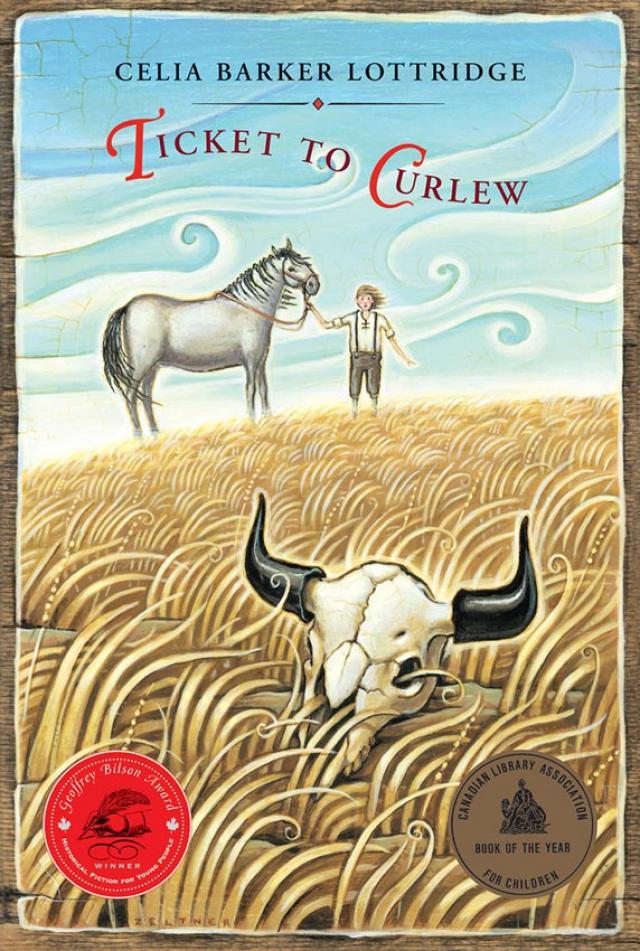
MATT WAS FASCINATED by Sam’s buffalo skulls. He made Sam tell him over and over exactly how he had found them, and every morning at breakfast he said, “Can you take me out to the bone places today, Sam?”
But every day there were jobs to do. Pa had found a stand of buffalo grass and cut it to make bedding for the livestock. Sam spent three days learning to make a proper strawstack. Then there was fence to be strung with wire. Mama needed help, too, getting the house settled.
One day after noon dinner Pa said, “I have to drive in to Curlew to get oats for the horses. Do you boys want to come with me?”
Sam caught Matt’s eye. “Matt wants me to take him exploring,” he said. “Could we do that instead?” The truth was, Sam missed his long walks. Matt would be good company as well as a good excuse.
“That sounds like a good plan,” said Pa.
Mama said, “You had better wait till the worst of the heat is over. Take some bread and jam and water with you. Then you won’t have to hurry back for supper. But be back well before dark.”
“Oh, we will,” said Sam. “It doesn’t get dark here till after ten o’clock. Remember, Mama? This is the north.”
“Just an Iowa warning,” said Mama, and she laughed a little. “But don’t be too late.”
When they set out, the shadow of the barn was big enough to give the cows some shelter from the hot sun. The boys had only their hats for shade, but there was a light wind and soon the air would start to cool off. Matt was bouncing with excitement.
“You’re going to be disappointed,” Sam warned him. “There’s nothing to find in those places now that I’ve taken the skulls away. I can’t even be sure exactly where they were. I can show you the buffalo wallow, though.”
He could tell right away that exploring with Matt was not going to be like exploring alone. Sam had gotten into the habit of keeping to a fairly straight line as he walked across the land. That way it was easy to know what direction to go to head back. But Matt kept seeing interesting things to the right and left — a big tumbleweed, a gopher hole, a bird’s nest. Where his attention went, his feet followed.
Sam wasn’t worried about getting lost. He knew they were going generally southwest. Anyway, with all Matt’s zigzagging and stopping to look, they couldn’t get very far.
So he was surprised when he looked back and could see no sign of the house or the barn. They had walked a long way.
Then he turned around and he couldn’t see Matt, either.
“Matt,” he called sharply. “Where are you? We have to go back.”
Matt’s voice seemed to come from far away. “Not yet, Sam. Come and see what I’ve found.”
Sam looked in the direction of his brother’s voice. There was no Matt to be seen. Sam turned slowly around, trying to make a short brown-haired boy appear. He could see nothing but waving prairie grass clear to the horizon in every direction.
He was alone in the middle of a great round plate that seemed to turn and tilt under him.
“Sam, I’m right over here!” Matt’s urgent voice seemed to come from below the earth.
“Where are you, Matt? I can’t see you.”
“I just went down the hill. Come down, Sam.”
“First you come up,” said Sam. What was Matt talking about? There were no hills here.
Then, all at once, Matt appeared. He had gotten a good way ahead but he was definitely there.
“Wait, Matt!” Sam yelled, and he began to run toward his brother.
Matt waited. As Sam came up to him he pointed, and Sam saw that he was standing on the edge of a place where the land, instead of being level, sloped sharply down.
“Let’s go down,” said Matt. He seemed to find the hill perfectly natural, but to Sam it was astounding to be walking down a fairly steep slope in the middle of the prairie.
It wasn’t a very long slope. At the bottom was a little grove of trees with dusty silvery-green leaves. The trees weren’t much taller than Sam, but their branches dropped toward the ground, making a thick screen. The boys could not see what lay beyond.
Sam looked around. He couldn’t see the prairie at all. The slope curved around and blocked out everything but the sky.
Matt began to talk excitedly. “It’s a secret place, Sam. No one can see us here.” He grabbed Sam’s hand and began to pull him into the trees. “It’s a jungle,” he said. “Maybe there are wild animals. Maybe there are buffalo.”
But in twenty steps they were out of the little grove of trees. Or really, Sam saw, they were in a clear space in the middle of the grove. And there they saw not wild animals, but flowers. Red-orange blossoms, a thick carpet of them. They made Sam think of Mama’s doorstep garden back in Iowa.
“Look, Matt,” he said. “It’s not tigers. It’s tiger lilies. At least they’re spotted like tiger lilies but I think they’re even prettier. And no one can see them but us and the birds.”
The boys walked all around the edge of the patch of flowers. They were smaller and more red than tiger lilies and they grew so thickly that it would be impossible to walk through them without breaking many of them.
When they had made a complete circle the boys sat under one of the little trees and ate their bread and jam. Mosquitoes sang in the still air, but it was worth some bites to have a real picnic.
Matt said, “Mama won’t get to see these flowers and neither will Josie and Papa. We could pick some for them.”
“Just a few,” said Sam. He was afraid that the flowers they picked would make a hole in the perfect pattern, but when they looked they couldn’t see any gaps in the glowing mass of blossoms.
He looked up at the sky. The sun was moving down toward the horizon. There was still plenty of day left, but it was time to be going home.
They went back through the trees and up the slope. When they moved a few steps away from the little valley they couldn’t see it at all.
Sam said, “It’s hard to believe it’s there, isn’t it, Matt?”
Matt’s eyes shone. “It’s a secret,” he said. “A real secret.”
“It’s a secret for sure,” said Sam. “I just hope we can find it again.” He was hoping even more that they could find their way home. They had wandered around so much that his careful compass reading didn’t help.
“If we head straight east,” he said to himself, “we’ll definitely hit the wagon road. Then we can turn north toward home.” He had no idea how far they had come and he could see that Matt was tired. Still, there was nothing to do but start walking.
Matt stayed close to Sam now. That was one good thing. As they plodded along, their little valley seemed more and more like a dream. The dusty land stretched ahead of them.
“My feet hurt, Sam,” said Matt. He was walking more slowly.
“Don’t think about your feet,” said Sam, trying desperately to think of something to talk about so that Matt wouldn’t notice how tired he was. “Think about the buffalo. There used to be thousands and thousands of them right here.” Matt looked around a little nervously. “Oh, they’re gone now,” Sam went on. “But I like to think about them. They were kind of like cattle, you know, only big and shaggy. You remember the buffalo robe Grandpa had for the sleigh? They were furry like that.” He talked on and on. After a while he didn’t think Matt was listening to his words, just to his voice.
The sun seemed to be sinking faster and faster. Sam tried not to see it out of the corner of his eye. He didn’t want to think what they would do out on the prairie in the dark.
Just as he was deciding he would have to think about it, he stumbled over a deep rut in the earth. It was the wagon track. He thought he had never seen anything as wonderful.
“Now we’ll be all right,” he said.
His voice was so happy that Matt said, “Are we almost home, then?”
“I don’t know,” Sam had to say. “I don’t think it can be too far.” But there was no barn and no house in sight. All they could do was go on.
Now the boys didn’t talk anymore. They just walked. Matt kept stumbling over the rough track, but Sam didn’t dare stop. He put his arm over his small brother’s shoulder and guided him along the smoother earth between the ruts.
He was so tired himself that he thought he was dreaming when he heard the sound of horses’ hoofs and the creak of a wagon. But he lifted his head.
Driving toward them was the boy who had stood in the doorway of the sod house.
Sam pulled Matt to the edge of the track and waited for the team to go past. He thought of waving to stop the boy, but how could he explain their problem? This boy spoke no English. If only he could ask how far from home they were.
Suddenly he realized that the wagon had stopped. The boy was looking down at him, his dark eyes serious.
They stared at each other. Sam had to say something. In a way he was glad he didn’t have to explain that they had almost gotten lost.
He pointed toward the north and said, “Do you know how far it is to our place?” The boy just shrugged and shook his head. But he didn’t drive on. Sam stretched his arms wide, trying to indicate distance. He pointed to Matt, drooping beside him.
All at once the boy smiled, a broad joyous smile. He said something and nodded toward the back of the wagon. Sam understood.
“Come on, Matt,” he said. “Get in the wagon.”
“Is he taking us home?” asked Matt.
“I don’t know,” said Sam. “But we can’t just keep walking.”
After they were settled on the floor of the wagon the boy sat for a minute with the reins slack. He looked down the track toward his own house and frowned. Then he shrugged and clucked to the horses. The wagon rocked as the team turned and headed north toward the Ferriers’ place. Sam knew what the boy was thinking. He would probably be in trouble for getting back after dark.
Matt was asleep long before they got home. Sam himself had no idea how long the drive took. He roused when the wagon came to a stop.
They were home. Pa and Mama were running across the yard. Pa was lifting Matt out of the wagon. Mama was holding both her hands up to clasp the boy’s hands.
“Come in and have some soup,” she said. But the boy shook his head, turned the team and drove away. Sam hoped the boy’s mother and father would not be angry.
Sam was halfway to the house when Mama caught up with him. “Oh, son,” she said in a sharp voice she almost never used. “You are far too late. It’s nearly dark.” Then she saw the flowers that Sam was still clutching. “Prairie lilies. How beautiful.” She went on more gently, “You had better have some soup. Then tell us.”
Even Josie was quiet as Sam and Matt ate their soup. Matt fell asleep before his bowl was empty, and Pa carried him to bed. Then he sat down and looked at Sam across the table.
Sam told them about the little valley and about losing their direction.
“There are no landmarks out there,” he said. “It’s too big. I knew to go east and that’s how we found the wagon track. We would have followed it home. But before that I didn’t know where we were. I know I shouldn’t have got lost with Matt, but I couldn’t help it.”
Pa and Mama listened until he was finished. Then Pa said, “I think you did well. This country doesn’t offer you much help. I’ve heard of folks wandering in circles, but you had more sense than that. Of course, we can’t risk losing you and Matt.”
Sam’s heart sank. He was sometimes afraid out on that wide land, but he couldn’t bear to stay close to the house all the time. He wanted to see the little valley again, if he could find it.
Suddenly Pa grinned. “So we’re going to get you young ones some help,” he said, and he slapped the table with the palm of his hand. “Yes, sir, the very help you need.”
Sam looked at Mama, but she just smiled. He knew it was no use begging his father to say what he was talking about. Pa loved surprises. There was nothing to do but go to bed and wonder.
8
THE FRONT STEPS of the Ferriers’ house were built extra wide to make them comfortable for sitting on.
“Someday we’ll have a front porch with chairs on it,” Pa told Mama, “but there’s no reason we shouldn’t sit out and enjoy the sunsets in the meantime.”
Most evenings after the dishes were done, Mama brought her mending and Pa brought his planning book and they sat on the steps till the sun went down. There was usually enough breeze to keep the mosquitoes away. Sometimes Sam and Josie and Matt sat, too, especially when the sky turned flaming orange and the clouds seemed to be lined with gold. Usually they played tag or King of the Castle.
One August evening Mama said, “James, I think we should lay in our winter provisions soon.”
Sam looked out over the dry summer grass. Winter seemed very far away. He could hardly remember snow.
“Some of the women at church were telling me that storms can come early,” Mama went on. “We could have a heavy snow or an early blizzard that lasts for days. Sometimes even the trains can’t get through. We’re lucky that the corn crop in Iowa was good this year. We have the cash to stock up.”