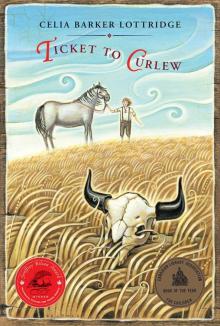
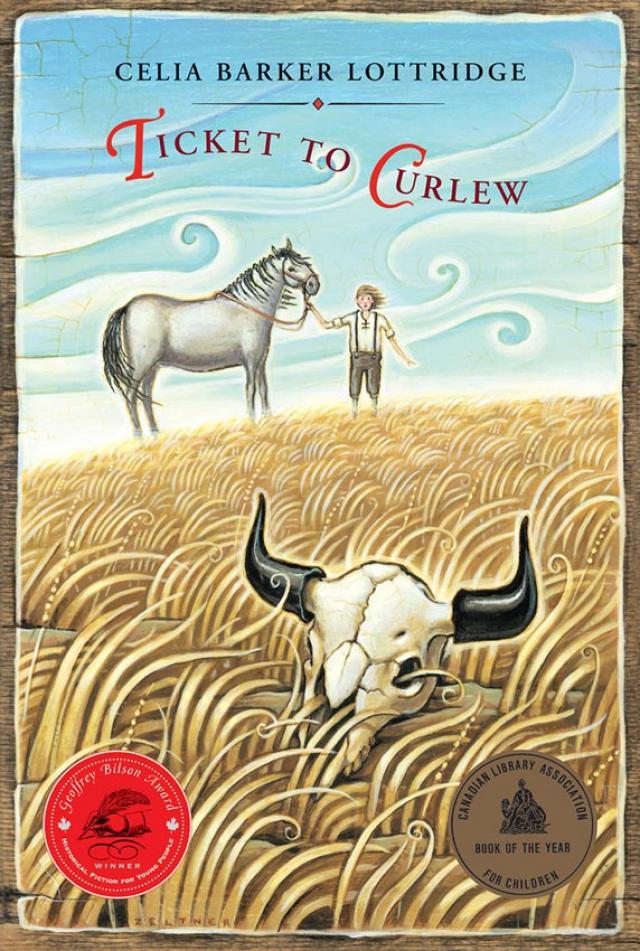
Ticket to Curlew, page 11


“We need King,” said Josie. “Our King.”
Sam got busy currying Lady, but it wasn’t her solid brown shape he saw. He saw a white horse galloping at the head of a whole herd of horses, his black eyes shining, his mane blowing. King of the horses.
“We need Pete and Goldie, too,” said Pa. “If they don’t all come back in a day or two we’ll have to go get them. You two skedaddle back in and eat your breakfasts. I’ll finish up here.”
Now Sam looked for King every day. He could imagine him at the farm gate in the morning or the evening, hoping for oats. As he rode Rabbit to school and home again, Sam’s eyes searched the prairie for the band of horses. But there was no sign of them.
At dinner on Friday Pa said, “I need Rabbit here on the farm. I just can’t spare him any longer.”
“We have to get King back,” said Josie. “But how will you find him, Pa?”
“That shouldn’t be a problem,” said Pa. “Corbett tells me that the band of horses has been sighted just a few miles northwest of here. We’ll go out tomorrow, Sam, and bring in our three.”
Sam woke up very early the next morning. He tiptoed to the kitchen to look out the window. There was only a faint hint of dawn in the dark sky but Sam was too excited to go back to bed. He got dressed and went out to the barn to get King’s stall ready for him. He put some straw in Pete and Goldie’s stalls, too, but he gave King extra.
He got back into the house just as Mama was shaking down the ashes in the stove and adding more coal.
“This is an important day, isn’t it, Sam?” she said.
“It sure is.” He wanted to tell Mama about how worried he was that King wouldn’t want to come home, but Matt came in to get dressed by the stove, and Josie was clamoring for her turn.
Pa and Sam started out right after breakfast. They both rode Rabbit, just as they had when they came home after setting the horses loose so many months before. Sam hoped he would ride home on King. Pa seemed to have no doubts about that.
“King may be a bit wild after a winter in the open, Sam. It may take him a few days to settle down with us. Don’t be too disappointed if he doesn’t seem glad to see you.”
Sam resolved that he would only be disappointed if King didn’t come home with them at all.
As they rode they constantly scanned the horizon for horses. It seemed to Sam that they had ridden a very long way. The sun was bright and he was afraid that its dazzle would keep him from seeing the horses if they were far away.
Then suddenly, to the west where he had seen nothing just a moment before, Sam saw dark moving shapes. He reached around Pa to point.
“Look! There they are.”
And there they were. Twenty or thirty horses grazing. As Sam and Pa got closer, they saw that most of them were bunched together, but three or four were scattered around at a distance from the herd. Sam couldn’t see King, but he thought he could spot Pete.
“We’ll move toward them very slowly,” said Pa. “I’m hoping King or one of the others will recognize us and remember oats and come to us.” He kept Rabbit at a slow, even walk. None of the grazing horses seemed to notice their approach except the nearest one, a spotted horse not much bigger than a pony. It lifted its head and moved uneasily.
When they were close enough that Sam could see its shifting eyes, the horse suddenly neighed loudly and bolted toward the main herd. All the horses lifted their heads.
Then out from the center of the herd came a white horse. He didn’t look in the direction of Sam and Pa. He just ran away from them toward the northwest with all the other horses behind him.
There was nothing Pa and Sam could do. They just sat and watched their horses and two dozen more disappear into the distance.
“By golly,” said Pa, “he’s set sentries. Did you see those horses grazing away from the others? King set them on watch duty to warn the herd of approaching danger. We’re going to have to outsmart him. But how?”
Sam didn’t have the answer. They rode home in silence. Sam wanted King back more than anything, but he couldn’t help thinking, What a smart horse. He really is a king.
On Sunday Adam Martingale went with them. Pa carried sacks of oats and Adam had a lasso. He knew how to use it, too, which surprised Pa and Sam.
“I’ve been practicing in the barn over the winter,” said Adam. “I’ll give you lessons, Sam. If you people are going to run any cattle, it’s a necessary skill.”
Once again they found the herd grazing peacefully with the sentry horses placed far enough away to give warning. “I guess we’ll have to start with them,” said Pa. “As long as they do their job we don’t have a chance with the main herd.”
He opened a sack of oats, slid off Lady’s back and quietly approached the nearest sentry horse with the bag open in his hands. The horse raised its head and sniffed. It looked toward the herd but it remembered the smell of oats and was drawn to Pa.
“Sam,” said Pa quietly. “Begin talking and ride closer to the herd. Talk to King. Maybe he’ll recognize your voice.”
So, while Pa enticed the spotted sentry horse with oats, Sam rode toward the herd.
“Hey, boy,” he said. “Hey, Prince, we’ve changed your name. You’re a king now and we’ll call you King. Come on, boy. I’ve missed you.” He talked and talked, getting closer and closer to the bunched-up horses. He could see Pete now and Goldie and a flash of white in the middle of all the horses.
Suddenly the black sentry horse to the west of Pa gave a resounding neigh. The group of horses parted, and Sam could see King. For a moment King looked at him. He wheeled and rose on his hind legs. He seemed to survey his herd. Then with a long neigh he broke out of the cluster and headed toward the north, away from Pa, Sam and Adam. Away from home.
The three of them rode slowly back.
“We’ll have to have a round-up,” said Pa. “We need more men and horses for that. Tomorrow I’ll ride out and talk with some of the others who have horses in that herd. We should be able to get them in on Tuesday or Wednesday.”
Sam had no doubt that these men would bring the horses in. Look what a few frontiersmen had done to the buffalo. But he hated the idea that King wouldn’t want to come home. What if he was a friend only because he had to be?
18
ON MONDAY PA rode off on Rabbit to organize people to bring the horses in.
“You children will just have to miss a day of school,” he said. “It’s a pity but I don’t see any help for it.”
Mama did not seem sorry that they would all be home for the day. She had a gleam in her eye.
“This is our chance to do a big washing,” she said. “All winter I’ve just kept us decent but not properly clean. I’m going to wash all the quilts as well as the sheets and clothes. There’s a good drying wind blowing. I’ll need all of you to help.”
Sam pumped pail after pail of water and lugged it up to the house. Matt grated the bar soap and dissolved it in warm water. Josie stood on a chair and stirred the washing in the big wash boiler while it heated on the stove. Mama used a stick to lift the wet clothes from the steaming water into the washtub. Then she and Sam took turns scrubbing them on the washboard.
They put the smaller things through the hand-cranked wringer, but the quilts were too thick to go through so the two of them had to twist the heavy fabric between them.
Clotheslines full of wet laundry stretched from the house to the barn by lunch time. Sheets and towels, quilts and pillowcases, shirts and dresses all flapped in the brisk spring wind.
Mama looked at the sky. “Most things will dry by dark,” she said. “The quilts can stay out overnight if necessary. It’s not going to rain tonight.”
They had bread and cheese and canned tomatoes for lunch. They didn’t expect Pa home till later, so they just sat down and ate. They all felt that they had done a good morning’s work.
Sam was just going to ask Matt if he wanted to walk up to the little valley when he heard the sound of the gate.
“That must be Pa,” he said. Then he heard it again. “No, it’s somebody having trouble with the latch. I’ll see who it is.” He jumped up and opened the door.
Beyond the bright rows of laundry he could see the farm gate. And at the gate stood King. He was reaching his head over the gate and pushing with his chest to make the latch rattle.
Pa has brought King home, thought Sam. He looked beyond King and there were Goldie and Pete. No Pa.
Sam felt swamped with joy. He wanted to shout but his voice was stuck in his throat.
King, however, was not speechless. He lifted his head and whinnied. Then he pushed against the gate again.
“Look, everyone,” said Sam finally. “King has decided to come home.”
They all came to the door. “Don’t rush out,” said Sam. “Pa said to take it easy. They might act kind of wild. But we can welcome them. Mama, is there any apple butter left?”
Mama spread bread thickly with apple butter. Sam took a piece and walked slowly down to the gate. He was going to take it very easy. He would not be disappointed if King wasn’t friendly right away.
But King was leaning farther over the gate, reaching out with his lips, ready to nuzzle up the treat Sam was holding.
Sam laughed. “Oh, King,” he said. “I’m glad you’re back. Do you mind being King? It’s your new name.”
King pushed against the gate again and looked straight at him.
“I guess it’s all right with you,” said Sam.
Goldie and Pete came over wanting a treat, too, and Josie and Matt were ready with more bread and apple butter. Mama came to rub the noses of all the horses.
“It does seem right to have them back,” she said. “We’ll let them in but we’ll have to tie them to the fence until the laundry is dry. You children can bring them some oats. They must be hungry.”
Josie and Matt brought oats in pails and Sam got the curry comb. King looked a bit thin, but he was still sturdy. His coat was thick and rough, almost shaggy. A coat for a prairie winter. Sam worked for a long time combing out the tangles and burrs.
Mama came out to check the laundry. “I wonder why he came home now,” she said.
“I think he saw the laundry,” said Matt. “It’s like flags. Maybe it reminded him of us.”
“I think he got to remembering home after he saw Sam and Pa,” said Josie. “What do you think, Sam?”
Sam looked at King standing there so calmly. He remembered this horse racing across the prairie leading the herd with his mane flying.
“I think he wanted to come home when he decided to come. He didn’t want to be brought. Did you, King?”
King nickered a little and nuzzled Sam’s shoulder.
“He seems to like his new name,” said Josie. “It’s kind of funny how easy it was to change to King.”
“That’s because it’s the right name,” said Sam. “Mama, could I go for a ride?”
Mama hesitated. Then she smiled. “Yes,” she said. “But don’t go far. Remember, King has to get used to our ways again.”
Sam knew she, too, was thinking of a wild horse galloping across the prairie. But King seemed perfectly happy to canter gently along. As they went west along the wagon track, Sam thought of all the places they could go. All the places they would go. The pond, the buffalo wallow, the little valley, Gregor’s house. And town. And school. Maybe he would find more buffalo skulls or something even better. There was no telling.
Sam looked at the blue sky and at the newly green prairie grass. Suddenly he saw that the grass was so thick with tiny purple flowers that it seemed to reflect the sky.
“Oh, King,” said Sam. “If we rode straight on maybe the earth would just melt into the sky.”
But instead of heading for the sky, Sam and King turned around and headed home.
Author’s Note
TICKET TO CURLEW was inspired by stories my father, Roger Barker, told me about his early years in Alberta. His father, Guy Barker, had bought land south of Provost when it was opened up by the railroad, and in 1915 the family went to live and farm on that land. My father was a very good storyteller and his tales of finding buffalo skulls out on the prairie, of helping his father build a house for the family to live in and, especially, the stories of his horse stayed in the back of my mind as I grew up.
These stories were awakened when I lived in Regina, Saskatchewan, under the prairie sky, as Writer in Residence at the Regina Public Library, and I decided that they would be a good basis for a novel. The town of Curlew is based on Provost but it is a fictional town, named after a bird that lives in the prairie grasses. Similarly, the family is somewhat like my father’s family but the Ferriers come out of my imagination. The horse, however, is as true to my father’s real horse as I could make him.
In gathering more material for the novel I especially benefited from reading the early issues of the Provost Star (now the Provost News), from my mother’s memories of more of my father’s stories and from the horse expertise of my friend, Taryn de Vos.
Celia Barker Lottridge
2007
About the Publisher
GROUNDWOOD BOOKS, established in 1978, is dedicated to the production of children’s books for all ages, including fiction, picture books and non-fiction. We publish in Canada, the United States and Latin America. Our books aim to be of the highest possible quality in both language and illustration. Our primary focus has been on works by Canadians, though we sometimes also buy outstanding books from other countries.
Many of our books tell the stories of people whose voices are not always heard in this age of global publishing by media conglomerates. Books by the First Peoples of this hemisphere have always been a special interest, as have those of others who through circumstance have been marginalized and whose contribution to our society is not always visible. Since 1998 we have been publishing works by people of Latin American origin living in the Americas both in English and in Spanish under our Libros Tigrillo imprint.
We believe that by reflecting intensely individual experiences, our books are of universal interest. The fact that our authors are published around the world attests to this and to their quality. Even more important, our books are read and loved by children all over the globe.
Celia Lottridge, Ticket to Curlew
Thank you for reading books on ReadFrom.Net
Share this book with friends
Sam got busy currying Lady, but it wasn’t her solid brown shape he saw. He saw a white horse galloping at the head of a whole herd of horses, his black eyes shining, his mane blowing. King of the horses.
“We need Pete and Goldie, too,” said Pa. “If they don’t all come back in a day or two we’ll have to go get them. You two skedaddle back in and eat your breakfasts. I’ll finish up here.”
Now Sam looked for King every day. He could imagine him at the farm gate in the morning or the evening, hoping for oats. As he rode Rabbit to school and home again, Sam’s eyes searched the prairie for the band of horses. But there was no sign of them.
At dinner on Friday Pa said, “I need Rabbit here on the farm. I just can’t spare him any longer.”
“We have to get King back,” said Josie. “But how will you find him, Pa?”
“That shouldn’t be a problem,” said Pa. “Corbett tells me that the band of horses has been sighted just a few miles northwest of here. We’ll go out tomorrow, Sam, and bring in our three.”
Sam woke up very early the next morning. He tiptoed to the kitchen to look out the window. There was only a faint hint of dawn in the dark sky but Sam was too excited to go back to bed. He got dressed and went out to the barn to get King’s stall ready for him. He put some straw in Pete and Goldie’s stalls, too, but he gave King extra.
He got back into the house just as Mama was shaking down the ashes in the stove and adding more coal.
“This is an important day, isn’t it, Sam?” she said.
“It sure is.” He wanted to tell Mama about how worried he was that King wouldn’t want to come home, but Matt came in to get dressed by the stove, and Josie was clamoring for her turn.
Pa and Sam started out right after breakfast. They both rode Rabbit, just as they had when they came home after setting the horses loose so many months before. Sam hoped he would ride home on King. Pa seemed to have no doubts about that.
“King may be a bit wild after a winter in the open, Sam. It may take him a few days to settle down with us. Don’t be too disappointed if he doesn’t seem glad to see you.”
Sam resolved that he would only be disappointed if King didn’t come home with them at all.
As they rode they constantly scanned the horizon for horses. It seemed to Sam that they had ridden a very long way. The sun was bright and he was afraid that its dazzle would keep him from seeing the horses if they were far away.
Then suddenly, to the west where he had seen nothing just a moment before, Sam saw dark moving shapes. He reached around Pa to point.
“Look! There they are.”
And there they were. Twenty or thirty horses grazing. As Sam and Pa got closer, they saw that most of them were bunched together, but three or four were scattered around at a distance from the herd. Sam couldn’t see King, but he thought he could spot Pete.
“We’ll move toward them very slowly,” said Pa. “I’m hoping King or one of the others will recognize us and remember oats and come to us.” He kept Rabbit at a slow, even walk. None of the grazing horses seemed to notice their approach except the nearest one, a spotted horse not much bigger than a pony. It lifted its head and moved uneasily.
When they were close enough that Sam could see its shifting eyes, the horse suddenly neighed loudly and bolted toward the main herd. All the horses lifted their heads.
Then out from the center of the herd came a white horse. He didn’t look in the direction of Sam and Pa. He just ran away from them toward the northwest with all the other horses behind him.
There was nothing Pa and Sam could do. They just sat and watched their horses and two dozen more disappear into the distance.
“By golly,” said Pa, “he’s set sentries. Did you see those horses grazing away from the others? King set them on watch duty to warn the herd of approaching danger. We’re going to have to outsmart him. But how?”
Sam didn’t have the answer. They rode home in silence. Sam wanted King back more than anything, but he couldn’t help thinking, What a smart horse. He really is a king.
On Sunday Adam Martingale went with them. Pa carried sacks of oats and Adam had a lasso. He knew how to use it, too, which surprised Pa and Sam.
“I’ve been practicing in the barn over the winter,” said Adam. “I’ll give you lessons, Sam. If you people are going to run any cattle, it’s a necessary skill.”
Once again they found the herd grazing peacefully with the sentry horses placed far enough away to give warning. “I guess we’ll have to start with them,” said Pa. “As long as they do their job we don’t have a chance with the main herd.”
He opened a sack of oats, slid off Lady’s back and quietly approached the nearest sentry horse with the bag open in his hands. The horse raised its head and sniffed. It looked toward the herd but it remembered the smell of oats and was drawn to Pa.
“Sam,” said Pa quietly. “Begin talking and ride closer to the herd. Talk to King. Maybe he’ll recognize your voice.”
So, while Pa enticed the spotted sentry horse with oats, Sam rode toward the herd.
“Hey, boy,” he said. “Hey, Prince, we’ve changed your name. You’re a king now and we’ll call you King. Come on, boy. I’ve missed you.” He talked and talked, getting closer and closer to the bunched-up horses. He could see Pete now and Goldie and a flash of white in the middle of all the horses.
Suddenly the black sentry horse to the west of Pa gave a resounding neigh. The group of horses parted, and Sam could see King. For a moment King looked at him. He wheeled and rose on his hind legs. He seemed to survey his herd. Then with a long neigh he broke out of the cluster and headed toward the north, away from Pa, Sam and Adam. Away from home.
The three of them rode slowly back.
“We’ll have to have a round-up,” said Pa. “We need more men and horses for that. Tomorrow I’ll ride out and talk with some of the others who have horses in that herd. We should be able to get them in on Tuesday or Wednesday.”
Sam had no doubt that these men would bring the horses in. Look what a few frontiersmen had done to the buffalo. But he hated the idea that King wouldn’t want to come home. What if he was a friend only because he had to be?
18
ON MONDAY PA rode off on Rabbit to organize people to bring the horses in.
“You children will just have to miss a day of school,” he said. “It’s a pity but I don’t see any help for it.”
Mama did not seem sorry that they would all be home for the day. She had a gleam in her eye.
“This is our chance to do a big washing,” she said. “All winter I’ve just kept us decent but not properly clean. I’m going to wash all the quilts as well as the sheets and clothes. There’s a good drying wind blowing. I’ll need all of you to help.”
Sam pumped pail after pail of water and lugged it up to the house. Matt grated the bar soap and dissolved it in warm water. Josie stood on a chair and stirred the washing in the big wash boiler while it heated on the stove. Mama used a stick to lift the wet clothes from the steaming water into the washtub. Then she and Sam took turns scrubbing them on the washboard.
They put the smaller things through the hand-cranked wringer, but the quilts were too thick to go through so the two of them had to twist the heavy fabric between them.
Clotheslines full of wet laundry stretched from the house to the barn by lunch time. Sheets and towels, quilts and pillowcases, shirts and dresses all flapped in the brisk spring wind.
Mama looked at the sky. “Most things will dry by dark,” she said. “The quilts can stay out overnight if necessary. It’s not going to rain tonight.”
They had bread and cheese and canned tomatoes for lunch. They didn’t expect Pa home till later, so they just sat down and ate. They all felt that they had done a good morning’s work.
Sam was just going to ask Matt if he wanted to walk up to the little valley when he heard the sound of the gate.
“That must be Pa,” he said. Then he heard it again. “No, it’s somebody having trouble with the latch. I’ll see who it is.” He jumped up and opened the door.
Beyond the bright rows of laundry he could see the farm gate. And at the gate stood King. He was reaching his head over the gate and pushing with his chest to make the latch rattle.
Pa has brought King home, thought Sam. He looked beyond King and there were Goldie and Pete. No Pa.
Sam felt swamped with joy. He wanted to shout but his voice was stuck in his throat.
King, however, was not speechless. He lifted his head and whinnied. Then he pushed against the gate again.
“Look, everyone,” said Sam finally. “King has decided to come home.”
They all came to the door. “Don’t rush out,” said Sam. “Pa said to take it easy. They might act kind of wild. But we can welcome them. Mama, is there any apple butter left?”
Mama spread bread thickly with apple butter. Sam took a piece and walked slowly down to the gate. He was going to take it very easy. He would not be disappointed if King wasn’t friendly right away.
But King was leaning farther over the gate, reaching out with his lips, ready to nuzzle up the treat Sam was holding.
Sam laughed. “Oh, King,” he said. “I’m glad you’re back. Do you mind being King? It’s your new name.”
King pushed against the gate again and looked straight at him.
“I guess it’s all right with you,” said Sam.
Goldie and Pete came over wanting a treat, too, and Josie and Matt were ready with more bread and apple butter. Mama came to rub the noses of all the horses.
“It does seem right to have them back,” she said. “We’ll let them in but we’ll have to tie them to the fence until the laundry is dry. You children can bring them some oats. They must be hungry.”
Josie and Matt brought oats in pails and Sam got the curry comb. King looked a bit thin, but he was still sturdy. His coat was thick and rough, almost shaggy. A coat for a prairie winter. Sam worked for a long time combing out the tangles and burrs.
Mama came out to check the laundry. “I wonder why he came home now,” she said.
“I think he saw the laundry,” said Matt. “It’s like flags. Maybe it reminded him of us.”
“I think he got to remembering home after he saw Sam and Pa,” said Josie. “What do you think, Sam?”
Sam looked at King standing there so calmly. He remembered this horse racing across the prairie leading the herd with his mane flying.
“I think he wanted to come home when he decided to come. He didn’t want to be brought. Did you, King?”
King nickered a little and nuzzled Sam’s shoulder.
“He seems to like his new name,” said Josie. “It’s kind of funny how easy it was to change to King.”
“That’s because it’s the right name,” said Sam. “Mama, could I go for a ride?”
Mama hesitated. Then she smiled. “Yes,” she said. “But don’t go far. Remember, King has to get used to our ways again.”
Sam knew she, too, was thinking of a wild horse galloping across the prairie. But King seemed perfectly happy to canter gently along. As they went west along the wagon track, Sam thought of all the places they could go. All the places they would go. The pond, the buffalo wallow, the little valley, Gregor’s house. And town. And school. Maybe he would find more buffalo skulls or something even better. There was no telling.
Sam looked at the blue sky and at the newly green prairie grass. Suddenly he saw that the grass was so thick with tiny purple flowers that it seemed to reflect the sky.
“Oh, King,” said Sam. “If we rode straight on maybe the earth would just melt into the sky.”
But instead of heading for the sky, Sam and King turned around and headed home.
Author’s Note
TICKET TO CURLEW was inspired by stories my father, Roger Barker, told me about his early years in Alberta. His father, Guy Barker, had bought land south of Provost when it was opened up by the railroad, and in 1915 the family went to live and farm on that land. My father was a very good storyteller and his tales of finding buffalo skulls out on the prairie, of helping his father build a house for the family to live in and, especially, the stories of his horse stayed in the back of my mind as I grew up.
These stories were awakened when I lived in Regina, Saskatchewan, under the prairie sky, as Writer in Residence at the Regina Public Library, and I decided that they would be a good basis for a novel. The town of Curlew is based on Provost but it is a fictional town, named after a bird that lives in the prairie grasses. Similarly, the family is somewhat like my father’s family but the Ferriers come out of my imagination. The horse, however, is as true to my father’s real horse as I could make him.
In gathering more material for the novel I especially benefited from reading the early issues of the Provost Star (now the Provost News), from my mother’s memories of more of my father’s stories and from the horse expertise of my friend, Taryn de Vos.
Celia Barker Lottridge
2007
About the Publisher
GROUNDWOOD BOOKS, established in 1978, is dedicated to the production of children’s books for all ages, including fiction, picture books and non-fiction. We publish in Canada, the United States and Latin America. Our books aim to be of the highest possible quality in both language and illustration. Our primary focus has been on works by Canadians, though we sometimes also buy outstanding books from other countries.
Many of our books tell the stories of people whose voices are not always heard in this age of global publishing by media conglomerates. Books by the First Peoples of this hemisphere have always been a special interest, as have those of others who through circumstance have been marginalized and whose contribution to our society is not always visible. Since 1998 we have been publishing works by people of Latin American origin living in the Americas both in English and in Spanish under our Libros Tigrillo imprint.
We believe that by reflecting intensely individual experiences, our books are of universal interest. The fact that our authors are published around the world attests to this and to their quality. Even more important, our books are read and loved by children all over the globe.
Celia Lottridge, Ticket to Curlew