Nothing But Blackened Teeth, page 7


“Tell me about it.” Lin smiled like he meant it. We both knew he didn’t. He lit a cigarette—hand-rolled, cut with tamarind peel and weed—and squatted beside me, smoke curling between his teeth. The ohaguro-bettari followed, kneeling beside him, beside us. Lin didn’t look at her once.
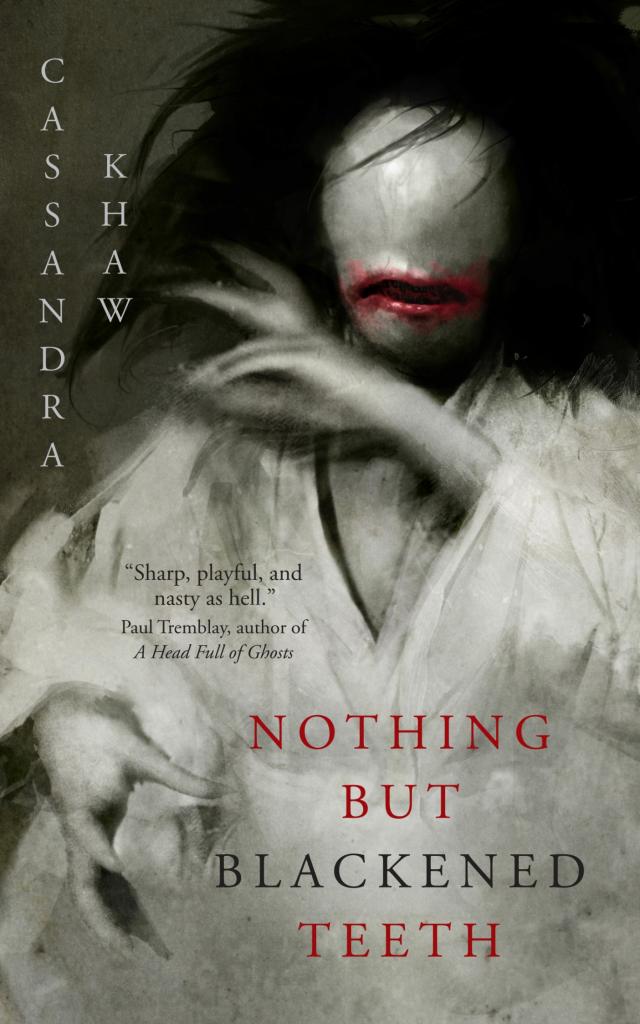
But I did. I stared at the yokai as I took a toke from Lin’s joint. She had the angles of someone carefully starved from cradle to nuptials, clavicle and collarbone in stark chiaroscuro. Her skin didn’t just look like porcelain, it was porcelain, enameled and gleaming, faultless save for her red mouth; no eyes, no nose, no philtrum, not even the conceit of cheekbones. But even her flesh wasn’t as pale as the shiromuku she wore, the satin the color of expensive chalk.
“We could just go, you know?”
“No.”
“The doors aren’t locked. The manor isn’t keeping us in here.”
“Is that so?”
“Cat.” He plucked the cigarette from my fingers, his voice gentle as he could make it, the same timbre as the one you’d extend to a suicide risk: slightly frightened, too much syncopation. Lin’s breath plumed white. It’d gotten cold again in the last few minutes. “He isn’t your responsibility.”
I exhaled on my fingertips, the nails already purpling at the base. “He’s my best friend.”
“And an absolute fucking idiot.” A bristling of rage—not anger, Lin never did anything halfway—like the pelt of a dog rubbed the wrong way, his smile vicious.
I nodded. There wasn’t much else to say so we sat for a long minute, passing the cigarette between us until it shriveled to an ember, Faiz and Phillip fighting the whole while. They’d diversified to character attacks, petty insults, all those years of friendship run through the abattoir, back and forth until every secret was turned inside out. Any second now, something was going to snap, a neck or a temper or a spine.
I looked over. The ohaguro-bettari was smiling like an ingénue at her first soiree, a blood-soaked husband on the horizon. He’d be the last man to stagger from the killing block, an axe in his hands, and that’s how you knew he was the one. Because he was a survivor, Mr. Take No Prisoner.
“Look, I’m not going to insult your intelligence. We both know exactly what’s going to happen next. One of them”—Lin jerked his chin at the pair, his fingers curling with mine and when he squeezed, I squeezed back, hard as I could, like our hands could keep us moored in normal—“is going to say something really fucking stupid. The other one is going to snap. If it’s Faiz, he’ll get a boost of adrenaline and he’s going to grab Phillip, and they’re both going to wrestle until Faiz somehow manages to accidentally impale him on a piece of scenery.”
“And if it’s Phillip?”
Lin had a laugh like a bark, like a wound weeping sepsis. “Faiz is going to die outright. Duh.”
* * *
This is the problem with horror movies:
Everyone knows what’s coming next but actions have momentum, every decision an equal and justified reaction. Just because you know you should, doesn’t mean that you can, stop.
* * *
Phillip moved first.
If I was a betting woman, I’d have put money on Faiz being the one to break the stalemate. I’d have gambled on his idiocy. Grief makes us worse people. But it was Phillip who pulled the metaphorical trigger, knuckles gore-smeared as he drew his knuckles back from Faiz’s face, vermillion and black. Faiz gawped at him, palm cupped beneath his jaw, nose bridge split in three spaces, the tip concave. He drooled blood and rills of mucus.
“You broke my nose.” You brok muh nus. Enunciation is a bastard when your nasal septum has been flattened, and your mouth is sticky with salt and snot. Faiz swallowed, rubbed his thumb along his chin. The skin stayed red and wet.
“I—” Phillip shook out his fist and stared at Faiz, stupefied. Golden-boy Phillip, good-guy Phillip, valedictorian, voted “Most Likely to Succeed” seven consecutive years in a row, cut down at the knees, no more exceptional than your average punk, another man’s blood curdling between his fingers. He wiped his hand over his face, leaving four lines across his cheeks. “I didn’t mean to.”
His voice was a hush, full of shame for the sin he’d committed against better judgment. Men like Phillip don’t punch people. Except when they do.
“You broke my fucking nose.”
“It was an accident—”
“You fucking punched me.”
“Dude. I’m sorry. I didn’t mean to hit you. You were just going off the rails there—I. I didn’t know what else to do. It was an accident, okay? I wasn’t thinking.” He breathed out. “I wasn’t thinking.”
Beside me, Lin was unfolding, uncurling to his full height, slim as my waning hopes. Ohaguro-bettari. Nothing but blackened teeth. Nothing but teeth stained with tannic acids and ferric compounds. An old girlfriend told me once about the unguent that the aristocrats used: iron fillings fermented in vinegar, in tea, in cups of sake, stirred with gallnuts from the sumac tree until it became something that’d stick.
I wondered for a second what the mixture would taste like, if it’d be like kissing copper from the ohaguro’s tongue, if I could content myself knowing the last person I kiss was a dead woman’s ghost.
“This is the part where we all die,” Lin whispered.
Faiz pulled a knife. Of course he did. There was no timeline where he wouldn’t have escalated, wouldn’t have found a knife or a gun or a jag of glass. Something heavy enough to breach the skull, pulp the brain into paste. He swung as I staggered to my feet, a scream loaded in my lungs. No artistry to the swoop of his arm but a knife is a knife is a knife is a sharp edge meant to split the seams of the skin, open up the torso and let in the light.
I bayed like a wolf under the lunatic moon as blood gushed free. Muscles relaxed and gravity tugged; slick reams of purple-grey intestine unspooled from the gash in Phillip’s belly. Faiz had cut so deep. Lin grabbed me, both arms. I howled. Phillip spasmed onto the tatami, every convulsion disgorging another palmful of viscera, clawing at his entrails but they wouldn’t fit back inside.
The room smelled of gastric juices and vomit, of urine and bowels. The room smelled of blood. The room smelled of the man my best friend had murdered. The room smelled of dying.
“Help me.” His face was whiter than paint.
“Don’t,” Lin hissed into my ear. I couldn’t tell what he meant, if what he was saying was don’t engage, or don’t try because we are in act three and barreling down to the end, or don’t look. Don’t let this be the thing you remember about Phillip, golden boy, dead boy, organs slopping out of his side.
* * *
I didn’t cry.
Don’t let anyone tell you I did. People expect certain weaknesses from girls. But they don’t cry over a man they’d never loved, could not love, even if he said he respected the swagger of her insouciance, her post-punk rhetoric, even though he said maybe and she said she couldn’t. I didn’t cry for Phillip.
I didn’t cry for any of them.
I didn’t.
I swear.
CHAPTER 9
“Oh, god.” The words clattered out of Faiz. “Oh, god. Oh, god. Oh, god. Oh, god.”
He repeated them until they hitched in his throat, always snagging on the second syllable, until all it sounded like was Faiz saying oh and oh again, quieter each time. He sagged to his knees. The knife slid from his fingers.
“I didn’t mean to. I’m sorry. I’m sorry. I’m sorry.”
Phillip moaned. The sound could have meant anything.
“Don’t,” Lin told me again, his mouth in my hair. I could feel his jaw mold the consonants, the motions of his lips. “There’s no point. We can’t stop the bleeding. We’re five hundred miles away from the nearest hospital. I don’t have anything—” His voice tore. “He’s going to die, Cat. He’s dead. He’s dead. So, don’t look. Don’t.”
I did anyway. I shrugged his embrace apart and shambled towards where Phillip lay, bile and blood soaking into the mouldering straw. I read somewhere that it takes about twenty minutes to die from disembowelment, which doesn’t sound long at all but hurt has a way of stretching out a heartbeat into an infinity of going colder, slower, every breath another starburst of too much to cope with, lighting up the cerebrum with constellations of anguish. Phillip’s eyes were rolled up to the whites and he stank of piss. I didn’t know someone else’s pain could have a texture, a bite, a gelatinousness you could hold in your teeth, but I could almost gnaw on Phillip’s dying.
“Cat.” Faiz knuckled at his own eyes, crying without embarrassment, his face a slaughterhouse of bruises and reds. “I didn’t mean to. I didn’t mean—you know I wouldn’t hurt anyone. It was an accident. I didn’t mean to. I didn’t. I’m sorry. I’m sorry.”
The ohaguro-bettari laughed. The sound was a knife, was a hole like an eye opening beneath the ribs, was the memory of one man being held up to the shining light of another, one man being less than, second-best, always inferior to the other. The sound was a thought: wouldn’t it make all the sense in the world to let that lack of self-worth move your hand, just a little, just for a second while no one’s watching?
“You’re sorry,” I repeated. I wanted to touch Phillip, let my fingers drag through his hair, the pale strands clumped to his cheek like letters and when I scrunched my eyes a certain way, they almost read like liar.
“Sure you are.” Lin’s voice shook. “Sure. Abso-fucking-lutely. You have absolutely no motivation at all to kill the guy your fiancée used to date. The Greek god to your sedentary geek. No reason. Nothing like that ever crossed your consciousness. In fact, you’re so sure about this being an accident, you can guarantee this never crossed your subconscious either.”
“Are you saying I murdered him?” There was no threat in his voice, only incredulity, shame in the slurry of his speech.
“I did not. The words ‘Faiz murdered Phillip’ never crossed my lips. Nope. No, sir. Or any variations of the statement. Ask Cat. She’s right here. She’d tell you if—”
“Lin. Stop it.” The ohaguro-bettari had moved again, blurring from where she’d sat behind us to kneeling at Phillip’s head, his skull pillowed on her lap. She crooned to him with a mockingbird’s warble. His breathing slackened. “You’re not helping the situa—”
“What situation?” Lin grinned wider, half-screaming, arms flung out. He spun like a top and the yokai twirled with him, expressions ecstatic. “There’s no situation here. Faiz absolutely did not take advantage of a situation to murder Phillip. No one would dare dream about saying anything like that. Not with the knife still in reach.”
“Lin!”
“I’m sorry. I’m sorry.” M’awwy. M’awwy. Faiz burrowed his face into his palms.
My lungs felt full. Heaving with earth, and wet concrete, and fingertips grated down to the bone. I swallowed and snarled: “The book—does anyone remember what the fuck the book said?”
Both men shut up.
“I—” I ran a hand through my hair, swallowed, swallowed again, but the reek of Phillip’s insides persisted, a sour caul gloving my tongue, the back of my mouth tasting muddily of coins. You know there was nothing in that book, a voice in my head reminded me. But we’re past that. This is past logic. “You said it was a bit of blood, a bit of cum, a bit of bone, and a bit of organ.” I swallowed a third time, ran my tongue over my teeth. “Do either of you remember if it was meant to be fresh?”
“No, no, no. Cat,” Lin hissed. “What the fuck?”
“Probably fresh, I guess,” I continued, six thousand miles away, numb in a way that made me wonder if I’d ever come home to myself, every word another lock to keep me out. “That’d make the most sense. That’s why it is human sacrifice and not grave digging.”
Faiz stared at me like I’d told him the secret names of the prophets, the private and the profane, the sacred alphabet shared by devotee and deity. He looked at me like I’d taken up the memory of his first word and given him a corpse instead. “I didn’t mean to.”
“I know,” I said, all the while thinking you’re lying, you’re lying, you’re lying. A decade of friendship teaches you a lot of things: the tics that separate I’m sorry and I’m sorry you caught me, that hangdog expression that is really code for when the other person’s expecting you to fix their mess.
I wondered what they saw in my face.
I leaned down and warmed my hand in Phillip’s belly. He shuddered at the contact.
“I know,” I said again, tired, the lie practically lit up in red neon lights. “I know. But Phillip’s dying, so we—I—let’s make it count for something, I guess.”
* * *
We dug a hole at the base of the fourth pillar and placed Phillip’s viscera into that cradle of shallow loam, one coil at a time. Faiz and Lin fought over whether we should cut his throat or whether we should measure out his offal and fill another three holes, just to be sure. One last act of mercy for the man we’d known since we were all sixteen, or have his death matter. But then the manor sighed—a long, slow breath, a dying man’s breath spun of silk filaments—and suddenly, there was Talia, propped up against a wall, still garlanded in her wedding whites.
It was exactly like the fairy tales promised: a little blood, a little bone, a little cum, a little bit of organ, and the manor returned the girl of Faiz’s dreams. She smelled of the earth and summer sunlight. Honeysuckle and fabric softener and skin warmed on a stoop in the sun. When Faiz took Talia in his arms, Phillip’s heart gave out, one last exhausted pump. He died alone while our backs were turned. Twenty-four years of being the center of everyone’s attention and that’s how he went out, not with a bang or a whimper, just a sigh and the world going colder and the last light from the lanterns dimming to nothing, fireflies in blind eyes.
We went home after that.
What else were we supposed to do?
EPILOGUE
When Phillip’s parents called to tell us there’d be a memorial in Vermont, that ancestral home his mother would say a hundred times she’d regretted leaving, none of us made excuses. We showed up in our funerary best: me in a black dress, Lin in his long coat, and Faiz in a suit that no longer fit. Talia stayed in the hospital, nursing her nightmares.
There were policemen at the wake but they stood loose-stanced and long-bodied, bored already of their assignment. No awkward sympathy mottled their paired expressions. They slouched in a corner, hunkered over YouTube videos, only occasionally subjecting the crowd to halfhearted audits. I didn’t blame them. Compassion, like everything else, can be worn dull by rough use.
Moreover, the investigation was closed. Before we came home, we’d turned the mansion into Phillip’s pyre. Then we lied on repeat until the fiction became as natural as terror: there was alcohol, there was a fire, there was a panic. When we came out, we realized we were one short. By then, it was too late.
It worked.
Somehow, they believed us.
Phillip’s death was a mistake, said the doctors and the detectives, the reporters and the neighbours until, one by one, drained of conspiracies and condolences, they went away. At Lin’s behest, we skewered Phillip on a jut of broken timber, let what remained of him unravel, spread like Christmas lights. Lit a fire. Watched it burn.
There was nothing to find.
There was nothing found.
And all at once, it was over.
Phillip stopped being Phillip.
He became instead a closed casket and terse conversations, a house with every curtain drawn shut. Phillip’s mother wafted between her guests like a spectre, her beauty-queen face veiled, her hands gloved in velvet.
“I’m sorry,” I said to her.
Phillip’s mother, gorgeous even in despair, sobbed into my shoulder, while I prayed that her son’s ghost might find its way home. He had been his parents’ only son. Their sweet heir, their shining light, their hope.
“I’m sorry,” I said again. I didn’t have breath for anything else.
His mother gave us three pairs of cufflinks, pretty as you please, identical wolf heads with dewdrops of opals for eyes. Because Phillip thought of us as his pack, she said. She gave me a box I recognized from Phillip’s nineteenth birthday. I’d put his shirt inside, the one he left behind in my dorm room. In it, she’d stacked his comic books: the mint-condition, first-edition ones he always said he’d give me. Insurance against a bad year, Phillip had insisted that winter’s morning, as we lay there under the sunroof, not together but not anything like friends. I could pawn them for all the Subway sandwiches I wanted, he said, and smiled like the sun came out for him alone.
“If you remember anything else. Anything else at all,” she said, pressing the box into my grip. “Tell us. We won’t blame you. We know bad things happen.”
We said nothing. After everything that had happened, how could we? We tucked the lie of Phillip’s death between Starbucks pick-me-ups and takeout dinners, Skype conversations and police interrogations, kept repeating its specifics until we almost believed it. Then, we tucked ourselves into our own lives, drifting until we were nothing but Facebook notifications to each other, an endless circuit of birthdays and likes and curated photographs.
I went back to school. Six months before, you couldn’t have put the idea in front of me without making me laugh. But after everything that had happened, I decided I needed a do-over. So, I went back to school. Oxford University, to be exact. Economics, with a minor in accounting. Neat numbers. Tidy things, unlike what happened so many months ago.