Nothing But Blackened Teeth, page 5


“Why?” Just a whisper in the autumn-blued air, one word, the sound of it raw and desperate. Moonlight seeped through cuts in the trees, striping his cheek like wounds scratched across my thigh.
“Because you were so unhappy.”
“Is that why you didn’t visit me either? Didn’t reach out?” The words swayed like a body on a rope, finally slack. Emotional distance reframing that previous incarnation as a stranger, without body or nuance, a monochrome despair decanted into the slumped mouth, a six-month affair with cigarettes and self-loathing. I wasn’t that person, couldn’t possibly be, and the evenness in my voice had to be testimony to the fact. “You could have said something. You could have been there for me. Instead, you went and … I don’t know. I have no idea what I’m trying to say anymore. Life’s kinda messy, isn’t it?”
“I’m sorry I wasn’t there.” Every part of that sentence ached through its recital.
“It’s not your fault. You’re allowed happy.” I shed my hoodie, tossed it into the pool below us. The algae, clumping filthily around the bulrush, kept the garment from sinking, and something else floated it away. A fish broke the surface tension, gasping, green clinging to its lips. “It really isn’t. You don’t have to—look, this isn’t about that. I’m just trying to make a point. These guys kept me from doing anything too stupid. So, I owe them. Kind of.”
Close enough. There wasn’t time for anything else.
The nature of my announcement pressed down, and I watched for a long minute as the light sieved from his face. He swallowed. I reached out and bent my forehead to his.
“I was scared and stupid and, frankly, selfish. I just…”
“You came back and that’s what is important. We’re friends again.”
“I’m still sorry,” Lin said, threading his fingers with mine. “It—”
“It’s okay. You’re here now. But we gotta go. Now.” This time, Lin didn’t argue.
* * *
By the time we found them, Talia was all dressed up in someone else’s wedding clothes.
She looked radiant in the dim hall into which Lin and I stepped, illuminated by the lantern set down at her sandaled feet. Her jūnihitoe was sumptuous, palatial in architecture, every single color from the palette of a perfect dawn, each drape of silk embroidered with faces from a children’s book, glimmering with reflected candle-glow. Against the vermillion of the overcoat, Talia’s skin seemed depthless. Not brown, but black as ink on teeth.
“Where the fuck—” Lin wasn’t smiling for once, no attempt to defuse, disarm. “You know what? Doesn’t fucking matter. You know this probably belonged to a dead person, right?”
“The hell is wrong with you?” Faiz trotted out from a side room, wearing executioner blacks: a regular suit, slightly rumpled, bowtie and everything. “If you’re going to be an asshole, get out.”
“Sorry,” Lin said, not sounding like he was at all. “Just pointing out the obvious.”
Faiz pinched his brow. “You two are drunk idiots.”
I slid down to a knee, gritted my teeth against the headache painting lights behind my eyes. “This is a mistake.”
“Are you talking about the ghost girl?” Phillip circled around from behind me, cupped me below the arms, and lifted me straight up, propped me against an alcove where a vase blooming with dead flowers sat. The petals crumbled to ashes as I leaned back. The air tasted like honey, had a chewiness to it. “No one’s seen her. Don’t worry.”
No. Not like honey, I corrected myself. It was sinewy, sweet as a knot of tendon after you’d gnawed on it for minutes, a faintly corrupt delight. “We need to go.”
“After the ceremony,” said Phillip.
“We need to go,” I said again.
“It’ll be fine.”
“Spoken like a true white guy.” Lin rolled a frustrated noise in his throat, entirely animal. Ahead of us, Faiz and Talia joined shy hands in front of an altar to the faded dead, the small gods of whatever still lived in the eaves. You could feel the house pull in a breath. You could feel its eyes. I could. “Ignoring everything that Cat’s said, how does any of this seem like a good idea? Even—even assuming that it’s all just the delusions of an incredibly drunk mind, this is just plain weird. How the fuck does any of this make sense to you people?”
“You know—” Talia sighed.
Lin, always so happy to rephrase everything as a joke, sucked at the air, before the words came out in a shotgun blast. “Fuck you and everything you think you know.”
“You’re welcome to leave. The only person who wanted you here was Cat, and the two of you—” She bit her lip as I stood, teeth a wound of white. Untangling from Faiz, Talia surged forward, red silk worming behind her. “Just. Get out, will you? No one wanted you here. Not you, not your jokes, your stupid goddamned cheese—”
“Hey. You ate as much of my rice as anyone else, thank you very much.”
“Go,” Talia said, one last time with feeling. “Just. Go away.”
“Fine,” I said.
Everyone turned as I spoke. Every eye in the hall including the ones dotting the walls, the ones framed in gold-leaf, drawn in brushstrokes. The room spun, wobbled on the fulcrums of a thousand painted faces.
And the manor breathed out.
“We’re leaving,” I said, and then once more for good measure, softer the second time around. “We’re leaving.”
“Cat, don’t.” Faiz was already cutting in. “You don’t have to go. We don’t have any problem with you. It’s just. Lin, dude. Sorry. No hard feelings. But I’d like this to be a happy thing, you know? Just. Can you take—actually, I don’t know, you know?”
“They can both go, if they want,” said Talia.
“Talia.” Phillip, intervening at last, a clergy’s bright collar buttoned to his cassock, every inch the Hollywood caricature. Neither Talia nor Faiz were Catholic, but the joke had been that it didn’t matter. This whole thing was meant to be nondenominational, nonorthodox. A gift wrapped up in a joke, wrapped up in an experience. “Is this really what you want for your wedding? I don’t think kicking Lin out of—”
Talia tweaked her veil into place: an anachronism, a concession to media indoctrination by the West. It was a scrap of white lace, so gaudy against her borrowed raiments, threaded with something that made it gleam in the light. The tasseled curtain came down with a sigh of silver.
The lights twitched.
“Don’t need your pity,” I said, stiffly. “Don’t want it either.”
“Cat. You’re drunk,” Phillip said, and his kindness had a kind of teeth to it, had subtitles. Sit the hell down, it said. The walls wore a senate of kitsune, pale-furred, the tips of their tails dip-dyed in coal. They waited, uncharacteristically imperious. A delegation of tengu was bringing their prime minister a gift.
“What happened to trying to keep these idiots alive?” said Lin.
“Like he said, I’m drunk.” My laugh was just bones knocking together, without any meat to cushion their clamor. Hateful, hollow. I gritted my teeth against their stares, began limping back towards the door. “I don’t know better. I’m tired.”
“You don’t have to go,” Faiz said again. Like that’d be exactly enough to make it all better, put me back on my leash. He said it with so much sympathy too. Too much, in fact, his expression greasy with it. And I stared at him, I could see where that compassion slopped away to reveal exasperation, irritation, disgust as old as the memory of us first exchanging hellos in school. “Really.”
I ignored him. “Come on, Lin.”
“Cat.” Faiz, still trying. Too little, too late.
I didn’t look back.
Footsteps charted the mathematics of their motions: a drag of fabric as Talia swept around the bell curve of her orbit, Faiz’s plodding shuffle falling a quarter-beat behind. Phillip’s footsteps crisp but hesitant, loud on the wood. Lin was the only one who moved like he wasn’t weighted down by sins, nearly noiseless as he padded along behind me.
Halfway:
“You know what? Fuck it.”
That was all the warning we were given. Lin’s stride became a run, and I turned in time to see him lunging for Talia’s veil. His fingers closed over the pearlescent gauze, the beaded trim. The fabric tore in ripples, like swathes of pale skin, sunlight gleaming through, soft as eyelashes. Lin’s cry of triumph choked to death halfway to its birth.
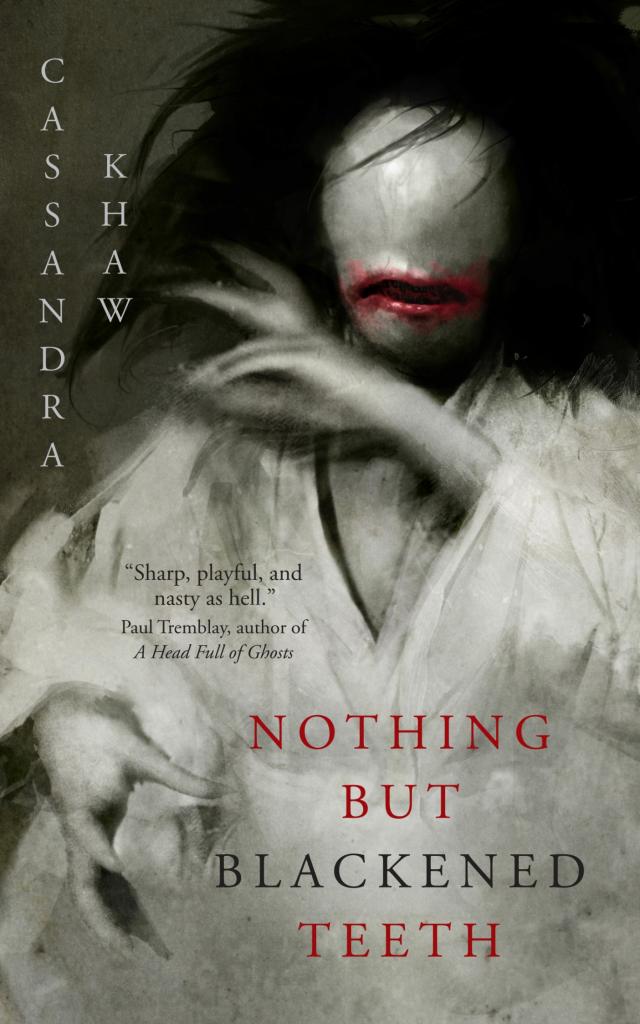
She hid nothing this time, the thing beneath Talia’s veil. My girl from the mirror. There wasn’t a face to remember because there wasn’t a face to find. Black hair tendriled across contourless meat, no features to be seen. Only suggestions. Only smooth flesh and that grinning mouth, those red lips stretched as far as they’d go, black teeth, and the smell of ink. As I gawked, Talia’s kimono bled itself of color, pinks and golds runneling from every layer, pouring into the dust at her feet so all that was left was white, the color of expensive chalk and bone left to cook in the sun.
The ohaguro-bettari began to laugh before any of us could think to scream.
CHAPTER 6
“Who the—what the fuck is that?”
Faiz made a noise that I’ve never heard, a whining sound that hitched in his lungs, expressed in gasps. The kitsunes turned. No more pretenses now. Painted tengu approached in staccato, ticking across the seams in the shoji, a stop-motion flock, their expressions mocking. Faiz hit the floor, crab-walked about two feet backwards, gargling obscenities in a throat that wouldn’t work.
Phillip crossed himself the wrong way three times before he looked over, eyes so wide that both irises were necklaced in white. Outside the room, through cracks in the walls and in the few places where the lantern-light would reach, I could see movement, subtle and swaying.
“Told you she was probably going to be possessed and everything was going to hell,” Lin said, more satisfied, maybe, than anyone had a right to be.
The dead girl, the thing in Talia’s place, Faiz’s changeling bride, white as a tongue of wax, let her laughter ebb to a giggle, low and coquettish. Demurely, she raised a sleeve to her mouth, her chin ducked, and moved towards Faiz, each of her steps causing a scramble back of his. He whimpered, head lolling.
“Suenomatsuyama nami mo koenamu.”
“What the fuck is it saying?” Faiz whispered hoarsely.
“Dude, seriously. We’re both Chinese. Don’t know what Phillip is.” Lin jerked a thumb at the other man, voice thinned by hysteria. “But you’re the only one with a Japanese parent.”
“Something about a mountain.” I swallowed, too petrified to correct him. I spoke the language too, if barely at this point, the knowledge leeched by crisis. “A-a promise?”
“That’s helpful.” Phillip thumbed through his phone and whatever dregs of satellite data he could milk from the air, face contorted. His hands shook. “I’ve got a—shit, the fucking page won’t load. Why won’t this—ah, fuck.”
“Suenomatsuyama nami mo koenamu,” said the dead bride again, this time with no musicality, her delivery urgent, her voice abraded, like she’d spent too long screaming in the dark.
Then a memory filled my mouth: “If I were one that had a heart that would cast you aside and turn to someone else, then waves would rise above the pines of Seunomatsu Mountain.”
“What the fuck are you talking about?” demanded Lin.
“That’s the poem. The thing she keeps repeating. It’s part of the poem,” I said. “She’s still waiting for her husband-to-be. After all these years, she’s hanging on to the hope he’s coming home.”
“That or she’s saying it ironically,” declared Lin. “Which, I can tell you now, worries me because that sounds like the recipe for an angry fucking ghost.”
He paused.
“Or angry ghost fucking.”
I bayed my laughter, sudden and delirious. At the sound, Phillip’s phone slid from his trembling fingers, cracked open on the floorboard. Glass shimmered. The ohaguro stopped, a broken wind-up toy. No breath, no shiver of muscle, candlelight washing golden blue over enamel skin.
“Fuck,” Phillip repeated and we all stared as one at our ghost.
She chittered and the kitsune in the walls answered, applauding in perfect silent synchronicity, their fur flushing burgundy from nose to curling tails. Their eyes grew cataracted, a film of silk. I couldn’t stop staring. Then, the ohaguro began to laugh.
“Where’s Talia?” Faiz whispered.
The ohaguro stopped and, jerkily, she cocked her head.
“Where’s Talia? Where the fuck is Talia? Where is she you fucking—” Faiz choked down that last word, but the swallowed bitch still hissed through the air. He stumbled upright, slipped on sweat, nostrils and mouth and eyes dripping clear mucus, a slickness pearling along his chin. “Give her back. Give. Her. Back.”
The words stuttered together, warping with agony. Over and over and over, until he’d tortured the meaning from the refrain, until it was a croak hollowed out of his belly. Give her back. Give her back. Giveherback. Giverakgiverakgiverak.
“Jesus, man. What do you—” Phillip started.
Faiz hit her.
His fist bore into her sternum, through it. But there was no crunch, no wet pop of bone concaving, no sound to speak of. Nothing but softness, the ohaguro’s body bending into the impact, swallowing his arm to the elbow. For a moment, I thought she might have a mouth buried in the mound of white silk, that we were a sliver of a breath away from hearing Faiz scream himself bloody.
But he only stared at her.
“Please.”
She stroked his cheek with the back of her alabaster hand, wove her fingers beneath his jaw, slid her thumb across his lips before popping the digit into his parted mouth. I thought I saw his tongue move, see Faiz suckle at the extremity, red muscle laving over her pale, pale skin. That laugh again. Girlish, gorged with knowing. The rest of us stood rooted, transfixed by the obscene tableau.
“Please,” Faiz moaned around the curve of her thumb.
The ohaguro vanished.
* * *
But the kitsune stayed.
The tengu did too.
The ceiling ripened with bodies, yokai bleeding from the other rooms to come gawk; first oozing through the cracks in the architecture, slithering rills of wet ink, before regaining three-dimensionality. They leered at us from the wood and the paper, faces and palms pressed against what now felt like a sheeting of glass. It was as though we stood in a vivarium, had always stood in display, surrounded by children but unconscious to that truth until now.
But even that impression gave way.
Slowly, as more painted bodies—some no more than scrawled lines, others magnificently detailed—crowded the ceiling, it began to distend, almost as if it had turned gelatinous. Under a pustular overhang of grinning onlookers, our group turned to each other.
“Now what?” Lin demanded.
Faiz sat keening into his hands, a broken howl that wouldn’t stop or waver, no matter which of us came over to whisper platitudes into his ear. He convulsed with his misery, scratched at his cheeks until the skin tore into translucent ribbons, embedding itself under his nails. Blood ran in thick stripes, muddying his hands.
“I don’t know,” I said, chugging water. The taste of it made me think of the pond, of algae and silt and bodies, bellies curdle-pale and soft, curving out of the murk. Wide piscine eyes flashing beneath the surface, silvery with mucus. I gagged and spat petals of duckweed, slick tangles of black hair. “What the—”
“Looks like we hit critical mass for supernatural stuff.” Lin giggled, high and weird. I winced at his pitch, each burst of lunatic laughter like a nail pounded through my temple.
“Stop it,” I said.
No one listened to me. Faiz kept crying, Lin and Phillip argued about something, and the yokai continued to stare, whispering to themselves. I could hear them now, pieces of conversation that didn’t quite slot together, spoken in dialects older than the house itself and bursts of cutting-edge slang. Here and there, English as punctuation, barely intelligible. Almost none of it made any sense except for the words bride and hello and wet, repeated so many times they soon began to resemble a heartbeat.
hello hello hello
I drank more of the brackish water. This time, the house didn’t try to choke me with weeds.
The headache began to ebb, a hum now, like bees had taken residence in the fibrous, grey crenellations of my brain. At least half the lanterns had gone out, and I was thankful for the dimness. I stood and staggered towards Lin and Phillip, the former holding a pose like a demented Peter Pan, fists propped against slim hips.
“Clearly, we need to leave,” Lin said.
Phillip shook his head, his lion’s mane of blond hair sticky with sweat. “Talia.”
“I don’t care.”
“You don’t, but I do.” Phillip, for all of his easy swagger, knew the trick of standing smaller, being shorter. Most days, you couldn’t tell he was six feet three, an artist’s rendition of the American dream. Broad shoulders, muscled thighs, a ruggedly Neolithic jaw. But now he’d given that up, exchanged his approachability for something more contentious, a predatory stillness that drove a scream through the medulla oblongata.
I thought of domestic cats and their wilder cousins, shoulders low to the soil, every paw fitted into the footprint abandoned by the last. I tried not to look down as the smell of ammonia rose sharply, to see whose crotch bloomed with dark stains. It felt rude, somehow. Even indecent. Like I was crossing a line, unmaking one final propriety.
“Yeah, that’s you. Go ahead and stay, I guess. But this is when the murders start. You know this is when the murders start.” Lin’s voice cracked twice through the sentence. He removed his glasses, wiped them along the hem of his shirt. “We’re going to die here.”
He shuddered. Palmed his face and sang under his breath, giggling as he rocked along his heels.
“Gonna die, gonna die, gonna die. La, la, la. We’re all going to die. Because the dead are lonely in the dark, and they all miss the sun.”