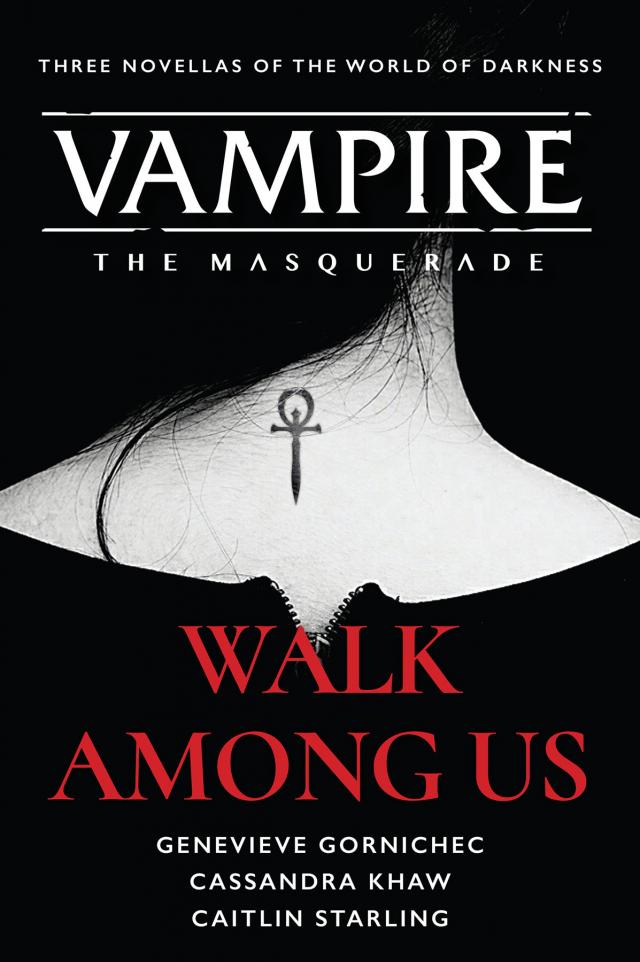
Walk Among Us, page 21


“I mean, why else would people donate blood so often? Key had me schedule out the next couple visits, and it just seems excessive.”
I make a note to myself to talk to Key later.
“Listen, I get it,” I say, “but some of us believe that because blood is a renewable resource, donating when we’re able to is a public good.”
She stares at me.
“I said something wrong,” I venture.
“A renewable resource?”
Okay, maybe not the best choice of words. I do make mistakes occasionally. I laugh, rubbing at the back of my neck. “Well, yeah. Like dairy cattle. No, don’t—don’t look at me that way, I mean it in the most respectful way possible. What if I said, like honey? The product of labor the body does anyway, that can benefit others with careful donations. It’s not like a liver. It grows back.”
“Livers do grow back,” she points out.
“Huh. Well. Taking out a liver would be more invasive.” I try to get back on script as quickly as possible. “And at any rate, very few members actually donate each visit,” I say. “I can show you the numbers. But I promise you, we do our best to balance encouraging participation against protecting the more vulnerable in our community. It’s not like James Marion Sims.”
By Robin’s shudder, she knows the name. Good. It’s nice when people remember history. They know things could always be worse.
“We’re not treating people as expendable for the greater good,” I continue. “We really do our best to treat every individual community member with dignity, because regardless of what the world thinks, every one of them is human and deserving of the same treatment.” I pause, then add, “You know, if you do end up staying in administration, you can help with oversight on that.”
She perks up. She eats some of her cauliflower. “I don’t think I have the training for that,” she says after she swallows. But it’s clear she’s interested. “I’m not a social worker or anything.”
“Right, but,” I say, gesturing with my full water glass, “you’ll be in a position to know who might be more vulnerable, and to make sure they know they don’t need to participate. And you’re an incredible writer. I know you don’t do marketing-type work—I get that’s not where you’re comfortable—but maybe you could help our messaging. Make it clear. We can do better together, I’m sure of it.”
She leans forward, wholly engaged. Her expression loses its confusion, its concern, replaced with the heady thrill of having a mission. “Do you think so?”
I nod.
“I’d like that,” she says. “It’d make me feel a lot better.”
Of course it would.
It’s called forced teaming, what I did to her, what I do to the whole community. We’re in this together. We all know. We all agree. I make sure to accept dissenting voices, parrot them back, make people feel heard, but in the end, it’s all management. And when somebody takes issue, when Robin asks is this ethical, I make sure the door is open in case it’s best for them to leave, because if they leave easily, they stress the rest of the group less. But it’s better still to redirect the dangerous behavior. It’s better to fix a problem than to cull it.
Culling is much more noticeable.
We treat every human in the commune with the same amount of dignity, because, in the end, they’re all one herd. And it’s easier to make decisions when, despite all their individuality, you can treat them as a unit.
Robin finishes her paloma, finishes her cauliflower, and begins talking about other things. Writing, the city, how great a singer Ethan is. I know I have her. She strayed, but now she’s a part of the herd again.
And I’m happy.
Messy
If anybody asks, the bleached, denatured blood residue that will still linger in crevices despite how furiously I’m scrubbing all the tile tonight is poultry blood. In Oregon, if you slaughter less than a thousand birds a year for farmers markets, or any number just for your own consumption, you don’t need a license. Which is good, because we don’t have a license for anything else sold commercially, and we don’t have any weanling pigs on private contract with customers this year.
It’s true we’ve had slaughter and processing classes here with some of our residents using last year’s lambs. That would more than explain the blood, just not the timeline. But the important thing is that there’s been blood in here before. There will be blood in here again. There will be no DNA left to test, and everything here is done up to the FDA standards for a regulated abattoir, even though we don’t qualify, even though we’ll never have an FSIS inspector here every day. There’s nothing here to incriminate us.
But I’m still paranoid.
This is the most dangerous thing we do. Especially on nights like tonight, when things get messy.
This guy . . . this guy was something else. He’s always left a mess, but this . . . I’ll need to have a talk with him, because he crossed a line. Spread the blood around, made a game of it. It’s pathological, and money or no, the commune isn’t going to survive if people like him think they can just break the rules because they’re donors.
What a mess.
And it doesn’t help that I’m on edge, maybe because of going out with Robin earlier.
Robin.
Robin, because she is perfect and incredible and clearly felt alive after our outing, is finishing the soup for me. When we got back to campus, I checked in with Lucille at the office and let her know I’d take care of the rest of the evening. She was gone without a word. That left me to head back to the kitchen until our stakeholder (ugh) arrived. It was only one in the morning, so I had a few hours left to finish cooking before then. I could handle it all, as long as I focused.
And then I found Robin there, waiting for me in the kitchen.
I should have been annoyed. I should have sent her off to bed as kindly as I could. It wouldn’t have been hard. She was buzzed and it was late. But instead, we sat up and talked about the city, and about art, while I turned the oven back on. When it was time to load up the color-designated pots half an hour later, she fetched the canned, homemade stock—half vegetable, half chicken, for all our varied nutritional needs—and we were still basking in each other’s company by the time my phone buzzed.
The soup wasn’t finished. It had another half hour to go, minimum, and then it needed to be pureed and canned after. But it was time. Time for blood and a mess Robin could not be allowed to see. I must have let my consternation show (I must have been too relaxed . . . was definitely too relaxed) because she asked if there was a problem.
What I should have done: said no, told her it was almost three in the morning and she should go to sleep, promise her I could finish up alone, then put the soup on the back burner for a few hours.
What I did: hesitated, said I needed to get back to my office (couldn’t tell her there’d be a visitor; who visits a commune at three fucking a.m.?) but the soup would keep, and don’t worry. And Robin—perfect Robin, drunk Robin—was right there, ready to take over. She didn’t even ask if Lucille could step in and finish the soup. (Of course, she wouldn’t. She doesn’t care for that sort of thing anymore, just old architecture and beautiful books. But that would have given me another opening, if Robin had asked. Another chance to lie and do my job properly.)
So here I am, an hour and a half later, scrubbing blood that isn’t poultry blood off the tiles, not knowing if Robin has been reasonable and knocked off to bed, or if she’s still waiting, wondering, adding to her list of questions I thought I’d nipped in the bud. What should I tell her when I finish up? Especially since she’s already worried about the blood donations, I can’t tell her I was cleaning up a late-night mess in the slaughter room.
Something else about the animals, maybe? No, she could figure out that was a lie.
A medical emergency? Even easier to debunk.
Nothing at all, because it isn’t her business?
Except she trusts me.
She likes me.
When I finally finish bleaching and scrubbing and rinsing and (for good measure) scheduling ten chickens for slaughter the next day under a fake customer number, I go and shower until there’s no coppery-sweet scent of blood or tang of bleach left on me. It takes extra time, but not too much, and it’s necessary.
My hair is short. It dries quickly. By the time I walk back to the kitchen, there’s no trace of damp left, and I’m wearing a T-shirt with the ecovillage logo on it, the exact same logo that was on the shirt I was wearing before.
I find Robin waiting there, asleep at the kitchen table.
I rouse her gently and apologize. I say I must have fallen asleep at my desk, and I look embarrassed, and I thank her for finishing the soup. Say it smells delicious (it does, but doesn’t quite mask the scent-memory from that damn room). Tell her to get some rest, because the pressure canner will take at least another half hour to come up to temp.
I think for a moment she’s going to argue and try to stay, but she’s too sleepy and this is all so mundane, the excuse so boring, that it barely registers as anything worth questioning. I simply walk her back to Hawthorn House and bid her good night. I all but tuck her into bed.
And then I go and clean the slaughter room again—and say a silent thanks that there’s no body to get rid of.
The Applicant
I have another round of applicants to interview tonight. I’d say it was a mistake coming in early for Robin’s, because now Key wants to offload all the after-rush-hour interview blocks to me (I think they’re nervous after the talking-to I gave them about what duties it’s reasonable to give a new hire), but I can’t regret it.
Still, I don’t necessarily enjoy the majority of these interviews.
We say we accept applicants on a lottery model. That’s not true, but we put in the effort to make it look that way, and I’m honestly very proud of the system I helped invent. A commune like this needs an exacting balance of personalities, skill sets, skill levels. We provide housing and food to those in need, including emerging artists, but we’re a humanitarian effort on our tax forms, not an artist retreat.
We don’t exclude based on race, sexuality, or health status. Not even addiction issues. We don’t exclude based on anything, but we do need to keep a balance. Hence the lottery system that isn’t a lottery system, and a lot of late nights researching everybody we invite to stay, from the luminary dancer to the active meth addict to the single mother of two (though those specific examples are all based on one person: Julie, over in Columbine House).
I know I do it a lot, and I know it’s bad form to compare what I do to managing a flock of sheep, but it’s really not so different when you get down to it. A cohesive group makes everybody’s lives easier, keeps them healthier, and benefits their shepherd. And I’m their shepherd.
Well, community manager. Same thing.
So I knock out two interviews that are just for show (they’re not being accepted), and then settle in at my spinning wheel for some decompression. I’ve only gotten a few yards spun up when I’m interrupted by a knock at my door.
It’s always something.
I look up, expecting Ethan or Julie or half a dozen other members of the community, here to ask for intercession on some interpersonal dispute or for help with a burst pipe, but the face hovering in my open doorway is unfamiliar.
And something about him sets my teeth on edge, just a little.
“Hi there,” I say, securing the batt I was working from and getting up off the stool. “Can I help you?” Our community members are, of course, allowed to have visitors on site, but not overnight. The rule gets a little fuzzy in winter, because night falls before dinner’s even served. I hope that’s what’s happening here.
But it’s not. He clears his throat, and the motion draws my eye to a crescent moon tattoo just peeking out of the neck of his sweater.
I straighten to my full height.
“Yeah, uh. I heard about this place, and it seems—seems really cool. I was hoping I could apply for a room here?”
It’s so ridiculously implausible of an excuse I want to laugh, but I’m too busy staring, because this is not what my split-second deduction prepared me for. I eye the tattoo once more, then back away from the door, motioning him in without a word.
I’m not sure what I want to say just yet.
“I’ve lived somewhere like this before,” he says, edging inside. “Down in Lents. Nothing formal like this, but a couple of houses on some shared land filled with artists and plumbers and musicians and a couple office workers. Lots of shared labor, productive gardens, and stuff. So I’ve got skills you could use.”
“There’s a formal application process,” I say.
He colors. Colors, as if this is completely normal. As if he’s completely normal. “I, yeah, I know, I just—I don’t have anywhere else to go right now. Don’t have much time to wait. And I thought it was worth a shot.”
“I could call around to the shelters in town. You can fill out an application, then wait there for, say, a week”—not enough time, but enough distance, it might break his interest, but there’s still something wrong about this whole scenario—“and then I’ll get back to you.”
That crescent moon tattoo. It could be a coincidence, feels like it has to be a coincidence, but I’m not buying it.
He meets my eyes, finally. He’s shy. “They don’t want people like me,” he says. And maybe he just means that he’s gay, that he’s not white, that he’s got so many tattoos that the crescent moon barely stands out, gauged ears, “alternative” hair. Portland claims to be progressive, and it is—right up until it isn’t.
But I don’t think that’s all this is.
The longer this conversation goes on without him indicating conclusively one way or another which way his blood leans, the more nervous I get. This could be a distraction. A trap. Anything.
The time has come to end this dance. I bare my teeth.
His eyes widen.
“Oh shit,” he whispers. “Oh shit! Fuck, this is your hunting ground, isn’t it, shit, I didn’t know, I swear I didn’t know!” He’s terrified. If he were human, he’d be close to pissing himself. He’s on the floor now, though I haven’t moved an inch, haven’t so much as raised a finger.
He didn’t know.
He’s not here to hunt. He doesn’t even want to buy a share. He’s applying to live here, like a desperate mortal, the kind of desperate mortal he looks just like. It feels wrong, that he stumbled into us. Impossible. But I’m skilled at reading people, and he’s well and truly stunned.
“I’ll go, I’ll get out of your hair, I’m sorry—”
“No,” I say, holding up one hand.
He goes preternaturally still.
He’s young, looks just like any baby-queer anarchist still idealistic and knocking around Portland. He’d fit right in with our human contingent, and I’d wager, with the way his color doesn’t fade now that he knows what I am, he can walk in the sun when it’s really overcast out, as long as he bundles up and wears a hat.
He’s useful.
Caution says he goes—immediately. But curiosity makes me want to know more. How the hell did he stumble across us? Is he really just looking for someplace to live? So many unanswered questions dance in my head, and one thing is clear:
I’m not ready to make this decision alone.
“What’s your name?”
“Kasim.”
“Come by next Tuesday, Kasim,” I say. “I want you to meet Lucille. Can you bring your papers?”
“Yeah,” he says. “Yeah, I’ve got everything. I’ll bring it. Shit, are you sure?”
He’s already halfway out the door, too afraid I’ll take it back or, worse, snap and tear his throat out.
“It’s an audition,” I tell him. “Come prepared to show off.”
December
New Employee
I half expect Kasim to ghost us, but he’s outside my office when I stroll into work on Tuesday, clutching a ragged satchel to his chest. He’s dressed up a little for the occasion, and he’s nervous. I take my time unlocking the door, checking my messages, straightening some paperwork, before finally addressing him.
“Welcome back,” I say. “Follow me.”
An interview like this poses a few logistical problems that I’ll admit I wasn’t entirely prepared for. I don’t want to take him to my house or to Lucille’s, because I don’t need him knowing where we sleep if this doesn’t work out, but I can’t have him near the humans if we’re going to talk shop. I considered the husk of Hawthorn House, but Robin’s not allowed to work nights yet, and even if she could, I don’t want him knowing where she sleeps, either.
That leaves somewhere off campus, the fields, or the barn. I pick the barn, and shoot off two texts: one to Lucille telling her where we’ll be, and one to Key telling them I’ve stepped out for my appointment, and can they please hold down the fort for the next two hours?
It’s still early, so there’s a chance some community members will be working in the barn, but it’s blessedly empty. Even the sheep are still mostly outside; only a few sick ones are penned in. I check the doors to be sure, then gesture with a lift of my chin to a hay bale. He sits. I extend my hand and he gives me his papers, meaningless to anybody who doesn’t know exactly what she’s looking for.
I do, though.
He’s exactly what his tattoo claims: a duskborn who follows Camarilla law. I didn’t know we had any duskborn, but then again, it’s not like they’re allowed into Elysium meetings, and it’s not like I go to Elysium meetings, unless it’s specifically demanded of me, so clearly I’m no expert.
I ask him a few questions about his background and his hobbies while we wait for Lucille. After a nervous look around, he starts talking. He was turned only a few months ago and has lived in Portland since he was a young teenager, both on his own and drifting between rough sleeping groups and support homes. For all that, he’s still idealistic. Still fundamentally likes people, even if he doesn’t trust them. If I had to guess, whoever embraced him was from some of our remaining philosopher-kings, one of the Brujah who stayed in town thinking they could add Portland to the Anarch Free States. But Portland is commercializing its Weird too fast, and we’re still Camarilla for the time being.