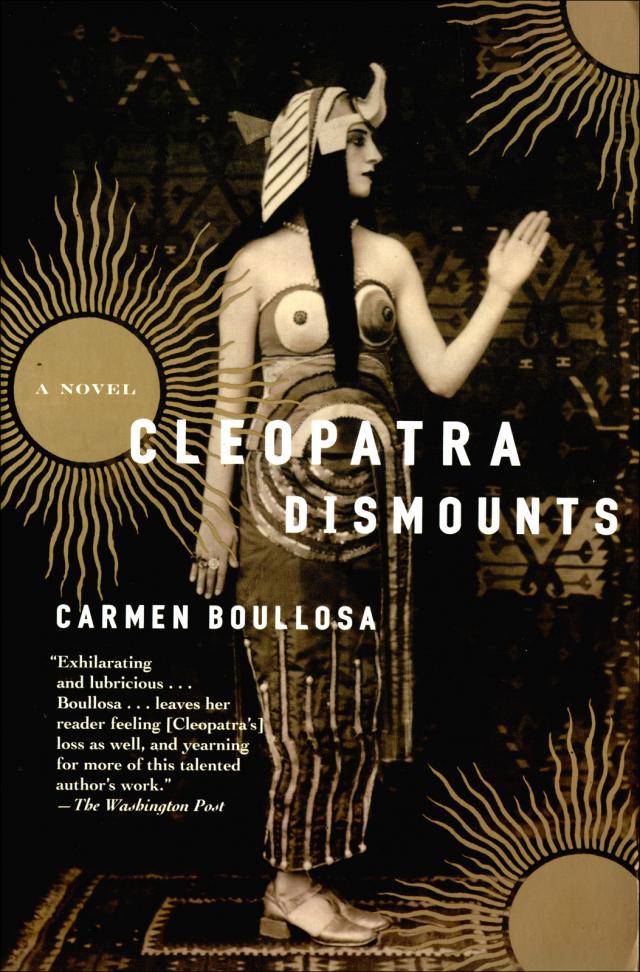
Cleopatra Dismounts, page 6


The streets of Alexandria were empty. Men’s voices, the creaking of wheels, the bumping of boxes on carts, the grunting of beasts of burden, the songs of birds, even the barking of dogs—all quite absent.
Trembling from my bed and its dream, driven by insatiable desire, I dashed all alone both hither and thither, for it was impossible to find the only man I wanted to kiss. I did not walk, really I ran, fleeing all the places where tyrant Love knows how to ensnare his victims.
My despair got wilder and wilder. If I had leapt terrified from my bed, I was now terrified of every single thing. My eyes saw all objects in a bright light that glowed with a painful intensity and almost burned me. Everything lay in semi-darkness—for it was the middle of the night and the street lamps had been extinguished by the watchman—but a light shone with a dangerous insistence from every object.
It was a moment of dreadful darkness, though darkness is hardly the right word when everything glowed bright enough to hurt me. My grief was literally splitting my heart in two and mockingly rubbing one half against the other. In the recent past, I had not been strong enough to bear the sight of the sun. I had stayed in my bedroom, wanting to know nothing of Egypt. I had suffered, drowned in my miserable tears. But all this was nothing compared to the grief that possessed me now; and it had come without warning, because I believed myself free of him, free of my sickly attachment to Mark Antony, the man who did not love me. Now the very objects of my world were hostile to me. The universe had sided with him: it had joined him in his rejection of me. I was a mere nuisance, a superfluity in the world. I needed to be cast out violently from land and sky and the winds the gods unleash. Objects touched me and called out, “Enemy, enemy, enemy!” It was a fearful moment, but when I compare it to the moment in which I now speak, I envy myself that experience. I would choose to be back there, to be that woman again, once more to be Cleopatra.
Then at some point, my eyes glimpsed a sharp piece of metal on the ground. I picked it up, grasping it firmly. A little farther along, some fist had used the metal to scratch a message on the wall and then tossed it away to avoid suspicion. The message read:
My name is not Cleopatra.
I wasn’t born a woman or the child of a drunken king.
My father drank water and kept bees.
I am a slave.
I wasn’t, I won’t be, I don’t want to be a Lagid,
But the mystery of my soul is as deep as that of the wretched queen!
Beside the words, he had started to daub a face with a huge nose and pronounced wrinkles on the neck, as if in mockery of me. The sketch got my nose right but those wrinkles belonged more to Arsinoe than to me.
“Wretched queen!” What a slap in the face! Seeing my name written with such contempt, I saw with total clarity how the rejection of Mark Antony had torn me to pieces, that my face had become a shapeless lump. I thought I saw that when morning came to this same street, two or three dozen women with faces exactly like mine would be walking here. My hair was disheveled, and the same lack of care was apparent in my face. These women, my counterparts, each one of them would be exactly like Cleopatra, though none with hair as disordered as mine. So there was nothing unique about me anymore! I was a mere nobody, Antony, because you had erased me. I saw your hands, your fat fingers with the palms too big for them, I saw them molding one of those shapeless faces out of clay. I saw your hands holding the sharp metal I had just picked up from the ground, and with it you scratched features into my face, without any bleeding, as if I were clay also, but for all that, I suffered excruciating pain.
This horror at seeing myself erased by you and then repeated in so many other women had a red-stained edge to it, the color of blood, and it came with a pain beyond bearing. Then it took pity on me and withdrew its fangs and was replaced by a chill breath of wind. The breeze on my face spurred me to tears and I felt a sense of relief. I remained motionless, while my grief disfigured not just my face but the whole city. I wanted to die. I thought I was dying. The wet tears on my face turned to fire, became rivers of lava, and, the worst of all torments, the sand frozen by night. And I, the queen, was the victim.
At first I had not heard two men approaching. They were chatting and, after they saw me, they used their lamps to read the inscription on the wall. Then they started to shout. By now I’ve heard the story of that meeting told a thousand times. I can imagine clearly, I can see and hear that before they saw me, the two friends were exchanging laughs and teasing phrases about the endless party they were returning from so late at night. They were Philostratus and Crinagoras of Rhodes. But they had not a drop of wine in their veins, for they had been dining at the austere table of Olympus, the sage who has since become my doctor, and who now, in this final hour, remains faithful to me. They had sat in the open air, their only light the pale starshine, but they had spoken and listened their fill. Around this table pranced neither musicians nor dancers, neither comedians nor poets. They wore no garlands and reclined on no cloth of gold. They had only the herb garden of Olympus and his secretaries and students, men who clad themselves in coarse white wool, the plain dress of shepherds. In all this, there had been a gentle, moving simplicity, even though a student, who was not of their number but was studying mathematics, an arrogant youth with the long curly hair of a child—years later he would give himself out to be a prophet—had irritated them with his impertinent questions and his drinking of wine. They were making fun of his drunkenness and his questions at the time they bumped into me. On seeing me, Philostratus exclaimed, “There’s another drunk, and this one’s female! What kind of milk are mothers giving their children nowadays that they grow up with such feeble bones? One cup of wine and they fall over and talk drivel!”
But in spite of chiding me with his first glance, he spoke to me in a softer tone, perhaps because he felt compassion for my near-nakedness and my pregnant condition. “Little girl! Where are you going? May we accompany you?”
“Don’t talk to her! Let’s get out of here,” Crinagoras said to him. “Can’t you see what’s she’s written here and how provocatively she’s showing off her . . . Let’s beat it. Look what she’s written. Find out who she is.”
“She didn’t write that!”
“She’s got a sharp piece of metal in her hand.”
“But she isn’t the one. Don’t you remember the poem?
The man whose dust lies in this deep-dug hole
Toiled as a slave while he was here on earth,
Yet earned he merit of an equal worth
To royal Darius, by his honest soul.
It’s by Anyte. From ’The Tomb of the Slave.’ Anyte, the one Meleager called ’the Homer among women.’ It was going a bit far to say that, don’t you think?”
Crinagoras hastened to reply, “Love for poets always does go too far, oversteps the limits, and with Anyte being a woman—well, she had twice the reason to overdo it.”
Quoting Anyte, they had forgotten me. I too had forgotten myself, sinking deeper and deeper into that cauldron of grief where everything rang loudly and glittered sharply. I hadn’t seen or heard them until Philostratus, remembering me, dried my tears with the edge of his rough, woolen cloak. Only then did I become aware of them there in front of me.
“Why did you scratch that up there?” he snarled. “You’re asking for trouble, you know. You’re endangering your child and everything. And for what? To travesty a poet who’s been dead for hundreds of years.”
“I didn’t scratch anything on the wall,” I said, without checking my tears.
“Why are you crying, pretty girl? You’re about to have a child. You have life and happiness ahead of you. Have you quarreled with your husband?” Raising my face, he said to Crinagoras, “This woman’s no beggar. Just look at her face. Where do you live? Calm yourself.”
I could not calm myself. My face, beneath the edge of his cloak, felt that it was breaking asunder in every slightest part of itself, that Antony had obliterated it, exhausted it, robbed all its features of definition. How could he have done that to me? Had I imagined it all, that we had loved the way we had loved? Had I meant nothing to him? Had it happened only inside my head, in my imagination, for me alone? Did his Octavia have what Antony needed? Why didn’t I have it? I wanted to die.
“What’s the matter, little girl? Love troubles, eh? You’re lovesick. Is that it?”
What made him think that? Was it so obvious?
“What else could hurt a woman like you, with such strong features? Look at her. She has a really striking face, with so much character. Any painter would want to paint her portrait.”
A voice from behind then spoke up. “They’ve already painted her, man.”
Did I know him? Had I met him before?
“She’s still crying.”
“You two, you better not touch her. Get out of here. Everybody knows that’s Cleopatra.”
Philostratus and Crinagoras swung round to the man who addressed them.
“It’s you!”
“Yes. Have you sobered up yet? We were just talking about you before we found her,” Philostratus said to him.
“Sure you were. I was right behind you. What you were saying sobered me up. You made me feel ashamed of myself. You’re right. I was impertinent.”
“How do you know it’s Cleopatra?”
“For God’s sake. Everybody in Alexandria knows it. Crinagoras, Philostratus, you only need to live near the Nile to know it.”
“Let’s take her to Olympus’s house. He’ll look after her. We’re not going to leave her here.”
“What makes you think it could be Cleopatra?” Crinagoras asked nervously. “All by herself? Half-naked?”
“Are you our wise queen?” Philostratus asked me, without ceasing to wipe away the endless flow of tears that poured from my eyes, now loaded with even more feelings, shame, humiliation, anger, rage, gratitude, surprise . . .
I admitted I was. How could I deny it?
I don’t know what the old man said to me but it had an extraordinary effect and calmed me down. If I could recall his words, he would be saying, “And do you weep over Antony? I have to tell you: forget him. You are the most desirable woman in the kingdom. You were Caesar’s woman. You are not a Roman. Your customs are beyond their understanding. The legend of Egypt is yours. If he is not here with you, if he happens to be with another, it is because he is inferior to you. Let him go. I do not know if there is another Caesar for you, but if there is, it is not Antony. Stop worrying about being left alone. Surely some god will come down from the heavens to spend his nights with you.”
I know Philostratus did not actually say that to me, but it was what I was hoping to hear. But he did tell me what I needed to calm me down, and he took me to spend the night in the house of Olympus.
Prudent and serene, they sent a servant to station himself at the palace gate, to advise the guards of the whereabouts of Cleopatra as soon as day dawned, or before, if he heard any sign of alarm. They sat down at my side, prepared to stay awake with me if I did not fall asleep. But I stayed awake and spent the night in what proved to be a refreshing cure for me, owing to their conversation and a long skein of anecdotes.
By my side, without a pause, Olympus, Philostratus, and Crinagoras spoke on and on, tackling one subject after another, seamlessly. I imagine that over the table they had so lately left, they must have discussed other subjects, the abstruse topics over which wise men bother their heads. With me, however, they shared stories and fables, a lifetime’s collection of incidents, like three nurses intent on soothing their child to sleep with a lullaby of words.
The nightlong talk those three sages bestowed on me finally cured me of the pain of Antony’s desertion.
As a consequence, I included them in my court. When Antony returned, they learned how to appreciate his mind and gave him their genuine loyalty. Olympus is still my doctor and is the one living soul who now visits me. Where Crinagoras of Rhodes has ended up, I don’t know. In my isolation here, shortly before the dying Antony arrived, I was told of the fate of Philostratus, my poet. The Romans cruelly humiliated him in the streets. They stripped him of his clothes and forced him to walk down the street on all fours, like a dog. They made him eat, like a dog, the manuscripts of poems dedicated to me that he kept in his house. “Gobble down your Cleopatra,” the centurions bellowed. “All she’s good for is to be food for dogs like you.” Then they made him swallow cattle dung till he could swallow no more. “Gobble down your Cleopatra, dog,” they kept chanting, chanting, chanting. “Gobble her down, gobble her down, gobble her down.”
These soldiers of Octavius kept up their torture till they suffocated him. Like Antigone, I wonder, “Will they torture me?” And I answer with the reply that Creon gave her: “No, your death will suffice.” What this tyrant does not know is that my death has long been a gift from Antony, who also tortured me. What does it matter what Octavius can do to me?
As I said, Mark Antony, you came back. Two years after you had left me in Alexandria, you returned.
You sent me a long, persuasive letter. I feel a desire to repeat it here, so sweet a letter! You did not know I had learned it by heart. From time to time I repeat it, to bathe my tongue in honey. If I still had a tongue, I would want to drink its words now, but I am totally lost to everything.
In that letter you begged the queen of Egypt to take her twins and herself to Antioch, so that you could know “the twin fruits of the best days of your life.” Inside the five sheltering walls of that city, our glances met again. At once the bond that united us, the knot of mutual pleasure, tied our bodies together, binding us with its protective force.
The two years that had divided us were transformed into the four steps that our bodies took to form an embrace, fusing us together, one into the other.
Had you really been widowed and then married Octavius’s sister? Had I really forsaken my better self till I was restored to health by the city’s sages? All that disappeared the second we saw each other. You had never gone away; you had only drawn closer. You and I had found a route that bypassed every wall, every rampart, every form of separation.
A few days later, we celebrated our marriage Egyptian-style, convinced that nothing could separate us ever again. We forgot that
Nothing lasts for those who are born to die,
Both fortune and misfortune hurry by.
We were drunkenly happy, with a happiness that made us unique, vigorous, indefatigable enjoyers of life.
We minted coins with both our images on them. Wishing to fix forever the two aspects of our love, I stamped on my seal the word: methe, intoxication, for the gold of our laughter, our joy, our being together, and for the desperation with which we possessed each other, the madness of losing ourselves irretrievably, the torment in which our woven sheets wrapped our bodies. It was a torment that we in our drunkenness would not forgo. I wanted to see you every day, Antony, never to let you out of my sight for fear my exasperated need for you would tear at my flesh. You brought me no peace, no serenity. You brought me intoxication and fever. The wealthy queen of Egypt lived on the verge of starvation. Not that the delights of your love did not satisfy me to the full. Not that you did not come to me with laden hands, giving me more than any man had ever before given a woman. But you, too, were scourged by our hunger for each other. Love obliged us to live on our nerves. Nothing induced calm or repose. Nothing reduced the anguish of love’s arrows.
Temperance, that good without equal, had no place in our style of life. Like a tongue of flame, we set ourselves under each other’s heels. But we did not want to remove that burning pain, for the mere notion of losing each other again was worse than seeing ourselves devoured by a thousand tongues of fire.
We both donned the same garment of Deianeira, the one she wove with her own hands for her beloved Hercules to wear. Out of jealousy she dipped it in the blood of the centaur Nessus in the hope of recovering her hero’s love. Do you recall the story? Hercules was returning with her to the walls of his city, when he encountered the turbulent waters of Evenus, swollen by winter rains, more turbulent than ever before. The river was full of treacherous whirlpools, and Hercules, instead of reminding him that he had recently defeated a river in order to gain his bride, thought only of the rapids and feared for his wife, who was not familiar with the fording places. Hercules! All you had to do was grasp her by the waist and carry her across like a child. You had just come from a victory over the tumultuous rivergod Achelous, but fear for your Deianeira stole away your confidence in your own powers. You thought fainthearted thoughts about how to get your beloved to the opposite bank without any risk.
And what did you do? Trusting the words of the fierce Nessus, you let her cross the river on his back. When the centaur, emboldened by the current, caressed her flesh, she cried out and you wounded him with a poisoned arrow. Treacherous to the end, he said to Deianeira, “Your beauty had destroyed fierce Nessus. I leave you, my beautiful one, this present. Keep my blood where daylight cannot reach it. If one day Hercules, in his blindness, fails to recognize your charms, soak a robe in my blood. Make him wear it and he will adore you once again.” And other things, too, he said that I will not repeat here.
When Hercules returned victorious from his labors, his eyes were glutted with the beauty of a young captive. It was then that Deianeira bathed the tunic in the centaur’s blood. It consumed him in agony.
We both put on the tunic of Deianeira. With us, the centaur got his revenge without needing to lie to its weaver. We were both like the fleece of the white sheep she used to daub the tunic. We devoured ourselves, we turned ourselves into fugitive smoke there on the bed we made for ourselves.
We set about destroying each other; there hardly remained a visible trace of us, only a mere scattering of ashes where the tree once grew. We continued bubbling away, as if on the boil, and nobody could see the damage the fire was causing.