Biggles Sees Too Much, page 6
part #98 of Biggles Series
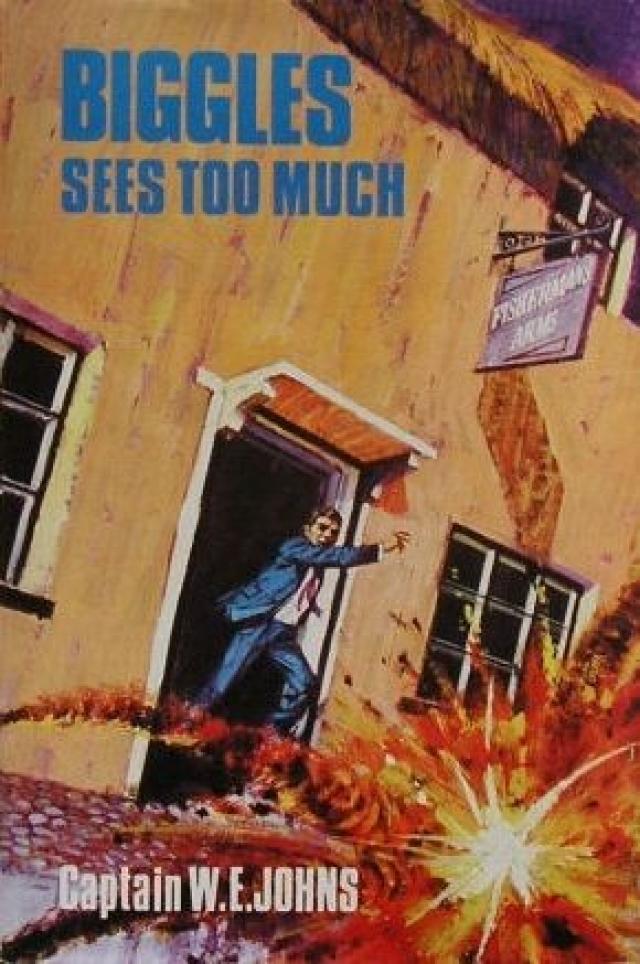


He reached Penlock and pulled up outside Fernside Cottage. He was disappointed not to find Biggles at the gate waiting for him. Possibly with Ginger. But as this was not so, he went to the door and knocked. It was opened by Mrs. Cator.
‘I’ve come for Mr. Bigglesworth,’ Bertie said cheerfully.
‘I’m afraid he isn’t here,’ Mrs. Cator said.
‘Not here!’ Bertie felt as if his legs had been kicked from under him. ‘Where is he?’
‘I don’t know.’
‘You’re — you’re not saying he didn’t come back here last night?’
‘I haven’t seen him since he went out last night. He still wasn’t in when I went to bed, and this morning when I took him a cup of tea, I found his bed hadn’t been slept in.’
For a moment Bertie groped for words. ‘I see,’ he managed to get out. He smiled bleakly. ‘In that case I shall have to find him. Goodbye for the time being.’
Hardly knowing whether he was coming or going, as the saying is, he went back to the car and sank down in the driving seat. This was something he had not reckoned on. What to do about it he did not know, although obviously he would have to do something. He couldn’t just sit there all day in the car waiting for things to sort themselves out. He sat deep in thought for some time and then saw a ray of light. Algy. Algy had better know what had happened. At least he would be someone to talk to.
He put the car into gear and set off for Morven Flying Club airfield.
CHAPTER 7
WHY GINGER WAS LATE
IT will be remembered that Ginger was left on the road near Penlock Grange with every intention of walking back to the village, to rejoin the others, as soon as he had made a preliminary survey of the big house.
He could see nothing from where he stood because, as with so many second-class Cornish roads, it was sunk between high grassy banks which completely concealed the view on either side. A profusion of wild flowers sprang from the grass. At the top of the banks were hedges, chiefly a tangle of thorn and briars, with an occasional tree at intervals. Ginger was only interested in one side, the side broken by the entrance to the drive which had been passed on the way to the spot where he now stood: the drive into which the Daimler had presumably turned. It was evident that if he wanted to see anything, there was only one thing to do. Climb to the top of the bank and look over the hedge. If he could not see the house from the top of the bank, he would have to walk back to the drive and do a little cautious scouting from there.
One thing he now noticed for the first time, for he had not been able to see it from in the car, was something in the sky. An anvil-shaped cloud which he knew well enough was almost invariably the forerunner of a thunderstorm. However, that did not worry him. He had been wet before.
With the car already out of sight, he scrambled to the top of the bank and with some little difficulty parted the top of the hedge sufficiently for him to get a view of what lay beyond. He was disappointed to find he could not see very much. In the foreground was a meadow in which some cattle were grazing, and a few cock pheasants pecking about here and there. On the far side of the field, at a distance of about a hundred yards, was a long wood, or a belt of trees, of mixed timber. At one point, just showing above the tops of the trees, were two stacks of chimneys, real or imitation Tudor style. It was plain they rose from a house of some size, which, Ginger thought, considering its position in relation to the drive, could only be The Grange.
He could see nothing else of interest, so all the information he had gained from his survey was the precise position of the house. There seemed to be nobody about. He was not particularly disappointed, because this was what might have been expected: but naturally he was not satisfied. He would have liked to see more. He had learned nothing that was not already known; so if this was to be the sum total of his reconnaissance, it seemed as if he had wasted his time.
For a few moments he considered trying to get nearer to the house; but as he could see no way of doing that without exposing himself in the open, he did not entertain the thought. It would be taking an unjustifiable risk, which he had been ordered not to do.
A footstep on the gravel road made him turn sharply and he saw he was not alone. Standing looking up at him was a heavily built man of about fifty years of age dressed in the manner of a sportsman or a well-to-do farmer. He carried a twelve-bore gun under his arm. A dog, a yellow labrador, walked obediently to heel.
The man was smiling in a good-natured way. ‘Looking for something?’ he inquired pleasantly, in a voice that held just a trace of foreign accent
Ginger came down the bank. ‘Nothing in particular,’ he replied. ‘I was trying to see where I was. One can’t see a thing between these high banks.’
‘As I know only too well,’ answered the man. As they began walking together down the road he went on: ‘Going far?’
‘Only as far as Penlock,’ returned Ginger casually, seeing no reason to make a secret of it.
As they walked on side by side a pigeon swung into sight overhead. It jinked when it saw them. Up went the gun. Bang. Down fluttered the pigeon to hit the road in a cloud of feathers. The dog ran to fetch it.
‘Good shot!’ exclaimed Ginger. And he meant it. It was a very good shot indeed. A jinking pigeon is never an easy mark.
‘These wood pigeons are a confounded nuisance,’ said his companion, taking the dead bird from the dog and carrying it by the neck. ‘There are too many of them. They play havoc in my vegetable garden. That’s why, although the shooting season hasn’t started yet, I always carry a gun when I go for a walk.’
‘The bird you’ve just shot isn’t a wood pigeon,’ Ginger pointed out. ‘It’s a tame pigeon. It looks like a homer.’
The man looked at the pigeon. ‘So it is. At the distance I didn’t notice it. Still, what does it matter? Pigeons are all the same as far as I’m concerned. I only had time for a snap shot.’ Which of course was true. ‘You are a very observant young man,’ he concluded, giving Ginger a sidelong glance.
‘I know the difference between a wood pigeon and a homing pigeon, although I must admit that in the air I could have made the same mistake.’
At this juncture, as they walked on, from not far away there came a long, low peal of thunder. The man looked up at the sky, now menaced by a dark, fast-moving cloud. ‘We’d better hurry or we look like getting wet,’ he remarked.
Which again was obviously true.
They quickened their pace, and presently came to the iron gates that marked the entrance to the drive. By this time a few big drops of rain were falling.
‘You’d better come home with me till this passes over, or you’ll have a wet shirt by the time you get to the village,’ the man said.
‘I don’t think it’s going to be much,’ answered Ginger, after another glance at the sky.
‘Better come in for a bit. There’s no sense in getting wet through.’
‘Do you live somewhere near?’ asked Ginger.
‘Only just up here. It isn’t far.’ The man indicated the drive by which they had paused.
‘Is it the house I could see beyond the trees when I was up on the bank?’ questioned Ginger, to cover a moment of confusion at this startling piece of information, which came as a mild shock although, as he now realized, he should have suspected it.
‘That’s it,’ said the man. ‘Are you coming? If you are, let’s get along before the storm really breaks.’
Ginger’s first reaction was to decline. It was too much like putting his head in the lion’s mouth. The shooting of the pigeon suddenly took on a new significance. Was the incident a demonstration by his companion of how well he could shoot? Then, thinking fast, he realized this might turn out to be a golden opportunity for him to get the information he had been left to obtain. There seemed little risk. After all, he had been invited. It was not as if he had been caught prowling near the house.
With the man waiting, he made up his mind. The chance was too good to let slip. ‘This is most awfully kind of you,’ he said. ‘I will certainly accept your hospitality for a few minutes. As you say, there’s no sense in getting wet through if it can be avoided.’
‘This way, then.’ The man entered the drive and turned to close the iron gates.
This gave Ginger a moment in which to think. His brain was racing in an attempt to keep up with these fast-moving events. First and foremost he was trying to devise a way of letting Biggles know where he was should he be delayed. That was a matter of common sense, for Biggles would certainly come to look for him should he not arrive as arranged. Drop some paper? No, that wouldn’t do. He couldn’t make the place look as if there had been a paper chase without the man noticing it. He felt in his pockets and found a packet of book matches. On the flap was an advertisement for the restaurant near to where they lived and at which they often had a meal. They gave the matches away. That would do. He tore off the protecting flap. Biggles would recognize the advertisement, realize only he could have dropped it, and why. At least, he could only hope so. Of course, Biggles might not find it; but if he came looking for him he would almost certainly look at the drive.
He did not drop the flap in one piece. That would be too conspicuous. The man might notice it. Instead, he tore it across, twice. That is in four quarters. He dropped one piece where he stood and the rest at intervals as he joined his companion who, having closed the gates, was moving on. All this had occupied less time than it takes to tell.
Ginger realized he still didn’t know the name of the man who had invited him in. He could only guess. He felt it was time he knew. It would be a reasonable question. ‘May I ask your name, sir?’ he inquired, as they hurried on, for the rain was falling faster.
‘Certainly,’ answered the man. ‘It’s Brunner. Julius Brunner. This is my home, Penlock Grange.’
Although by this time Ginger had good reason to suspect this, he felt another twinge of surprise, the reason being that the man beside him did not line up, in his manner or the way he was dressed, with the sort of person he had visualized. He didn’t look like a criminal. But that was no criterion. There was another aspect that gave him cause for disquiet. Why, if Brunner was engaged in an illegal enterprise, was he asking him into his house? That was the last thing that could have been expected. Was there a sinister reason for this, or were they all completely mistaken in their suspicions?
However, he had gone too far to withdraw without a reasonable excuse. Rounding the bend in the drive the house came into view. It was larger than he had supposed, being in the manner of an early Victorian mansion house; the sort of house the squire of the village might occupy. As they drew near Ginger saw a face peering at them through one of the ground floor windows. It was a black face; or at least a dark-skinned one. This did nothing to dispel his uneasiness and he made a last attempt to retire. The storm had passed, leaving in its tail only a slight drizzle.
‘It’s stopped raining,’ he observed, coming to a hesitant stop. ‘I might as well go on to the village.’
‘Having come so far, why not come in and have a cup of tea to give the weather a chance to clear?’ replied Brunner smoothly as he opened the front door and entered the hall.
Anything but happy, Ginger followed him in. He couldn’t see what else he could do without being pointedly rude, and no one likes to be discourteous in the face of proffered hospitality. He had a feeling that Biggles, who had warned him not to take chances, would disapprove of what he was doing. His qualms were not relieved when a door at the far end of the hall was opened and a man appeared.
Although Ginger had only seen him once, at the village shop, he recognized him immediately. It was the chauffeur of the Daimler. He no longer wore the dark double-breasted uniform with brass buttons, but was dressed in the manner of an indoor servant. A footman perhaps. Was it imagination, Ginger thought, or did the man give him a penetrating stare as he took their hats and hung them on the hall stand? Brunner also handed him his gun. With this the man retired, the dog following him. ‘You might bring us some tea,’ Brunner said, as the man was leaving them. ‘We shall be in the library.’
‘Yes, sir.’ The man disappeared.
‘This way,’ Brunner said, putting a hand on Ginger’s arm.
They entered a room lined with bookshelves. ‘Take a seat and make yourself at home,’ continued Brunner easily. They sat in leather covered armchairs facing each other. Not knowing what to say, Ginger waited for Brunner to speak. He did not have long to wait.
‘What part of the country do you come from?’ was the first and quite natural question.
‘From Yorkshire, originally, although I now live in London,’ informed Ginger.
‘Down here on holiday, I suppose?’
‘That’s right.’
‘Where are you staying?’
‘At a little place on the coast some way from here. You may not have heard of it,’ answered Ginger evasively.
‘And what do you do for a living, if you don’t mind me asking?’
‘I fly aeroplanes,’ answered Ginger truthfully, seeing no reason to lie.
‘Really! How interesting. I’ve often wished I’d learned to fly, when I was younger. Now I’m afraid I’m past it and have to be content with pursuits more in accord with a man of my age.’
‘And what may they be?’ queried Ginger, really for something to say.
‘I like sailing. I also do a little shooting in the season. That’s really why I live here. I raise a few pheasants. From your remark when I pulled down that pigeon, I gather you’ve done some shooting, too.’
‘When I get the opportunity, which isn’t often,’ Ginger said.
‘You must come here and have a day with me when we start on the pheasants,’ suggested Brunner.
‘That’s very kind of you. I’d like to,’ accepted Ginger.
At this moment the door was opened and a coloured man carrying a tray came in. Ginger thought it was the same man he had seen at the window as they approached the house, but he couldn’t be sure of that. The man pulled forward a small table and put the tea tray on it. ‘Mr. Bates would like a word with you, sir, when you can spare a moment,’ he said, and then retired.
‘Excuse me a minute,’ Brunner said to Ginger as he got up. ‘Something always seems to be going wrong in a house of this size. I’d better see what the trouble is now. I shan’t keep you long. Help yourself to tea.’
He went out, leaving Ginger a prey to fresh doubts and misgivings, although up to now the conversation had been perfectly normal and Brunner’s behaviour had been all that could be desired. What, wondered Ginger, did the man Bates want to see him about so urgently? Bates. Who was Bates? Was he the servant who had met them in the hall? The chauffeur? Then he remembered. Bates was the name of the man he had picked up on the radio, at the aerodrome, when he was trying to make contact with Biggles. ‘Pug’ Bates he had announced himself when he sent out a warning signal. Was this a coincidence? Ginger didn’t know what to make of it.
He had not long to reflect. Brunner came back, resumed his seat and pulled the tea tray towards him. His manner was unchanged, Ginger was relieved to note.
‘Why, you haven’t poured yourself any tea,’ chided Brunner. ‘Never mind. Sit still. I’ll give you a cup. Do you take sugar?’
‘One lump, please.’
‘There you are.’ So saying Brunner filled Ginger’s cup and handed it to him.
‘Thank you,’ Ginger said. ‘There’s no need for you to wait on me.’
‘Ah, but there is,’ answered Brunner. ‘You’re my guest, don’t forget.’
As Ginger sipped his tea Brunner went on, still in a matter-of-fact tone of voice: ‘My chauffeur, Bates, tells me he saw you in the village earlier this afternoon.’
Ginger realized he was getting on dangerous ground, but it would be foolish to deny this. ‘If he was in the village he might well have done so, as I was there,’ he admitted.
‘What were you doing in the village?’
‘I was in a car with some friends. One of them wanted some cigarettes, so we stopped at the shop,’ explained Ginger. Again he drank some tea to prepare himself for more difficult questions which he felt sure would be forthcoming. He was finding it a little difficult to think clearly.
‘I believe your friend is named Bigglesworth,’ Brunner said evenly. His voice sounded far away.
‘Yes, that’s right,’ Ginger agreed.
‘He’s staying at Polcarron, I think.’
‘Yes, that’s right,’ Ginger said again, unable to think of anything else to say.
‘What’s he doing in this part of the world?’ questioned Brunner.
Ginger struggled to think of a non-committal answer. So Brunner had known all the time, he thought, or else Bates had just tipped him off.
‘Answer me,’ rapped out Brunner. His voice now had a harder quality.
Ginger was finding it difficult to think at all. His brain seemed to have stopped working. He drank some more tea, but his hand was so shaking that he spilt more than he swallowed. He opened his mouth, but no words came. The room was beginning to spin, the face in front of him, now enormous, spinning with it. Then, suddenly, the truth struck him like a blow on the head from a hammer. My goodness! he thought desperately. I’ve been doped.
The last thing he remembered was the crash of his cup and saucer as they fell on the floor and shattered to pieces.
CHAPTER 8
PROBLEMS
WHEN Biggles had told Mrs. Cator, at his lodging at Fernside Cottage, that he was going to take a short walk for some fresh air before turning in, he meant exactly that. It was too early to go to bed, and in any case he had to wait for Bertie to bring his things from Polcarron. He was worried by the long absence of Ginger and did not feel inclined to sit in the cottage parlour listening to Mrs. Cator talking of matters that were of no interest to him. He wanted to do some uninterrupted thinking, and the best place for that was on the quiet country road.