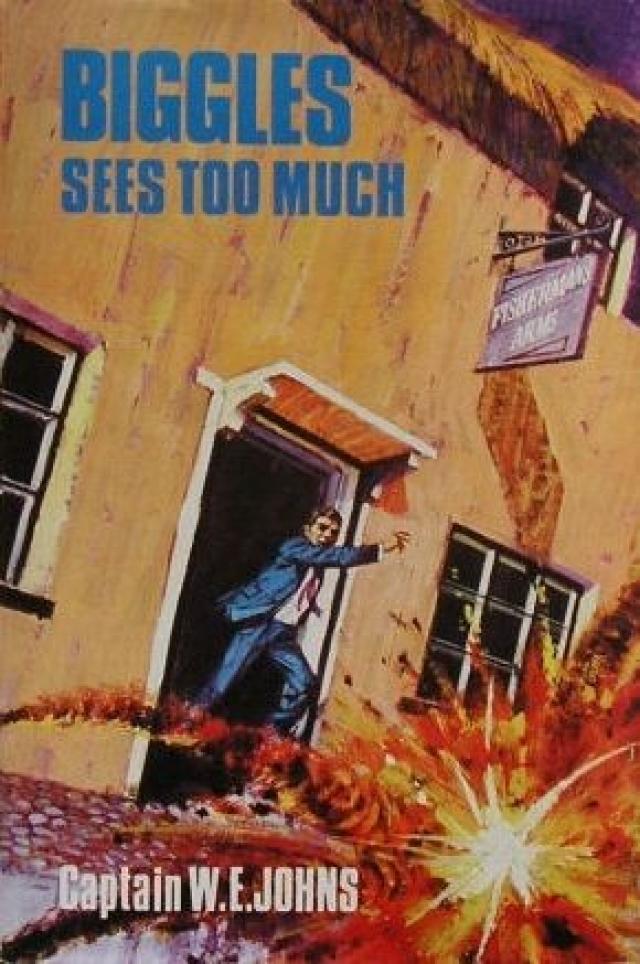
Biggles Sees Too Much, page 10
part #98 of Biggles Series


* * *
1 The rotary engines of the early days of flying were lubricated with vegetable oil, normally castor oil, which, being used by the gallon, made them expensive to run. The oil went straight through the cylinders and was flung out of the cylinder heads. Being hot it gave off a sweet, sickly smell which, once experienced, was unmistakable. One could usually tell a Camel pilot by the black oil stain on his tunic.
2 Ask any schoolboy to name the Channel Islands and he will probably answer without hesitation, Jersey, Guernsey, Alderney and Sark. A boy who has studied his atlas might add Herm and Jethou. But it is unlikely that he would be able to name the many others; such as Lithou, Burhou, Ortae, the Casquets, Les Ecrehou or the Chausey Islands, a group that lies close to the French coast and incidentally, belongs to France. In fact, there are a great many islands, large and small, within the region embraced by the Channel Islands. Nobody seems to know exactly how many there are. Some are mere heaps of rock, most of which are now uninhabited, although ruins of houses show they were once occupied. One or two are privately owned. One is a nature sanctuary. On one a man lives alone, making a living by lobster fishing, his catch being collected from time to time by a boat from one of the larger islands.
The islands were once described as ‘pieces of France dropped in the Channel and picked up by England’. Actually, a thousand years ago they were part of the Duchy of Normandy, and when William the Conqueror, Duke of Normandy, captured England, he brought them with him — so to speak. In the circumstances, therefore, Algy’s apparently poor geography becomes understandable and excusable.
CHAPTER 12
BACK TO POLCARRON
BEFORE reaching the coast, and still four or five miles from Polcarron, Biggles and Bertie saw the Auster race over them; whereupon, as soon as it was judged the aircraft was in sight of the sea, as Biggles was at the wheel Bertie tuned in for signals. ‘Now we should soon know what the luck’s like,’ he remarked cheerfully.
The luck appeared to be good, for they had not long to wait before the first message came through. ‘They’ve found her,’ Bertie told Biggles crisply. Presently he went on: ‘She’s still six or seven miles out, travelling in top gear and seems to be on a course for Polcarron. Algy says he’s keeping well clear but won’t lose sight of them.’
‘Fine. That suits us,’ Biggles said, accelerating. ‘We should just beat them to it.’
A few minutes later, with the sea in view, Ginger came in, and again Bertie reported to Biggles. ‘Yes. Unless the boat changes course at the last minute it’s going to be Polcarron. The boys want to know if they’re to stand by or carry on with the operation as arranged?’
‘Tell them we’ll take over now. We should be able to see the boat ourselves in a couple of minutes. They can press on for London.’
Bertie transmitted the message. ‘Okay, me lucky lads. Off to town you go. That’s all. Over and out.’ He switched off.
Within five minutes they were running into Polcarron. ‘There she is,’ observed Bertie. ‘Just coming in. We’ve got her on the dot. So what next?’
Biggles slowed the car to a crawl. When it was level with the little harbour he let it run to a stop. ‘It looks as if she intends to tie up against that little concrete mole,’ he said quickly. He looked around. ‘There doesn’t seem to be anyone about except my old gossip Sam, on the seat. I’ll tell you what, Bertie. You get out and walk along to see what they do next. It doesn’t matter if they see you. They’ll take you for a casual visitor.’
‘What about you?’
‘I’ll stay here in the car. If Bates is about — the fellow who drives the Daimler, he’ll recognize my old Ford. Not that it matters. He once spoke to us here, you remember. You walk along to see what they do and where they go.’
‘Okay, old boy.’ Bertie got out and strolled along the quay, deserted except for old Sam on his usual seat.
Biggles kept his eyes chiefly on the boat, now alongside the mole that formed a protecting wall on the far side of the harbour. But he noticed that when Bertie was level with the seat Sam got up and walked along with him; for what purpose of course he did not know unless it was mere idle curiosity.
Watching the boat Biggles saw two men doing something on the forward deck, but was unable to see what it was. They then walked together along the mole towards the village street, at the end of which they went up a flight of steps and out of his sight. Bertie and Sam walked along the mole as far as the boat, stood talking for a minute and then walked back and up to the street where they, too, could no longer be seen. A minute or two passed; then Biggles saw Bertie coming along the quay, alone, towards the car.
‘Well?’ queried Biggles, when he arrived. ‘Where did they go?’
‘They’ve gone into “The Fishermen’s Arms”.’
‘The devil they have.’
‘The Daimler is in the car park.’
‘Who were the two men? Did you recognize them?’
‘One of them. Bates, the chauffeur. I’ve never seen the other, but I have a feeling it might be Julius Brunner, brother of the fellow who keeps the pub. Old Sam thought that was who he was having seen him in the village once or twice. He told me something else, although I don’t know quite what to make of it. You saw us walk along to the boat?’
‘They were doing something with a shark. Not a very big one. It’s still lying on the forward deck.’
‘So they must have managed to get one. Algy, or Ginger, said he thought he saw someone fishing.’
‘No. That’s the point. They didn’t catch one.’
‘I don’t get it.’
‘According to old Sam that fish has been dead for a week. He says he’s seen it before, once if not twice. Matter of fact that was why he went along, to have a look at it. He swears it’s the same fish he saw one day last week. It’s a blue shark. They don’t come close inshore. According to Sam you have to go at least twenty miles out to get ‘em.’
‘Well, he should know.’
‘He can’t make out what those two fishermen are up to.’
‘I can understand that,’ Biggles said.
‘What do you think is the idea?’
‘There’s one obvious answer to that. A dead shark provides proof that the boat has been out fishing — should anyone in authority come along to make a check.’
‘So that’s it.’
‘I can’t think of any other reason and I’m not going to waste time now trying to think of one.’
‘What are we going to do?’
‘We might as well go along to “The Fishermen’s Arms” and have something to eat.’
For a moment Bertie looked startled. ‘You’re not forgetting who’s already in there?’
Biggles smiled. ‘That’s one of the reasons why I’m going in. We may learn something. I’ll take the car up and park it outside. We’re at a loose end, anyhow, until we get word from the Air Commodore what he wants us to do. Things have reached the stage when I don’t feel like acting on my own responsibility.’ He started the car and moved off.
‘You know, old boy, there’s one thing about all this that puzzles me; it doesn’t seem to add up,’ Bertie said thoughtfully. ‘You said that when you got suspicious of this sharking set-up, you noticed that the number of men who came back was the same as the number that went out. Which meant that any Customs official who happened to be about would take no notice.’
‘That’s right,’ agreed Biggles.
‘Yet today four men went out, but only two came back. Surely that meant taking a chance of being asked what happened to the two passengers?’
‘No. You’ve overlooked a point of detail.’
‘What have I overlooked?’
‘The boat didn’t return to the harbour from which it set out. It left from Portwin Cove, but came back to Polcarron. It’s most unlikely, therefore, that anyone who saw it depart would see it return; so no questions would be asked. I fancy that’s a regular practice which has enabled them to get away with what they’re doing.’
‘Pick up the customers at one place and come ashore again somewhere else.’
‘Exactly.’
Bertie frowned. ‘How is it you always manage to come back with the bally answer?’
Biggles smiled. ‘It’s just a matter of using the grey stuff you have between the ears. I had to develop the habit when I was young. Here we are.’ He brought the car to a halt outside the front entrance of ‘The Fishermen’s Arms’. ‘As we shall need the car again presently we’ll leave it here.’
‘And what exactly are you hoping to do now, if I may ask?’
‘Before I do anything else I’m going to have a drink,’ declared Biggles. ‘I’m no camel. I need sustenance from time to time. The only thing that has touched my lips today, apart from a thin slice of cold beef, has been a cigarette or two, and there isn’t much nourishment in tobacco. We’ll call at the bar on the way to the dining-room. I’ll stand you a noggin. What’s it to be?’
‘A glass of beer, thank you kindly.’
Pushing open the swing doors they entered the bar to find it empty except for the new barman.
‘Two half pints, please,’ ordered Biggles.
The barman looked at him but did not move.
Biggles repeated the order.
Still the barman looked. He did not move or speak.
For a moment, naturally, Biggles looked puzzled. ‘You suddenly struck hard of hearing?’ he inquired.
‘I heard you,’ the barman said.
‘Then how about doing something about it?’
‘I’ve had orders not to serve you.’
‘Oh! So that’s it. Who gave the order?’
‘The boss.’
‘Is he in?’
‘I think so.’
‘You’d better find out. You can either produce the beers I ordered or go tell him I’m sending for the police; and I don’t think he’d like that. We’re not drunk, so you’ve no excuse for not serving us. These are licensed premises and this is a public bar. Now jump to it.’
After a moment’s hesitation the barman disappeared through a door at the end of the bar.
‘What an infernal cheek,’ growled Bertie, polishing his monocle with his handkerchief.
‘Not to worry,’ returned Biggles cheerfully. ‘He’ll serve us.’
The barman came back. Without a word he took two glasses from the shelf behind him, filled them and banged them on the bar so that some of the beer was spilt.
‘Top them up and then wipe the glasses,’ ordered Biggles in a voice that would have cut iron. ‘I want to put the beer down my throat, not over my collar.’
The barman obeyed.
‘That’s better,’ Biggles said.
‘That’ll be two shillings,’ snapped the barman.
Biggles paid the money. ‘You can now go and tell your boss that when we’ve drunk this we’re going through for a meal.’
‘Lunch is off.’
‘Then someone had better put it on again or you’re likely to lose your catering licence.’ Biggles did not raise his voice.
Again the barman went off. He returned with the boss, Stephen Brunner, who said, curtly: ‘You’re late.’
‘I know, and I’m sorry; but we were delayed by circumstances beyond our control,’ explained Biggles, evenly. ‘But remember, we are residents, so let’s not have any argument about it. We need something to eat and we’re having it here. Some cold meat and pickles will do us.’
‘The police were here a little while ago asking for you,’ informed Brunner in a surly voice. ‘I’m to tell you that the inquest on my late barman has been postponed.’ Brunner spoke as if he was reluctant to pass on the information yet dare not withhold it.
‘Indeed! Why postpone it?’
‘How should I know?’
‘Well, I suppose they have their reasons,’ Biggles said. ‘It sounds as if they might suspect foul play. That settles any question about us leaving, doesn’t it? I mean, as there’s nowhere else in the village we shall have to remain here, whether you like it or not.’
‘I’m not so sure about that,’ growled Brunner.
‘I am,’ returned Biggles smoothly. ‘I’d advise you not to go out of your way to look for trouble. Come on, Bertie.’ With that he walked past Brunner and on into the dining-room.
They found two men there, at a table with food in front of them. They were Julius Brunner and his chauffeur Bates. They stopped eating to stare, apparently unprepared for the encounter.
‘Nice day for a spot of angling,’ Biggles called cheerfully to Julius Brunner. ‘Have any luck today?’
‘We caught a fish,’ was the answer, in a curious voice.
‘Only one? Somebody told me you usually came back with a brace,’ returned Biggles easily.
‘Who told you that?’
‘A friend of mine. Tell me something, if I’m not being too inquisitive. When you catch a shark what do you do with it?’
‘It goes to the fishmonger for cats’ meat.’
Biggles smiled. ‘I couldn’t think of a better way of disposing of it.’
These pleasantries were brought to a close by the entrance of Stephen Brunner carrying a tray. He brought it to the table where Biggles and Bertie were sitting and served them with what Biggles had ordered.
‘That suit you?’ he questioned gruffly.
‘Just the job,’ acknowledged Biggles. ‘Sorry if I’ve disturbed your little party.’
‘Don’t mention it,’ muttered Stephen Brunner with unconcealed sarcasm. Then he added venomously, as if no longer able to control his temper: ‘You think you’re smart, but I’ll get even with you one of these days.’ With that he joined his brother at the other table.
‘No threats, now,’ chided Biggles reprovingly, and then proceeded calmly with his meal.
‘What’s the idea of this back-chat?’ Bertie asked softly.
‘There’s nothing like getting the enemy rattled; it interferes with his judgment,’ answered Biggles.
The meal proceeded without further conversation. When it was finished Biggles sat back with a sigh of contentment. ‘That’s better,’ he remarked, looking at his watch. ‘Now, as there’s nothing we can do here we might as well be getting back to the airfield to see if the boys are there with orders from headquarters. Let’s go,’ he concluded, getting up.
‘We shall be back,’ he called across to Stephen Brunner as they went out.
‘You’re asking for trouble,’ remarked Bertie, when they were outside.
‘It’s sometimes the quickest way to bring matters to a head,’ Biggles answered soberly, as he started the engine.
CHAPTER 13
BIGGLES SHOWS HIS HAND
BIGGLES and Bertie arrived at the airfield to find the Auster already there, on the small concrete apron, with Algy and Ginger standing by it apparently waiting for them.
‘Come on — come on,’ grumbled Algy. ‘You’ve been a long time getting here.’
‘We’ve had things to do,’ Biggles explained.
‘Such as?’
‘Among other things, arguing the toss with Brunner about staying on at the pub.’
‘Well?’
‘We’re staying. He can’t put us out. The inquest on Tom Draper has been postponed and the police may want Bertie to give evidence.’
‘I know. The Chief may have been indirectly responsible for that. He got in touch with the Chief Constable of the County and suggested a postponement. It would allow time for a post mortem examination of the body to ascertain if Tom had been drinking.’
‘I’ll swear he was cold sober when he spoke to me,’ put in Bertie. ‘He told me he was on his way to his new lodging for the night.’
‘Never mind about that,’ came back Biggles impatiently. ‘What does the Chief suggest we do about all this?’
‘You can ask him yourself. He’s here.’
‘Where?’
‘In the clubhouse, waiting for you.’
‘How did that happen?’
‘I flew him down. When I had given him the gen he decided he’d have to see you, and to bring him down here would be quicker than fetching you to London. We collected the Chief Constable on the way, as we’re operating in his territory. They’re together now, inside, talking things over.’
Biggles whistled softly. ‘By gosh! We have got things buzzing.’
‘There’s a reason. Listen to this. I haven’t finished yet. That crook Limpy Logan, who you saw come ashore when you were last staying in Polcarron, has been picked up in London. He’s squealed, and is ready to turn Queen’s Evidence. As a result there wasn’t much I could tell the Air Commodore.’
‘So he knows the name of the island where the switches are made.’
‘No. There’s a snag about that. Logan doesn’t know the name of the island. He was never told. But from our description, and going over the chart with the Air Commodore, we think it must be one of a group of islets called the Petit Caraloes. The trouble is, they don’t look the same two days running, or even at the time of day. It seems there’s a big rise and fall of the tide in the Channel Islands. According to Admiralty Sailing Directions, the island I saw might be little more than a reef at high tide. The tide was out when I saw it, so it would look bigger than it really is.’
‘What has the Chief decided to do about it?’
‘I don’t think he’s made up his mind yet. There are difficulties whichever way the job’s tackled. You can ask him yourself. Here he comes, now.’
Biggles turned and saw Air Commodore Raymond coming towards them accompanied by a man he did not know. Both were in civilian clothes.
The Air Commodore came up. ‘Good work, Bigglesworth,’ he greeted. ‘You’ve proved what you suspected was going on.’ He introduced his companion as Colonel Hudson, Assistant Chief Constable of the County.
‘Thank you, sir,’ acknowledged Biggles. ‘We should be about ready to get the case buttoned up.’
The Air Commodore looked dubious. ‘It isn’t as easy as that. The thing still bristles with difficulties. Before we strike we’ve got to get unshakable evidence. Remember, Julius Brunner is a rich man, so you may be sure he’ll employ the best lawyers in the country for his defence. After all, the charge may be one of murder. Do you know where he is now?’