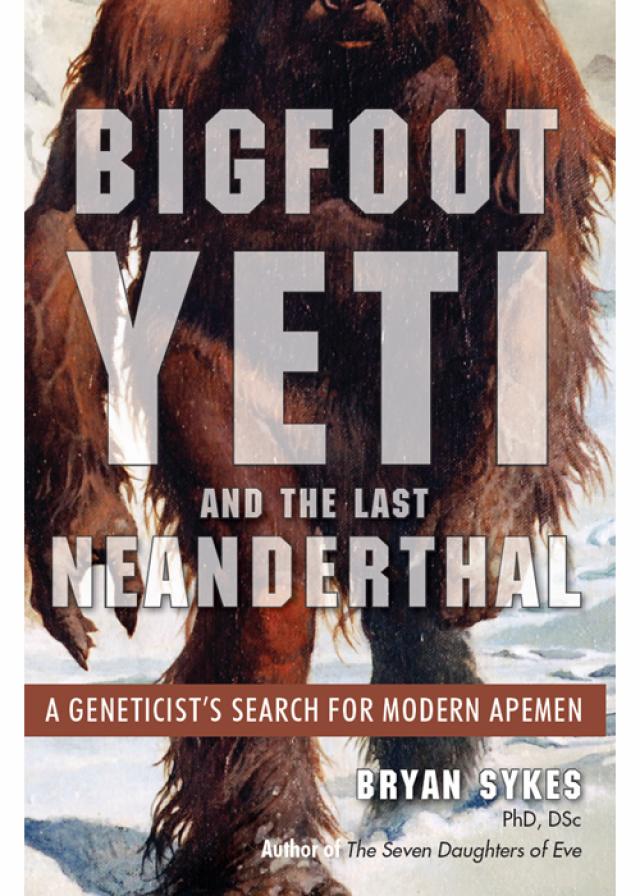
Bigfoot, Yeti, and the Last Neanderthal, page 32


1. Hillary, E. and Doig, D. in Napier, J. 1972. Bigfoot. p.133, Jonathan Cape, London.
5: The Professor
1. Ward, M. 1997. Wilderness and Environmental Medicine 8, 29–32.
7: The Russian Almasty
1. Regal, B. 2013. Searching for Sasquatch: Crackpots, Eggheads and Cryptozoology. Palgrave MacMillan, London.
2. Halbertsma, T. 2011. ‘Mongolia's “Homo sapiens Almas”’, Kraken 2, 41–57.
8: The Godfather
1. Heuvelmans, B. 1969. Bull. Inst. Sci. Nat. Belg 45, 7–24.
9: Clutching at Straws
1. Coleman, L. 1989. Tom Slick and the Search for the Yeti, p.87, Faber & Faber, Boston.
10: Our Human Ancestors
1. Green, R. et al. 2010. Science 328, 710–22.
2. Abi-Rached, L. et al. Science 334, 89–94.
3. Pääbo S. 2014. Neanderthal Man: In Search of Lost Genomes. Basic Books, New York.
4. Krause, J. et al. 2010. Nature 464, 894–7.
5. Pääbo S. ibid. p.235.
6. Hammer, M. et al. 2011. Proceedings of the National Academy of Science of the United States of America 108, 15123–8.
7. Meyer, M. et al. 2014. Nature 505, 403–6.
11: Keeping it in the Family
1. Van Gelder, R. 1977. Novitates no.2365, 1–25, American Museum of Natural History, New York.
2. Bernolet-Moens, H. Ref to come.
3. Chilvers, H. 1930. The Seven Lost Trails of Africa. p.7. Cassell & Co, London.
4. Etkind, A. 2009. Studies in the History and Philosophy of Science 39, 205–210.
5. Heuvelmans, B. and Porchnev, B. 2011, L' Homme de Néanderthal est toujours vivant. Les editions de l'oeil du Sphinx, Paris.
14: Good Science, Bad Science
1. Meldrum, J. and Schaller, G.B. 2006. Sasquatch: Legend Meets Science, pp.266–7. Tom Docherty Associates, New York.
2. Milinkovitch, M.C., Caccone, A. & Amato, G. 2004. Molecular Phyogenetics and Evolution 31, 1–3.
3. Matthiessen, P. 1998. The Snow Leopard, pp.75–80. Vintage Books, London.
4. http://www.lanevol.org/LANE/yeti_3.html.
5. Coltman, D. and Davis, C. 2006. Trends in Ecology and Evolution 21, 60–1.
26: The Russians
1. Daily Mail Online. 12 February 2013 http//www.dailymail.co.uk/video/news/.../Is-proof-Yeti-sighting-Siberia.html
27: The Laboratory Reports
1. Fahrenbach, H. 1997. Cryptozoology 13, 47–75.
2. Meldrum, J. and Schaller, G.B. 2006. ibid.
3. The control region sequence of sample #25213 varied from the reference sequence at positions 16,234, 16,311 and 16,346, the last position being heteroplasmic.
28: The Ice Bear
1. Smythe, F.S. 1936. The Valley of Flowers. p.144. Hodder & Stoughton, London.
2. Brunner, B. 2007. Bears: A Brief History. p.64, Yale University Press.
3. Lindqvist, C. et al. 2010. Proceedings of the National Academy of Science of the United States of America 107 (11), 5053–7.
4. Talbot, S. and Shields, G. 1996. Molecular Phylogenetics and Evolution 5, 567–75.
29: Zana
1. Bayanov, D. 1996. In the Footsteps of the Russian Snowman, pp.46–52, Crypto-Logos, Moscow.
2. Heuvelmans, B. and Porchnev, B. 2011. L'Homme de Néanderthal est toujours vivant. Les editions de l'oeil du Sphinx, Paris.
3. Koffman, J.-M. 1991. ‘L'Almasty, yeti du Caucase’, Archeologia 269, 24–43.
ZANA and her DESCENDANTS
Showing percentage of African DNA
Acknowledgements
Researching The Yeti Enigma has been a long journey from a crazy idea to a finished book, a scientific publication and a television documentary so there are a lot of people to thank.
In chronological order, I want to thank those of my colleagues in Oxford, especially Sir Anthony Epstein FRS who encouraged me that this was a perfectly sound scientific project. Without similar encouragement from Michel Sartori and Ken Goddard it would have been a lonely struggle to complete it. Michel, of course, deserves extra thanks for lending the name of his museum to the enterprise as a collaborator while Ken made me very welcome in the US Fish and Wildlife Forensic Laboratory in Ashland, Oregon.
I have met many wonderful people as I gathered the all important material on which this book is based. Some, like Reinhold Messner, are celebrities on the world stage while others, like Peter Byrne, Adam Davies, Jonathan Downes and Rhettman Mullis are the celebrities of the cryptozoology community. I am also indebted to Rhettman for introducing me to so many of his contacts and travelling with me to remote locations in America to collect samples.
Which brings me to the many people who donated samples for me to analyse. They were brave to do so, knowing that genetics is no respecter of personal opinion, however deeply felt. So I am very grateful to Justin Smeja, Bart Cutino, Derek Randles, Dan Shirley, Garland Fields, Loren Coleman, Betty Klopp, Marcel Cagey, Sam Cagey, Lori Simmons, Mike Long, Patrick Spell, Maxwell David, Mark McClurkan, Rob Kryder, Jack Barnes, Jeff Anderson, David Ellis, Steve Mattice, Brenda Harris, Stuart Fleming, Igor Burtsev, Dmitri Pirkulov, Michael Trachtengerts and Dmitri Bayanov for submitting samples and for their progressive stance in doing so. Thanks also to Peter Byrne, Ray Crowe, Ronnie Coleman, Greg Roberts and Tom Graham for discussing their experiences and to Jeff Meldrum and Anna Nekaris for their advice and guidance.
As well as Ken Goddard I would like to thank Ed Espinoza, Mike Tucker, Barry Baker, Bonnie Yates, Cookie Smith and Dyan Straughan of the US Fish and Wildlife Service Forensic Laboratory, Ashland, Oregon for help with hair identification and introducing me to forensic methods of trace evidence analysis.
Terry Melton has been the rock on which the entire project has rested. Thanks to her skills, and those of her colleagues Charity Holland, Bonnie Higgins, Gloria Dimick, and Michele Yon, I was able totally to rely on the results from her laboratory.
Making ‘The Bigfoot Files’ was great fun and my thanks go to Harry Marshall, the creative director of Icon Films for deciding to follow the project well before we had any results and to Sara Ramsden from Channel 4 for having the courage to commission the film. Thanks also to Brendan McGinty, Sam Challenger, Claire Efergan, Kate Edwards, Mark Evans and Steven Clarke, the people who made the film, for welcoming an ingénue on the set. I want also to thank Paul Smith, Director of the University Museum of Natural History in Oxford for allowing me to pluck some hairs from Mandy, the Shetland pony and other exhibits as controls and also for letting me be filmed in his magnificent office in the museum as if it were my own.
My agent, Luigi Bonomi, has kept me going, as always, with his infectious enthusiasm while Emily Hayward helped me through the unfamiliar maze of film contracts. Both deserve my thanks, as do my researcher Marcus Morris who coaxed the best from interviewees he met on my behalf, and my secretary Hilary Prince for keeping everything in order while I was away. Sue Foden's reading of my early drafts helped to get my manuscript into decent order. I was very fortunate to have Mark Booth as my editor at Hodder. His gentle yet firm suggestions improved my text beyond measure, as did Tara Gladden's eagle-eyed copy-editing, while Fiona Rose kept everything flowing.
Closer to home, my son Richard improved The Yeti Enigma with his fine sketches at the beginning of each chapter, while my wife Ulla came with me when she could, and, as always, sprinkled stardust wherever she went.
About the Author
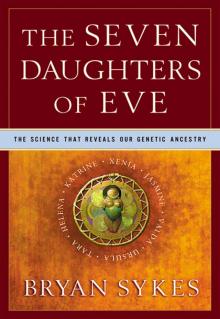
Bryan Sykes is a Professor of Human Genetics at the University of Oxford and a Fellow of Wolfson College. He has been involved in a number of high-profile cases dealing with ancient DNA, including those of “Otzi the Iceman,” a well-preserved natural mummy of a man who lived around 3,300 BC and “Cheddar Man,” the remains of a man found in Cheddar Gorge from approximately 7,150 BC. It is Britain's oldest complete human skeleton. Professor Sykes is best known outside the community of geneticists for his bestselling books on the investigation of human history and pre-history through studies of mitochondrial DNA.
Visit the author at: www.oxfordancestors.com
Bryan Sykes, Bigfoot, Yeti, and the Last Neanderthal