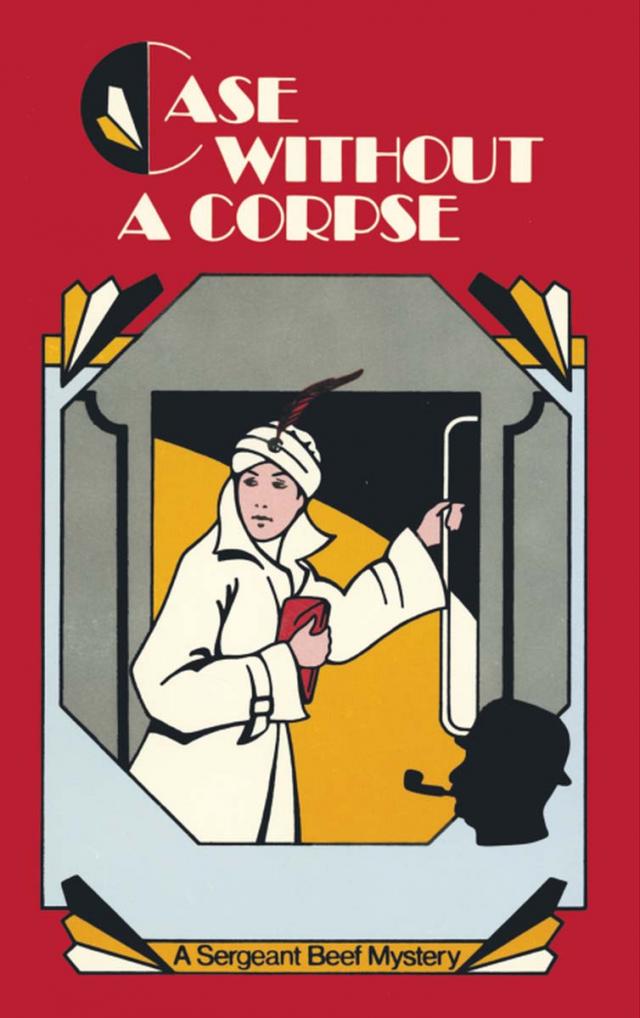
Case Without a Corpse, page 8


As for the foreigner, it was too obscure. We had no hint even of his nationality, certainly not of his reason for being in Braxham. But suppose young Rogers had killed him, afternoon or evening, who was it that I saw standing across the road when Beef and Simmons were carrying the corpse? Who had visited the corpse that night, and why?
It was all very well for Stute to talk about his system and his time-table, let him answer a few of these questions. Why, good heavens, we were as much in the dark as ever. We didn’t even know young Rogers’s real name.
CHAPTER XIII
DETECTIVE-INSPECTOR STUTE scarcely said good morning, when I reached the station next day, before he referred with some irritation to Beef.
“Not here yet!” he said. “The man has no sense of time.” He gave me a rather grim smile. “You’ve spoiled him, you know, writing up the bit of luck he had in that Thurston case. The poor chap thinks he’s a detective.”
“I don’t think he’s ever thought that,” I returned.
Just then Beef entered, looking somewhat dazed and irritable, as he is apt to do in the early morning.
“Well, Sergeant,” said Stute, “I’ve done half a day’s work. I’ve given instructions in London that every effort shall be made to find the girl Smythe’s address or to trace her story before this happened. If she is what we suppose it shouldn’t be hard to find out where her room was, though whether she’s still alive or not remains to be seen.”
His brisk voice went on, as he turned over the papers before him.
“I’ve also arranged for the Common to be searched, at any rate for two hundred yards each side of the road to begin with. They will form search parties out there. Fortunately the hunting instinct is still strong enough in human beings to make the formation of a search party an easy matter.”
Stute paused and lit a cigarette.
“Then—are you listening, Sergeant?—I have sent for the postman who delivers in the High Street to come here as soon as he’s finished his round.”
“Wotever d’you want ’im for?” These were the first words Beef had spoken.
“I want to see whether any other letters were delivered to young Rogers of which his aunt and uncle knew nothing. An ordinary routine enquiry, Beef. The sort of enquiry you ought to have made already. I wish you could realize that a case like this is not cleared up by some miraculous flash of insight or deduction, but by a steady accumulation of the facts.”
“Yessir,” said Beef.
“Then, since I gather you had forgotten the matter, I have given orders for the searching of the interior of that warehouse beside the Dragon.”
“Oh yes. I get you,” said Beef, sucking his moustache.
“And finally, I had a look at the motor-bike. I understand that you have allowed it to remain at old Rogers’s. I had it brought round. It should have been brought here at once.”
“Why? There was nothink to see. I ’ad a look at it.”
“That is for me to judge, Sergeant. And now, will you kindly attend while I tell you what reports have come in this morning? Thank you. The Research Department tell us that the stains on the cuff of the shirt and the sleeve of the coat are actually the stains of human blood. The bottle from which young Rogers drank contained cyanide of potassium. And the Fairfax couple have not yet been traced.”
“Well, we knew about the stains and the bottle,” said Beef, “so we aren’t much forrader.”
“Wait a minute,” said Stute. “I have a report here from a man who examined the only one of young Rogers’s fellow stewards who had anything revelant to say.”
Beef looked up. This seemed to interest him.
“Only one little point emerges,” said Stute, “and it’s this. Young Rogers was apparently in the habit of bringing home a number of tickets for the Buenos Aires Lottery. He had them in a sealed envelope, and told this steward that he was always a bit afraid they would be found on him by the Customs officers.”
“’S’ that all?”
“Yes. Our man tried hard to get anything further there might be, but Rogers had never told him what he did with the tickets in England.”
“Well, that’s worth knowing, anyway,” said Beef.
“Everything connected with the case is worth knowing,” said Stute. “It is by co-ordinating all these pieces of information that we shall arrive at the truth.”
There was a knock at the door, and Constable Galsworthy came in. There was an air of respectful independence about this big, finely-built countryman, with the ruddy young face and rather intelligent eyes, which made me inclined to support his claim for consideration as an efficient policeman, as against that of Constable Smith of Chopley, who had been almost ingratiating towards Stute.
“Fawcett, the postman, is here, sir,” he said to Stute.
“Show him in,” said the detective.
Fawcett looked a little embarrassed as he took a chair. His encounters with Beef were usually less formal.
“I want you, Fawcett, to think carefully. Can you remember what letters you have delivered for young Rogers lately?”
Fawcett thought carefully. “There was one,” he said at last.
“When did it arrive?”
“I can’t say exactly. A day or so before he got home.”
“You didn’t notice the postmark?”
“No. I didn’t. If I had to notice every postmark on the letters I deliver—well.”
“Nor the handwriting?”
“No.”
“And you can’t remember any others lately?”
“No.”
“None from abroad?”
This query caused Fawcett to think carefully again.
“There was one from abroad,” he said at last, “but I don’t think it was for him. It was for Mr. Rogers.”
“When did that arrive?”
“Before the other one. I should say about a week before. I remember that because it was one of those thin envelopes what they use for air mail.”
“Indeed? You are sure it wasn’t for young Rogers?”
“Not so far as I can remember. I have an idea—can’t be sure, mind you—that it was just addressed to ‘Mr. Rogers’ and nothing more. But that may be my fancy.”
“You remember delivering it?”
“Yes. Because I said to Mr. Rogers that you want to be careful of them thin envelopes in case they get lost among the others.”
“He took it himself.”
“That’s right.”
“And where had it come from?”
“Ah. Now you’re asking,” said Fawcett. “I don’t know nothing about foreign postage.” He implied that he was nothing less than an authority on the home variety. “I can only say this came from abroad.”
“Well, I’m much obliged to you, Fawcett. That’s all we shall require.”
And Fawcett, though he couldn’t afterwards have explained his reason for it, said, “Thank you, sir,” and left.
Stute was uncharacteristically silent and thoughtful for a moment, then he said, “Might be worth following up. Send me that constable with the ridiculous name, Beef.”
“Galsworthy!” Beef shouted without rising from his chair.
Stute winced but turned to the young man. “Go round to Mr. Rogers, the bootmaker, and ask him if he remembers a letter arriving by air mail from abroad about a week before his adopted nephew came home. Find out who had written it, and to whom it was addressed, and anything else you can. And by the way, I would like a specimen of young Rogers’s handwriting.”
“Very good, sir.”
Once more we were alone.
My recollection of the whole of that day, in fact, is of spending hours in Beef’s little office, with Stute receiving reports and sending out enquiries. It was a day for trimming the edges of our evidence, and squeezing out the last detail from local informants. Before mid-day the man who had searched the warehouse returned to say that he had found nothing. It was Beef’s second constable who had done this job, a rather lanky young man, with a large nose, called Curtis.
“There was nothing there, sir,” he said quite coolly to Stute, to whom he was making his report, “and you can take it that unless anyone had a key and went in from the door that opens on to the street, no one has been there. There was dust and cobwebs round the windows and doors on the river side which hadn’t been disturbed for months.”
“And nothing in the place?”
“Nothing at all, sir.”
“Thank you, Curtis.”
Stute never showed any sign of disappointment when he drew blank. And he had another disappointment a few minutes later when Galsworthy returned from the bootmaker’s.
“Well?” he snapped at the constable.
“I saw Mr. Rogers, sir,” began Galsworthy rather breathlessly, “and he remembered the letter perfectly. It was to him, he says, and had been sent by young Rogers himself from Rio de Janeiro on the way home.”
“Did you ask him what it was about?”
“Yessir, Nothing special, he said. It appears that young Rogers had the habit of sending them an air mail letter now and again when he was out there. Mr. Rogers looked to see if he’d kept it, but he hadn’t. He found an old envelope addressed in young Rogers’s writing and gave it to me. Here you are, sir.”
We examined a dirty envelope. The writing was firm and straight, not altogether the writing of an illiterate man, but not ornate or scholarly.
“Very well, constable,” said Stute. He still could not bring himself to enunciate the name.
The next person to be shown in brought us more satisfying information. He was the Vicar of Chopley, a boisterous and professedly busy individual, rubicund and noisy.
“Ah, Inspector,” he shouted to Stute, and I silently wondered why parsons so frequently opened their sentences with that sound, “young Smith, our village policeman at Chopley, suggested that I should give you a call.”
His tones rang through the whole police station. I was thankful to see that Stute treated him with no more ceremony than he had shewn to other informants.
“Sit down, Vicar,” said Stute.
“Fact is, I may be able to help you in this tragic business. Or then again my information may be useless. But I was talking to young Smith—he used to be one of my choirboys, you know; smart young fellow, and I hope he gets on.” My personal championship of Galsworthy against Smith was instantly strengthened. “I was telling him that I was returning from Braxham on Wednesday afternoon in my car….”
“What time would that have been?”
“Time? Time? Ha! Ha! You ask me what time! You don’t know my reputation, Inspector. Most unpunctual fellow in the world. I’m notorious for it. Time means nothing to me.”
“Still, about?”
“Well, it must have been between five and six in the afternoon. I was alone at the time. And I happened to see a motor-bike standing by the roadside.”
“Facing which way?”
“Towards me. Towards Braxham.”
“What make?”
“Ah! There I can help you. Used to be a great motor-cyclist. Had to give it up now, of course. It was a Rudge-Whit worth. The 500 c.c. Special type. I should say fairly new. Well, I thought, the usual thing. Young people, Inspector, young people!” And he gave a laugh which I suppose might be described as hearty, but to me sounded almost macabre.
“Did you see anyone?”
“Indeed I did. A young man and a girl. They were walking away from me across the Common. I couldn’t see their faces. But the fellow wore one of those black oilskin outfits complete with leggings. And the girl had a white mackintosh. Of course I drove straight on.”
“Of course.” Stute rose before his visitor. “Very much obliged to you, Vicar.”
“Not at all. Delighted. Wish I could tell you more. Tricky job, yours. Ha! Ha! Got the murderer and can’t find the murder! Well I never! Good day, Inspector!” And he shouted himself out of the building.
It was then about three o’clock, and Stute elected that we should drive at once to the Common and see how the search party had progressed. The Vicar’s statement seemed to be an additional indication that hopes of discovery lay in that area. However noisy and disturbing his personality, his information was very much to the point. There was no mistaking his description of the clothes worn by Rogers and Smythe, and the girl. He had even noticed the make of the motor-bike.
There seemed to me to be a good chance that we might be going straight to a solution. I was glad that Stute drove fast and that Constable Smith of Chopley was awaiting us.
“I concentrated the search in the part the Vicar showed me,” he said.
“Found anything?”
“Quite a lot,” answered Smith, with a self-satisfied smile, and began leading us towards a collection of objects laid out on the grass.
Stute frowned. “What on earth’s all this?” he asked.
A curious miscellany was displayed. Old boots, paper bags, the remains of a woman’s skirt, a newspaper, tins, two kettles (one spoutless), a man’s hat, a rusted pen-knife, and a child’s doll. But almost every one of these articles had quite evidently been on the Common at least since the previous summer, possibly for years. The boots were almost historical, the skirt might have served several seasons ago for a gypsy, the tins and the pen-knife were hopelessly rusted, the hat a mere relic, the doll in a worse condition than the one found by the sentimental lady whose song enlivens Charles Kingley’s Water-Babies.
“Good heavens, Smith,” said Stute angrily.
“Thought I better collect all there was, sir.”
“The man’s a fool,” remarked Stute, to my great pleasure.
But Smith was smiling. “I found this, too,” he said, “it was near a few sodden ashes of burnt paper.” And he handed Stute a small fragment of a Ms. Peeping over his shoulder I saw:
you know I
always, but
Stella, when
never. We
but not
please
It was in young Rogers’s handwriting.
PART TWO
CHAPTER XIV
THE inquest had taken place some days ago, and had revealed nothing new. The investigation, in fact, had become almost hum-drum, for there had been no discovery which could be described as startling since that priggish young Constable Smith of Chopley had found a fragment of young Rogers’s letter.
But Stute stayed on in Braxham, and since he was putting up at the Mitre, where I always stayed, we saw a good deal of one another, and had become quite close acquaintances. I liked the man. He was thoroughly efficient, and behind his brisk manner there was a kind of humanity which one could respect. I had complete confidence in his capabilities, and knew that it was only a question of time before he solved this peculiar problem.
I no longer went round with him and Beef, nor followed all their researches in person, but Stute and I usually dined together in the evening, and he was glad of someone to talk to about the case. “Poor old Beef’s all very well,” he used to say, “but there are some points of psychology which one could scarcely expect him to follow.” So over our meal, Stute would give me a curt outline of their progress, and I was duly appreciative.
One evening he more or less summed matters up in a long statement of the case as he saw it. I could see that he was expounding it largely in order to get his own ideas clear, for there is nothing like a verbal exposition of facts to make them coherent to the speaker. But I did not mind in the least being used as an audience. I, too, wanted to get the thing less jumbled in my mind.
“There are,” said Stute, “so far as we have reason to know at present, four main possibilities. One, that Rogers murdered Smythe. Two, that Rogers murdered Fairfax. Three, that Rogers murdered the foreigner. And four, that Rogers only believed that he had murdered someone, and had actually done nothing of the sort. I don’t think we need seriously consider the possibility of his having murdered more than one person. But since it is not mathematically certain that he did not do so, you can call that number five if you like.
“Now against every one of those possibilities, there is something which seems almost to preclude it. Take the girl first. We know that he took her away from Chopley. We know that he stopped on the Common and walked away with her. But then we know that no corpse was found on the Common, for I’ve now had the whole area thoroughly searched. And we know that he was seen not far from Braxham station with her, at ten to six.
“I’ve cross-examined the station staff, but they can’t tell me whether the girl travelled on the six o’clock or not. Quite natural. It’s a fast train and fairly crowded. They can’t remember seeing young Rogers at the station, but they agree that he might easily have been there without their noticing him. There was no taxi waiting outside to see him arrive on his motor-bike. In fact no evidence one way or the other.
“Suppose, then, that she did not travel, but was murdered. The only time, it seems, that he had in which to murder her was between ten to six and ten past, for at ten past he entered the Dragon alone. And the only possible place would be in the alley beside the Dragon, or on the landing-stage of the factory. But both those seem fantastic to me. It would be virtually out of the question for him to persuade her to follow him down that alley, and stab her there. For one thing, there would have been the risk, if not the certainty, of her screaming, and raising the alarm, for it was within a few yards of the back windows of the Dragon. For another thing, how could he have persuaded her to accompany him there? And for another there could scarcely have been time, for Sawyer the publican heard him come up on his motor-bike and enter the bar without enough delay to attract his notice.
“There are two other ways in which he might have murdered Smythe. He might have done it after 6.40. But then what did he do with her while he was in the Dragon? She was not at all the sort of girl to share our good Beef’s views on a woman’s attitude towards a public house. She would never have waited patiently for him while he went in for a drink. And although I’ve had the most exhaustive enquiry made in the town I can find no one who saw a girl in a white mackintosh on Wednesday evening at all. And anyway, why should she have stayed in Braxham at that time? I admit that this is not wholly off the cards. She might have waited for him somewhere while he was in the Dragon. He might have killed her later. But somehow the chance of it seems too small to be considered.