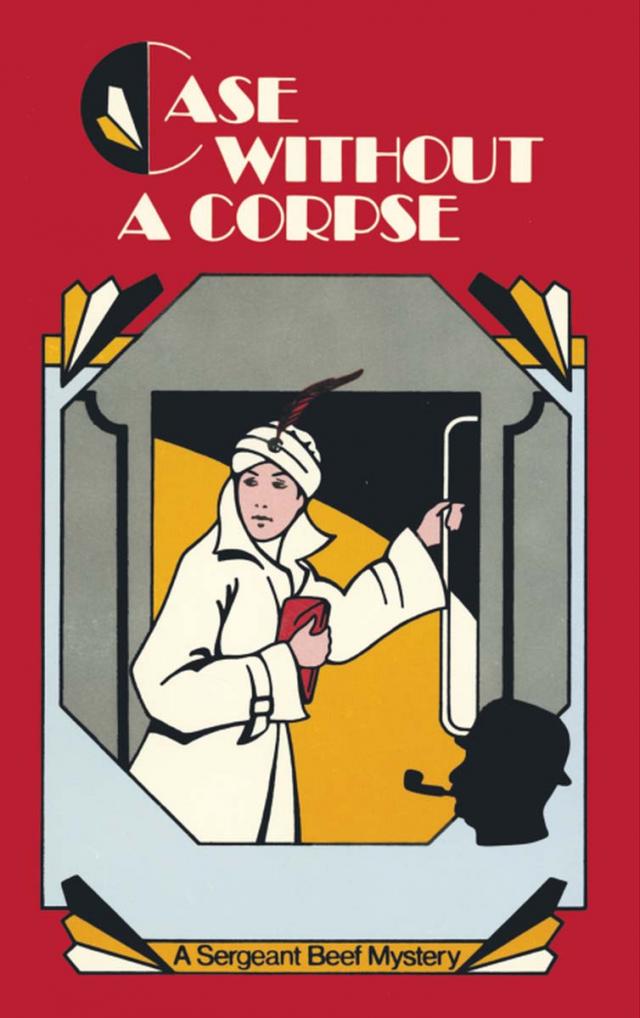
Case Without a Corpse, page 18


We had been fortunate enough to get a new taxi with a competent driver, and by the time we had reached the first set of traffic lights we were right on the other car’s tail.
CHAPTER XXX
THE big car was going Southwards.
“Do you know,” I said after a quarter of an hour, “I shouldn’t be surprised if he’s making for Croydon.”
“No more shouldn’t I,” agreed Beef. “’E’d be off in an aeroplane if I wasn’t going to stop ’im.”
“But why?” I asked impatiently. “Why is he so anxious to get away?”
I could not reconcile myself to the incongruity of that mild little bootmaker dashing towards the air-port in a great hired car, dressed up in his Sunday suit, and with a battered suitcase in his hand.
“Is he so frightened of being questioned?” I went on, since there was no answer.
“I shouldn’t say frightened, exactly,” said Beef.
“Or is it …” I began more excitedly as a sudden thought struck me, “that he wants to see Fairfax? Does he know something against Fairfax? Does he want to find out something from Fairfax?”
“Now, Mr. Townsend,” said Beef, “you know very well I can’t go telling you every-think. You’ve ’ad as much chance as wot I ’ave to get at the truth until this morning. I’m not going to tell you no more. It wouldn’t be etiquette.”
“At least you can tell me how you’re going to stop him leaving,” I returned. “If he really is making for Croydon he’s certain to have his passport in order. How do you think you’re going to prevent his crossing?”
“Ah,” said Beef, “that’s where you come in.”
“I?”
“Yes. You’ll ’ave to charge ’im.”
“Charge him? What with?”
“For pinching a ‘undred pounds off of you, all in one pound notes, wot ’e ’as secreted on ’is person at this minute.”
I exploded. “Don’t be a fool, Beef!” I said. “D’you think I’m going to pay out thousands of pounds, when he proves that he was wrongfully arrested.”
Beef gave a self-satisfied chuckle. “’E won’t do that,” he said, “you trust to me.”
“I shouldn’t consider it,” I said. “To charge a man with stealing! You ought to be ashamed of yourself as a policeman suggesting such a thing.”
Beef coughed. “If I could tell you every think I’m bio wed if I wouldn’t, but I can’t, not at this point. But I’ll tell you two things, Mr. Townsend. That ole gent in the car in front knows ’oo was murdered, and ’as done all along. And life or death depends very likely on ’is not getting away from England to-night. Now, you’ve got to ’elp me. I wouldn’t take no chances of you losing a lot of money. You won’t lose nothink. On’y you’ve got to charge ’im, see? It’s the way to ’old ’im back. You wouldn’t like to feel that when a man’s life or death depended on it you was found wanting would you?”
Frankly, I was bewildered. I had some idea of the seriousness of a step such as Beef wanted me to take. But on the other hand he seemed so sure of himself.
“Are you absolutely certain you’re right about this?”
“Yes.”
“Have you got proof?”
“Certainly I ’ave.”
“And you say old Rogers has known all along?”
“That’s right.”
“And there is no chance whatever of my getting into trouble for doing what you ask?”
“No there isn’t.”
“Well, I suppose I shall have to do it.”
“Thank you, Mr. Townsend. That’ll be a real ’elp.”
I didn’t like the implication of his emphasis, but I let that pass. There was now little doubt that we were making for Croydon. The traffic was not so thick here, and Beef had leaned forward to tell our taxi-driver to keep some distance between ourselves and the big blue car in front, lest we should be observed. However the blind had been pulled down at the back of the saloon car so that there was little chance of this.
There is always something stirring about pursuit—even when it is no more than the pursuit of so meagre a quarry as our little bootmaker. It may be, as Stute had indicated when he arranged for the formation of a search party, some primitive hunter’s instinct which takes hold of us. But I am sure that old Beef and I, sitting side by side in our taxi, felt the thrill of it when at last we reached the air-port and saw the big car turn in to it.
“Now then,” said Beef, “you ’ad that ’undred quid in your room at the ’otel to-day. You saw old Rogers coming out with some excuse about looking for you. When you got in you found ’em gone. You went after ’im but ’is wife said ’e’d left for Croydon. See?”
“I see,” I replied dubiously. “But it sounds pretty weak.”
“It’ll do for the minute,” said Beef, “’specially when they find the notes on ’im.”
The little man was paying the smart and gentlemanly driver of his large car.
“’Old on a minute,” said Beef to our taxi-man, “We’ll wait till ’e goes inside. There’s police standing there.”
We did. As soon as old Rogers had entered our taxi drew up, and we followed him.
The next few minutes are very vivid to me. I may have over-acted a trifle. I think perhaps now that in my excitement I did so. But I was anxious to be convincing. It is not altogether easy to make an accusation sound credible when you are charging an elderly and well-established bootmaker with having stolen £100 from you, when you know perfectly well that you had never carried this sum in notes. I dashed across the station, and, as I afterwards realized, forgot even my grammar in the urgency of the moment.
“That’s him!” I shouted.
Several passengers turned towards me, and I was thankful to see that two policemen who had been chatting in the discreet manner of the police, with their eyes on the people about them, had turned to watch me.
“Stop him!” I went on, at the top of my voice.
One of the policemen now slowly came across.
“What’s the matter?” he asked.
I pointed at the narrow back of old Rogers, who had remained apparently oblivious of the shouts behind him.
“That man!” I said. “He’s a thief. I want to charge him!”
And now, for the first time, the bootmaker turned. He saw that I was indicating him and stopped. But he was ten yards away, and when I dropped my voice to address the policeman, he could not hear me.
“He stole a hundred pounds from me this afternoon, in one pound notes. I heard he was coming to Croydon and I’ve followed him here.”
“Ah!” said the policeman non-commitally.
We started walking towards old Rogers who stood looking rather pathetic and dumb-founded, with his suit-case still in his hand. When we came up to him he was the first to speak.
“Why, Mr. Townsend, whatever’s the matter?” he asked, staring at me wide-eyed.
I felt rather wretched as I turned to the policeman.
“My name is Stuart Townsend,” I said, “I’ve been staying at Braxham where this man has a shop….”
The constable broke in. “Before we go any further,” he said to old Rogers, “I’d like to know your name.”
“Rogers,” said the old chap.
“Mr. Rogers, what money have you on you?”
“I can’t see what concern that can be of yours,” said old Rogers. He spoke not indignantly but in a puzzled voice, as though he really would have liked to know.
“Well, there’s a mix-up here,” was all the explanation he got, “and it would simplify things if you’d tell me.”
“I have … some treasury notes. I really don’t know how many.”
“Any objection to my seeing them?”
For a moment I thought that he was going to refuse. He glanced first at me, then at the policeman.
“You may look,” he said, and plunging his hand into an inside pocket he drew out a thick bundle.
The policeman turned to me.
“Are these yours?” he asked.
“They look like it,” I was wise enough to say. “I had a packet of a hundred in my bedroom at the hotel to-day. At three o’clock I went upstairs and found this man coming out of the room. I looked in the drawer where I kept them, and found them gone. I am sure enough to charge him.”
“You are?”
“Absolutely.”
“Very well.” He turned to old Rogers. “I shall have to arrest you,” he said.
The old man hadn’t spoken a word since I had made my preposterous accusation. And to my surprise he said nothing now. He stared at me with an expression which I find hard to describe. It was not of surprise so much as of wonder. It was as though he were trying in his mind to settle some question about me.
The policeman turned to his colleague for a moment and I contrived to draw near to the old boy. I could not bear to let him feel as he must do about me.
“It’s all right,” I whispered, “Beef says it’s all right. He says it’s a matter of a human life.”
He stared at me no longer but with a shrill and angry voice began to address the police. It seemed that my brief sentence, which had been meant to calm him, had had the opposite effect. He stormed at us. It was a trumped-up accusation, he said. I was an impostor. He was a respectable tradesman of many years standing who was going for a well-merited holiday. It was scandalous that he should be delayed in this way. The policeman and I would answer for it.
I have never had more respect and gratitude for the laconic obstinacy of the police. The constable had decided to arrest old Rogers, and arrest him he did. In fact, it seemed that if he needed any more to convince him of the validity of the charge the old man’s indignation provided it.
“Come along,” he said unsympathetically, and I saw old Rogers led briskly away.
Beef was waiting for me in a great state of pleasure and excitement.
“You wasn’t ’arf good!” he said, slapping me too heavily on the back. “You ort to’ve been an actor! The way you ran arfter ’im! I shall never forget it.” He chuckled. “And charged ’im prop’ly you did. I was larfing fit to bust myself when I saw them take ’im orf!”
This praise from Sergeant Beef would have been more pleasant if he had been a dramatic critic instead of a policeman. As it was I was conscious of having done a very dubious thing, and one which might land me into all sorts of trouble.
“Thank you,” I said coldly. “And now I think you owe me some explanation.”
“All right. All right. You shall ’ave all the explanation you want. And your part in this shan’t be forgotten, Mr. Townsend.”
“I should much prefer that it were,” I said feelingly.
“No you wouldn’t—not when you know the ’ole truth. And you shan’t be kep’ waiting much longer for that. We’re orf to Scotland Yard now. I’m going to make my report. I just rung up Inspector Stute and ’e’ll be waiting for us.”
“That’s good,” I said, but without any enthusiasm, as we got into our waiting taxi. We were soon humming back towards town.
CHAPTER XXXI
“WELL now,” said Beef, when we were sitting in Inspector Stute’s office at Scotland Yard, “I’d like to get this job done with. I’m not much of an ’and at telling ’ow I come to get on to any think, but I’ll do my best, and be as quick as I can.” He consulted a large silver watch. “There was a chap come through Braxham the other day wot said ’e always ’ad a game of darts at night in the Bricklayers’ Arms, off the Gray’s Inn Road, and I should like to get round and see him before they close.”
“Am I to understand Beef,” put in Stute impatiently, “that you really believe you’ve got to the bottom of this case?”
“That’s it, sir.”
“You know who was murdered?”
“Yes. I know ’oo was murdered.”
“Then where’s the corpse?”
“Buried, sir.”
“Good heavens. Are you …?”
“Suppose you let me start at the beginning. We shan’t never get done this way. I’ll try to tell it as it came to me.”
“Very well,” snapped Stute, interested, in spite of himself.
“Of course, sir, with all the advantages you gentlemen up ’ere ’ave over us nowadays—and Gawd knows you ’ave got them, with all these new methods and that—there’s one way we come out strong in a case like this. That’s knowing the people in our own districts. I mean, you understands their sick … sick …”
“Psychology?” I whispered.
“That’s it. You understands all that—but we knows their natures. It ’elps, as you’ll see. The very first thing I thought to myself about this case was—what was young Rogers doing committing suicide like that.”
“A very profound reflection, Beef.”
“Thank you, sir. What I mean is, he wasn’t the one to think it out a long way a’ead. I know ’im well. ’E was a crazy young bounder, always up to somethink. But ’e wasn’t one to ’ave no morbid thorts about doing ’isself in. Very well then, ’ow ’ad ’e got ’old of that poison?”
“It didn’t occur to you, I suppose, that a man who had for years been smuggling large quantities of cocaine into the country would have facilities for obtaining a few grains of cyanide of potassium?”
“Oh yes it did,” returned Beef. “’E’d ’ave ’ad the facilities all right. But wot would ’e ’ave wanted it for? ’E couldn’t ’ave made no money out of bringing it in, because it’s cheap enough over ’ere without that. And if ’e’d never ’ad no idea of suicide, why should ’e ’ave bothered to buy it abroad?”
“Since the murder was committed with a knife I don’t quite see what you’re driving at,” said Stute.
“You will in a minute,” returned Beef calmly. “The next thing that made me think was that suit of overalls I told you about, wot was ’anging in young Rogers’s room. ‘Is Aunt said ’is uncle ’ad bought them for ’im, but they’d all ’ad a larf, because they was too small. I couldn’t understand that. They was careful ole people, the Rogers, not skinflint, but careful ’ow they spent their money. ’Ow ’ad ’is uncle come to make that mistake in buying them overalls? ’E must ‘ave known that young Rogers would want the big size. Whatever ’ad possessed ’im to do that?”
“I could give you half a dozen explanations. The assistant in the shop where he bought them could have wrapped up the wrong suit.”
“Admitted,” said Beef grandiosely. “Admitted. I’m not giving you evidence yet, sir. I’m just telling you wot put me on to it.
“See, I’ve always been told that when there’s something you can’t understand in a case, you’ve got to go on figgering it out and figgering it out, till you do understand. And that’s wot I did with those overalls as you shall ’ear when I get to it. Then there was another thing.” Beef leaned forward. “Wasn’t it a bit funny that Mrs. Rogers should ’ave stayed the night with Mrs. Fairfax? I mean we know what those Fairfaxes’ game was. It struck me as funny at the time,”
Stute sighed, but said nothing.
“And then there was that bit about young Rogers’s coming in while ’is uncle was out for ’is walk, and going out again. I didn’t much like the sound of that. It was a funny sort of a night for the old man to go for a walk on, anyway. And then we know from that lady with them children that young Rogers come in on ’is bike between ’arf past six and seven. Old Rogers says ’e came in again in ’is mackintoshes about eight. Wot was ’e doing all that time with them ’eavy oilskins on? ’E wasn’t in no pub or we should ’ave ’eard of it. Where was ’e and wot was ’e up to?
“Last of all there was that nice young lady. Why didn’t ’e meet ’er like ’e’d promised? ’E could ’ave. ’E got to ’is ’ome before seven, and it’s not five minutes from the Cinema where ’e was meeting ’er. Wot made ’im not pop round?”
Still Stute said nothing.
“Those were the things that made me think,” confessed Beef. “An’ I thort and thort.”
“Excellent,” Stute said, “and your conclusions?”
“You must excuse me, sir,” said Beef. “I don’t ’ardly know ’ow to present the matter. I think I’ll ’ave to start at the other end of the story. Now don’t get impatient. I’ll get on as fast as I can.”
Stute nodded.
“’Ave you ever thort, sir, where the cleverest criminals are found? They’re not found in criminal meeting-places, nor yet living in luxury wot no one can understand ’ow they can afford. They’re found, like Crippen and Seddon and them, living just ordinary and doing a everyday job as though nothink was going on. Well, that’s the kind of criminal old Rogers was.”
“Old Rogers?” I gasped.
“You ’eard,” said Beef. “I ain’t arf glad I got on to ’im. If ever there was a proper ole scoundrel it was ’im. ’E’d been bringing in drugs for years and years. When you come to go into it you’ll find ’e’s got a fortune tucked away somewhere. Even Fairfax, ’oo only worked for ’im, is rich enough to retire. But ole Rogers had the sense to keep on with ’is trade. Nice old bootmaker wot everyone thort the world of. But not me. Soon as ever I ’eard ’e was a teetotaller I ’ad my eye on ’im. I never trust ’em. Never.”
“I suppose that eventually we shall come to some evidence?” queried Stute.
“Proof, not evidence,” promised Beef, and continued.
“About seven years ago this respectable ole shopkeeper wot ‘ated the very thort of beer, but didn’t mind selling people drugs, was working in ’is shop in Bromley when in walks a young chap down and out. When ’e tells the ole chap ’is story Rogers isn’t ’arf interested. ’E’s been a steward on a boat going to South America. ’E’s been in jug. And ’e ’asn’t got nothink. ’E just fits ole Rogers’s programme.
“And now I come to one of the bright spots of the ole thing wot you won’t ’ardly believe in. Rogers’s wife never knew nothink of wot ’er ’usband was up to. Not a word. She’s as nice an old lady as ever you can meet. I’m afraid all this is going to be a narsty shock for ’er. A narsty shock. But there you are. She really took to the young chap, and arfter a bit they decides to wot they call adopt ’im.