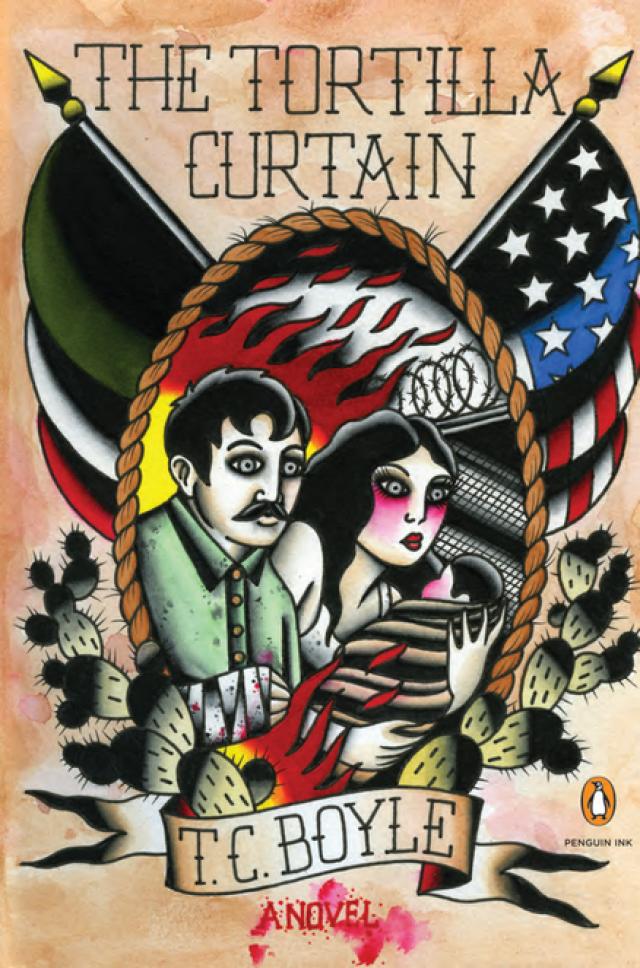
The Tortilla Curtain, page 27


On the way home they stopped in at Gitello's to pick up a few things--odds and ends--for the feast they were planning on Thursday, for Thanksgiving. They were having the Cherrystones and the Jardines over, as well as Kyra's sister and brother-in-law, with their three children, and Kyra's mother, who was flying in from San Francisco. They'd already spent two hundred and eighty dollars at the Von's in Woodland Hills, where nearly everything was cheaper, but the list of odds and ends had grown to daunting proportions. Kyra was doing the cooking, with Delaney as sous chef and the maid, Orbalina, on cleanup detail, and she was planning a traditional dinner: roast turkey with chestnut dressing and giblet gravy, mashed potatoes and turnips, a cranberry compote, steamed asparagus, three California wines and two French, baked winter squash soup and a salad of mixed field greens to start, a cheese course, a home-blended _granité__ of grapefruit and nectarine, and a hazelnut-risotto pudding and crème brûlée for dessert with espresso, Viennese coffee and Armagnac on the side.
Delaney retrieved the preliminary list from the folds of his wallet as Kyra strode brusquely through the door and selected a cart. The list was formidable. They needed whipping cream, baby carrots, heavy syrup, ground mace, five pounds of confectioners' sugar, balsamic vinegar, celery sticks and capers, among other things, as well as an assortment of cold cuts, marinated artichoke hearts, Greek olives and caponata for an antipasto platter she'd only just now decided on. As he followed her down the familiar aisles, watching her as she stood there examining the label on a can of smoked baby oysters or button mushrooms in their own juice, Delaney began to feel his mood lifting. There was nothing wrong, nothing at all. She was beautiful. She was his wife. He loved her. Why mope, why brood, why spend another angry night on the couch? The wall was there, a physical presence, undeniable, and it worked two ways, both for and against him, and if he was clever he could use it to his own advantage. It was Thanksgiving, and he should be thankful.
He stood at Kyra's side, touching her, offering suggestions and advice, inhaling the rich complex odor of her hair and body as she piled the cart high with bright irresistible packages, things they needed, things they'd run out of, things they might need or never need. Here it was, cornucopian, superabundant, all the fruits of the earth gathered and packaged and displayed for their benefit, for them and them alone. He felt better just being here, so much better he could barely contain himself. How could he have let such a petty thing come between them? He watched her select a jar of piccalilli relish and bend to set it in the cart, and a wave of tenderness swept over him. Suddenly he had his hands on her hips and he was pulling her to him and kissing her right there beneath the Diet Pepsi banner, under the full gaze of the lights and all the other shoppers with their carts and children and bland self-absorbed faces. And she kissed him back, with enthusiasm, and the promise of more to come.
And then, at the checkout, he was amazed all over again.
“You want your turkey?” the girl asked after she'd rung up the purchases--a hundred and six dollars and thirty-nine cents, and why not? The girl was dark-eyed, with a wild pouf of sprayed-up hair and penciled-in eyebrows, like a worldly waif in the silent films. She was snapping gum, animated, bathing in the endless shower of all this abundance.
“Turkey?” Delaney said. “What turkey?” Their turkey was home in the refrigerator, eighteen pounds, four ounces, range-fed and fresh-killed.
“It's a special offer, just this week only,” the girl said, her voice a breathless trill playing over the wad of pink gum Delaney could just catch a glimpse of when she opened her mouth to say “special.”
“If your order totals over fifty dollars you get a free twelve-pound turkey, one to a customer.”
“But we already--” Delaney began, and Kyra cut him off. “Yes,” she said, looking up from her compact, “thank you.”
“Carlos!” the girl sang out, shouting toward the distant fluorescent glare of the meat department at the back of the store. “Bring me another turkey, will you?”
For his part, Cándido Rincón didn't exactly welcome the season either. That it was hot, that the winds blew and the sweat dried from your skin almost before it had a chance to spill from the pores, was fine and good, ideal even--if only it could be sustained indefinitely, if only the sun would grace him for another two or three months. But he knew that the winds would soon blow themselves out and the sky would blacken and rot far out over the ocean and then come ashore to die. He couldn't smell the rains yet, but he knew they were coming. The days were truncated. The nights were cold. And where was his son going to be born--in a bed with a doctor looking on or in a hut with the rain driving down and nobody there but Cándido with a pot of water and his rusty knife?
None of this sat easy with him as he trudged up the rutted trail to the market. América was down below, in a funk--she wouldn't leave the lean-to, no matter how much he might beg or plead. She was like a deranged person, sitting there over her swollen belly, rocking back and forth and chanting to herself. She scared him. No matter what he did, no matter what he brought her--magazines, clothes, things to eat, a rattle and a pair of booties for the baby--she'd just give him the same numbed look, as if she didn't recognize him--or didn't want to recognize him.
It was this place, he knew it. The defeat of having to come back here, of having to live like vagos after the promise of that day in Canoga Park, after the luncheonette and the flush toilet and all those rich things and the houses with the cars out front and the peace and security inside. She'd had a breakdown then, like nothing he'd ever seen--even on the streets of Tijuana, even in the worst and lowest places. He'd seen women in hysterics before, but this was something else altogether, this was like a fit, a spell, as if somebody had put a curse on her. She wouldn't stand up. Wouldn't walk. Wouldn't eat the chicken he'd found for her, perfectly good pieces of Kentucky Fried Chicken the _gabachos__ had thrown away untouched, and he'd had to drag her back down to their camp, fighting her all the way. Yes, they were desperate. Yes, they'd lost everything. Yes, he was a fool and a liar and he'd failed her yet again. But still they had to make the best of it, had to survive, didn't she see that?
She didn't. For the first few days she just sat there, immobilized, catatonic. He'd leave to go out scrounging for food, for work, for the cans he found along the roadway and turned in for a handful of nickels and pennies, and when he came back, whether it was two hours later or six or eight, there she'd be, just as he'd left her, sometimes in the same pose even. She wouldn't talk to him. She refused to cook. She stopped washing her hair and her body and within the week she stank like one of the homeless, like a wild thing, like a corpse. Her eyes gored him. He began to think he hated her.
Then he met Señor Willis. It was serendipity, good luck instead of bad. He'd got work a few times over the course of the first two weeks after the Canoga Park idiocy, standing out front of the post office with a knot of other men, not so many now, and keeping a sharp eye out for the INS or some vigilante _gabacho,__ defying them, yes, but what choice did he have? The labor exchange was gone. Someone had come in and planted some pepper trees, little sticks six or eight feet high with a puff of foliage at the top, black plastic hose running from tree to tree like a lifeline. That was the labor exchange now: saplings in the ground and the dead blasted earth. So he stood there outside the post office and took his chances, breathing hard every time a car slowed--was it a job or a bust?--and he was there late one howling hot dry-as-a-bone day, two o'clock probably, and a sledgehammered old Corvair pulled into the lot like some arthritic bird, and there, sitting at the wheel, was a man in the same shape as the car, an old white man with a sunken chest and turtle-meat arms, white hairs growing out of his nose and ears. He just sat there, looking at Cándido out of watery old gray-blue eyes that were distended by the lenses of his glasses till they didn't look like eyes at all, till they looked like mouths, grasping crazy wide-open gray-blue mouths. He was drunk. You could see that from twenty feet away. “Hey, _muchacho,”__ he called out of the passenger's-side window, which still had the sparse teeth of broken glass sprouting from the frame, the rest a vacancy. _“¿Quieres trabajar?”__
It was a joke. It had to be. They let the old gabachos out of the nursing home and sent them down here to taunt honest men, that's what it was, Cándido was sure of it, and he felt his jaws clench with hate and anger. He didn't move a muscle. Just stood there rigid.
_“Muchacho,”__ the old man said after a minute, and the wind, the tireless Santa Ana, pinched his voice till it was barely there, _“¿qué pasa? ¿Eres sordo?__ Are you deaf? I said, do you want to work?”
The car rumbled and farted through its crippled exhaust. The wind blew. The mouths of the old man's eyes beckoned. What the hell, Cándido said to himself, what have I got to lose? and he made his way round the car to the driver's-side window and leaned in. “What work?” he asked in Spanish.
There was a bottle on the seat next to the old man--two bottles, one of vodka, with a red label and clear liquid, the other with the same label but filled with a yellowish fluid, which Cándido later learned was urine. The old man didn't smell good. When he opened his mouth to smile there were only three teeth visible, two on the bottom and one on the top. “Building,” the old man said, “construction. You got a strong back, you work for me, no pissing around, eight bucks an hour.”
_Eight bucks?__ Was he kidding? It was a joke. It had to be.
“Get in the car,” the old man said, and Cándido went back round to the passenger's side, nothing to lose, jerked open the door--it was battered shut--and slid into the seat beside the two capped bottles, the clear and the tinted.
That was Señor Willis, and Señor Willis proved to be a surprise, a big surprise, the best surprise Cándido had had since he left Tepoztlán with his seventeen-year-old bride. The Corvair took the canyon road at about thirty miles an hour, the front end ratcheting and swaying, the tires gasping, black smoke pouring so thickly from the exhaust that Cándido was afraid the thing was on fire, but it made the crest and wound down into Woodland Hills, where Señor Willis pulled up in front of a house that was the size of three houses, and the bald nervous-looking _gringo__ who owned it came out and shook his hand. That was Señor Willis.
Cándido worked past dark, doing what Señor Willis told him, lifting this, pulling that, fetching a wrench, a hammer, the screw gun and two boxes of tile from the trunk of the car. Señor Willis _was__ remodeling one of the six bathrooms in this grand hushed house that was like a hotel with its potted plants and rich Persian carpets and leather chairs, and Señor Willis was a genius. An old genius. A drunken genius. A worn-out, battered and decrepit genius. But a genius all the same. He'd built hundreds of houses in his day, built whole developments, and not only in California, but in Panama too, where he'd picked up his Spanish that was so bad it made Cándido feel the way he had as a kid when the teacher would scratch her nails on the blackboard to get the attention of the class.
Cándido worked a full week with Señor Willis and then the job was done and the old man disappeared, drunk for a week more. But Cándido had money now, and he bought America things to try to cheer her, little delicacies from the grocery, white bread and sardines in oil, and the apartment fund began to grow again in the little plastic peanut butter jar. Two weeks went by. There was no work. _La Migra,__ rumor had it, had snatched six men from in front of the post office, and the agents were in an unmarked car, black, plain black, and not the puke-green you could see a mile away. Cándido stayed away for a while. He dipped into the money he'd made. America was like a stranger and she was getting bigger by the day, so big he was afraid she'd burst, and she ate everything he could bring her and kept wanting more.
He climbed the hill. Stood out front of the post office and sweated the police. And where was Señor Willis? He'd died, that must have been it. Sleeping in his car because his wife hounded him so much he couldn't take it, drinking out of the one bottle and pissing in the other, seventy-six years old with bad hips and an irregular heart and who could survive that? He was dead. Sure he was. But then, one hopeless hot wind-tortured afternoon, there came the Corvair, drifting down the road like a mirage, and there was Señor Willis with one eye bruised purple and swollen shut like some artificial thing grafted to his face, a rubber joke you'd find in a novelty shop. “Hey, _muchacho,”__ he said, “we got work. Get in.”
Three days this time. Installing new gates with gravity feed on an old iron fence around a swimming pool, then replacing the coping. And then Señor Willis was drunk, and then there was more work, and now, now that they had nearly five hundred dollars in the jar, there was a month's worth of work coming up, a whole big job of work, putting an addition on a young couple's living room in Tarzana, and what was wrong with that? America should jump for joy. They'd be out of here any day now, out of here and into an apartment where Señor Willis could come by and knock at the door and Cándido could come out and just get into the Corvair and not have to worry about La Migra snatching him off the street. But América wasn't jumping for joy. She wasn't jumping at all. She wasn't even moving. She was just sitting there by the moribund stream and the dwindling pool, bloated and fat and inanimate.
Cándido went up the hill. He was worried, always worried, but then life had its ups and downs and this time they were on the upswing, no doubt about it. He was making plans in his head and when he passed the big stubbed-toe rock where he'd encountered that son of a bitch of a _half-a-gringo__ with the hat turned backwards on his head, he refused even to think about him. There was no work today or tomorrow either. It was a holiday, Señor Willis had told him, a four-day weekend, and they would start in on the new project, the big job, on Monday. But what holiday was it? Thanksgiving, Señor Willis had said, _El Día de las Gracias, El Tenksgeevee.__
Well that was all right. Cándido would rather be working, he'd rather be putting his first and last months' rent down on an apartment, any apartment, anywhere, and bringing his wife up out of the hole she was in, but it could wait another week at sixty-four dollars a day--or at least he hoped and prayed it could. América was due soon--she looked like an unpoked sausage swelling on the grill. But he had no control over that--sure, he'd stood out there by the post office this morning, but nobody came by, nobody, it was like the whole canyon was suddenly deserted--and now he was coming back up the hill, three o'clock in the afternoon, to buy rice, stewed tomatoes in the can, a two-quart cardboard container of milk for his wife and maybe a beer or two, Budweiser or Pabst Blue Ribbon, in the tall brown one-liter bottle, for _El Tenksgeevee.__
He kept his head up on the road. La _Migra__ wouldn't be working today, not on _El Tenksgeevee,__ the lazy overfed fat-assed bastards, but you could never tell: it would be just like them to pick you up when you least expected it. There wasn't a lot of traffic--more than in the morning, but still it was nothing compared to a working day. Cándido crossed the road--careful, careful--made his way through the maze of shopping carts and haphazardly parked vehicles in the lot, and entered the _paisano's__ market, stooping to pick up a red plastic handbasket just inside the door.
The place was the same as always, changeless, as familiar to him now as the market in his own village, and still there wasn't a scent of food, not even a stray odor, as if the smell of a beefsteak or a cheese or even good fresh sawdust was somehow obscene. The light was dead. The shoppers were the same as always, the same changeless bleached-out faces, and they gave him the same naked stares of contempt and disgust. Or no, they weren't the same, not exactly: today they were all dressed up in their finery for _El Tenksgeevee.__ Cándido made his way down the canned-vegetable aisle, thinking to save the beer cooler for last, so as to keep the beer cold to the last possible moment--and he would reach way in back too, to get the maximally chilled ones. He smelled plastic wrap, Pine-Sol, deodorant.
He lingered over the beer, standing in front of the fogged-over door, comparing prices, the amber bottles backlit so that they glowed invitingly, and he was thinking: One? Or two? America wouldn't drink any, it was bad for the baby, and if she drank beer she might forget how implacably and eternally angry she was and maybe even let a stray smile fall on him. No, she wouldn't drink any, and one would make him feel loose at the edges, little fingers crepitating in his brain and massaging the bad side of his face, but two would be glorious, two would be thanksgiving. He opened the case and let the cool air play over his face a moment, then reached into the back and selected two big one-liter bottles of Budweiser, the King of Beers.
He was thinking nothing at the checkout, his face a mask, his mind back in Tepoztlán, the rocky _cerros__ rising above the village in a glistening curtain of rain, the plants lush with it, fields high with corn and the winter dry season just setting in, the best time in all the year, and he didn't pay any attention to the _gringos__ in line ahead of him, the loud ones, two men already celebrating the holiday, their garish shirts open at the neck, jackets tight in the shoulders. “Turkey?” one of them shouted in his own language, and his voice was rich with amusement, with mockery, and now Cándido looked up, wondering what it was all about. “What the hell do we want with a turkey?”
The man who'd been speaking was in his twenties, cocky, long-haired, rings leaping out of his knuckles. The other one, his companion, had six little hoops punched through his earlobe. “Take it, man,” the second one said. “Come on, Jules, it's a goof. Take it, man. It's a turkey. A fucking turkey.”
They were holding up the line. Heads had begun to turn. Cándido, who was right behind them, studied his feet.
“You gonna cook it?” the first man said.
“Cook it? You think it'll fit in a microwave?”
“That's what I'm saying: what the fuck do we want with a fucking turkey?”
And then time seemed to slow down, crystallize, hold everything suspended in that long three o'clock Thanksgiving moment under the dead light of the store and the sharp cat-eyed glances of the gringos. “What about this dude here? He looks like he could use a turkey. Hey, man”--and now Cándido felt a finger poke at his shoulder and he looked up and saw it all, the two sharp dressers, the plastic sack of groceries, the exasperated checkout girl with the pouf of sprayed-up hair and the big frozen bird, the _pavo__ in its sheet of white skin, lying there frozen like a brick on the black conveyor belt--“you want a turkey?”