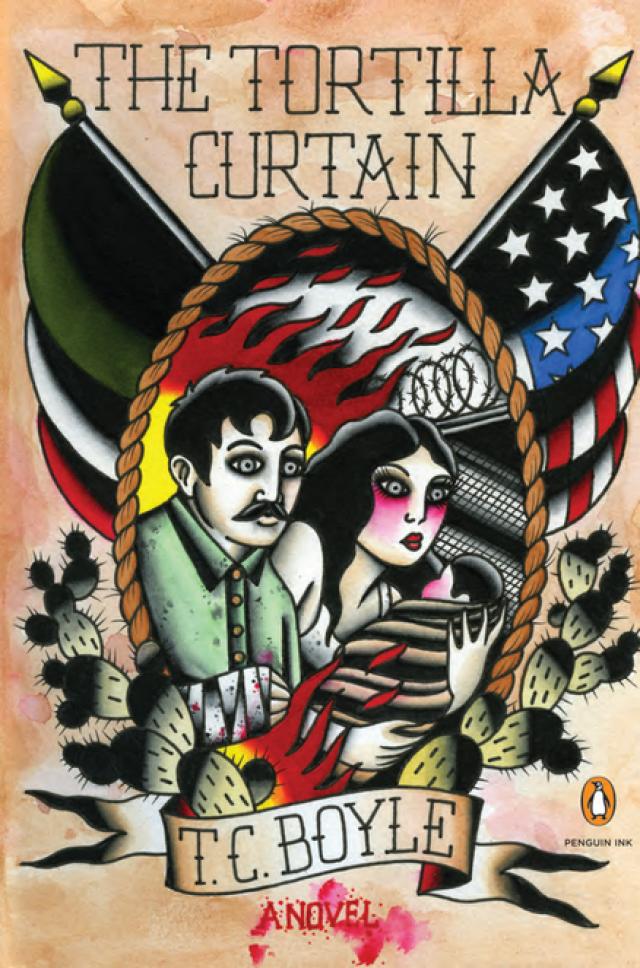
The Tortilla Curtain, page 13


Some hikers carried guns. Delaney had heard of robberies on the Backbone Trail, of physical violence, assault, rape. The four-wheel-drive faction came up into the hills to shoot off their weapons, gang members annihilated rocks, bottles and trees with their assault rifles. The city was here, now, crouched in the ravine. Delaney didn't know what to do--slink away like some wounded animal and give up possession of the place forever? Or challenge them, assert his rights? But maybe he was making too much of it. Maybe they were hikers, day-trippers, maybe they were only teenagers skipping school.
And then he remembered the girl from the birding class he'd taken out of boredom. It was just after he'd got to California, before he met Kyra. He couldn't recall her name now, but he could see her, bent over the plates in Clarke's _An Introduction to Southern California Birds__ or squinting into the glow of the slide projector in the darkened room. She was young, early twenties, with thin black hair parted in the middle and a pleasing kind of bulkiness to her, to the way she moved her shoulders and walked squarely from the anchors of her heels. And he remembered her cheeks--the cheeks of an Eskimo, of a baby, of Alfred Hitchcock staring dourly from the screen, cheeks that gave her face a freshness and naivete that made her look even younger than she was. Delaney was thirty-nine. He asked her out for a sandwich after class and she told him why she never hiked alone, never, not ever again.
Up until the year before she'd been pretty blithe about it. The streets might have been unsafe, particularly at night, but the chaparral, the woods, the trails no one knew? She had a passion for hiking, for solitary rambles, for getting close enough to feel the massive shifting heartbeat of the world. She spent two months on the Appalachian Trail after graduating from high school, and she'd been over most of the Pacific Coast Trail from the Mexican border to San Francisco. One afternoon in May she went out for a short hike up one of the feeder streams of the Big Tujunga Creek, in the San Gabriels. She'd worked past two, waitressing for the lunch crowd at a grill in Pasadena, but she thought she'd get two or maybe three hours in before dinner. Less than a mile up there was a pool she knew at the base of a cliff that rose to a thin spray of water--she'd never been beyond the pool and planned to climb round the cliff and follow the stream to its source.
They were Mexicans, she thought. Or maybe Armenians. They spoke English. Young guys in baggy pants and shiny black boots. She surprised them at the pool, the light faded to gray, a faint chill in the air, their eyes glazed with the beer and the endless bullshit, stories about women and cars and drugs. There was an uncomfortable moment, all five of them drilling her with looks that automatically appraised the shape of her beneath the loose sweatshirt and jeans and calculated the distance to the road, how far a scream would carry. She was working her way around the cliff, unsteady on the loose rock, her back to them, when she felt the grip of the first hand, right there--she showed him--right there on her calf.
Delaney held his breath. The voices had stopped abruptly, replaced by a brooding silence that hung in the air for what seemed an eternity before they started up again, lazy now, contented, the buzz of a pair of flies settling down on the sidewalk. And then, through some auditory quirk of the canyon walls, the voices suddenly crystallized and every word came to him true and distinct. It took him a moment, and then he understood: Spanish, they were talking Spanish.
He was already angry with himself, angry even before he turned away and tried to slink out of the reeds like a voyeur, angry before the choice was made. The hike was over, the day ruined. There was no way he was just going to waltz out of the bushes and surprise these people, whoever they were, and the defile was too narrow to allow him to go round them undetected. He lifted one foot from the mud and then the other, parting the reeds with the delicacy of a man tucking a blanket under the chin of a sleeping child. The sound of the creek, which to this point had been a whisper, rose to a roar, and it seemed as if every bird in the canyon was suddenly screaming. He looked up into the face of a tall raw-boned Latino with eyes like sinkholes and a San Diego Padres cap reversed on his head.
The man was perched on a boulder just behind and above Delaney, no more than twenty feet away, and how he'd got there or whether he'd been there all along, Delaney had no idea. He wore a pair of tight new blue jeans tucked into the tops of his scuffed workboots, and he sat hunched against his knees, prying a stick of gum out of his shirt pocket with exaggerated care. He attempted a smile, spreading his lips in a show of bravado, but Delaney could see that the man was flustered, as confounded by Delaney's sudden appearance as Delaney was by his. “Hey, _amigo,__ how's it going?” he said in a voice that didn't seem to fit him, a voice that was almost feminine but for the rasp of it. His English was flat and graceless.
Delaney barely nodded. He didn't return the smile and he didn't reply. He would have moved on right then, marching back to his car without a word, but something tugged at his pack and he saw that one of the reeds had caught in his shoulder strap. He bent to release it, his heart pounding, and the man on the rock sprawled out his legs as if he were sinking into a sofa, folded the stick of gum into his mouth and casually flicked the wrapper into the stream. “Hiking, huh?” the man said, and he was smiling still, smiling and chewing at the same time. “Me,” he said, “I'm hiking too. Me and my friend.” He jerked his head to indicate the friend, who appeared behind Delaney now, just beyond the reeds.
The friend regarded Delaney out of an expressionless face. His hair hung in coils to his shoulders and a thin wisp of beard trailed away from the base of his chin. He was wearing some sort of poncho or _serape,__ jagged diamonds of color that leapt out against the quiet greens of the streambed. He had nothing to add to the first man's description. They were hiking, and that was it.
Delaney looked from the first man to his companion and back again. He wasn't alarmed, not exactly--he was too angry for that. All he could think of was the sheriff and getting these people and their garbage heap out of here, of hustling them right back to wherever they'd come from, slums, _favelas, barrios,__ whatever they called them. They didn't belong here, that was for sure. He jerked the reed out of the ground and flung it away from him, adjusted his pack and began picking his way back down the streambed.
“Hey, _amigo”__--the man's voice came at him in a wild high whinny--“you have a nice day, huh?”
The walk to the road was nothing--it barely stretched his muscles. The anticipation had gone sour in his throat, and it rankled him--it wasn't even noon yet and the day was shot. He cursed as he passed by the sleeping bags again, and then he took the bank in five strides and he was out in the glare of the canyon road. He had a sudden impulse to continue on down the stream, under the bridge and around the bend, but dismissed it: this was where the creek fanned out into its floodplain before running into the ocean, and any idiot who could park a car and clamber down a three-foot embankment could roam it at will, as the successive layers of garbage spread out over the rocks gave testimony. There was no adventure here, no privacy, no experience of nature. It would be about as exciting as pulling into the McDonald's lot and counting the starlings.
He turned and walked back up the road, past the line of cars restrained by a man in a yellow hard hat with a portable sign that read STOP on one side and SLOW on the reverse. The trucks and bulldozers were quiet now--it was lunchtime, the workers sprawled in the shade of the big rippled tires with their sandwiches and _burritos,__ the dust settling, birds bickering in the scrub, chamise and toyon blooming gracefully alongside the road with no help from anyone. Delaney felt the sun on his face, stepped over the ridges of detritus pushed into the shoulder by the blades of the earthmovers and let the long muscles of his legs work against the slope of the road. In one of his first “Pilgrim” columns he'd observed that the bulldozer served the same function here as the snowplow back East, though it was dirt rather than snow that had to be cleared from the streets. The canyon road had become a virtual streambed during the rainy season and Caltrans had been hard-pressed to keep it open, and now, in early summer, with no rain in sight for the next five months, they were just getting round to clearing out the residual rubble.
That was fine with Delaney, though he wished they'd chosen another day for it. Who wanted to hear the roar of engines and breathe diesel fuel down here--and on a day like this? He was actually muttering to himself as he passed the last of the big machines, his mood growing progressively blacker, and yet all the defeats and frustrations of the morning were nothing compared to what awaited him. For it was at that moment, just as he cleared the last of the Caltrans vehicles and cast a quick glance up the road, that he felt himself go numb: the car was gone.
Gone. Vanished.
But no, that wasn't where he'd parked it, against the guardrail there, was it? It must be around the next bend, sure it was, and he was moving more quickly now, almost jogging, the line of cars across the road from him creeping down toward the bridge and a second man in hard hat and bright orange vest flagging his SLOW sign. Every eye was on Delaney. He was the amusement, the sideshow, stiff-legging it up the road with the sweat stinging his eyes and slicking the frames of his glasses. And then he made the bend and saw the tight shoulderless curve beyond it and all the naked space of the canyon spread out to the horizon, and knew he was in trouble.
Dumbstruck, he swung reluctantly round on his heels and waded back down the road like a zombie, tramping back and forth over the spot where he'd parked the car and finally even going down on one knee in the dirt to trace the tire tracks with his unbelieving fingertips. His car was gone, all right. It was incontrovertible. He'd parked here half an hour ago, right on this spot, and now there was nothing here, no steel, no chrome, no radial tires or personalized license plates. No registration. No _Introduction to Southern California Birds or Trail Guide to the Santa Monica Mountains.__
The first thing that came into his head was the police. They'd towed it. Of course. That was it. There was probably some obscure regulation about parking within two hundred feet of a road crew or something--or they'd posted a sign he'd missed. He rose slowly to his feet, ignoring the faces in the cars across from him, and approached a group of men lounging in the shade of the nearest bulldozer. “Did anybody see what happened to my car?” he asked, conscious of the barely restrained note of hysteria in his voice. “Did they tow it or what?”
They looked up at him blankly. Six Hispanic men, in khaki shirts and baseball caps, arrested in the act of eating, sandwiches poised at their lips, thermoses tipped, the cans of soft drink sweating between their fingers. No one said a word.
“I parked right there.” Delaney was pointing now and the six heads dutifully swiveled to regard the vacant shoulder and the scalloped rim of the guardrail set against the treetops and the greater vacancy of the canyon beyond it. “A half hour ago? It was an Acura--white, with aluminum wheels?”
The men seemed to stir. They looked uneasily from one to the other. Finally, the man on the end, who seemed by virtue of his white mustache to be the senior member of the group, set his sandwich carefully down on a scrap of waxed paper and rose to his feet. He regarded Delaney for a moment out of a pair of inexpressibly sad eyes. “No espick Ingliss,” he said.
Fifteen minutes later Delaney was having his hike after all, though it wasn't exactly what he'd envisioned. After questioning the boss of the road crew--_We haven't towed nothin' here, not to my knowledge__--he started back up the canyon road on foot. It was three miles or so to the near grocery and the telephones out front, but it was all uphill and the road wasn't designed for pedestrians. Horns blared, tires screeched, some jerk threw a beer can at him. For fear of his life he had to hop the guardrail and plow through the brush, but it was slow going and the burrs and seedheads caught in his socks and tore at his naked legs, and all the while his head was pounding and his throat gone dry over the essential question of the day: what had happened to the car?
He called the police from the pay phone and they gave him the number of the towing service and he called the towing service and they told him they didn't have his car--and no, there was no mistake: they didn't have it. Then he called Kyra. He got her secretary and had to sit on the curb in front of the pay phone in a litter of Doritos bags and candy wrappers for ten agonizing minutes till she rang him back. “Hello?” she demanded. “Delaney?”
He was bewildered, immobilized. People pulled into the lot and climbed casually out of their cars. Doors slammed. Engines revved. “Yes, it's me.”
“What is it? What's the matter? Where are you?” She was wound tight already.
“I'm at Li's Market.”
He could hear her breathing into the receiver, and he counted the beats it took her to absorb this information, puzzle over its significance and throw it back at him. “Listen, Delaney, I'm in the middle of--”
“They stole my car.”
“What? What are you talking about? Who stole it?”
He tried to dredge up all he'd heard and read about car thieves, about chop shops, counterfeit serial numbers and theft to order, and he tried to picture the perpetrators out there in broad daylight with hundreds of people driving obliviously by, but all he could see was the bruised face and blunted eyes of his Mexican, the wheel clutched between his hands and the bumper gobbling up the fragments of the broken yellow line as if the whole thing were one of those pulse-thumping games in the arcade. “You better call Jack,” he said.
8
IT WAS LIKE BEING HAUNTED BY DEVILS, RED-HAIRED devils and _rubios__ in eighty-dollar running shoes and sunglasses that cost more than a laboring man could make in a week. What had he done to deserve such a fate? Cándido was a sinner like any other man, sure, but no worse. And here he was, half-starved and crippled by their infernal machines, bounced from one to another of them like a pinball, first the big jerk with the Elvis hair and then the _pelirrojo__ who'd run him down in the road, the very one, and his gangling tall awkward _pendejo__ of a son who'd hiked all the way down into the canyon to violate a poor man's few pitiful possessions. It was too much. He needed to go to confession, do penance, shrive himself somehow. Even Job would have broken down under an assault like this.
For the next hour he hid himself in a clump of shrubbery at the far end of the parking lot, watching the door of the _supermercado__ for América. This was where she'd look for him--it was the only place she knew besides the Chinese store, and she must have known he wouldn't hang around there any longer than he had to. So he waited in the bushes, out of sight, and though his concealment made him feel better--at least now no one was going to push him around--he was still in a fever of worry. What if he'd missed her and she was down below in the canyon, staring numbly at the bleak pile of rocks where their camp used to be? What if the _patrón__ of the job he hoped she'd gotten forced her to do something with him? What if she was lost, hurt or worse?
The traffic was thinning on the road now and fewer cars were pulling in and out of the lot. His tormentors--the _gabachos__ young and old--had shoved into their cars and driven off without so much as a backward glance for him. He was about to give it up and cross the road to the labor exchange and look hopelessly round the empty lot there and then maybe head back down the road to where the path cut into the brush and shout out her name for every living thing in the canyon to hear, when a Mercedes sedan pulled up in front of the grocery and America stepped out of it.
He watched her slim legs emerge first, then her bare arms and empty hands, the pale flowered dress, the screen of her hair, and he was elated and devastated at the same time: she'd got work, but he hadn't. They would have money to eat, but he hadn't earned it. No: a seventeen-year-old village girl had earned it, and at what price? And what did that make him? He crouched there in the bushes and tried to read her face, but it was locked up like a strongbox, and the man with her, the _rico,__ was like some exotic animal dimly viewed through the dark integument of the windshield. She slammed the door, looked about her indecisively for a moment as the car wheeled away in a little blossom of exhaust, and then she squared her shoulders, crossed the lot and disappeared into the market.
Cándido brushed down his clothes, made good and certain that no one was looking his way, and ambled out of the bushes as if he'd just come back from a stroll around the block. He kept his head down, avoiding eye contact with the _gringos__ he passed nd out goas he crossed the lot and ducked into the grocery. After a week and a half of living on so little that his stomach had shrunk and his pants were down around his hips, the effect of all that abundance was devastating. There was no smell of food here, no hint of the rich stew of odors you'd find in a Mexican market--these people sanitized their groceries just as they sanitized their kitchens and toilets and drove the life from everything, imprisoning their produce in jars and cans and plastic pouches, wrapping their meat and even their fish in cellophane--and yet still the sight and proximity of all those comestibles made his knees go weak again.
Candy, there was a rack of candy right by the door, something sweet and immediate to feed the hunger. Little cakes and things, Twinkies and Ho-Ho's. And there, there were the fruits and vegetables lit up as on an altar, the fat ripeness of tomatoes, mangoes, watermelon, corn in its husk, roasting ears that would sweeten on the grill. He swallowed involuntarily. Looked right and then left. He didn't see America. She must be down one of the aisles pushing a basket. He tried to look nonchalant as he passed by the checkers and entered the vast cornucopia of the place.
Food in sacks for pets, for dogs and cats and parakeets, seltzer water in clear bottles, cans of vegetables and fruit: God in Heaven, he was hungry. He found América poised in front of one of the refrigerated displays, her back to him, and he felt shy suddenly, mortified, the unwanted guest sitting down at the starving man's table. She was selecting a carton of eggs--_huevos con chorizo, huevos rancheros, huevos hervidos con pan tostado--__flicking the hair out of her face with an unconscious gesture as she pried open the box to check for fractured shells. He loved her in that moment more than he ever had, and he forgot the Mercedes and the rich man and the _gabachos__ in the parking lot assailing him like a pack of dogs, and he thought of stew and _tortillas__ and the way he would surprise her with their new camp and the firewood all stacked and ready. Things would work out, they would. “América,” he croaked.