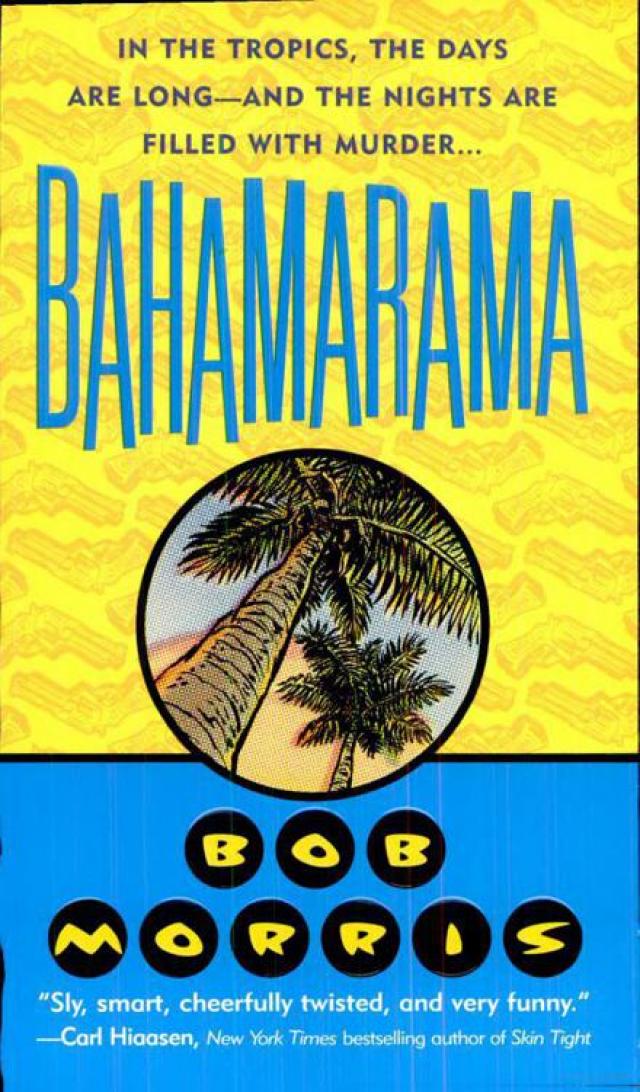
Bahamarama, page 3
part #1 of Zack Chasteen Series


Maybe I should have kept my appointments with the Bay-point psychologist, maybe that would have kept me from feeling the way I felt. Part of the “matriculation process” at Baypoint called for a series of one-on-one therapy sessions aimed at preparing inmates for reentry into the outside world. I went to the first one and listened as an earnest young man, probably no more than six months out of grad school, told me the object of our sessions would be to “nurture my sense of self-esteem,” “reassess my life goals and core motivations,” and “find empowerment by embracing positive values.” All of which I translated to mean: Zack, you fucked up and did a bad thing, but you’ll feel better about yourself if you promise not to do bad things again and always walk on the sunny side of life. And since I couldn’t swallow the first part of the equation—mine was the oldest line in the slammer: I didn’t do it, dammit—I thought it would be hypocritical of me to buy into the rest of the program. I listened to the earnest young man’s psychobabble for, oh, three minutes, then I shook his hand, thanked him kindly for his time, and walked out.
But at that very moment I could have used a big boost in the self-esteem department. Didn’t matter that I wasn’t guilty of what had just cost me nearly two years of my life. The system had judged me and so be it. Punch up Zachary Taylor Chasteen on the FBI’s master shit list and it would be laid out in black-and-white. There aren’t any asterisks in the sentencing books. I was a convicted felon. I had no job, no bank account, no immediate prospects. Hell, I didn’t even have any long-range prospects. What I had was diddly-squat.
Then again, screw the pity party. I was riding in a limo with two thousand bucks in my pocket, on my way to the Bahamas and a woman who loved me. Always walk on the sunny side of life . . . .
4
An hour down the road Chip slid open the Plexiglas divider and said we needed to pull off for gas. He stopped at a 7–Eleven. The place was crowded and we had to wait in line. Families in minivans with out-of-state plates, coming to Florida for vacation, beach chairs and bicycles strapped on the racks. Construction workers in pickup trucks, the beds filled with sawhorses and scaffolding. Old people in old Chryslers, washing bugs off windshields and trying to figure out how to work the dagblasted pumps. Finally it was our turn. Chip pumped twenty-four gallons into the limo. Then he went inside to use the bathroom. I got out and stretched.
I was feeling fat and flabby. Probably the worst shape I’d ever been in. Lots of guys in prison, they use the time to work out and sculpt themselves into real brutes. Not me. All I did was lie in bed and read. Stories about sailors and the sea, mostly. I finished the complete Patrick O’Brian series, all twenty books about Jack Aubrey and Stephen Maturin. I reread the Bounty trilogy, which I had first devoured when I was twelve or so, and which had more or less ruined me for a land-based lifestyle. Then I finished up with a book about Ernest Shackleton and his torturous expedition to Antarctica. Stories of hardship and peril. They made my own dilemma seem a little less worse than it was.
I kept an eye on vehicles pulling off the interstate and into the 7–Eleven. No thugs behind tinted windows. No one who seemed the least bit interested in dragging me off for a little chat. But sooner or later someone else would be along. No doubt about that. If I was right about who Goatee and Raul worked for—and there was really only one person it could be—I knew the time I’d bought in the Baypoint parking lot wasn’t much of a cushion. This person had lots of guys like Goatee and Raul. If he wanted to mess with me, he had all the troops he needed. I just couldn’t figure out why he would bother. He was supposed to be dead. That’s what had kept him out of prison. And that’s what had sent me there. But why would he blow his cover? And why would he blow it now?
I walked around the limo and stopped at the driver’s door. The piece of cardboard taped to the side of the limo was coming loose. I pulled it off the rest of the way and stood there looking at a phenomenal piece of airbrush craftsmanship: a pair of women’s breasts—humongous, cartoonish breasts—painted in the same bright pink as the limo’s chrome piping. Tiny pink lightbulbs marked each of her nipples. The face belonging to the fulsome rack wore big hair and a teasing smile. A curlicue logo read: “Ruby Booby’s—Fort Lauderdale’s Finest Ladies.”
I looked around. People were watching me. Limos tend to draw attention. Big tacky limos with naked women painted on them tend to draw even more.
Chip left the 7–Eleven and walked across the parking lot. He was sipping a Big Gulp. People were watching him, too. He was a sight alright, big guy like that in a too-tight chauffeur’s uniform, that crazy blond hair sticking out every which way from under the chauffeur’s hat, those wild electric-blue sunglasses—looked like the love child of Hulk Hogan and Captain Kangaroo, something born on another planet.
He walked up beside me. He took a long draw on the Big Gulp, draining it. He looked at the piece of cardboard in my hand. Then he said: “Why’d you take that off?”
“Wanted to see what it said underneath. That where you work?”
He shrugged, didn’t say anything.
I said, “What’s this? The Ruby Booby’s party car?”
“Yeah.” He grinned. “They call it the Mercedes-Bangs.”
“Cute.”
“That sofa back there, where you been sitting, they call it the cockpit.”
“Even cuter.”
“You wouldn’t believe some of the stuff goes on back there.”
“Oh, I believe,” I said.
I walked around to the passenger side. There was a piece of cardboard on that door. I ripped it off. I stood there looking at another Ruby Booby’s logo, a matched set. Then I flipped both pieces of cardboard into a trash can.
“Chip?”
“Yeah.”
“Rest of the way, I’ll be riding up front with you.”
Chip liked to play the radio loud. Real loud. He kept flipping stations. We listened to rock. We listened to country-western. We listened to music—I don’t even know what you would call it. I didn’t complain. I just looked out the window and watched North Florida go by. Billboards and pastureland, tract homes and trailer parks. Little dried-up towns wishing they were closer to Disney or a beach. Folks call it home.
Just before Live Oak we hit a stretch where Chip couldn’t pick up anything on the radio, so he turned it off. We drove for a while. And then Chip said, “So this woman you’re hooked up with, she must be loaded, huh?”
“She’s done well,” I said. “Worked hard.”
“She’s in the magazine business or something, isn’t that it?”
“That’s right.”
“There a lot of money in that?”
“Can be,” I said. “If you’re the one who owns the magazines.”
“How many she own?”
He was asking a lot of questions, but I didn’t mind. Mainly because the topic was Barbara, and I enjoyed bragging about her. Besides, we had to talk about something, I guess, and that was the common ground. I couldn’t figure out what friend of Barbara’s might know a guy like Chip, but it was getting me where I needed to go, so why think too hard about it?
“Well, there’s Tropics,” I said. “That’s the main magazine, the one she started out with. Covers the Caribbean. It’s a travel magazine, high-end stuff. Then there’re some smaller magazines for different islands—the Live! publications. Got Barbados Live! and Jamaica Live! I forget all of them.”
“So how did the two of you get together?” he asked.
“Couple of years back, she booked my boat for an office party, a big Christmas shebang on the river by Minorca Beach.”
“That where she lives?”
“No, that’s where I live. She lives in Orlando. Winter Park, actually. Little town next to Orlando. Nice place. That’s where her offices are. Orb Media.”
“How many people she got working for her?”
“Oh, I don’t know. Thirty or forty. I don’t pay that much attention to her business, tell you the truth.”
“So what do you do? You own a boat?” Chip asked.
“Used to. Several of them. Not anymore.”
“Giving people boat rides—that was your business?”
“That and a few other things,” I said. “I did day trips, sunset sails, deep-sea fishing, charters to the Bahamas. Had a flats boat, too. But . . .”
I’d lost all of it. Every damn bit of it. Gone. But to hell with wallowing in the past. I was itching to be in the Bahamas with Barbara. Only, there was something I needed to do first.
“Which way you going to Fort Lauderdale?” I asked Chip.
“Taking 1–10 all the way across to 75, then south until we hit the turnpike. Same way I came.”
“I want to get off the highway and cut across to Minorca Beach. I need to stop by my place.”
“Too far out of the way,” Chip said. “We don’t have time.”
“What’s the hurry? My plane doesn’t leave until tomorrow. You got a date or something?”
Chip turned and looked at me. I think he was trying to give me his whup-ass glare, but it was hard to tell, what with him wearing his fancy shades.
“I got stuff I need to do,” he said.
“Well, it’ll have to wait. Barbara paid you for two days. We’re barely into day one. We’re going to Minorca Beach.”
We rode along for a minute or so, Chip squeezing the steering wheel, restless in his seat. Then he looked at me and said, “I don’t know how to get to there. And there’s no map in the car.”
“Not a problem,” I said. “Just get off 75 at Ocala, take 441 down to Pedro, cut through the forest on 42, hang a right at 452, then catch 44 across to Deland, and follow it until it ends at Minorca Beach. How about that?”
Chip spent a few seconds grinding his jaw, letting me know he was ticked off. Then he flipped on the radio and turned it up to shatter-the-earwax volume, clearly unimpressed that he was chauffeuring Mr. Rand Damn McNally.
We drove, and we didn’t talk, except for when I told Chip which way to turn. The news came on a couple of times. A boatload of Cubans had washed up in the Keys. Gas prices were expected to increase as much as fifteen cents a gallon before Labor Day weekend. And a tropical depression seven hundred and fifty miles east of the Turks and Caicos had been upgraded to the third tropical storm of the season. They were calling it Curt.
Just outside of Deland, Chip’s cell phone rang. He looked to see who it was, but didn’t answer. A couple of minutes later he pulled into another 7–Eleven.
“Need to make a phone call,” he said. He got out of the limo and walked to the other side of the parking lot, punching numbers on his cell phone, then talking to someone.
I didn’t have anything else better to do, so I started nosing around. Opened the limo’s glove compartment. Not much that was interesting or surprising—a couple dozen condoms, along with what appeared to be a hash pipe. Also a first aid kit. Seemed to cover all the bases for a good time on wheels. There were some business cards in the glove compartment, too. They had the Ruby Booby’s logo engraved on them. “Chip Willis,” the cards read. Under that it said: “Transportation and security.” So our boy was a bouncer, too. Seemed more his style. I plucked a card from the stack. Never knew. Maybe I was headed for a midlife crisis. Maybe I might be overcome by the urge to go out on the town, smoke dope, and cavort in the cockpit with bimbos. Then again, maybe someone would have the good sense to shoot me first.
Chip opened the limo door and stuck his head in.
“This might take a while. I need to make a couple more calls.”
“Can’t you do that in the car?” I said.
He shook his head.
“Reception sucks, need to be outside. You want, you got time to go inside, take a leak, get something to eat.”
Sounded like a good idea. I got out of the limo.
“Get you anything?” I said.
“Yeah, I’ll take another Big Gulp. Diet Dr Pepper. And how about a bag of Cheetos, something like that?”
He reached in his pocket and pulled out some money, but I waved him off.
“My treat,” I said. Figured the two of us might as well kiss and make up. Still had several hours ahead of us.
I went inside the 7–Eleven. Used the facilities, washed my hands and face. Got a bottle of water for myself, and the Big Gulp and Cheetos for Chip. Came to $3.67. Of Barbara’s money.
When I stepped outside the limo was gone.
5
I stood there thinking about all the reasons why Chip would have ditched me. Maybe the little show in the Baypoint parking lot had scared him off. Maybe he really did have a hot date down in Fort Lauderdale. Or maybe he just thought I was a lousy conversationalist. It didn’t really bother me until I realized he’d taken off with the plastic envelope containing all my i.d.’s—driver’s license, passport, the works. Then it bothered me a lot.
U.S. citizens don’t need passports to enter the Bahamas, but they must at least present a driver’s license along with a registered birth certificate, the kind with the raised seal on it. I had seen entire families turned away on vacations simply because a by-the-numbers Bahamian bureaucrat wouldn’t accept a photo-copy of some kid’s birth certificate. Lacking even a library card, I had no idea how I was going to pass muster. It was a Friday afternoon and government offices would be closing for the weekend. Even if I could get all the papers filled out and filed, plus have a new photo shot, it would take several days to get a new passport even if I paid the hefty premium for a rush job. I might be able to get a duplicate driver’s license, assuming my felony record didn’t gum up the works. But the birth certificate would be trickier. Requests had to go through the bureau of vital statistics in Jacksonville, and that would take a day or two, at best.
The short of it—I was screwed unless I could get myself to Fort Lauderdale, then try to find Chip and the limo. Failing that, I’d turn to Charlie Callahan for help. He had plenty of Bahamas experience, a good deal of it on the sly. If anyone could sneak me into the Bahamas it was Sorry Charlie.
I walked over to the pay phone, stuck in some money, and called my house. It was a long shot, but maybe Boggy was there, and maybe he would answer. He could drive over to Deland and pick me up. It was only about twenty miles.
Back when I had my boats and a decent business, Boggy was my first mate, although that implies a ranking system our relationship doesn’t have. Then came the shit storm and my sojourn at Baypoint. Boggy stuck with me—he always has, even when I have tried to shake him loose—keeping an eye on things in my absence.
I let the phone ring ten times, until the automated voice came on and told me that if I stuck in another seventy five cents it would forward a message. I hung up.
I looked around the parking lot. Two young guys—seventeen or eighteen, barefoot, shirtless and wearing knee-length surfer trunks—were checking the straps that fastened their boards to the top of a rusty Volvo sedan. Orlando kids, heading for the inlet to catch some waves. I walked over and asked if they wanted to make an easy hundred bucks. I told them I’d throw in a Big Gulp and a bag of Cheetos to sweeten the deal. A couple of minutes later we were on our way.
Minorca Beach hadn’t changed all that much in the time that I had been gone, which is something you can’t say about most Florida beach towns. Two bridges connect it with the mainland. They’re named after a couple of dead politicians, but everyone calls the old one the Low Bridge, and the new one the High Bridge. I had hated the new one when it was built several years ago, but it had grown on me for the view alone, and it was the one we took.
I’ve driven over that bridge probably a thousand times and never once have I not been completely blown away by all that spreads out before me: To the north, where Coronado Inlet casts its apron unto the ocean, white-capped rip currents slash against granite boulder jetties—a vain attempt to thwart the Atlantic’s crusade to reclaim this spit of sand. To the south, man-grove mud flats huddle along the Indian River, eventually leading to the broad inland sea known as Redfish Lagoon. In between, humankind has done its best to blight the landscape, but has come up short compared to its shabby conquests in Daytona, and Cocoa, and too many other places. There is no-table excess, of course, because this is, after all, Florida. A slew of too-tall condos snake along the shore. Strip malls sprawl out on turf better served by cabbage palms. And people with too much money and too little sense of grace have erected over-done beachfront homes too close to the dune line. I wouldn’t wish a hurricane on anyone, but . . .
We crossed the bridge and followed A–l–A south a few miles, almost to where it ends at the entrance of Coronado National Seashore and where the island is only a few hundred yards wide. Looking left, I could see the ocean. To my right was Redfish Lagoon. And straight ahead, for miles and miles, there was nothing but a skinny sliver of land—beach to the east, dunes in the middle, tidal flats to the west—splitting the two bodies of water.
The Cold War had been good for something. It had sparked the space race, which in turn prompted NASA to claim a giant chunk of Florida’s east coast so those pesky Russians couldn’t get a peek at what we were up to at Cape Canaveral. Later, after things began loosening up, NASA turned over most of the buffer zone to the National Park Service, the result being that Florida still has twenty-some-odd miles of coastline that remains virtually the way it was centuries ago.
We passed the park’s ranger station with its big parking lot for people using the boat ramp. Only a couple of SUVs with trailers were parked there. It was too hot for fishing. We came to a dirt-and-oyster-shell road that hooked off A–l–A and cut past a sign that said: “Leaseholder vehicles only beyond this point.”
“Turn in there,” I told the kid who was driving.
The road slithered through clumps of saw palmetto and sea grape. It jutted down to the lagoon and hugged it awhile before reaching a clearing where a low wooden pier stuck out fifty yards or so into the river. Just beyond the pier stood the first of several houses that faced the lagoon—big cracker houses with wraparound porches and broad, overhanging eaves, and tin roofs long since gone rusty. None of the houses were particularly grand, but all of them were old, all of them were in various stages of disrepair, and all of them were, quite obviously, empty. Ancient cedar trees, their trunks gnarly and knotty, lined the road as it ran by the houses. There were rotting boat hulls, and the skeletons of vintage pickup trucks, and picket fences falling down.