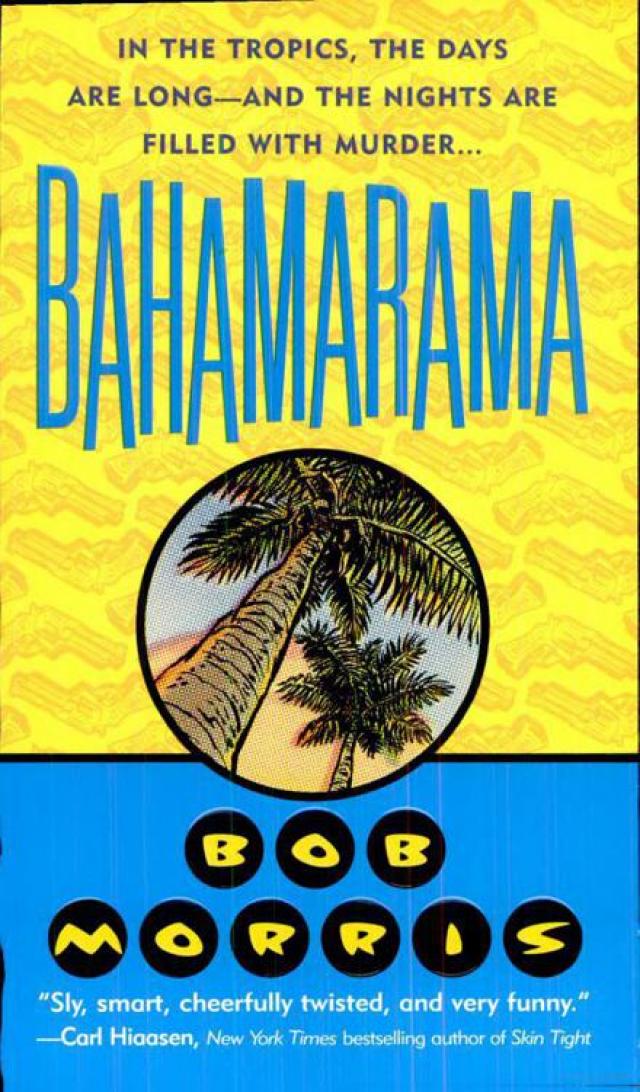
Bahamarama, page 18
part #1 of Zack Chasteen Series


I had picked up some gravel in one of my sandals, and when I stopped to shake it loose, the guy stopped, too. He pretended to admire the blossoms on a royal poinciana tree by the side of the road. I started walking again; he started walking again.
Looking back on it, I had noticed the same guy a couple of other times that morning when I was going back and forth between the marina and the Albury. He was obviously a tourist, and I remembered thinking it was unusual to see a tourist walking around Harbour Island alone. Most people who visit Harbour Island are on honeymoons or romantic getaways and they tend to hang out in couples. This guy just didn’t fit in. Yeah, he was definitely tailing me.
I had never been tailed before and I thought I might as well make the most of it. I picked up the pace. I hadn’t gotten in my run that morning and, after that exasperating sitdown with Zoe Applequist and the little faceoff afterwards with Pederson, I had some pent-up energy to burn. I hit power-walk stride and plowed down Front Street. I hung a left at Bay Street and shot a quick glance behind. The guy in the windbreaker was almost jogging, trying to keep up. When I reached The Landing Hotel, Toby Tyler, one of the Aussie owners, was standing out front. I stopped just long enough to exchange pleasantries and listen to Toby tell me about the swell that was expected to come in from the tropical storm and how it meant eight-foot surf for parts of Eleuthera.
“I’ve got an extra board, Zack,” said Toby, “should you want to give it a shot.”
“Thanks,” I said. “But I’ve had all the humiliation I can handle lately.”
As I stepped away, I looked back at the guy in the windbreaker. He had pulled up in the shade of a casuarina tree to catch his breath and was looking across the bay, making like he was enjoying the scenery.
I headed up Chapel Street and beelined it through Dunmore Town, not looking back until I reached the top of the hill by Angela’s Starfish Restaurant. The guy had fallen behind, but he was hanging in there. He had his head down now, just concentrating on keeping up, didn’t even see me turning around and looking at him.
I kept on walking. I looped back through Dunmore Town on Colebrook Street, looked in the window at the Dilly Dally Shop, then followed Front Street all the way to Uncle Ralph’s Aura Corner. Other than its pink-sand beach, the closest thing Harbour Island has to a tourist attraction is Aura Corner. Several years back, a local housepainter by the name of Ralph Sawyer began painting slogans, inspirational verses, and other nuggets of wisdom on pieces of driftwood and hanging them in the trees outside his home. There are hundreds of them now. Mostly it is bumper-sticker philosophy: “Good things come to those who wait . . . and I’m damn tired of waiting,” or “Work like you don’t need money/Love like you’ve never been hurt/And dance like no one is watching.” Uncle Ralph has strung a couple of hammocks so visitors can rest in the shade. Each morning he gets up and picks fresh hibiscus to stick in the bleached-out conch shells that line his property. And there are a couple of plastic jugs with “Donations” painted on them.
There wasn’t anyone at Aura Comer when I got there. I ducked under the trees, crouched behind a croton hedge and waited. A couple of minutes later, the guy in the windbreaker came walking past. He stopped at the intersection and looked in all directions. He was solid looking, thick shoulders, a bull of a guy. His face was flushed and he was breathing hard. He wiped the sweat off his forehead and started off down Eunice Street toward the bay.
I stepped out from the hedge and followed him. I wasn’t sneaky about it. I pulled close, just a few feet behind him, and scuffed my sandals on the pavement to make sure he heard me. He stole a peek over his shoulder and started walking faster. I stayed with him.
“So how’s Victor Ortiz?” I said.
He ignored me and kept on walking. I pulled alongside him.
“I know what the hell you’re up to,” I said.
“Go fuck yourself,” said the guy, not looking at me.
I stepped in front of him shot out an arm, and thumped his chest. He stopped and reached inside his windbreaker, but I caught him by the wrist, spun him around, and yanked his arm backwards, wrenching it at the shoulder. He grunted and went down on his knees. I held him there and stuck a hand inside the windbreaker. I pulled out the gun that was stuck in the waistband of his pants. It was flat-black with a snub-nosed barrel. More than that I can’t tell you. It was just another damn gun.
“What kind of cheapshit operation is Ortiz running these days?” I said. “You can’t even afford a holster for this thing?”
I eased off him and stuck the gun in the pocket of my shorts. That’s when he squirmed loose. He came at me, head tucked down, legs pumping. He moved pretty well. He landed a shoulder square in my chest and knocked me backwards onto the pavement. He got off a flurry of stinging punches before I flipped him over and sent an elbow to the side of his head. It took the fight out of him. He lay there looking up at me.
“Empty your pockets,” I told him.
He didn’t move. I kicked him in the side.
“Empty your pockets.”
He did it. He wasn’t carrying much, just his wallet and a room key. The wallet had a Florida driver’s license that said his name was Hector Suarez of 1122 San Rafael Drive, Hialeah. He was thirty-three years old and in the event of a fatal accident he wanted his vital organs to go to the state donor program. Thoughtful guy for a thug. The key was for room six at the Heron Inn. It was on St. Ann Street, just a couple of blocks away.
“OK, on your feet, Hector,” I said. I gave him back his wallet, but kept the key. “We’re going to your place.”
He stood up slowly and took his time dusting himself off. He looked me up and down.
He said, “You kill me, he’ll just send someone else.”
“I’m not going to kill you, Hector.”
“So why you kill his nephew?”
“His nephew?”
“Yes, his sister’s son, Eduardo. You kill him in the water, leave his body there.”
The young guy in the boathouse. So that had been Ortiz’s nephew.
“I didn’t have a choice,” I said.
Hector shrugged.
“Just as Ortiz, he does not have a choice.”
“So that’s why he kidnapped them? Because I killed his nephew?”
Hector just looked at me, his face blank. He said nothing.
“Start walking,” I said.
Five minutes later we were standing in room six at the Heron Inn. It was a threadbare joint that was closer to a boardinghouse than an inn. But it had a room phone and I was using it to call Continental Airlines. I was holding Hector’s round-trip ticket from Miami to North Eleuthera. He wasn’t scheduled to leave for another four days, but I was changing that.
“There’s a flight at 2:20 P.M.,” said the agent at the other end of the line. “But it will cost one hundred dollars to change over.”
“No problem,” I said. “Just put it on Visa.”
I read off the number on the card that I had taken from Hector’s wallet. Hector, meanwhile, had finished packing his bag and was sitting on the bed. I hadn’t been able to get anything out of him since we had returned to his room.
I hung up the phone and handed Hector his ticket.
“You’re good to go,” I told him.
I found a notepad and pen by the phone and wrote down the phone number at the Albury Beach Club. I folded it and gave it to Hector.
“You give that to Ortiz and you tell him to call me. You got that?”
Hector stuck the note in a pocket. He said, “Yeah, I got it. But it don’t make no difference. There’s nothing you got to say that he wants to hear.”
“Just tell him to call me, Hector.”
I opened the door and motioned Hector outside. I followed him out to St. Ann’s Street and pointed to Government Dock.
“You go straight there and get on a water taxi and take a cab to the airport,” I said. “Don’t let me see you back on this island again.”
I patted the gun in my pocket.
Hector started walking. He didn’t look back. I stood there watching until he got on a water taxi that sped him away to North Eleuthera, then I headed back to Valentine’s marina. When I reached the water I took Hector’s gun out of my pocket and flung it into the bay.
39
Boggy stood on the dock by Miz Blitz, his head tilted back, his eyes closed. He appeared to be sniffing the air. I walked up behind him and watched him. His nostrils flared and he breathed in deeply, and then he did it again. After a moment he opened his eyes and turned to me, and said, “The storm, it comes this way.”
“You can smell it?” I asked.
“Smell it, feel it, taste it. It is growing, this storm. Three days, it will be here.”
Most of the time I can handle Boggy’s mumbo jumbo. But at that particular moment I wasn’t in any mood for it.
“If you’re so damn good, how come you can’t sniff out where Barbara is?”
I hopped on the boat, swung through the hatch, and stepped down to the galley. A coffeepot sat on the stove. It felt warm. I looked in the cupboard and found a mug. Boggy came down and sat on a bench by the big teak table. I picked up the coffeepot. I put my nose to the spout. Smelled like coffee.
“This coffee?” I asked Boggy.
He nodded. I poured a cup and drank some.
Boggy said, “With dogweed in it.”
I stopped drinking.
“For the stomach. Drink. It’s good. That way the coffee it doesn’t give you shits.”
“I can hear them now at Starbucks,” I said. “‘Give me a skinny latte, no foam, with a double shot of shitstopper.’”
I sat down across from Boggy. His hands were folded in front of him on the table. If he was ticked off about the way I had spoken to him on the dock, then his face didn’t show it. His face rarely showed anything, actually. I don’t know if it was a matter of him having complete control over his emotions or complete control over the way he displayed them, but every now and then I wished he would just give me a little something to work with, some way to read him.
“With people is different,” he said.
“What’s different? What are you talking about?”
“People. Predicting how they will behave. Is not like a storm. Is not like a fish. Is not like the stars or the moon,” he said. “I wish to find Barbara, too.”
“I know you do,” I said.
“I need to know what you know,” he said.
So we sat there, and I drank the coffee with dogweed in it and told him about Hector and how I had caught him tailing me. Then I told him about Burma Downey and Zoe Applequist and how they had turned over the two hundred fifty thousand dollars. I told him how I had asked Burma Downey to write down what the man on the cell phone had told her. I pulled the note from my shorts and let him read it.
When he was done, he said: “The one who wrote this, she is the one who is injured?”
“Yes, she was in a car accident. In Fort Lauderdale.”
“She had many years of school?” asked Boggy.
“I have no idea. She grew up in England. I suppose she went to school there.”
“Barbara, she went to school in England, too. Is that right?”
“Yes, it is. Why?”
“No reason,” he said. “Just to know.”
Then I told him about how I had gotten into it with Lynfield Pederson after we had left Burma Downey’s house.
Boggy said, “You think there was a reason why he made you sit here waiting?”
“I don’t know. I just think it’s real strange that he insisted on me staying on the boat for three hours when I could have been there at the house when Zoe and Burma got the phone call and delivered the money.”
“He is police.”
“Yeah. And your point is?”
“Sometimes, the police, they must insist that other people do things just so the people know that the police are the police.”
“Pederson got that point across when he hauled me into his office and made me sit there for half of yesterday. I don’t have time for these little control games. I’m tired of sitting around and waiting on people.”
“Yes, Zachary, that is good,” said Boggy. “It is always better to put things in motion than it is to sit and wait for the motion to begin.”
“So how do you propose we put things in motion?”
“You have a boat. You do not wish to know your boat again, to see how she moves?”
A few minutes later, the engine was rumbling, and Boggy was untying the lines while I stood at the wheel. I don’t know why I hadn’t thought of doing this earlier, but now I was itching to take a ride on Miz Blitz, to let her rip awhile. I didn’t know where we were heading, but we would blow out the pipes, and I would think about things without even knowing I was thinking about them, and maybe something would fall into place. Even if nothing came of it, it beat heck out of just sitting around.
I glanced toward Bay Street and saw Nixon Styles walking with some of his buddies. When he looked my way I gave him a wave. He split off from his pals and walked out on the dock.
“Hey, Mr. Big Man. That your boat?”
“Yeah, it is. How you like it?”
“Fine-looking boat.”
Nixon studied the name on the transom.
“Miz Blitz. Why you name it that?”
“Football. I used to play.”
“You the quarterback?”
“No, I played safety.”
“You any good?”
“I was OK. The safety blitz was something I did best.”
“Safety blitz?”
“Yeah, it’s when the safety runs in and tries to knock the quarterback on his ass before he can throw the ball.”
Nixon thought about it.
“You getting ready to take this ass-knocking boat for a ride?”
“Sure am,” I said. “You want to go?”
Nixon was on the boat before the words were out of my mouth. He scurried up the ladder to the bridge and stood beside me at the wheel as I moved Miz Blitz away from the dock.
“How long we be gone?” asked Nixon.
“Not long.”
“I need to be back in a couple hours. Supposed to go over to the mainland to help my auntie.”
“Oh, we’ll be back by then. I just want to run my boat in the open water, get the feel for her again,” I said. “You going to help your auntie at the farm?”
“Yeah, they working the stew out of me,” said Nixon. “You eat those pineapple I gave you?”
No, I told him, they were still sitting down below in the galley. I asked him to run down and get them, and when he came back up, Boggy was with him. Boggy had a knife—he always has a knife—and as we idled out to the main channel, Boggy sliced the two pineapples and served us wedges that were dripping with juice. It was the best-tasting pineapple I’d ever eaten and I told Nixon so.
“You want, I can bring you back some more when I come back from Eluthera tonight,” he said.
“I want,” I said.
Just before we hit the main channel, I heard the telltale three-beep signal on the radio, then a voice saying, “This is the National Hurricane Center in Miami.”
I flipped up the volume. I have been listening to hurricane updates on the radio ever since I was a kid and I have this theory about the guys who read them. I think they must come from a family dynasty of hurricane update announcers, just like Harry Caray, and Skip Caray, and Chip Caray in sports. Every hurricane update announcer I’ve ever heard speaks in the same flat, rural, utterly trustworthy Southern voice. They could just as easily be reporting on soybean futures or boll weevil infestations. I guess the whole idea is not to sound excited or alarmed.
The announcer said, “At 1 P.M. Eastern Standard Time today Tropical Storm Curt was located at 37.6 degrees latitude and 84.2 degrees longitude, or approximately two hundred nautical miles east-southeast of Grand Turk Island. Winds at the storm’s center were estimated at sixty-five miles per hour, just short of hurricane strength. The storm is expected to intensify as it continues over warm water. Its present course is due west at fifteen miles per hour, which would take it well south of the Bahamas and the U.S. mainland with a possible landfall in Cuba. The next report will be at 5 P.M. Eastern Standard Time.”
I turned down the radio and looked at Boggy.
“You want me to radio the National Hurricane Service and tell them they got it all wrong?”
“No, that is not necessary,” Boggy said. “Soon enough they will know.”
40
We skipped along North Eleuthera Sound, past the tip of Harbour Island. There were some good-sized swells rolling in from the Atlantic as we skirted the lee of Man Cay, and Miz Blitz took them without a hitch, slicing through with enthusiasm. It was good to be at her helm again.
Checking depths and shoals on the nautical chart, I came across the green blotch that was French Jug. I eyeballed it on the near horizon—a saucer-shaped island with a bit more elevation than the surrounding cays—and pointed Miz Blitz at it, opening the throttle.
After we negotiated a tricky cut at Blind Taylor Shoals, Nixon sidled alongside me on the bridge. He said, “We going to French Jug?”
“Thought we might stop for lunch,” I said. “What’s it like?”
He shook his head.
“Don’t know. Hadn’t ever been there.”
Only then did I remember what Lynfield Pederson had said about French Jug and its unofficial apartheid policy.
“We don’t have to go,” I told Nixon.
“I want to,” he said. “Besides, none of them French Juggers gonna mess with me if I got you and that Indian man at my back.”
The chart showed a small harbor just past the south tip, at Blountston, the island’s only settlement. Boggy grabbed the binoculars, found the channel markers, and stood on the bow, pointing the way in. The channel was narrow, barely wide enough to let two vessels of any size pass at the same time. Once, when I was looking at the chart and not paying close attention, I let the boat stray just a hair, and felt the bump-bump of bottom against the hull before I cut hard on the wheel to avoid running aground.