The Sidekick, page 36


There’s always a pause while they look at the monitor, during which time they have information about the next phase of your life that you don’t have.
After a minute, he said, “Sometimes in this job you get to give good news.”
“I’m okay?”
“It looks fine.”
“How do you know?”
“Because I’ve been doing this for thirty years.”
“But how can you tell?”
“Look, Brian. It’s the same as it was three months ago. To the last dot. Cancer doesn’t sit around on the couch all day, it changes, it grows, it moves.”
“So you’re done with me?”
“I’m done with you. Go forth and live.”
That night while eating Chinese takeout, I watched the Sonics beat Sacramento at the Arco arena. The Kings had nothing to play for except a lottery ticket, and the game was over by the middle of the third—Marcus sat down and never checked back in.
They flew home afterward and got into Austin around three in the morning, which gave them a day to rest before the season finale against San Antonio. This is a game they had to win to make the playoffs, because Utah defeated the Lakers that night in LA. (I lay in bed in the dark, fidgeting with my phone, checking for updates.) The problem was, San Antonio needed to win, too, to hold off Denver for the number one seed. Otherwise there’s no way that guys like Ginóbili, Duncan and Parker would even suit up.
Just keeping up with the news-cycle was a full-time job. For weeks the rumor had been growing that Mmeremikwu might come back by the end of the season. Coach Steuben refused to answer questions about him. He read out a scripted statement each day and left it at that. There were stories that Mickey had engaged in “full-contact workouts” and looked sharp in scrimmages. Taffy Laycock said, “Our priority is his long-term future with the team.” But he also said, “Austin needs playoff basketball, that’s what we came here for, to bring NBA excitement to the city.” What he really wanted was a tax break for a new stadium.
*
On the day of the game I didn’t leave the house. Messages kept coming in, from Fred Rotha and Alana Sissons and Kenny Albrecht. All the guys were in town. They were meeting at five for an early bite at El Chile, which I don’t much like anyway. From there you can just about walk to the stadium, under the highway, and show up dripping with sweat, when it’s ninety-five degrees out. Or share a ten-dollar cab.
Tip-off was seven-thirty, and the whole day seemed to drain toward the evening. Sometimes it’s like that in Austin anyway, it’s too hot to go out until the sun goes down. I should have gone to the stadium but couldn’t deal with the crowds. Or sitting in the press booth with everybody else, watching and talking and hearing them talk. Once the piece went live, I might have to answer questions about that, too, and face Marcus afterward in the locker room, which I didn’t want to do.
So I lowered the blinds and lay on the sofa and put one of my mom’s cassettes in the Walkman: Bach’s Concerto Number 5 in F major, Glenn Gould recording. I wanted to hear the math in it that said, Everything’s okay. There’s nothing you can do about it anyway. Phone on lap, I kept checking the score. It was like that bit in The Matrix where you see the world reduced to binary code—just a series of numbers flashing across the screen. Hayes … jump shot 18 ft … missed … rebound Duncan. 7–4 … 9–4 … 9–6 …
Mickey wasn’t playing. Steuben decided to hold him back; Marcus had to do it on his own. At halftime the Spurs led fifty-seven to forty-eight and I thought about calling Quinn. Then the phone rang and I realized I was lying in the dark. The sun had set and twilight fell in gray bars across the room.
Dad said, “Why don’t you come over. Everybody’s watching the game.”
So I walked the five blocks to Betsy’s house … along the wide Hyde Park avenues, where you can walk in the middle of the road. But when I got there only Dad was up, the kids had gone to bed. It was a little after nine o’clock, on a school night.
The second half had already started, and there he was, the guy I used to share a bedroom with, on TV. After a time-out, Marcus fed Roundtree in the post then ran a split action with Stepanik, who set the flare screen. Marcus popped to the top of the key and Roundtree swung it back to him. Boris Diaw got hung up on the switch and Marcus knocked down the three.
“Come on,” my dad said. The Sonics were down four.
He had lost weight since moving in with Betsy, or maybe it just descended to his belly because his shoulders had become these narrow, fragile old-man shoulders. On the soft couch, when he leaned back, you could see his belly like a heap of mashed potatoes, which he rested his hands across. Normally he fell asleep watching ball games, at least that’s what he did for much of my childhood, so that Mom used to come in and say, “Brian, tell your father to go to bed.” But tonight he looked wide awake.
“Are you packed?” he asked, during a commercial.
“Not yet.”
“What time’s your flight?”
“One o’clock.”
“Where you going first?”
“Atlanta.”
Then the game came back on. Roundtree picked up an offensive board and bounced a pass to Ty Jones, who was cutting for the layup. But then Ginóbili went on a mini-run for the Spurs—a three, a spinning drive, a one-hand pass to Danny Green, for another three. The lead shrank and grew again. At the end of the third, Marcus drove hard against Green, who moved his feet to block him off at the foul line. Diaw was there, too; they had started double-and triple-teaming him, collapsing in the lane. So Marcus turned three-sixty and switched the dribble from right to left and found a gap in the traffic. He rose up against Duncan but then ducked under him to finish with the left hand. Behind the backboard, and all around him, crowds stood and chanted.
I must have shouted, because Albert walked in, wearing only pajama bottoms—they had little VW bugs driving across them.
“You woke me up,” Al said.
“Come sit here,” my dad told him.
“Mom said go to bed.”
“It’s a two-point game.”
So Albert sat between us. I could feel the heat coming off his bare skin, because the sofa bent under my weight and made him lean against me.
At the start of the fourth, Steuben left Marcus on the bench, to extend the break. Albert kept saying, “Why isn’t he playing? Where’s Marcus?” and Dad said, “He’s resting.”
“Why is he resting?”
“At his age, you can’t go all out for forty-eight minutes anymore.”
“Why not? I can …”
So the whole time there was this undertone of conversation and explanation. With Marcus out, the Sonics couldn’t score. But Duncan was sitting, too, so was Parker, and Ginóbili went cold. He took one of his long set-shot threes that barely scratched the rim, and lost a dribble off his foot when Jones probably pushed him from behind. But the ref swallowed his whistle. The Erwin Center is really a college stadium, and the crowd inside was like a college crowd, young and loud. I saw a lot of painted faces on TV, people standing on the hard concrete rows, holding up signs.
“It’s not too late to change your mind,” my father said.
But I didn’t answer.
“When does the piece come out?”
“After the game.”
Marcus came back with a little over eight minutes left. He hit a three and missed a three, drove hard into a double team, and found Tony LaMarca under the basket for a dunk. The score went back and forth. Albert wanted to get his Marcus Hayes jersey from the bedroom, which he now shared with Troy. But I said, just leave it, we don’t want to wake him up.
“But I need it,” Albert said.
“Do you want him to sit here, too, and get in the way?”
“No.”
“So forget it.”
But every commercial break he kept repeating, I just want to get my Marcus Hayes shirt. Maybe it comforted him, to have something to say.
Steuben called time-out, with a minute left and the Sonics down two. Mostly just to give Marcus a breather. He had a couple of foul shots coming and made them both to tie the game. Parker brought the ball up for San Antonio and found Duncan in the post, who reversed it to Ginóbili on the wing. Roundtree had doubled from the weak side, which forced Marcus to switch on to Diaw—anyway, nobody picked up Ginóbili, who hit the three. The Sonics called another time-out. Off the inbounds pass, Marcus caught the ball on the right wing and drove into the lane. Diaw and Duncan converged, but he managed to loft a layup high off the glass and in. Parker brought the ball up again. There were thirty seconds left and the Spurs led by one.
Again, he set up Duncan in the post, but this time Marcus never cleared when Ginóbili cut along the baseline. Duncan had his back to him, and Marcus crept over and brought his hand down hard like a hammer on the ball. There was a scramble for it under the basket but he got there first and slowly dribbled up court. Time was running down and Marcus let it run, bouncing the ball in the glare of lights coming off the hardwood, about twenty-five feet from the basket—while Danny Green watched and waited for him to make a move.
All of this is just more binary code. If he scored, they won, if he missed, they lost.
Sometimes I like to think of these situations as just another problem at work. Down one, fifteen seconds left. Have we got anybody in the office who can deal with this? Well, somebody says, we got a guy … he’s been thinking about problems like this for the past twenty years. Ever since he was a kid. That’s really all he does. His whole life has been one long preparation—middle school, high school, college, his first few jobs after graduation. There’s nobody in the world right now with more expertise.
Okay, bring him in.
The analytics people like to tell you, there’s no such thing as clutch. Here’s what they mean by that. Nobody shoots better in late-game, high-pressure situations than they do the rest of the time—at least, not in any statistically meaningful sample size. Even the great ones roll the dice like everybody else. But here’s what clutch actually means. That everybody on court can know what you’re going to do and you still have a decent chance of doing it. For most guys, even NBA stars, the numbers drop off a cliff. Too much of their success relies on inattention. But for guys like Marcus, the numbers hold pretty steady. And here’s what the data tells us: over the course of the season, he made 49 percent of his midrange jump shots, between sixteen feet and the three-point line. An elite figure, but still, slightly worse than your chances of landing on heads if you flip a coin.
And yet, it’s true—this is why we watch sports. To feel for a moment the illusion that some guys can control the coin flip, too. That this is their relationship to the world. That for them, unlike the rest of us, it’s a perfect medium of self-expression.
Marcus inched forward, bounce by bounce, then took two hard steps to his right and stopped. He stopped dead, and Green went past him. Marcus pulled up from twenty feet and let fly. While this was going on, Albert kept saying, “I need my jersey, let me get my jersey. It’s my good luck jersey, I need my shirt, it’s good luck,” and I said, “Sh, sh, just watch. You may remember this one day.” Then Dad said, “Son of a bitch,” and tried to get up. “Eileen,” he called out, with his hands on his knees. “Betsy! Come see this. You should see this. They’ll show a replay in a minute.” Albert started screaming and running around, while fans rushed onto the court and crowded the television screen. Marcus didn’t move. He stood at the top of the key, while everyone pushed against him, and it was like everything I felt about him for the past twenty years was rushing the court, too, and surrounding him, while he just stood there.
About the Author
Benjamin Markovits is the author of ten previous novels. He was named a Granta Best of Young British Novelist in 2013 and in 2015 won the James Tait Black Memorial Prize for You Don’t Have to Live Like This. He lives in London and teaches creative writing at Royal Holloway, University of London.
By the Same Author
The Syme Papers
Either Side of Winter
Playing Days
Imposture
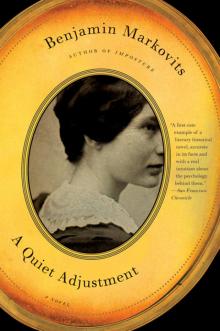
A Quiet Adjustment
Childish Loves
You Don’t Have to Live Like This
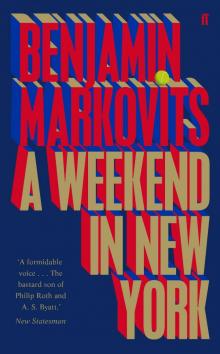
A Weekend in New York
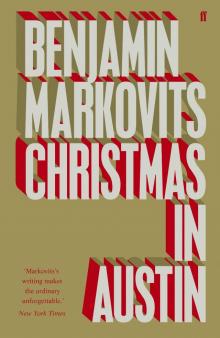
Christmas in Austin
Copyright
First published in 2022
by Faber & Faber Limited
Bloomsbury House,
74–77 Great Russell Street,
London WC1B 3DA
This ebook edition first published in 2022
All rights reserved
© Benjamin Markovits, 2022
Cover design by Faber
Photo © Melissa Karlberg / Arcangel
The right of Benjamin Markovits to be identified as author of this work has been asserted in accordance with Section 77 of the Copyright, Designs and Patents Act 1988
All characters, names, places and events in this book are fictitious and any resemblance to persons living or dead, places or events is entirely coincidental.
This ebook is copyright material and must not be copied, reproduced, transferred, distributed, leased, licensed or publicly performed or used in any way except as specifically permitted in writing by the publishers, as allowed under the terms and conditions under which it was purchased or as strictly permitted by applicable copyright law. Any unauthorised distribution or use of this text may be a direct infringement of the author’s and publisher’s rights, and those responsible may be liable in law accordingly
ISBN 978–0–571–37154–9
Benjamin Markovits, The Sidekick