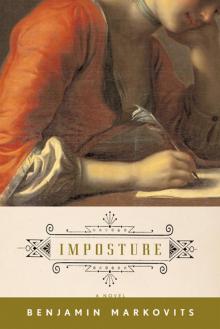
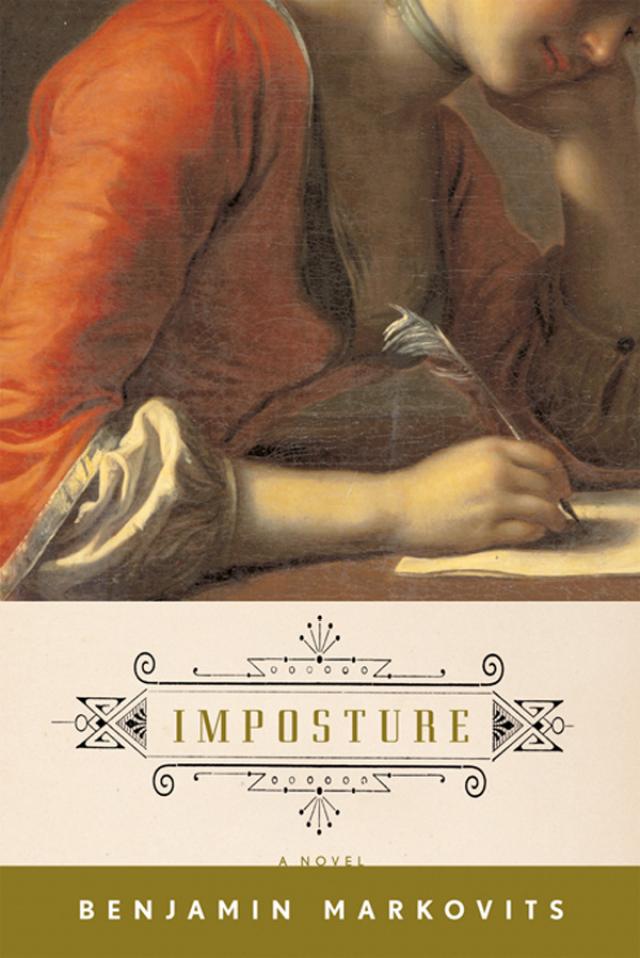
Imposture, page 11


‘My history,’ she answered, thrilling, for her part, with the sensation that for the first time she could speak openly, plainly, fatuously of her private passion, ‘is books. The history of Zuleika, of Kaled, of Medora.’ She passed over her life as a governess, as a servant; the bruises she suffered bumping against the human indifference around her; her cramped quarters, the loom of the eaves above her head as she slept, which cast its thick shadow even onto her dreams. She listed instead the heroines of Byron’s eastern tales. ‘I have been loved, abandoned, widowed, a hundred times over. The rest is blank.’
It wasn’t the answer he’d hoped for. ‘You seem very young,’ he said, disappointed; then added, with an irony kindly meant, ‘I mean, to have read so much.’
He could hear the porter on the stairs, singing and sweeping. The law-clerks bustled out at five; it was just gone half past four. Had she been observed? She had wantonly compromised herself – for nothing, for no one. The silence that followed was for him to break. ‘What would you ask of me?’ he said at last. He had a sense of waiting for an echo. The bell had been struck, but the answering tone hung uncertainly in the air. Perhaps by now Lord Byron would have brought her to bed, pulled up her dress by the hems, tasted her neck . . . A thought that carried with it an unpleasant image of his rain-soaked mattress and the unwashed sheets lying on the floor in the next room. Still, his imagination could not help playing the scene out. He inched towards her, unsure of his hands, which he buried sweating in his pockets.
‘I do not expect you to love me.’ She rose uncertainly. Then, with growing conviction, ‘I am not worthy of your love. I feel you are – superior.’ Her voice, wonderfully low, was like the shadow of a voice, that grows darker in a general brightness. It possessed an almost religious urgency. She held out her hand to him.
His palms were slick. He touched hers only with his fingers, to raise it to his lips. He kissed her knuckles. They smelled of books. ‘Whatever I love is destroyed,’ he said. ‘Consequently, I have broken the habit of it.’
That last line had too much truth in it: he decided, for the moment, to spare her. Besides, Colburn’s assistant was expected any minute, he’d be bound to give Polly away – a prospect that made the doctor flush with shame. It occurred to him that he was beginning to depend on what he thought of (in that vague language he used to prop up his self-love) as Miss Esmond’s ‘good opinion’. She had read and admired his story, after all, though under a false impression. And yet the image she’d fallen in love with had been his own: he had been standing in that balcony window; his glance had passed over her in the street. The world, as she put it, was all before him then; but he had more patience for an interruption now.
‘May I call on you, at Lady Walmsley’s?’ he said, bowing. ‘I’m afraid, I am expecting – a friend.’
He realized at once what this suggested, its instant charge, but could not retract it in time. Eliza, however, was rather relieved than otherwise; the effort to preserve her role had almost exhausted her. And she had her own secrets to maintain. If he visited her, he could not help discovering that Eliza’s position at her Ladyship’s house was far from unequivocal; that she was not even, quite, a governess to the two children; that her duties extended occasionally to the kitchen; that she slept with the other servants under the eaves. She said, ‘I never expected you to sacrifice yourself; that is my part.’ And added, ‘On Sundays – that is, tomorrow – my father and I are accustomed to taking the air in the tea-garden at Bagnigge Wells, about two o’clock. He, he . . . is also a writer, a novelist. You may look out for us there, if you like. They make uncommonly refreshing syllabubs.’ After a moment’s embarrassment, she continued, ‘He would be charmed – he would be quite overwhelmed, to meet you.’ And then, lowering her voice, ‘I need hardly say you may trust him absolutely.’
She now wished for nothing but solitude. She had fed almost too richly on the encounter; she wanted to pick more slowly over its crumbs. Her final words to him, as she stood in the doorway, had an almost business-like simplicity. They were a useful summing up. ‘Well,’ she said, turning away, ‘you can do what you like with me.’ He followed her steps along the corridor, down the echoing stairwell, and then walked to close his window – the season turned quickly – against the late afternoon chill.
He remained at the casement long enough to see her leaving. The sunlight had deepened in setting, a cold bronze glow. He watched her in it: she cast a slanting, implacable shadow along the pavement. It hardly shifted as it moved, a clear black shape slipping over the street. No wonder, he suddenly thought, Lord Byron used to fall in love so easily. The pleasure of giving pleasure is a wonderful thing: the freedom of living, that is, in the confidence of being loved. It struck him that he was happier than he had been before her visit; a change in temper as forceful and obvious as an increase in light. She, for her part, had never been happier in her life.
CHAPTER TEN
THAT NIGHT, POLIDORI BEGAN a second memoir of his travels with Lord Byron. Or rather, he attempted to begin it. He had taken over his rooms from a law student, who had departed suddenly and without explanation, leaving behind not only several weighty legal tomes (which Polidori had just sold as his own), but a writing table, a mattress, and a bureau missing its hinges. Its doors were held in place by loose paper tightly applied, and Polly, capable of almost any incuriosity, had not once looked within after two months of residency. The writing table stood beneath one of the parlour windows; he sat down uncomfortably to begin, crossing and uncrossing his legs with difficulty under the low desk. His knees suffered several sharp knocks. He was a nervous composer and the waste of his energies overflowed in constant physical adjustments. He needed something to write on and had almost addressed his pen to the margins of his copy of Childe Harold, when he remembered the scraps of paper wedged into the bureau doors.
This was just the kind of practical diversion his muse depended on; and he promptly rose from his seat and began to prise open the cupboard. Inside he found, nailed against the backing, a narrow shelf supporting three or four low glass bottles, unstoppered. They were powdery to his touch; the dust blended instantly with the perspiration in his palms to produce a thick tacky surface to his skin, most unpleasant. Polidori had a horror of unclean hands, and was turning towards the wash basin when he noticed one of the bottles had several inches of ruby liquid in it, and a leather string around its neck. He lifted it by this, put his nose to the opening and inhaled its pent-up acridity: laudanum. He hadn’t taken laudanum since his days as a medical student. Well, if sleep wouldn’t come that night, here was something to turn to. Composition, especially the blankness of failure, tended in him to produce the equal blankness of insomnia. He carefully smoothed the pages under the heel of his palm, and spread them over his desk. Only then did he soak and rub his hands clean; but since there was nothing to dry them on, except the dirty shirt he was wearing, the wet line of his small finger darkened the paper as he pressed the page to write.
‘In the spring of 1816, I accompanied Lord Byron on his second tour of the continent. In the midst of a painful separation from his wife, he had decided to leave Albion’s shores behind him; and had taken me on, in the capacity of medical attendant, owing to a series of physical indispositions, which, he feared, amidst the rigours of travel, might eventually transfigure themselves into an incurable mental malaise. His wife, he informed me in our initial interview, had alleged insanity among the grounds for separation – a particularly painful suspicion, he continued, given a family history not unblemished by incidents of psychological infirmity. Madness, he added, had always seemed to him the most likely consequence of that hot restlessness from which he suffered; madness or self-slaughter.’ Polidori paused here, resting the quill against the lobe of his ear. He added after a minute, ‘I mentioned to him my special knowledge of somnambulism – the subject of my medical dissertation – and other forms of psychic outbreak, which, I urged, peculiarly fitted me to the role of his attendant. After a brief examination, both physical and psychological, I could offer him the following consolation: he seemed, in my professional opinion, no more likely to end his days in the mad-house or the suicides’ cemetery than I myself.’ He dipped his pen into the inkwell and finished off the page, ‘He engaged me at once. I was nineteen years old.’
But the thought of his youth put a stop to him: what a boy he had been, after all! He saw himself lift a hand to his sister’s mouth; he felt her teeth against it. That morning he’d received a note from his father: Frances had returned, unexpectedly, from Milan. Papa Gaetano offered no further explanation. The curtness of the note demanded a visit, which Polly had, at least for the day, put off. For various reasons, not the least of them, the circumstances in which he’d seen her last: in Milan three years before.
Byron had girlish fingers, rather fat, even after one of his purges; there was something peculiarly trusting about their plump heat. In his mind’s eye, he watched Frances open her mouth to receive them. Why do you not bite him? Why do you not bite? A three-quarter moon lay awkwardly on its back in the sky, but its brightness suggested the abrupt certainty of a struck gong. He seemed to be waiting for it to go out, as one waits for the ringing to cease. It continued undiminishing. He noticed only by the ache in his forearm that he was holding his pen-hand in mid-air. The trouble may have been those last few lines, their casual return to self: ‘he seemed, in my professional opinion, no more likely to end his days in the mad-house . . . than I . . . I was nineteen years old.’ In fact, he wasn’t sure he’d said anything of the sort. The line had the freshness of a recent addition, an invention. It was the kind of thing that struck him now as true; he was writing himself back into the story, and worse still, imposing everything that was going to happen on the boy he once was, setting forth. He must begin again. He lowered his elbow to the table and did not move.
Naturally, his thoughts turned again to that summer on the shores of Lake Leman. Byron and he (how sweetly that and suggested an equality of companionship, a shared purpose – unmerited, of course) had been looking for a house to let for the summer. The Villa Diodati, which they eventually settled on, was rumoured to be taken. In any case, there had been a misunderstanding, and Polly and his lordship had rowed back and forth across the lake to no purpose, till the doctor, at least, was thoroughly out of temper. Getting out, they ran into a party of English travellers, which included the poet Percy Shelley, a slim boyish figure with the complexion of a fat child. Snippings of fair hair, Polly observed, lay on his neck, around his ears, on his fingertips – the marks of hasty cutting. He was accompanied by a pair of women whom Polidori took to be sisters: a pretty, flat-faced girl with short dark curls; the other was smaller, plainer, more composed. The hands and wrists of both of them were covered in short blond shavings, a fact that drew Polidori’s instinctive envy. It made one itch to look at them. The women presumed upon a previous acquaintance with his lordship, and, in fact, Byron himself, who could be very charming when he was bored and anxious for company, pretended to a flattering knowledge of Shelley’s Queen Mab.
Polly had learned to hate every introduction among strangers. Strangers were bound to ignore him. He was, after all, as he later expressed it to Mrs Shelley (by way of apology, after another embarrassing episode, in which he had challenged her husband to a duel) ‘only a tassel on the purse of fame, a star lost in the halo of the moon’. Among familiars he might receive a little attention from just those persons whom Byron had, for whatever reason, chosen to neglect himself. But amid fresh company, he disappeared at once, like salt in solution. He took out the boat again in something of a sulk and lay on his back and let the water move him. The lap of waves sounded like the murmur of intimate conversation, distantly heard. His jealousy, an actual acridity furring his tongue, would, he thought, soon pass, if he indulged in the taste of it, just once. But as the summer lengthened, it concentrated, grew stronger, became almost unpalatable, indigestible.
Polly put his pen aside now, and rose suddenly from his chair. Somewhere he had a copy of his old diary, unless it was mixed in with the books he had sold to Colburn. The thought brought on a sweat of anxiety; Polidori was beginning to be overwhelmed by a sense of how much that mattered in his life he was capable of simply mislaying. He found it at last, kept safe in the empty case for a pistol, a weapon he had hidden in one of his boots and carried with him wherever he went. (A habit he had picked up from Percy Shelley, who, in a schoolboyish way, liked to travel armed: the Pistol Club was one of B’s affectionate terms for their circle of friends.) He returned to his narrow seat beneath the window, and began to leaf through the pages of his journal. He had, for almost a year now, denied himself this pleasure. His obsession with that brief period in his life was, he suspected, becoming unhealthy; nevertheless, a resolution was quickly and almost painlessly broken‚ for a second time within the week, he noted. He had, after all, just given in, under Colburn’s prompting, to his love of gambling – though he still hoped to nip that passion in the bud.
What struck him most, as he glanced through the jottings of his diary, was how casually he had lived. These famous times had passed him by as lightly as any ordinary day. ‘Tea’d and talked politics with B,’ he read. And then, ‘. . . after dinner, jumping a wall my foot slipped and I strained my left ankle. Shelley etc. came in the evening; talked of my play etc., which all agreed was worth nothing.’ The ankle, in fact, still afflicted him; it ached in wet weather. He remembered more of this incident than he had recorded at the time. Rain clouds had set in over Geneva. It was the first bad spell of their summer together, and just before supper, before the clouds opened, Mary Shelley had determined to ‘get in’ a walk along the shore, and had been caught out.
The flurry passed, and a black and purple twilight set in. Byron observed her from his balcony, as she mounted the hill towards Diodati with that peculiar air of drudgery of the recently doused. He turned towards Polidori and remarked, ‘If you wish to be gallant, jump over the balcony here, and offer your arm.’ Polidori felt a thrill of inclusion, but slipped as he landed on the wet ground, and his mood turned with equal swiftness the other way. Byron, to do him justice, hastened to carry his physician inside. Polly could feel, against his ribs, the triangle of youthful muscle formed by Byron’s breast and the top of his arm. They were all young men still. Later, Byron descended the stairs on his hobbling foot to fetch his young doctor a pillow for his leg. ‘Well,’ Polly said, touched by his master’s solicitude, and, from various motives, deliberately allowing that gratitude to curdle and sour, ‘I did not believe you had so much feeling.’ Byron did not answer.
The rain returned that night, and lasted, off and on, for much of the week. The company took on the close air of wet wool, a kind of smell. They were restless for some outbreak, of anger or amusement, and spent their energies on Polly’s new play. He sat on the balcony with his hand hiding his mouth and stared out over the water. Such chastenings always rendered him childish. At supper he drank too much wine, and regained some of his spirits, a little ferociously. They were discussing John Abernethy’s theories of the ‘electric or spiritual fluid’ animating the body – whether or not it was to be found in the blood. Mary, whose matronly manner grew with surprising ease out of her girlishness, suggested that any material conception of the life-principle would quickly run into palpable demonstrations of its absurdity. If ‘life’ was a substance that could be added or taken away, then death was merely a drought, easily replenished. Polidori, who saw in the dark girl the promise of warm sisterly comfort, cried, in overheated support, ‘It was a theory for vampyres, not scientists.’ Shelley remarked that in time even the subtlest fluids might be understood and mastered: ‘It did not seem to him a question of materialism.’ If the life-substance, in any form, was capable of addition and subtraction, then no subtlety could prevent the processes from being ‘reversed’. As for the comparative nature of the animating principle, one had only to look around the present company to see proof of the fact that the ‘vital quality’ was unequally shared. A nod at Byron, who, for once, kept quiet over his wine. Polidori felt the heat rise to his face – another slight! And remembered his father’s warning: the force of impossible comparisons.
They stayed up late into the chill of the early morning, reading from some volumes of ghost stories Shelley had discovered in one of the bedrooms. As the shadows of the candlelight began to dim in the false dawn, someone, nobody could remember who, suggested they each attempt a tale – a venture that became the single sustaining occupation of the week of wet weather that followed and more or less confined them to the house.
From the first, it was generally understood that Mary needed the greatest encouragement. ‘Have you thought of a story?’ was the question everyone asked, at breakfast, over dinner. And she was forced to confess every morning and evening, that she had not. It seemed to her that she was the last to begin, a delusion she afterwards cherished – that delicious suspension of spirit before the avalanche of inspiration. But the plain fact was that nobody had ever thought to inquire of Polly how he was getting on. Perhaps because he wasn’t, quite, one of their party, being a mere travelling physician. Besides which, they had begun to treat him with the tenderness of condescension, not least because it had the effect of subtly hushing him.
Polidori remembered, as he sat under the low desk in Lincoln’s Inn, the terrible blankness he had felt. He bit his quill, as he had bitten it three years before, and tasted the almost salty dullness of feathery bone. His thoughts began to follow familiar paths: what was the source of this absence, if absence could have a source? A man might be incapable, say, of mending a boat: this was a matter of skill or knowledge. If he couldn’t lift a stone, it was a question of weight and strength. But if, in the quiet of the guest room at Diodati – with a clear run of white parchment and a view of water, its gentle unevenness, the low green hills surrounding, the peaceful traffic of the shoreline – he found nothing to say or think or write, to what absence of knowledge or skill or strength could this be ascribed? Perhaps his failure resembled barrenness most; the childlessness he suffered from was one of thoughts. He wrote in a fair slow script: ‘The summer of 1816’ and sat, pen in hand and nothing in his head, considering the phrase until a little variation in his breath recalled him to his conscious self. He turned the pages of his journal.