The Accidental Empress, page 54


The books on which I relied in my research were: The Fall of the House of Habsburg by Edward Crankshaw; Twilight of the Habsburgs: The Life and Times of Emperor Francis Joseph by Alan Palmer; The Habsburg Monarchy, 1809–1918: A History of the Austrian Empire and Austria-Hungary by A. J. P. Taylor; The Lonely Empress: Elizabeth of Austria by Joan Haslip; The Reluctant Empress: A Biography of Empress Elisabeth of Austria by Brigitte Hamann; Franz Joseph and Elisabeth: The Last Great Monarchs of Austria-Hungary by Karen Owens; A Nervous Splendor: Vienna 1888–1889 by Fredric Morton; Fin de Siecle Vienna: Politics and Culture by Carl E. Schorske, and The Swan King: Ludwig II of Bavaria by Christopher McIntosh. All of these are nonfiction accounts, and all of them come with extensive bibliographies and source references. Especially invaluable were the personal letters and diaries of the members of the Habsburg family and court, translated and transcribed in Brigitte Hamann’s work. I thank all of these historians for making my job so much easier.
It was at Schönbrunn Palace, over a decade ago, that I first slipped into Sisi’s world, and I’ve been going back there in my mind since then. Now I hope readers will want to do the same, through their own imaginations and the pages of The Accidental Empress.
To my agent and friend, Lacy Lynch: thank you for your instinct, your tireless work ethic, your dedication, your integrity, your humor. Thank you for being on this journey with me, having believed in me and helped me grow since the very first and roughest of manuscripts.
To my editor, Beth Adams: I’m grateful that my work was once again in your capable hands. Thank you for your clarity of vision and for caring about Sisi and her story as much as I do. Thank you for steering the ship with grace, humor, and your keen insight.
To Lindsay Mullen, Katie Nuckolls, Alyssa VandeLeest, and the whole rock-star team at Prosper Strategies: you are untiring and unflappable. There is nothing you cannot do.
My deepest thanks to those who make it possible for me to do what I love: to Jan Miller, Shannon Marven, and the entire team at Dupree Miller & Associates; to Jonathan Merkh, Becky Nesbitt, Amanda Demastus, Brandi Lewis, Rob Birkhead, Jennifer Smith, Chris McCarthy, and the whole team at Howard Books; to Carolyn Reidy and the whole team at Simon & Schuster; to Judith Curr and your team at Atria; to Kathryn Higuchi and your team of meticulous copy editors; to Daniel Decker for your singular knowledge of the bookselling world; and to Rachel Cali for your fact-checking expertise.
Special thanks to friends who have supported me and worked with me on this journey: Ambassador and Mrs. Earle Mack; Ambassador and Mrs. Hushang Ansary; Carolyn Rossi and the Copeland family; Harvey Weinstein; Kathie Lee Gifford; the Yale, Hackley, and Putnam County communities, who have mobilized with gusto to help me launch my career; Allison McCabe for your friendship and words of wisdom; Leonard Riggio; Pamela Robinson; Lucy Stille; Dana Spector and the team at Paradigm; Pamela and David B. Ford and the team at Princess Pictures; Steve Golin, Doreen Wilcox Little, Paul Green, and the team at Anonymous Content; Zenia Mucha; Fred Newman; Richard Farren; Rabbi Jacob Freund; Sheila Weber; and Desiree Gruber.
To the veteran authors for whom I have such deep admiration and appreciation, your support means more than you know: Mary Higgins Clark, Philippa Gregory, Lee Woodruff, Michelle Moran, and Aidan Donnelley Rowley.
And to the treasured network of lifelong friends who have inspired me, encouraged me around blind corners and through very rough drafts, and shared in the highs and lows: thank you to Marya Myers, Charlotte Lamb, Margaret Hunter, Cristina Corbin, Ali Reed, Cristina Scudder, Kasdin Mitchell, Liz Steinberg, Jackie Carter, Emily Shuey, Dana Schuster, Shannon Farrell, Alyssa Oakley, Cornelia Kelly, Dede Philbrick-Wheaton, Katey McGarr, Blair Golden, Ashley Eklund, Lizzie Garvey, Carrie Wuellner, and so many others.
And last but furthest from least, to my family of siblings, parents, in-laws, grandmothers, aunts, uncles, nieces, nephews, etc.—I love all five hundred of you. Dave, you inspire me every day. Thank you for speaking my language. Thank you for supporting me and being on this great adventure with me. Here’s to stepping into our next decade together, hand in hand.
Mom and Dad, the only reason I even know about Sisi is because you took our family on enriching trips and instilled in us the importance of studying history, asking questions, and pursuing our passions. Dad, you are the consummate dreamer. I admire your wisdom and your intellectual curiosity, as well as your love for our family. Mom, you are perpetually undaunted. You are the most devoted and dogged cheerleader, and the way you roll up your sleeves and get to work humbles and amazes me.
To my siblings: Owen, Emily and Mike, Teddy and Emled—you guys make life joyful and exciting. And to my second family, Nelson and Louisa and all the Levys: I don’t know how I got so lucky as to win the family lottery not once, but twice. I love you all and am so grateful to call you my own.
Also by New York Times bestselling author Allison Pataki
The Traitor's Wife
* * *
ORDER YOUR COPY TODAY!
READING GROUP GUIDE
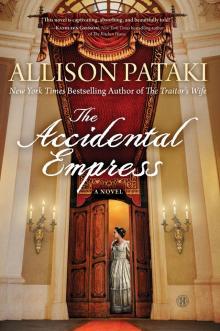
The Accidental Empress
A Novel
ALLISON PATAKI
Topics and Questions for Discussion
1. Though Sisi was often referred to as The Fairy Queen, this is not your typical fairy tale, in which a girl falls in love with a prince and the two of them live happily ever after. Could Sisi and Franz Joseph have had a happy marriage? Why or why not? How does Pataki’s novel take up the notion of “happily ever after” as it relates to the lives and marriages of the novel’s characters?
2. When Sophie learns of her son’s intention to marry Sisi, the archduchess has this to say: “She is not fit. It is as simple as that. She is too young—a child really, too giddy. Unable to fulfill the role and all of its obligations”. What was it about Sisi that made her, in Sophie’s eyes, “not fit” for the role of empress and wife? Was Sophie at all correct? Why did Sophie prefer that her son marry Helene?
3. As eager as she is to marry Franz Joseph, Sisi quickly becomes overwhelmed and intimidated by the amount of work that goes into preparing for her new role as empress. How would you feel in Sisi’s situation? Would you be excited to undergo such an extreme transformation?
4. On their wedding day, Franz Joseph turns to Sisi and says: “Repräsentazions-pflicht. Keeping up the front. That’s what this is. We play our roles today.” In what ways does Sisi resist this requirement of life at the Habsburg Court? Why does this job requirement bother Franz Joseph less? Would Sisi’s life have been easier if she had just accepted “how things are done,” as Sophie and Franz Joseph so often urge her to?
5. While Sisi bristles at many of the customs and rules of her new life at the Habsburg Court, perhaps nothing upsets her more in her first few days than when she discovers that Sophie has had her red slippers thrown away. Discuss this moment. Why do these “tattered red slippers” matter so much to Sisi? What other moments were difficult for Sisi in her adjustment to life at court?
6. Consider the character of Ludovika. What does the duchess’s presence at court mean to Sisi? Discuss the various mother figures in the novel. How does Sisi’s relationship with her mother compare to her relationships with her own daughters?
7. What is the most difficult aspect of Sisi’s life as empress?
8. Franz Joseph often finds himself in the middle of the conflicts between Sisi and Sophie. How does he do at navigating the tense dynamic? What might he have done differently? Were you in any way sympathetic to Franz Joseph, with the various pressures he shouldered in his roles as emperor, husband, son, and father?
9. Sisi feels dislike for Andrássy before she even knows him. How and why does her impression of Andrássy change over the course of the novel? Did your impression of Andrássy change throughout the book?
10. Throughout the novel, Pataki has chosen to intersperse the chapters with scenes from the Budapest coronation of 1867. Why did the author choose this final scene, in particular, to intersect the rest of the novel? What did this one moment mean for Sisi as empress? As a wife? As a mother? As an individual?
11. Compare Sisi’s relationship to Andrássy with her relationship to Franz Joseph. How are the two men different? In what ways are they similar? How does Sisi behave differently with each of them?
12. Sisi grows more and more consumed by her physical appearance as the novel progresses. Discuss this aspect of her personality. Does her beauty regimen become a true obsession, or is it more of a diversion? Does it make Sisi less sympathetic of a character to see her becoming so vain?
13. Sisi was an avid horseback rider, considered by many to be the best horsewoman in the world during her lifetime. At one point in the novel Sisi tells Andrássy: “I’ve never found a horse that could run fast enough”. Discuss what riding means to the character of Sisi throughout the novel. Through what other diversions does Sisi escape?
14. If you could pick one character from The Accidental Empress with whom to spend a day, which character would it be and why?
15. Consider the two epigraphs at the opening of the novel. Why did the author choose those two quotes? What other quotes are significant throughout the novel?
© TRICIA MCCORMACK
ALLISON PATAKI is the author of the New York Times bestselling and critically acclaimed historical novel The Traitor’s Wife. She graduated cum laude from Yale University with a major in English and spent several years writing for TV and online news outlets. The daughter of former New York State governor George E. Pataki, Allison was inspired to write The Accidental Empress by her family’s deep roots in Hungary. Allison is the cofounder of the nonprofit organization ReConnect Hungary. She is a regular contributor to The Huffington Post and FoxNews.com, as well as a member of The Historical Novel Society. Allison lives in Chicago with her husband. To learn more and connect with Allison visit www.AllisonPataki.com.
MEET THE AUTHORS, WATCH VIDEOS AND MORE AT
SimonandSchuster.com
authors.simonandschuster.com/Allison-Pataki
Facebook.com/HowardBooksSimonandSchuster
Twitter.com/Howard_Books
We hope you enjoyed reading this Howard Books eBook.
* * *
Join our mailing list and get updates on new releases, deals, bonus content and other great books from Howard Books and Simon & Schuster.
CLICK HERE TO SIGN UP
or visit us online to sign up at
eBookNews.SimonandSchuster.com
Howard Books
A Division of Simon & Schuster, Inc.
1230 Avenue of the Americas
New York, NY 10020
www.SimonandSchuster.com
This book is a work of fiction. Any references to historical events, real people, or real places are used fictitiously. Other names, characters, places, and events are products of the author’s imagination, and any resemblance to actual events or places or persons, living or dead, is entirely coincidental.
Copyright © 2015 by Allison Pataki
All rights reserved, including the right to reproduce this book or portions thereof in any form whatsoever. For information address Howard Books Subsidiary Rights Department, 1230 Avenue of the Americas, New York, NY 10020.
First Howard Books hardcover edition February 2015
HOWARD and colophon are trademarks of Simon & Schuster, Inc.
The Simon & Schuster Speakers Bureau can bring authors to your live event. For more information or to book an event contact the Simon & Schuster Speakers Bureau at 1-866-248-3049 or visit our website at www.simonspeakers.com.
Interior design by Davina Mock-Maniscalco
Interior map by Jeffrey L. Ward
Jacket design by Jeanne Lee
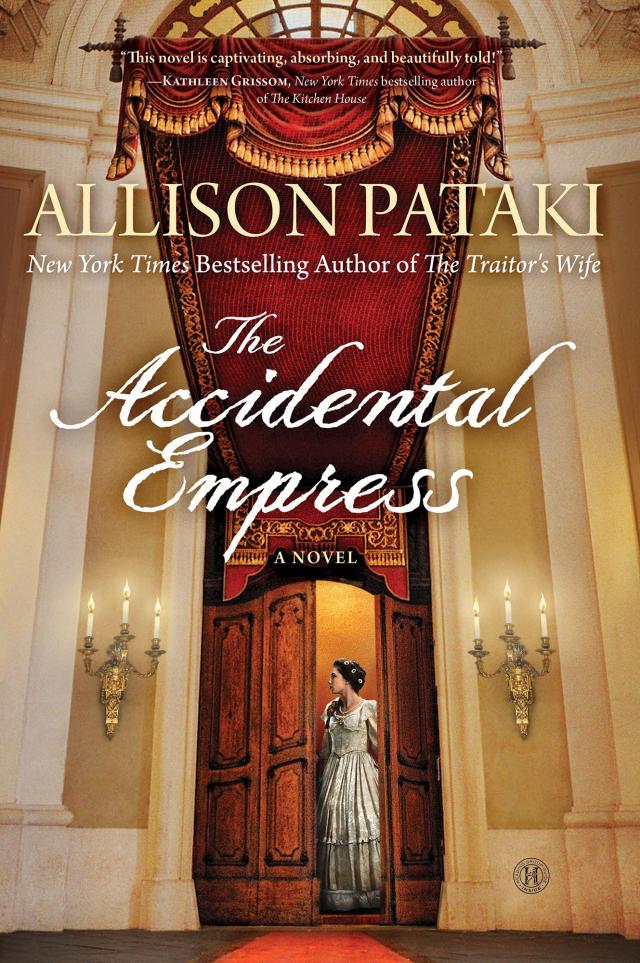
Front jacket palace photograph by Getty Images
Front jacket empress photograph by Steve Gardner/Pixelworks Studio
Library of Congress Cataloging-in-Publication Data
Pataki, Allison.
The accidental empress : a novel / Allison Pataki.
pages ; cm
1. Elisabeth, Empress, consort of Franz Joseph I, Emperor of Austria, 1837–1898—Fiction. I. Title.
PS3616.A8664A64 2015
813'.6—dc23
2014020804
ISBN 978-1-4767-9022-0
ISBN 978-1-4767-9023-7 (ebook)
Allison Pataki, The Accidental Empress